Key Takeaways
- SIG originated with a Swiss railway-car manufacturer that received an order for 30,000 military rifles in 1864.
- The P210, P226, P229, P320 and P365 represent distinct generations with materially different designs and intended uses.
- Collectors should prioritize factory configuration, markings, condition, and documented provenance over unsupported claims of rarity or service history.
SIG Sauer’s corporate history is not a single, uninterrupted story. It is the product of separate Swiss, German, and American businesses whose engineering traditions eventually converged.
The Swiss line began in 1853, when Friedrich Peyer im Hof, Heinrich Moser, and Conrad Neher established a railway-car factory near the Rhine Falls at Neuhausen, Switzerland. After entering a Swiss military rifle competition, the company received an order in 1864 for 30,000 Prélaz-Burnand muzzleloading rifles and adopted the name Schweizerische Industrie-Gesellschaft, better known as SIG.[1]
The German side is older. J. P. Sauer & Sohn traces its origins to the Sauer gunsmithing family in Suhl in 1751. The original enterprise was expropriated after the Second World War, and the J. P. Sauer & Sohn name was reestablished in Eckernförde, West Germany, in 1951. SIG acquired the company during the 1970s, bringing Swiss pistol development and German manufacturing together.[2]
That combination produced several distinct generations of handguns. The P210 reflected the costly precision of postwar Swiss manufacture. The P220 and P226 established the familiar hammer-fired SIG Sauer service-pistol system. The P320 reorganized the pistol around a removable fire-control unit, while the P365 applied high-capacity magazine design to a notably compact concealed-carry platform.
The P210 and the Swiss Precision Tradition
The pistol now known as the P210 entered Swiss military service in 1949 as the Pistole 49, or P49.[1] Its operating system developed from the French Modèle 1935A associated with Swiss-born designer Charles Petter. SIG acquired rights to the Petter system in 1937 and adapted it while seeking a replacement for Switzerland’s Luger-pattern service pistols.[3]
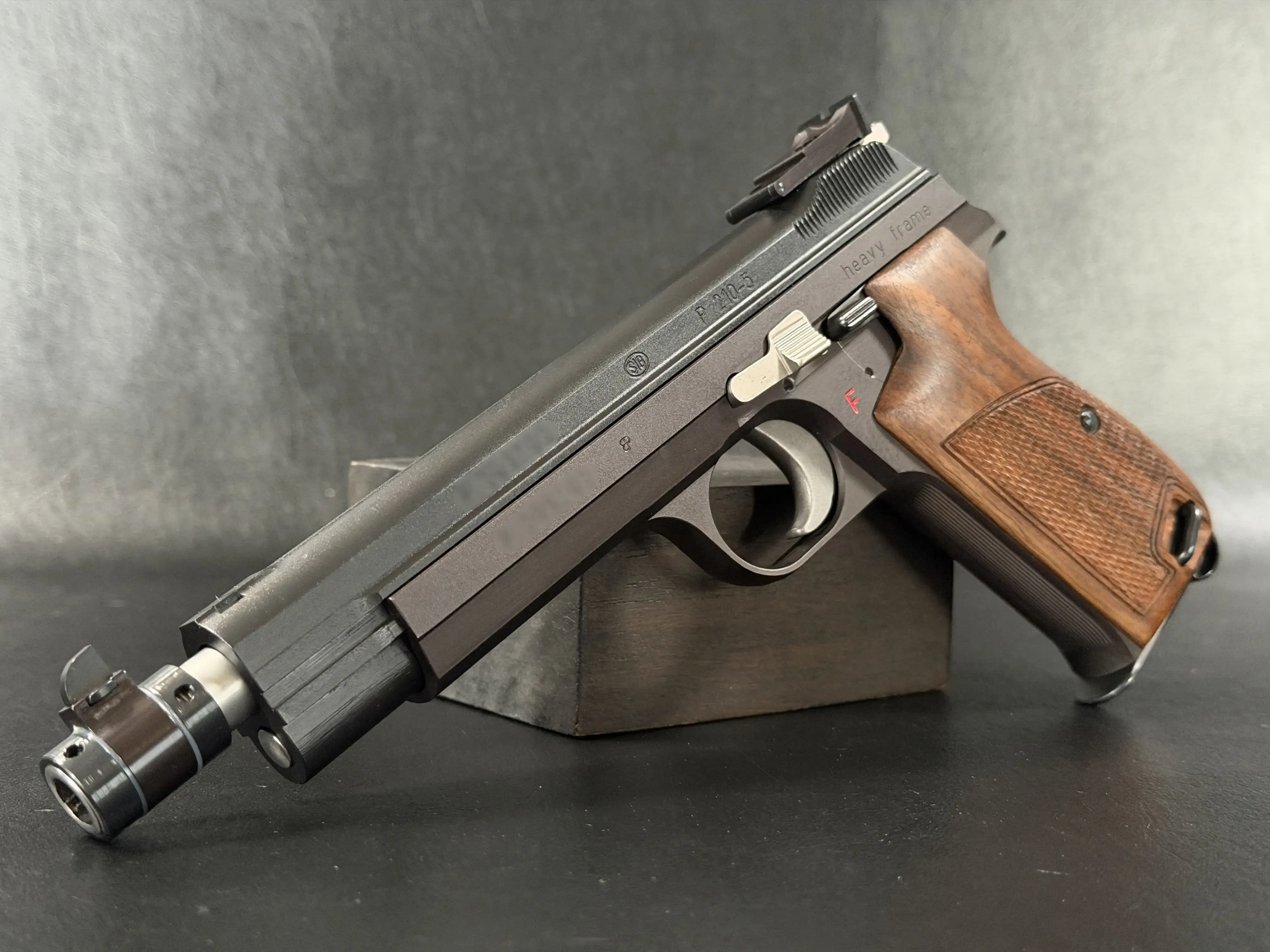
The P210’s construction explains much of its continuing collector appeal. Its all-steel frame encloses the slide rails, so the slide runs within the frame rather than around its exterior. The design combines a locked-breech operating system with close machining and a single-action trigger. These features helped establish the model’s reputation for accuracy, but they also made it expensive to manufacture as a general-issue military arm.
Collectors should distinguish documented Swiss production from later interpretations of the design. Military P49 pistols, commercial P210 variants, police-contract examples, target configurations, and commemorative editions were made for different purposes. Their markings, sights, grip frames, finishes, and provenance are not interchangeable. A model designation alone is therefore insufficient evidence of rarity or value.
Swiss service eventually moved to the lighter P220-based Pistole 75 in 1975.[4] Modern German- and American-made P210 pistols preserve the broad mechanical concept, but they belong to different production periods and should not be represented as original Neuhausen-made examples.
The P220 and the SIG Sauer Service-Pistol System
The P220 marked a deliberate departure from the P210. Instead of preserving an expensive all-steel service pistol, SIG and Sauer developed a more economical platform with an aluminum-alloy frame, a locked-breech action, and a conventional double-action/single-action trigger mechanism.
A frame-mounted decocking lever allowed the hammer to be lowered without firing while leaving the pistol ready for a double-action first shot. The system became a defining feature of the hammer-fired SIG Sauer family. Its ancestry also reflected Sauer’s own engineering history: the earlier Sauer 38H had employed a frame-mounted lever for controlling the hammer.[5]
The Swiss military adopted the P220 as the Pistole 75. Other members of the family followed, including the P225, P226, P228, and P229. Although these pistols share recognizable controls and operating principles, they should not be treated as minor variations of one model. Differences in frame dimensions, magazine capacity, slide construction, caliber, and contract configuration can be material to both identification and collectibility.
SIG’s formal American presence began in January 1985, when SIGARMS was established in Tysons Corner, Virginia, to import the P220 and P230. The company later moved to Herndon, Virginia, and then to New Hampshire. SIGARMS adopted the SIG Sauer name in 2007.[1]
The P226 and the XM9 Competition
The P226 was developed from the P220 system with a wider grip frame and double-column magazine. Its most important early test came during the U.S. military’s XM9 competition for a new 9mm service pistol.
The P226 and Beretta’s submission completed the required testing successfully. The Army awarded the contract to Beretta after evaluating the procurement packages, including pistols, magazines, spare parts, and support costs. A subsequent U.S. Government Accountability Office investigation rejected allegations that improper testing, covert agreements, or disclosure of competing bid information had determined the result.[6]
The P226 therefore occupies an unusual historical position: it lost the principal U.S. service-pistol competition of its era but still achieved substantial military, law-enforcement, and commercial recognition. For collectors, the important distinctions include country and period of manufacture, slide construction, proof and import markings, contract features, and documented agency or military provenance. Commercial markings or accessories that resemble an issued configuration do not by themselves establish government use.
The P229 and Changing Service Calibers
SIG began producing the P229 in .40 S&W in 1992.[1] The model retained the general proportions and operating system of the compact P228 while using a machined stainless-steel slide suited to newer chamberings. Versions were subsequently offered in .357 SIG and 9mm.
The P229 belongs to a period when American law-enforcement agencies were reevaluating handgun ammunition. The catalyst most often associated with that reassessment was the FBI gunfight near Miami on April 11, 1986, in which Special Agents Benjamin Grogan and Jerry Dove were killed, and five other agents were wounded.[7] The aftermath influenced FBI ammunition testing and contributed to the agency’s adoption of a reduced-velocity 10mm load. Smith & Wesson and Winchester subsequently introduced the shorter .40 S&W cartridge, which could fit into pistols with dimensions closer to established 9mm designs.[8]
That history is relevant to the P229, but it does not make every example a scarce collectible. Large numbers were manufactured for ordinary commercial and institutional use. Documented contract pistols, discontinued chamberings, early production characteristics, and original packaging may command particular interest, but condition and verifiable provenance remain more persuasive than generalized claims about service use.
The P320 and the Modular Handgun System
Introduced in 2014, the striker-fired P320 shifted the serialized component from a conventional frame to a removable stainless-steel fire-control unit. Compatible grip modules, slides, barrels, and magazines allow the same serialized unit to be configured in different sizes and, with the appropriate components, different calibers.[9]
This architecture was central to the pistol’s selection for the U.S. Army’s Modular Handgun System program. SIG Sauer received the contract in January 2017, with the full-size and compact military variants designated M17 and M18. The 101st Airborne Division became the first Army division to field the new pistols in November 2017.[10]
In August 2017, SIG Sauer announced a voluntary upgrade for commercial P320 pistols following testing involving drops beyond established U.S. safety standards. The company stated that a discharge could occur under particular drop conditions and introduced lighter trigger, sear, and striker components together with a mechanical disconnector. SIG Sauer also stated that the P320 met applicable U.S. safety standards and that the M17 military variant was not affected by the program.[11]
Reports and civil claims have subsequently alleged unintended discharges involving some P320 pistols. SIG Sauer disputes those allegations and maintains that the current P320 design cannot discharge without movement of the trigger. The reported incidents have involved differing circumstances and should not be presented as proof of a common mechanical cause or as evidence that P320 pistols generally are defective.[12]
For collectors and prospective buyers, the relevant distinctions are mechanical and documentary. The serial number and upgrade status of an early commercial P320 can be checked through SIG Sauer’s voluntary-upgrade program. Military-style appearance does not establish that a commercial pistol is an issued M17 or M18, and a pistol assembled from separately obtained components should not be represented as an original military-contract firearm.
The P365 and the Micro-Compact Format
SIG Sauer introduced the P365 at the 2018 SHOT Show. The original 9mm pistol measured approximately 5.8 inches long and 1 inch wide, with a 3.1-inch barrel and a 10-round flush-fitting magazine.[13] Its modified double-column magazine concentrated substantial capacity in a grip comparable in size to earlier, lower-capacity concealed-carry pistols.
The P365 family subsequently expanded through longer slides, larger grip modules, increased-capacity magazines, optics-ready configurations, and metal-framed variants. That commercial breadth makes careful identification essential. “P365” now describes a platform rather than one fixed configuration, and components can be exchanged among compatible versions.
Most P365 pistols remain current-use firearms rather than established rarities. Collector interest is more likely to attach to clearly documented early configurations, limited factory editions, discontinued variants, or examples retaining their original components and packaging. Assertions that an ordinary production pistol is rare should be supported by factory documentation rather than seller language.
What Matters to Collectors
SIG Sauer’s history rewards disciplined identification. The major generations reflect genuinely different manufacturing priorities: the P210 emphasized precision and costly steel construction; the P220 family pursued practical service manufacture; the P320 placed modularity at the center of the design; and the P365 combined compact dimensions with increased magazine capacity.
A credible evaluation begins with the individual pistol. Serial number, proof and acceptance marks, import stamps, factory configuration, finish, matching components, documented alterations, and provenance matter more than a broad model name. Military or police associations require records. Commemorative status requires confirmation of the specific factory issue. Claims of unusual production numbers or rarity require dependable documentation.
The railway-car origin is more than an appealing introduction, but it should not be stretched into a mechanical theory unsupported by records. What the history does establish is that SIG evolved through repeated changes in ownership, geography, manufacturing technique, and intended market. Understanding those changes is the soundest way to distinguish an historically significant pistol from an ordinary example carrying a famous name.
Frequently Asked Questions
When did SIG begin manufacturing firearms?
The Swiss Wagon Factory received an order for 30,000 Prélaz-Burnand rifles in 1864 and subsequently became Schweizerische Industrie-Gesellschaft, or SIG.
Why is the SIG P210 significant to collectors?
The P210 is known for its all-steel construction, close machining and association with Swiss military service. Value depends on the individual pistol’s variant, condition, originality and documented provenance.
Was the SIG P226 adopted as the U.S. military’s M9 pistol?
No. The P226 successfully completed the XM9 testing, but the military awarded the M9 contract to Beretta after evaluating the competing procurement packages.
What distinguishes the SIG P320?
The P320 is built around a removable, serialized fire-control unit that supports multiple compatible configurations. Military variants were adopted as the full-size M17 and compact M18.
What made the SIG P365 notable?
Introduced in 2018, the original P365 combined compact dimensions with a 10-round flush-fitting 9mm magazine. The platform later expanded into numerous sizes and factory configurations.
Sources
- SIG Sauer, “History,” corporate history.
- J. P. Sauer & Sohn, “The History of J. P. Sauer & Sohn,” official company chronology.
- Société de Tir du Corps de Police de Lausanne, “Le SIG P210, la ‘Rolls’ des pistolets militaires,” June 2, 2019.
- Wiley Clapp, “Tested: SIG Sauer’s Made-In-America P210 Pistol,” American Rifleman, December 13, 2018.
- Wiley Clapp, “SIG Sauer P226,” American Rifleman, March 15, 2012.
- U.S. Government Accountability Office, “Pistol Procurement: Allegations on Army Selection of Beretta 9-mm as DOD Standard Sidearm,” NSIAD-86-122, June 16, 1986.
- Federal Bureau of Investigation, “Director Observes 30th Anniversary of ‘Miami Shootout’,” April 11, 2016.
- Dave Spaulding, “The .40 S&W,” American Rifleman, November 19, 2012.
- SIG Sauer, “SIG Sauer Begins Shipping P320 Fire Control Unit and Launches P320 Studio,” November 2020.
- U.S. Army, “101st Airborne Division Fields Army’s New Modular Handgun System,” November 30, 2017.
- SIG Sauer, “P320 Voluntary Upgrade Program,” official program and technical summary.
- Holly Ramer, “SIG Sauer Ordered to Pay $11 Million to Philadelphia Man Wounded by Holstered Pistol,” Associated Press, November 20, 2024.
- SIG Sauer, “P365 Operator’s Manual,” technical specifications, 2018.
As a firearms enthusiast with a background in website design, SEO, and information technology, I bring a unique blend of technical expertise and passion for firearms to the articles I write. With experience in computer networking and online marketing, I focus on delivering insightful content that helps fellow enthusiasts and collectors navigate the world of firearms.
Comments
Be the first to leave a comment.
Be the first to read new editorial features, collector guides, and brand spotlights.