Key Takeaways
- The 92S introduced a slide-mounted safety-decocker, while the 92SB added a firing-pin block and relocated the magazine release.
- Type F pistols have a safety-decocker, Type G pistols are decocker-only, and Type D pistols use a double-action-only trigger.
- Model markings, controls, slide profile, dimensions, proof marks, and documented provenance should be evaluated together.
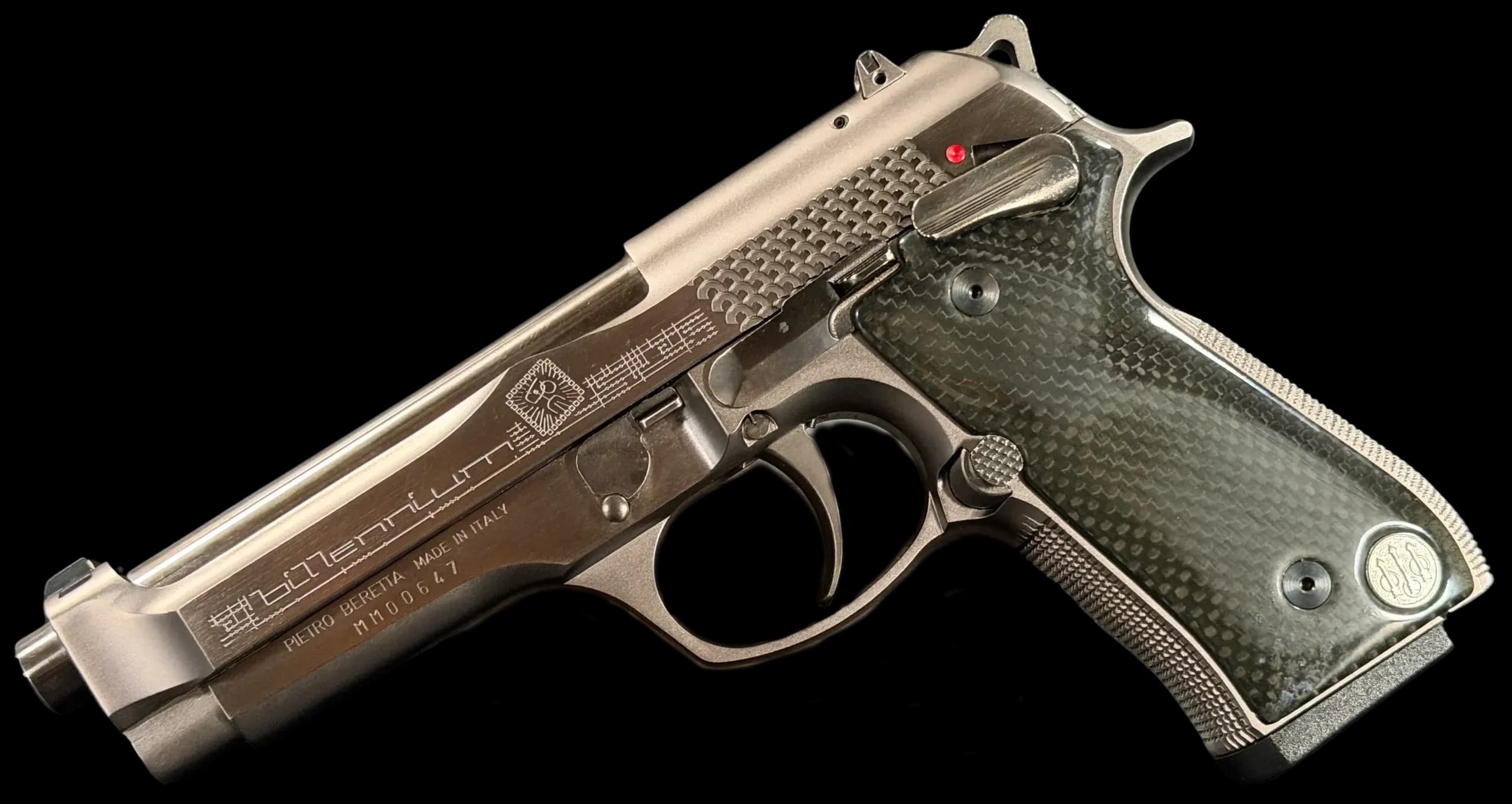
The Beretta 92 family is best understood as a sequence of mechanical revisions rather than a single pistol with numerous interchangeable names. Safety systems, magazine releases, slide configurations, frame dimensions, and military markings distinguish the principal variants.
From the Model 92 to the M9
Beretta introduced the original Model 92 in 1976. The 9×19 mm pistol combined an aluminum-alloy frame and 15-round, double-column magazine with the open-top slide and locking-block arrangement associated with the earlier Model 1951. Its manual safety was mounted on the frame.[1]
The Model 92S moved the safety to the slide and added a decocking function. Beretta subsequently developed the 92S-1 for U.S. Air Force testing in 1979. This version added ambidextrous safety levers and relocated the magazine release from the heel of the grip to a reversible button behind the trigger guard.[2]
The commercial Model 92SB followed in 1981. Its principal addition was an automatic firing-pin block that prevents forward firing-pin movement until the trigger is pulled fully rearward. Beretta then developed the 92SB-F, marketed commercially as the 92F, for the U.S. XM9 trials. Changes included a squared trigger guard, chrome-lined bore, revised grips, extended magazine floorplate, and Beretta’s black Bruniton finish.[2]
The 92SB-F was formally selected as the U.S. military’s M9 on January 14, 1985. The pistol replaced the M1911A1 and other handguns as part of an effort to standardize U.S. service sidearms and 9 mm ammunition.[2] The Army began issuing the M9 in 1986.[3]
Following military slide failures during the 1980s, Beretta incorporated a slide-retention feature consisting of an enlarged hammer-axis pin and a corresponding groove in the slide. The feature prevents the rear section of a fractured slide from leaving the frame. Commercial pistols incorporating it received the 92FS designation, while updated military pistols retained the M9 designation.[2]
The Army subsequently selected the SIG Sauer M17 and M18 Modular Handgun System to replace the M9. Fielding began in 2017, ending the M9’s position as the Army’s standard service pistol after approximately three decades.[3]
Operating System
The traditional 92 uses short-recoil operation with a falling locking block. During firing, the barrel and slide initially travel rearward together. The locking block then drops, stopping the barrel while allowing the slide to continue rearward for extraction, ejection, and hammer cocking. Unlike the more common tilting-barrel system, the Beretta barrel remains substantially horizontal during this cycle.[4]
The open-top slide exposes much of the barrel and provides a large ejection opening. An automatic firing-pin block prevents firing-pin movement unless the trigger is pulled fully rearward. The slide locks open after the last cartridge is fired.[4]
F, G, and D Controls
The suffix letters identify materially different operating systems.
Type F: The slide-mounted, ambidextrous lever serves as both a decocker and a manual safety. Rotating it downward lowers the hammer, disconnects the trigger mechanism, and leaves the pistol on safe. Moving the lever upward returns the pistol to the firing condition.[4]
Type G: The lever decocks the hammer but returns automatically to the firing position when released. It does not provide a manual safety that remains engaged.[4]
Type D: The pistol has a double-action-only trigger and no external safety or decocking lever. Its slide consequently lacks the projecting control levers found on F and G pistols.[4]
These distinctions should be confirmed from the controls themselves rather than inferred solely from a seller’s description. Slides and other components may have been replaced during a pistol’s service life.
Full-Size, Centurion, Compact, and Type M Models
Beretta’s earlier Series 92 manual lists the full-size 92FS with a 4.9-inch barrel, 8.5-inch overall length, 5.4-inch height, 1.5-inch width, and approximate unloaded weight of 34.4 ounces. The listed magazine capacity is 15 rounds.[5]
The Centurion combines a 4.3-inch barrel and 7.8-inch overall length with the full-size frame and 15-round magazine. Its grip height remains 5.4 inches.[5]
The conventional 92FS Compact has the same listed barrel and overall lengths as the Centurion, but its shortened grip accepts a 13-round magazine. Beretta listed its unloaded weight at approximately 32 ounces.[5]
The Compact Type M also uses a 4.3-inch barrel and 7.8-inch overall length, but its narrower, single-column magazine holds eight rounds. Type M magazines and grip dimensions are therefore distinct from those of double-column Compact pistols.[5]
Dimensions and capacities have changed across later production lines. Beretta’s current 92X specifications, for example, list a 4.7-inch barrel for the full-size version and magazine options ranging from 10 to 18 rounds. Current factory documentation should be matched to the exact model and production configuration under examination.[4]
Brigadier, Elite, and Later Configurations
A Brigadier is identified principally by its thickened slide. It should not be confused with the Model 1951 Brigadier, an earlier and mechanically different Beretta pistol. The 92FS Brigadier’s reinforced profile and removable front sight distinguish it from the slimmer standard 92FS slide, which traditionally uses an integral front sight.
Elite models combine selected performance-oriented features, but specifications vary by generation. The model inscription, slide profile, sights, barrel, controls, and frame should therefore be documented individually. “Elite” does not identify one uniform mechanical configuration.
Later members of the family added accessory and sighting provisions. Beretta identifies the M9A4 as having an aluminum frame, MIL-STD-1913 accessory rail, optic-ready slide, threaded 5.12-inch barrel, ambidextrous decocking levers, automatic firing-pin block, and 18-round magazine. The factory specification lists an approximate unloaded weight of 33.33 ounces.[6]
Evaluating a Collectible Example
Identification should begin with the complete model designation, serial number, manufacturer and location markings, caliber inscription, proof marks, and importer marking when present. Control type, frame profile, slide profile, sights, magazine-release location, and magazine configuration should then be compared with period factory documentation.
The earliest Model 92 is recognizable by its frame-mounted safety and heel magazine release. A 92S combines a slide-mounted safety-decocker with the heel release. The 92S-1 and 92SB move the magazine release behind the trigger guard, while the 92SB adds the automatic firing-pin block. The 92F and 92FS share the later external configuration, but the 92FS incorporates the slide-retention system.[1][2]
Military-style commercial markings do not establish U.S. government ownership or issue. A documented military M9 requires appropriate government markings and provenance. Similarly, matching finish and period-correct components may support an assessment of originality, but they do not replace factory records or documented ownership history.
Mechanical inspection should include the locking-block lugs, locking surfaces, slide, barrel, firing-pin block, extractor, and frame rails. Any pistol with an uncertain service history should be examined by a qualified gunsmith before firing. Replacement of a worn part may improve serviceability, but it can also affect collector interpretation when the original configuration is significant.
Frequently Asked Questions
What is the difference between the Beretta 92F and 92FS?
The 92FS incorporates a slide-retention system designed to prevent the rear portion of a fractured slide from leaving the frame. Commercial pistols with this feature received the 92FS designation.
What do the F, G, and D designations mean?
Type F has a safety-decocker, while Type G has a decocker that returns automatically to the firing position. Type D uses a double-action-only trigger without external safety or decocking levers.
How does a Beretta 92 Compact differ from a Centurion?
Both use a shorter slide and 4.3-inch barrel in the configurations covered by Beretta’s earlier manual. The Compact has a shortened grip and 13-round magazine, while the Centurion retains the full-size grip and 15-round magazine.
Is a commercial Beretta M9 the same as a military-issued M9?
A commercial pistol may reproduce the M9 configuration and markings, but that does not establish military ownership or issue. Government markings and documented provenance are required to support that history.
What should collectors examine on a Beretta 92?
Collectors should examine the model and serial markings, controls, magazine-release location, slide profile, sights, proof marks, importer markings, and mechanical condition. Claims of originality or service history should be supported by factory records or documented provenance.
Sources
[1] Keefe, Mark A., IV. “‘U.S. Pistol, M9’ Beretta Model 92FS.” American Rifleman, January 24, 2014.
[2] Thompson, Leroy. “The Beretta M9: 25 Years of Service.” American Rifleman, February 1, 2011.
[3] Cox, Matthew. “Army to Begin Fielding New Modular Handguns in November.” U.S. Army, July 20, 2017.
[4] Beretta U.S.A. Corp. 90 Series Operator’s Manual. Revision 0003, n.d., pp. 8–15.
[5] Beretta U.S.A. Corp. Series 92 Pistol User Manual. C60373 003, n.d., pp. 10–19.
[6] Beretta Defense Technologies. M9A4 Full Size, 9mm. n.d., pp. 1–2.
As a firearms enthusiast with a background in website design, SEO, and information technology, I bring a unique blend of technical expertise and passion for firearms to the articles I write. With experience in computer networking and online marketing, I focus on delivering insightful content that helps fellow enthusiasts and collectors navigate the world of firearms.
Comments
Be the first to leave a comment.
Be the first to read new editorial features, collector guides, and brand spotlights.