Key Takeaways
- The Model 686 combined stainless-steel construction and adjustable sights with Smith & Wesson’s strengthened L-frame design.
- Its larger cylinder and barrel-shank dimensions were developed to withstand sustained use of .357 Magnum ammunition better than earlier K-frame revolvers.
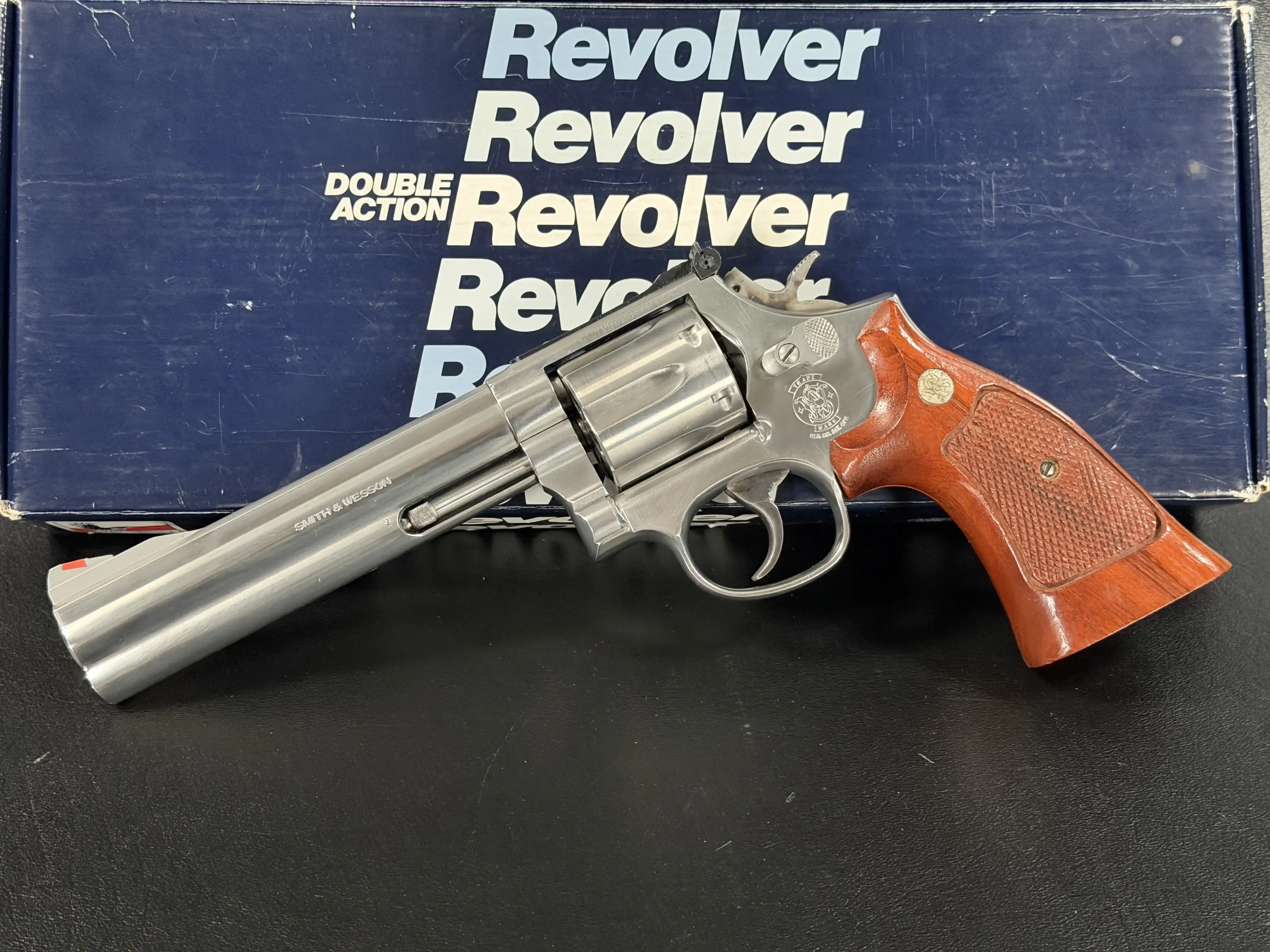
- Collectors should examine the sights, finish, barrel length, underlug profile, cylinder capacity, and factory documentation when identifying a Model 686 variant.
Smith & Wesson introduced its L-frame revolver family in 1980 in response to the growing use of high-performance .357 Magnum ammunition. The company’s earlier K-frame Model 19 and stainless-steel Model 66 offered practical size and weight for police service, but sustained use of some hotter ammunition could accelerate wear. The L-frame was designed with greater strength in the cylinder and barrel-shank areas while retaining a grip section close in size to that of the K-frame.[1]
The original L-frame family comprised four principal models. The Model 586 was made of blued steel with adjustable sights, while the Model 686 offered the same configuration in stainless steel. The Models 581 and 681 were less elaborate fixed-sight versions, with the 581 finished in blued steel and the 681 in stainless steel. Smith & Wesson marketed the adjustable-sight revolvers as the Distinguished Combat Magnum.[1]
L-Frame Construction
The L-frame was not simply an enlarged K-frame. Its cylinder measured approximately 1.557 inches in diameter, compared with 1.449 inches for the K-frame. The larger diameter permitted thicker cylinder walls around the bolt-stop notches. Smith & Wesson also increased the barrel-shank diameter, eliminating the flattened section required at the bottom of the K-frame’s barrel shank.[1]
A full-length underlug beneath the barrel became the L-frame’s most recognizable external feature. The underlug enclosed the ejector rod and added weight along the barrel. The resulting revolver was larger and heavier than a K-frame but remained smaller than Smith & Wesson’s N-frame .357 Magnum revolvers.[1]
The initial Model 686 offerings had 4- and 6-inch barrels. Smith & Wesson subsequently added 2.5- and 8 3/8-inch versions. The 4-inch Model 686 became particularly associated with individual police-officer purchases, while the fixed-sight Models 581 and 681 were also sold for law-enforcement use. Longer-barreled L-frames found a substantial civilian sporting audience.[1]
Smith & Wesson later characterized the Models 581, 586, 681, and 686 as the company’s most significant revolver development of the 1980s. Its corporate history credited the series with a substantial presence in both law-enforcement and sporting markets.[2]
The Seven-Shot Model 686
The original L-frame cylinder provided sufficient diameter for Smith & Wesson to develop a seven-chamber .357 Magnum version. The company introduced a seven-shot Model 686 in January 1996.[3] This version became known as the Model 686 Plus, distinguishing it from the traditional six-shot configuration.[1]
The additional chamber did not require an entirely different frame. Instead, Smith & Wesson arranged seven chambers within the existing L-frame cylinder diameter. The Model 686 Plus consequently retained the principal dimensions and operating format of the established Model 686 while increasing capacity by one round.[1]
Variants and Collector Identification
Smith & Wesson produced the Model 686 in configurations beyond the original full-underlug revolvers. Documented examples include the Mountain Gun, which combined the L-frame with a tapered barrel, short underlug, and fluted rib. The company also produced limited 5-inch configurations, including revolvers with full-length and shorter underlugs.[1]
These variations make configuration central to collector identification. A stainless-steel L-frame is not necessarily a Model 686 because the fixed-sight Model 681 used the same general frame material. Conversely, the blued Model 586 shared the Model 686’s adjustable-sight format and much of its mechanical design. Finish, sight arrangement, barrel length, underlug profile, and cylinder capacity must therefore be considered together.[1]
The distinction between the six-shot Model 686 and seven-shot Model 686 Plus is particularly straightforward, but barrel length alone does not identify every production variation. Smith & Wesson used several barrel lengths across standard models and special configurations. Surviving examples should be evaluated according to their complete physical configuration and any supporting factory documentation.
Frequently Asked Questions
What is the Smith & Wesson Model 686?
The Model 686 is the stainless-steel, adjustable-sight member of Smith & Wesson’s L-frame .357 Magnum revolver family.
Why did Smith & Wesson develop the L-frame?
Smith & Wesson developed the L-frame to provide greater strength in the cylinder and barrel-shank areas than its smaller K-frame .357 Magnum revolvers.
How does the Model 686 differ from the Model 586?
The Model 686 was produced in stainless steel, while the otherwise closely related Model 586 used blued-steel construction.
What is the Model 686 Plus?
The Model 686 Plus is the seven-shot version of the Model 686. Smith & Wesson introduced the seven-shot configuration in January 1996.
What features help identify a Model 686 variant?
Relevant features include the finish, sight arrangement, barrel length, underlug profile, and cylinder capacity. Factory documentation can help establish the original configuration of a particular revolver.
Sources
[1] Clapp, Wiley. “Smith & Wesson L-Frame Revolvers.” Shooting Illustrated, December 9, 2014.
[2] Smith & Wesson Holding Corporation. Form 10-KSB Annual Report for the Fiscal Year Ended April 30, 2002. 2002, p. 3.
[3] Smith & Wesson Holding Corporation. Form 10-KSB Annual Report for the Fiscal Year Ended April 30, 2003. 2003, p. 12.
As a firearms enthusiast with a background in website design, SEO, and information technology, I bring a unique blend of technical expertise and passion for firearms to the articles I write. With experience in computer networking and online marketing, I focus on delivering insightful content that helps fellow enthusiasts and collectors navigate the world of firearms.
Comments
Be the first to leave a comment.
Be the first to read new editorial features, collector guides, and brand spotlights.