Key Takeaways
- Smith & Wesson developed the Model 41 for approximately ten years before introducing it commercially in 1957.
- Its fixed barrel, compact blowback slide, adjustable trigger stop, and interchangeable barrel system were designed for precision competition.
- Notable configurations include the original 7 3/8-inch pistol, the 5-inch field barrel, the 5 1/2-inch heavy barrel, and the .22 Short Model 41-1.
Smith & Wesson introduced the Model 41 to the public in 1957 as a pistol intended for competitive target shooting. Unlike rimfire pistols adapted from general-purpose designs, the Model 41 was developed around the requirements of precision competition. Its production continued, with interruptions and revisions, until the final examples were completed in 2025.[1][2]
Ten Years of Development
The Model 41 originated under Smith & Wesson president Carl Hellstrom. In July 1947, the company completed two tool-room prototypes, identified as X-41 and X-42, and supplied them to its pistol team for testing. Hellstrom also brought successive experimental versions to the National Matches, where competitive shooters evaluated them. The company continued refining the design for approximately ten years before beginning commercial production.[2][3]
Smith & Wesson manufactured 679 Model 41 pistols during 1957. By the end of 1958, cumulative production had reached 9,875, yet demand still exceeded the company’s output.[2] The reception reflected both the growth of American precision-pistol competition and the Model 41’s specialized configuration.
A Fixed Barrel and Compact Slide
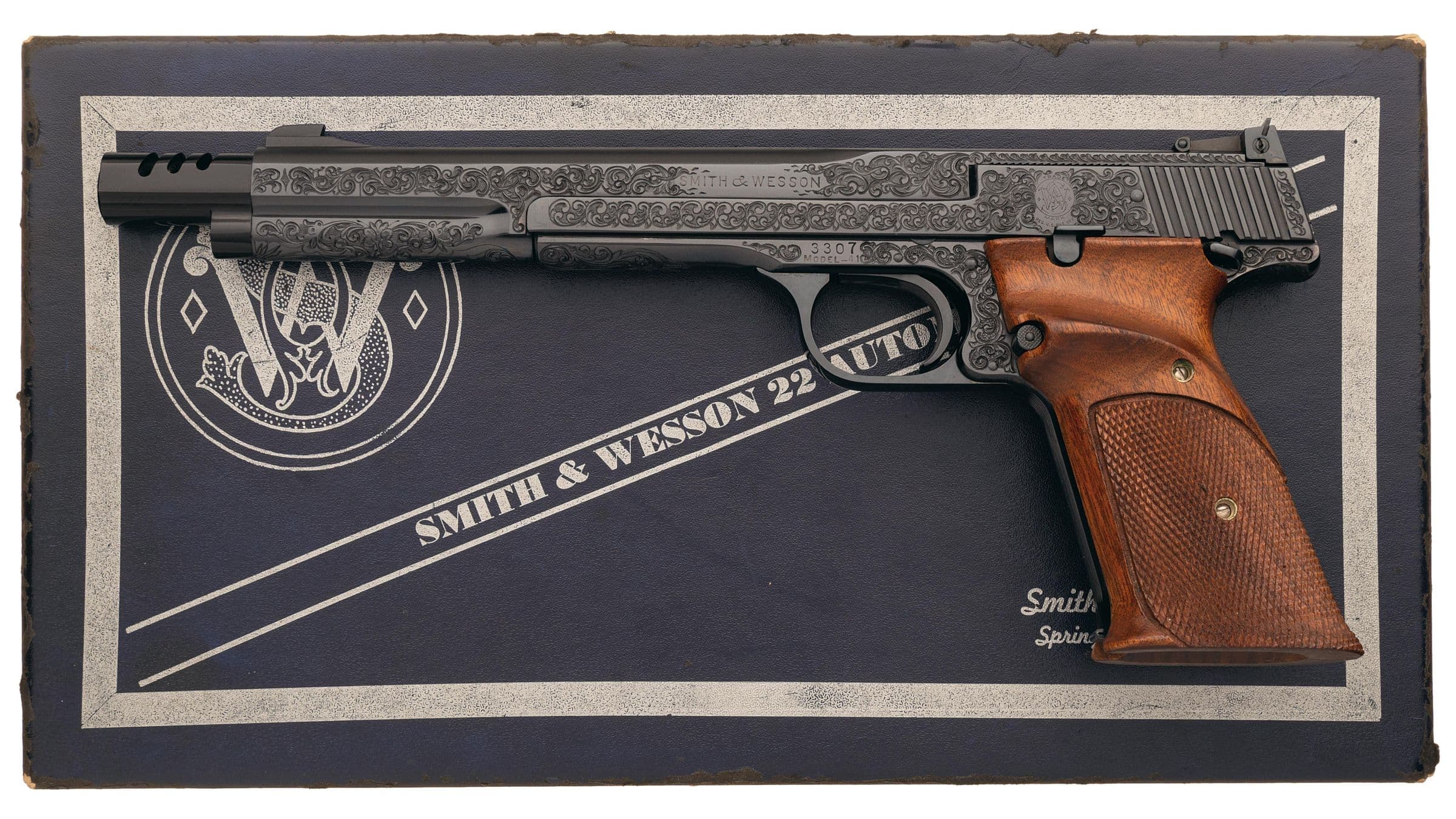
The standard Model 41 is a single-action, straight-blowback pistol chambered for .22 Long Rifle. Its slide is considerably smaller than the full-length slide of a conventional recoil-operated service pistol. The barrel and sights remain stationary while the compact slide reciprocates beneath and behind the barrel extension. This arrangement preserves the relationship among the barrel, front sight, and rear sight during firing.[2]
A detachable, single-column magazine holds ten cartridges. The pistol uses an internal hammer, a wide grooved trigger, and an adjustable trigger stop. The grip angle follows that of the M1911, allowing competitors to use a similar wrist position when moving between the rimfire and .45-caliber stages of conventional pistol competition.[2]
The original pistol combined blued-steel construction with a 7 3/8-inch barrel, Patridge-pattern sights, and a removable muzzle brake. Its target stocks were checkered walnut, with a flared base and a thumb rest shaped for a right-handed shooter.[2]
Barrel removal is integral to the design. With the pistol unloaded and the slide locked open, the trigger guard pivots downward to release the barrel assembly. The barrel can then be lifted from the frame. This system allowed one frame to accept different factory barrel assemblies while maintaining a rigid, wear-compensating lockup.[2][3]
Barrel Options and Competition Variants
In 1959, Smith & Wesson added a lightweight 5-inch barrel intended to make the Model 41 more suitable for field and sporting use. Owners could purchase the shorter assembly separately and install it on an existing frame. A 5 1/2-inch heavy barrel followed, including a version introduced in 1965 with an extended front sight that provided a sight radius closer to that of the longer target barrel.[2]
The most distinct factory variant was the Model 41-1. Introduced after the 5-inch .22 Long Rifle configuration, it was chambered for .22 Short and developed for International Rapid Fire competition. Because the lower-powered cartridge could not reliably operate the standard steel slide, Smith & Wesson fitted the 41-1 with a lighter aluminum slide. The pistol also used a barrel-mounted counterweight and muzzle brake. Fewer than 1,000 Model 41-1 pistols were produced.[2]
Smith & Wesson also offered the Model 46, a simplified companion to the Model 41. It retained the basic operating system but received less extensive exterior polishing, plastic stocks, and a 7-inch barrel. The first Model 46 pistols went to the United States Air Force. Smith & Wesson later offered a 5 1/2-inch version, but the model was discontinued in 1968.[2]
Later Model 41 production included 7-inch and 5 1/2-inch configurations, along with Performance Center versions equipped for optical sights. A Performance Center model examined in 2013 combined a 5 1/2-inch button-rifled barrel with an integral Picatinny rail, a skeletonized Patridge front sight, and a trigger specified for a pull between 2 3/4 and 3 1/4 pounds.[3]
Identifying a Collectible Model 41
Barrel configuration is one of the clearest starting points when examining a Model 41. The original 7 3/8-inch assembly, particularly when accompanied by its correct muzzle brake and weights, represents the pistol’s first commercial form. The lightweight 5-inch barrel, 5 1/2-inch heavy barrel, extended-sight version, later 7-inch assembly, and Performance Center rail-equipped barrel belong to different periods and intended uses.[2][3]
The Model 41’s interchangeable system also requires careful examination. A barrel presently fitted to a frame need not be the barrel originally shipped with that pistol. Stocks, magazines, muzzle brakes, counterweights, sights, and boxes are similarly detachable components. Configuration alone therefore cannot establish original shipment history.
The .22 Short Model 41-1 requires particular attention. Its aluminum slide, cartridge chambering, counterweighted barrel, muzzle brake, and rapid-fire purpose distinguish it mechanically from a standard .22 Long Rifle Model 41 fitted with an accessory barrel. Its documented production of fewer than 1,000 pistols also makes exact identification materially significant.[2]
Smith & Wesson announced in August 2025 that the Model 41 was approaching the end of its production run. Contemporary reporting subsequently recorded that the final examples were completed that year, closing a manufacturing history that began with the X-41 and X-42 prototypes in 1947 and reached the commercial market a decade later.[4][5]
Frequently Asked Questions
When was the Smith & Wesson Model 41 introduced?
Smith & Wesson introduced the Model 41 commercially in 1957 after approximately ten years of development and competitive testing.
What cartridge does the Model 41 use?
The standard Model 41 is chambered for .22 Long Rifle. The limited-production Model 41-1 was chambered for .22 Short.
How does the Model 41 operate?
It is a single-action, straight-blowback pistol with a fixed barrel and compact reciprocating slide. Its standard detachable magazine holds ten cartridges.
Can Model 41 barrels be changed?
Yes. Lowering the trigger guard releases the barrel assembly, allowing compatible factory barrels to be installed on the frame.
What distinguishes the Model 41-1?
The Model 41-1 was developed for International Rapid Fire competition and used an aluminum slide, counterweighted barrel, and muzzle brake. Fewer than 1,000 were produced.
Sources
[1] Smith & Wesson. “Our Story and History Since 1852.” Smith & Wesson, n.d.
[2] Campbell, Dave. “A Look Back at the Smith & Wesson Model 41.” American Rifleman, October 9, 2019.
[3] Bodison, Holt. “Smith & Wesson’s New Model 41.” GUNS Magazine, July 2013.
[4] Smith & Wesson. “The End of an Era | Smith & Wesson Model 41.” Smith & Wesson, August 19, 2025.
[5] Newdick, Thomas. “SR-71 Blackbird Crews Had These Custom Smith & Wesson Pistols Built for Them.” The War Zone, April 3, 2026.
As a firearms enthusiast with a background in website design, SEO, and information technology, I bring a unique blend of technical expertise and passion for firearms to the articles I write. With experience in computer networking and online marketing, I focus on delivering insightful content that helps fellow enthusiasts and collectors navigate the world of firearms.
Comments
Be the first to leave a comment.
Be the first to read new editorial features, collector guides, and brand spotlights.