Key takeaways:
- The Feederle brothers played central roles in developing the C96, while Paul Mauser supervised the project and held the patent.
- Most C96 pistols used a fixed magazine loaded from above, while the later Schnellfeuer employed detachable magazines and selective fire.
- A C96 should be identified through its complete configuration, including caliber, markings, serial numbers, proof marks, hammer, safety, and magazine system.
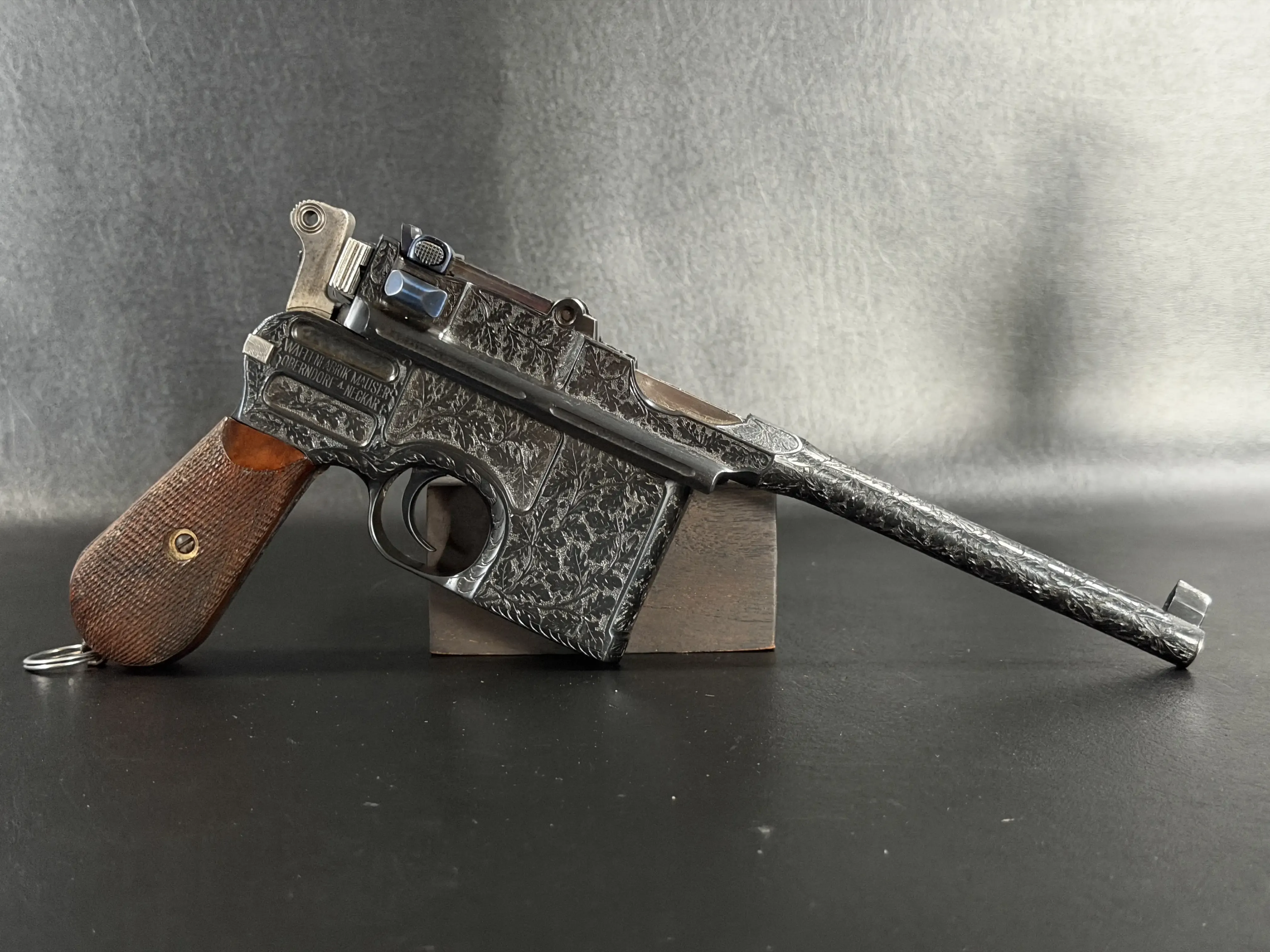
The Mauser C96 combined a locked-breech action, a fixed magazine ahead of the trigger, and an attachable wooden shoulder stock that doubled as a holster. Mauser manufactured the pistol from 1896 until 1937, completing more than one million examples in numerous configurations.[1] Its long production life, military use, commercial distribution, and frequent mechanical revisions created a field in which small differences can materially affect identification.
Development at Oberndorf
The C96 emerged from Mauser’s experimental workshop at Oberndorf am Neckar. Fidel Feederle, the workshop superintendent, and his brothers Friedrich and Josef played central roles in the design. Surviving correspondence also shows that Paul Mauser oversaw the project during its early development. The patent was issued solely in his name.[2]
Paul Mauser applied for the corresponding United States patent on February 14, 1896, following the German patent of December 11, 1895. U.S. Patent No. 584,479 was granted on June 15, 1897. It described a recoil-operated firearm in which the barrel, receiver, and bolt initially recoiled together before a locking block disengaged and allowed the bolt to continue rearward.[3]
That sequence defines the C96 as a short-recoil, locked-breech pistol. After firing, the barrel extension and bolt remain locked during their first short movement. The locking block then disengages, freeing the bolt to extract and eject the case, cock the hammer, and compress the recoil spring. On the return stroke, the bolt strips the next cartridge from the magazine and chambers it.[2][3]
The lock frame contains the hammer, mainspring, sear, trigger components, and disconnector as a removable assembly. Most components interlock without conventional screws or cross-pins. Apart from the grip screw and, on early examples, a rear-sight pin, the design relies largely on fitted surfaces, catches, and sliding joints.[2] This construction reduced exposed fasteners but required extensive precision machining.
A Distinct Mechanical Form
The standard C96 has a fixed magazine directly in front of the trigger guard. With the bolt held open, cartridges are pressed into the magazine from above using a charger or stripper clip. Mauser produced fixed-magazine versions holding six, 10, or 20 rounds, although the 10-round configuration became the most familiar.[1][4]
Early pistols were predominantly chambered for the 7.63x25 mm Mauser cartridge. A typical full-size example has a 140 mm barrel, an overall length of about 310 mm, and weighs about 1.13 kilograms. Many were fitted with tangent rear sights and slotted grips for the detachable walnut stock-holster.[4] The stock, attached to the grip, provided a third point of support and let the pistol function as a compact carbine.
The first production pistols differed visibly from later examples. Very early guns had a stepped transition between chamber and barrel, solid receiver rails, a single-lug locking block, and the hammer form now called the “conehammer.” By approximately serial number 200, Mauser had adopted a tapered barrel, fluted rails, and a two-lug locking block.[1] Later pistols appeared with large-ring and small-ring hammers, revised safeties, different receiver contours, and several grip and sight patterns.
These changes were evolutionary rather than a simple succession of formally named models. Terms such as “conehammer,” “flatside,” “large ring,” and “small ring” are principally collector classifications based on visible construction. Reliable identification therefore depends on the complete configuration, not a single conspicuous feature.
Military and Commercial Use
The Imperial German Army did not select the original 7.63 mm C96 as its standard service pistol. Mauser nevertheless received foreign military orders, including purchases by Turkey and the Italian Navy, and sold substantial numbers through commercial channels.[1]
During the First World War, the German government ordered C96 pistols chambered for the 9x19 mm Parabellum cartridge to supplement available P08 pistols. This produced the variant commonly called the “Red 9.” Many units cut a large numeral 9 into the wooden grip panels and filled it with red paint to distinguish these pistols from otherwise similar 7.63 mm arms.[5]
An Australian War Memorial example, manufactured in 1916, carries the Waffenfabrik Mauser Oberndorf address, a red 9 on the grip, and matching serial markings on the bolt and barrel breech.[6] The museum identifies the numeral as an ammunition warning intended to prevent using 7.63 mm cartridges in a 9 mm pistol.
The red numeral is a useful identification feature, but it cannot authenticate a military 9 mm pistol by itself. Grip panels are removable. Chambering, serial numbers, proof and acceptance marks, sight configuration, safety type, and the relationships among numbered components must match the proposed variant.
The C96 also attracted private military buyers. British officers of the period purchased their own sidearms, and some selected the Mauser. Winston Churchill carried a privately purchased example during the 21st Lancers' charge at Omdurman in 1898. C96 pistols were subsequently carried by participants on both sides of the Second Anglo-Boer War.[7]
Late Production and the Schnellfeuer
Mauser continued revising the C96 after World War I. Production included pistols with barrel lengths ranging from 99 to 140 mm, together with changes to the grip, safety, sights, receiver, and external markings.[8] These variations complicate attempts to assign a production period from barrel length or hammer shape alone.
The Model 1930 returned to the longer barrel and full-size grip while incorporating changes intended to simplify manufacture. It retained the fixed magazine and semiautomatic action of the established C96 pattern. Mauser ended C96 production in 1937.[8]
The final major development was the select-fire Schnellfeuer, commonly identified as the Model 712. It replaced the fixed magazine with a detachable box magazine and added a selector for semiautomatic or fully automatic fire.[8] Although its profile remained recognizably related to the C96, the feeding system and fire-control mechanism departed substantially from the original design.
Demand for the C96 pattern also encouraged production outside Germany. Spanish manufacturers Beistegui Hermanos and Astra developed pistols for markets that included China. Although these arms followed the C96’s general form, they incorporated different internal mechanisms, manufacturing methods, detachable-magazine systems, and, in some versions, selective-fire capability.[9] Chinese manufacturers also produced C96-type pistols, including examples chambered for .45 ACP.[8]
For identification, the manufacturer’s markings, mechanical system, magazine arrangement, caliber, serial placement, proof marks, and stock interface matter more than the pistol’s general outline. The C96 remained in production for four decades, and its variants document ongoing attempts to adapt an intricate 1890s mechanism to changing cartridges, military requirements, and export markets.
Frequently Asked Questions
Who designed the Mauser C96?
Fidel, Friedrich, and Josef Feederle played central roles in its development at Mauser’s experimental workshop. Paul Mauser supervised the project and received the patent in his name.
How does the Mauser C96 operate?
The C96 is a short-recoil, locked-breech pistol. Most examples have a fixed magazine ahead of the trigger that is loaded from above with a stripper clip.
What is a Red 9 Mauser?
The Red 9 is a First World War C96 chambered for 9x19 mm Parabellum. Many received a large red numeral 9 on the grips to distinguish them from 7.63 mm pistols.
What was the purpose of the wooden stock?
The wooden stock attached to the grip and provided additional support when firing. It also served as a holster and carrying case.
How can collectors identify a Mauser C96 variant?
Identification requires comparing the caliber, manufacturer’s markings, serial numbers, proof marks, hammer, safety, barrel, magazine system, and stock interface. No single feature is sufficient to authenticate every variant.
Sources
[1] Antaris, Leonardo. “In the Beginning: Semi-Automatic Pistols of the 19th Century.” American Rifleman, January 4, 2018.
[2] Ferguson, Jonathan. The ‘Broomhandle’ Mauser. Osprey Publishing, 2017, pp. 7-9.
[3] Mauser, Paul. “Recoil-Operated Firearm.” U.S. Patent No. 584,479, filed February 14, 1896, issued June 15, 1897.
[4] Royal Armouries. “Arms of the First World War.” Royal Armouries, n.d.
[5] National Museum of American History. “Mauser C96 Pistol, ‘Red 9’.” Smithsonian Institution, n.d.
[6] Australian War Memorial. “Mauser C96 ‘Red 9’ Pistol.” Australian War Memorial, n.d.
[7] National Army Museum. “Mauser C96 9 mm Self-Loading Pistol, 1916 (c).” National Army Museum, n.d.
[8] Campbell, Dave. “The Mauser C96: A Look Back.” American Rifleman, February 28, 2020.
[9] American Rifleman. “Spanish Broomhandles.” American Rifleman, October 19, 2010.
As a firearms enthusiast with a background in website design, SEO, and information technology, I bring a unique blend of technical expertise and passion for firearms to the articles I write. With experience in computer networking and online marketing, I focus on delivering insightful content that helps fellow enthusiasts and collectors navigate the world of firearms.
Comments
Be the first to leave a comment.
Be the first to read new editorial features, collector guides, and brand spotlights.