Key Takeaways
- Budischowsky’s delayed-breech mechanism was documented in a German patent application filed in 1978 and published in 1979.
- A contemporary 1985 evaluation documented the HSP 701’s careful workmanship, fixed-barrel design, and reliable performance during testing.
- Recent auction results demonstrate collector demand, but exceptional prices for elaborate examples should not be applied to standard pistols.
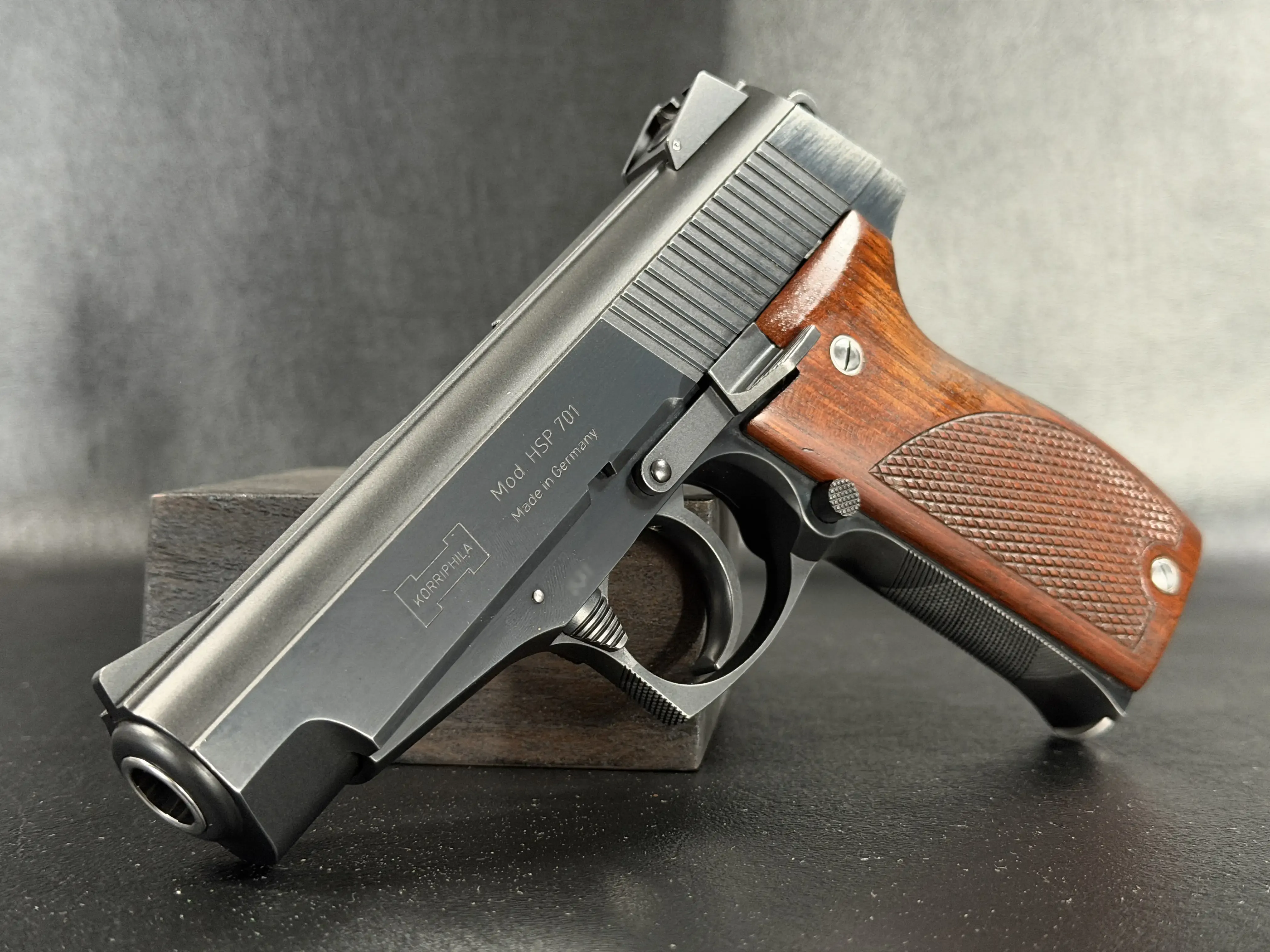
The Korriphila HSP 701 occupies an unusual place in modern firearms history. Designed by Edgar Budischowsky and manufactured in Heidelberg, West Germany, it was neither a military sidearm nor a conventional commercial pistol. It was a costly, low-volume firearm built around an original operating system and finished to standards more commonly associated with bespoke gunmaking.
An Unconventional Operating System
The HSP 701’s defining mechanism appeared in Budischowsky’s German patent application, filed on May 26, 1978, and published as DE 2822914 A1 on November 29, 1979.[1] The patent describes a self-loading firearm with a barrel rigidly attached to the frame and a breech mechanism delayed by a transverse roller and locking wedge. The application’s publication should not be confused with the grant of an enforceable patent; the surviving record identifies its legal status as withdrawn.[1]
In the HSP 701, a single roller beneath the breechblock interacts with the frame and locking wedge to delay opening after discharge. This differs from the paired, laterally moving rollers employed in firearms such as the Heckler & Koch G3 and MP5. Because the Korriphila’s barrel remains fixed, it does not tilt or move rearward during cycling. The arrangement allowed Budischowsky to combine a fixed barrel with cartridges that would ordinarily be unsuitable for an uncomplicated blowback pistol.
American gun writer Walter L. Rickell examined an early .45 ACP HSP 701 in 1984 and published his findings in the March/April 1985 issue of American Handgunner. He described a pistol with deep bluing, checkered walnut stocks and notably careful machining and polishing. The example had a four-inch barrel, a seven-round magazine and a double-action trigger mechanism. Rickell also documented a firing-pin lock, a loaded-chamber indicator and a slide-stop lever that served as a decocking control.[2]
The pistol’s construction was substantial. Rickell reported an unloaded weight of approximately 35 ounces for the four-inch .45 ACP example, heavy enough to moderate recoil without making the pistol exceptionally large.[2] The HSP 701’s low barrel position and fixed-barrel architecture were distinctive engineering choices, but claims that these features automatically guarantee superior accuracy or recoil control should be treated as design rationale rather than universal performance facts.
Contemporary Performance and Pricing
Rickell’s test provides a useful period performance record. Firing at 25 yards from a rest, he reported reliable operation with full-metal-jacket, hollow-point, and semiwadcutter ammunition. His best documented group, obtained with Winchester 185-grain match ammunition, measured approximately 2⅝ by 1¾ inches.[2] That is credible evidence of the tested pistol’s performance, although it does not establish that every HSP 701 will produce equivalent results.
The period article also complicates later accounts of the pistol’s original price. Its caption suggested that the HSP 701 “should retail for about $1,200,” while the text stated that price, availability and the identity of a prospective American importer remained unknown.[2] The frequently repeated claim that the pistol began at approximately $2,000 in 1984 therefore lacks firm support in this contemporary American source.
Known HSP 701s appear in several chamberings and configurations. The best-documented surviving examples are in .45 ACP and 9mm Luger, with both four and five-inch barrels represented in published records. Period reporting also identified .22 Long Rifle, .38 Special and .38 Super as contemplated caliber-conversion options, but Rickell noted that some versions were still under development when he wrote.[2] Later statements that every advertised chambering entered production, or that particular variants were made in exact quantities, require evidence from individual pistols, proof marks, or accompanying factory documentation.
No reliable, publicly accessible factory production ledger has established a definitive total for the original HSP 701. Estimates repeated in later references should therefore be treated as estimates, not audited production figures. The pistols were plainly made in limited numbers: contemporary reporting described availability as uncertain, and surviving examples appear only intermittently in major auction records.
The Modern Collector Market
Recent auction results demonstrate strong collector demand, but they also show why individual configurations and sale records matter. In November 2024, Hermann Historica sold a five-inch, 9mm Luger HSP 701 for €21,000. The pistol was described as retaining approximately 99 percent of its original finish and was accompanied by a cardboard box rather than a leather case.[3] This documented result corrects the substantially repeated but unsupported assertion that the same pistol brought €30,000.
The market subsequently recorded an even more exceptional result. A Damascus-steel HSP 701 in .45 ACP, fitted with a five-inch polygonal barrel and accompanied by a leather case, sold for €62,000 in 2025.[4] That price belongs to a materially different and unusually elaborate example; it should not be applied indiscriminately to standard pistols.
For collectors, the most important evidence remains specific to the firearm under consideration. German proof marks can help establish when a pistol passed proof, while its caliber markings and physical configuration document the gun as it presently exists. An original test target, manual, invoice, tools, box or fitted case can strengthen the historical record, provided those items can be credibly associated with the pistol.
The HSP 701 matters because its mechanical identity is real and documentable. Budischowsky did not merely refine a familiar locked-breech service pistol. He developed a compact, single-roller delayed mechanism around a fixed barrel and carried that design into limited commercial manufacture. Its importance rests less on superlatives than on this combination of independent engineering, demanding manufacture and scarcity in the surviving market.
Frequently Asked Questions
Who designed the Korriphila HSP 701?
Edgar Budischowsky designed the HSP 701. Its operating mechanism is documented in a German patent application filed in 1978.
How does the HSP 701 operate?
It uses a fixed barrel and a delayed-breech mechanism incorporating a single roller and locking wedge. This differs from the paired-roller systems used in several Heckler & Koch firearms.
Which calibers are documented?
Surviving examples are well documented in .45 ACP and 9mm Luger. Period reporting mentioned additional contemplated chamberings, but not every advertised option has been confirmed as entering production.
How many HSP 701 pistols were produced?
No publicly accessible factory ledger establishes a definitive production total. Published estimates should therefore be treated cautiously rather than presented as verified figures.
Why is the HSP 701 collectible?
Its collector interest rests on distinctive engineering, demanding manufacture and limited market availability. Configuration, condition and original documentation can materially affect the significance of an individual example.
Sources
- Edgar Budischowsky, “Semi-Rigid Lock for Small-Firearm Breechblock,” German patent publication DE 2822914 A1, filed May 26, 1978; published November 29, 1979.
- Walter L. Rickell, “Korriphila HSP 701,” American Handgunner, March/April 1985, pp. 42–45.
- Giorgio Brancaglion, “Hermann Historica Auction No. 102: Post-Sale Report,” All4shooters, December 3, 2024.
- SAM Wapenmagazine, “Korriphila,” issue 255, p. 30, 2025.
As a firearms enthusiast with a background in website design, SEO, and information technology, I bring a unique blend of technical expertise and passion for firearms to the articles I write. With experience in computer networking and online marketing, I focus on delivering insightful content that helps fellow enthusiasts and collectors navigate the world of firearms.
Comments
Be the first to leave a comment.
Be the first to read new editorial features, collector guides, and brand spotlights.