Key Takeaways
- Remington introduced the Model 700 in 1962, with the company identifying Mike Walker as its designer.
- ADL, BDL, CDL, varmint, police, and precision variants require configuration-specific research because specifications changed over time.
- Collectibility depends on documented originality, condition, configuration, and provenance—not unsupported claims of rarity or military association.
Introduced in 1962, the Remington Model 700 became one of America’s most adaptable bolt-action rifle families. Remington identifies engineer Mike Walker as its designer and records an extensive catalog history encompassing sporting, varmint, police, target, and custom-shop configurations. The company does not provide a verified total-production figure, so claims about precisely how many Model 700 rifles were manufactured cannot be confirmed from its published historical record.[1]
The rifle’s longevity rests on a common action adapted through changes in chambering, barrel profile, stock material, magazine arrangement, finish, and trim. That consistency makes the Model 700 recognizable, but it also complicates identification: a model name alone rarely establishes a rifle’s exact age or original factory configuration.
Understanding the Action
The Model 700 is a manually operated, centerfire bolt-action rifle. Its principal components include a removable bolt assembly, extractor, spring-loaded ejector, firing-pin assembly, trigger group, and internal magazine. Depending on the grade, that magazine is enclosed within the stock or fitted with a hinged floorplate.[2]
Standard-production rifles have appeared in short- and long-action configurations. Receiver length, bolt travel, magazine dimensions, and bolt face must correspond to the intended cartridge family. Familiar short-action chamberings have included .243 Winchester, .308 Winchester, and .22-250 Remington, while long-action offerings have included .270 Winchester, .30-06 Springfield, 7mm Remington Magnum, and .300 Winchester Magnum.[1]
Collectors should not infer action type or originality from appearance alone. Stocks, barrels, bottom assemblies, triggers, and bolts may have been replaced during decades of use. Cartridge markings establish the chambering marked on a barrel; they do not prove that the barrel is original to the receiver or that the assembled rifle remains mechanically correct.
ADL, BDL, and CDL
The ADL and BDL were the foundational Model 700 grades introduced in 1962. Remington’s historical record lists standard ADL production through 2004 and BDL production from 1962 onward, although uncataloged distributor and promotional runs prevent those dates from covering every rifle encountered in the market.[1]
The most useful practical distinction is the magazine arrangement. Traditional ADL rifles use a blind internal magazine, meaning there is no hinged floorplate through which cartridges can be released. BDL rifles use a hinged floorplate and associated latch assembly. Remington’s parts documentation separately identifies ADL and BDL magazines, followers, stock assemblies, and BDL floorplate components.[2]
The CDL, or Classic Deluxe, entered Remington’s catalog in 2004.[1] It continued the traditional sporting-rifle approach, commonly combining walnut furniture with restrained styling. Nevertheless, ADL, BDL, and CDL are product-grade designations rather than permanent specifications. Chamberings, barrel lengths, sights, checkering patterns, finishes, and stock details changed over time.
Varmint, Police, and Precision Variants
Remington began cataloging the BDL Heavy Varmint in 1967. Later heavy-barrel variants included the Varmint Special, VSSF, VLS, and VSSF II. The Police model appeared in the company’s catalog record in 1986, while the original Sendero followed in 1994.[1]
These rifles generally emphasized heavier barrels and stocks intended for supported shooting, but specifications must be checked against documentation from the correct production period. A heavy barrel, synthetic stock, or matte finish does not automatically identify a rifle as a factory police or precision model.
Sporting actions have frequently received aftermarket stocks, barrels, triggers, and bottom assemblies. Some distributor-exclusive rifles were also produced in configurations resembling cataloged police or varmint models. Remington expressly notes that special runs for distributors and conservation organizations did not always appear in its standard catalogs.[1]
The Model 700’s Military Connections
The Model 700 action formed the foundation of two important American military sniper-rifle families. The U.S. Marine Corps states that the M40 was based on the Remington Model 700 and entered Marine service in 1966. Later M40 variants were assembled and rebuilt by Marine Corps armorers rather than issued as unchanged commercial rifles.[3]
The U.S. Army’s M24 Sniper Weapon System was also based on the Model 700. An official Army account records that the M24 entered the Army and Special Operations Command inventory in 1986. The same account states that 2,520 M2010 Enhanced Sniper Rifles were subsequently built to replace M24 systems.[4]
Under an Army contract announced in 2010, Remington converted M24 rifles into the .300 Winchester Magnum XM2010 configuration. The upgraded system incorporated a five-round detachable magazine, free-floating barrel, modular chassis, suppressor, and Leupold optic.[5]
These military connections contribute to the Model 700 action’s historical importance. They do not, however, make an ordinary commercial rifle an M40, M24, or military-issued collectible. Such attribution requires documentation connecting the individual firearm to the relevant military system, contract, unit, or service history.
Chamberings and Production Changes
Remington’s historical chambering list extends from small-caliber varmint cartridges such as .17 Remington and .222 Remington to dangerous-game cartridges including .375 H&H Magnum, .416 Remington Magnum, and .458 Winchester Magnum. Some were regular catalog offerings, while others appeared briefly, belonged to the annual Classic series, or were restricted to the Custom Shop.[1]
A chambering can affect collectibility, but scarcity should not be asserted from caliber alone. Remington’s historical page does not supply production totals for the Model 700 family or its individual variants. A defensible rarity assessment requires evidence such as dated catalogs, factory records, shipping documents, authenticated special-order paperwork, or documented production data.[1]
The same caution applies to serial numbers. A serial number may help place a receiver within a production period, but it does not necessarily date the barrel, stock, trigger, or present-day assembly. Replacement barrels and other modifications can sever the apparent relationship between the receiver and its surrounding components.
Collectors should record the serial number privately, photograph all relevant markings, and compare the rifle’s physical features with dated manufacturer literature. Any mechanical uncertainty should be resolved by a qualified gunsmith before the rifle is fired.
Trigger Generations and the X-Mark Pro Recall
Trigger configuration is one of the most consequential identification and safety issues on a used Model 700. Early rifles are associated with the trigger design developed during Mike Walker’s tenure. Later Remington production included the X-Mark Pro trigger, while RemArms states that newly manufactured Model 700 rifles now receive factory-installed Timney triggers.[1][6]
The X-Mark Pro requires particular attention. Remington’s recall covers Model 700 and Model Seven rifles equipped with X-Mark Pro triggers and manufactured from May 1, 2006, through April 9, 2014. Remington reported that excess bonding agent used during assembly could, under certain circumstances, contribute to an unintended discharge.[7]
The recall notice instructs owners of affected rifles to stop using them and not attempt their own diagnosis or repair. It describes a ribbed trigger face as indicating a non-X-Mark Pro trigger and a smooth trigger face as an X-Mark Pro indicator. Owners are directed to confirm recall status using the rifle’s serial number.[7]
Rifles processed through the recall were marked with a punch on the bolt release. Remington also applied that mark to rifles produced after the relevant assembly process was corrected.[7]
Visual identification remains useful, but it is not conclusive on a used rifle because triggers can be replaced. Buyers should document the installed trigger, verify the serial number through the manufacturer’s current support channel, and have any uncertain or modified mechanism examined by a qualified gunsmith.
Stocks, Barrels, and Current Production
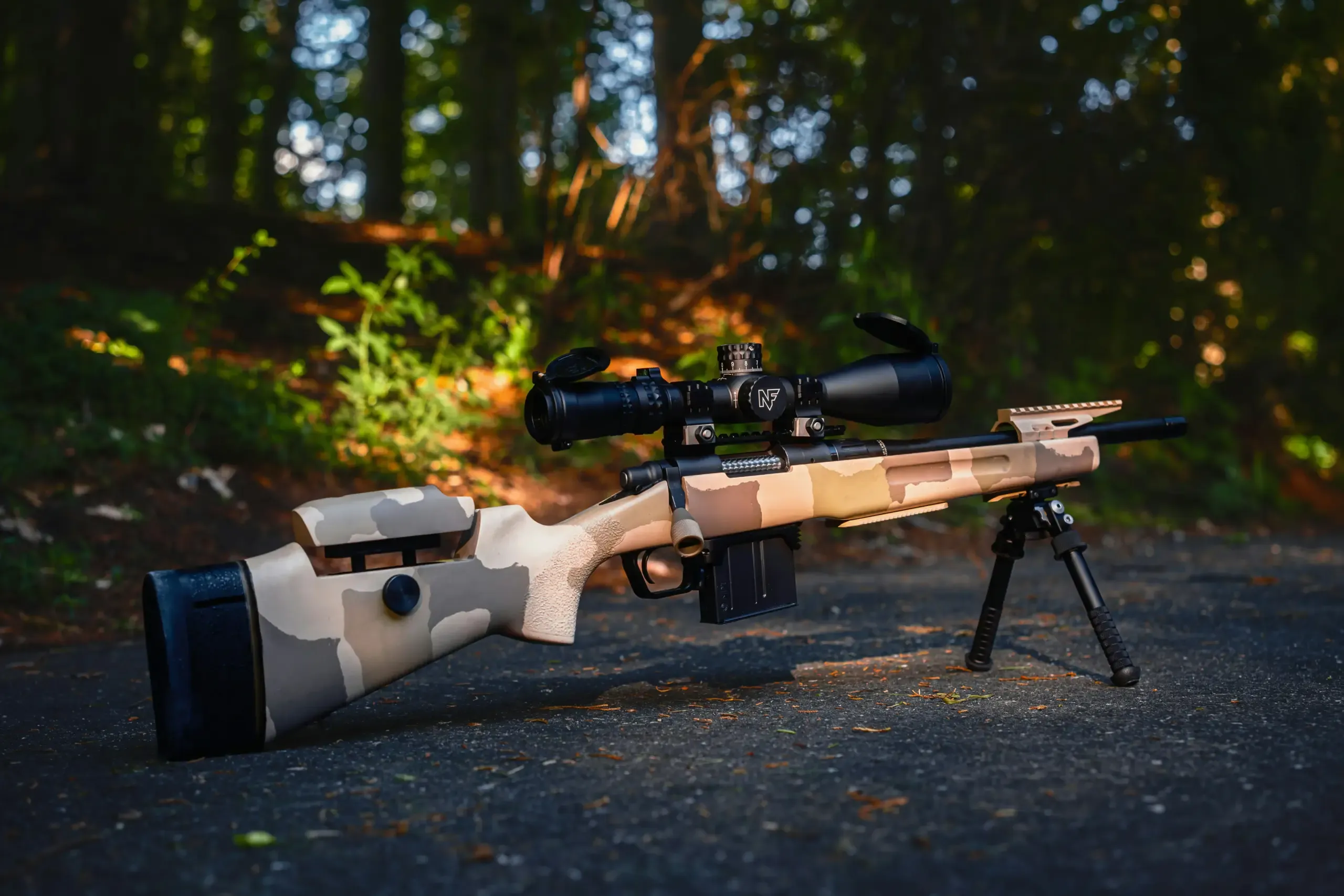
The Model 700 has been sold with walnut, laminated-wood, injection-molded synthetic, composite, and chassis-style furniture. Barrel configurations have ranged from relatively light sporting profiles to heavy varmint and target barrels. These differences affect handling and intended use, but they also provide valuable identification evidence when compared with period catalogs.
Current RemArms production continues the practice of adapting the Model 700 action to distinct purposes. The company describes its Model 700 Long Range as combining a heavy 5R target barrel, H-S Precision stock, threaded muzzle, and Timney trigger. RemArms also states that all newly manufactured Model 700 rifles receive factory-installed Timney triggers.[6]
Those statements apply to current RemArms production and should not be projected backward onto rifles produced under earlier ownership. Buyers should verify the specifications of the individual rifle instead of assuming that current features apply to every Model 700.
When evaluating a rifle, examine its barrel markings, crown, bore, recoil-lug area, bedding surfaces, action screws, stock inletting, bolt face, extractor, ejector, safety, and trigger. Evidence of refinishing, altered bedding, replacement hardware, or an aftermarket barrel is not necessarily undesirable in a working rifle, but it must be disclosed accurately when the firearm is represented as collectible or factory-original.
What Collectors Should Prioritize
A sound Model 700 assessment begins with identity rather than reputation. Establish the precise variant, action length, chambering, magazine system, barrel contour, stock type, trigger, finish, and production-era features. Then compare those elements with dated manufacturer literature.
Condition and originality should be evaluated separately. A mechanically excellent custom rifle may have considerable practical value but little claim to factory originality. Conversely, an uncommon original configuration may retain collector interest despite honest finish wear.
Provenance matters most when it is specific and documented. Military or police attribution requires records connecting the individual rifle—not merely its model—to an agency, unit, contract, or recognized owner. Descriptions such as “custom-shop,” “prototype,” “one of few,” and “special order” likewise require contemporary documentation or persuasive factory evidence.
The Model 700’s significance lies in its adaptability. Since 1962, the same rifle family has encompassed traditional sporting guns, specialist varmint rifles, police configurations, custom-shop arms, and the commercial foundation for two prominent American military sniper systems. For collectors, that variety is both the attraction and the reason disciplined identification is essential.
Frequently Asked Questions
When was the Remington Model 700 introduced?
Remington introduced the Model 700 in 1962. The company identifies engineer Mike Walker as its designer.
What is the principal difference between the Model 700 ADL and BDL?
Traditional ADL rifles use a blind internal magazine. BDL rifles generally have a hinged floorplate and corresponding latch assembly.
Was the Remington Model 700 used by the military?
The Model 700 action formed the commercial basis of the Marine Corps’ M40 and the Army’s M24 sniper systems. An ordinary commercial Model 700 should not be represented as a military rifle without firearm-specific documentation.
Which Model 700 rifles are covered by the X-Mark Pro recall?
The recall covers Model 700 and Model Seven rifles fitted with X-Mark Pro triggers and manufactured from May 1, 2006, through April 9, 2014. Owners should confirm eligibility through the manufacturer using the rifle’s serial number.
What should collectors examine before buying a Model 700?
Collectors should verify the rifle’s variant, chambering, action length, barrel, stock, magazine system, trigger, condition, and markings. Claims of rarity, originality, or special provenance require supporting documentation.
Sources
- RemArms, “Model 700: Firearm History.”
- Remington Arms Company, “Owner’s Manual: Model 700, Model Seven and Model 673 Bolt-Action Centerfire Rifles.”
- U.S. Marine Corps, “M40 Guides Snipers to Target,” 2016.
- U.S. Army, “Snipers Put Finishing Touches on the Last Sniper Rifle,” May 9, 2014.
- U.S. Army, “Army Awards Contract for Upgraded Sniper Weapon System,” September 30, 2010.
- RemArms, “Remington Firearms: Current Model 700 Production.”
- Remington Arms Company, “Product Safety Warning and Recall Notice: Model 700 and Model Seven Rifles.”
As a firearms enthusiast with a background in website design, SEO, and information technology, I bring a unique blend of technical expertise and passion for firearms to the articles I write. With experience in computer networking and online marketing, I focus on delivering insightful content that helps fellow enthusiasts and collectors navigate the world of firearms.
Comments
Be the first to leave a comment.
Be the first to read new editorial features, collector guides, and brand spotlights.