Key Takeaways
- Pre-’64 Model 70s use controlled-round feeding, a long claw extractor, a fixed blade ejector, and a coned breech.
- The 1964 redesign introduced push-feed operation, while a 1968 anti-bind improvement addressed a weakness in the earliest post-1964 actions.
- A period label alone does not establish value; configuration, originality, condition, markings, and documentation must support one another.
The Winchester Model 70 has passed through several distinct mechanical and manufacturing periods since its introduction in 1936. The terms “Pre-’64,” “push-feed,” and “Classic” refer to important differences in the rifle’s action, extraction system, ejection system, and production methods. Because Winchester also produced transitional configurations and numerous variations, identifying an individual rifle requires more than assigning it to a broad production era.
From the Model 54 to the Model 70
Winchester developed the Model 70 from the earlier Model 54 bolt-action rifle. The Model 70 retained the Model 54’s dual front locking lugs, non-rotating extractor, receiver-mounted ejector, and coned breech. Winchester redesigned other components, including the trigger, bolt stop, bolt sleeve, hinged floorplate, gas-handling provisions, and safety.[1]
The first Model 70 production rifles were completed in 1936, although deliveries to the trade began in 1937. Winchester’s historical timeline identifies 1936 as the model’s year of introduction.[1][2]
Winchester discontinued the original Model 70 configuration after 1963 and introduced the redesigned version in 1964. Rifles made in the original configuration consequently became known as Pre-’64 Model 70s.[2]
The Pre-’64 Action
The Pre-’64 Model 70 uses a controlled-round-feed action. As a cartridge rises from the magazine, its rim moves beneath the rifle’s long, non-rotating claw extractor. The extractor retains control of the cartridge during chambering and extraction.
Ejection is performed by a fixed blade mounted in the receiver. As the bolt moves rearward, the case contacts the ejector. The speed of the bolt’s rearward movement influences the force with which the case is ejected.
The Pre-’64 action also incorporates a coned barrel breech. This feature helps guide the cartridge toward the chamber during the feeding cycle.[1]
Common mechanical characteristics of the Pre-’64 action include:
- Controlled-round feeding
- A long external claw extractor
- A receiver-mounted blade ejector
- A coned breech
- Dual front locking lugs
- A one-piece bolt body with an integral handle
- A bolt guide intended to reduce binding
Pre-’64 Model 70s used one basic receiver length across a broad range of cartridges. Winchester accommodated different cartridge lengths through variations in bolt travel, magazine components, bolt stops, and receiver machining.[3]
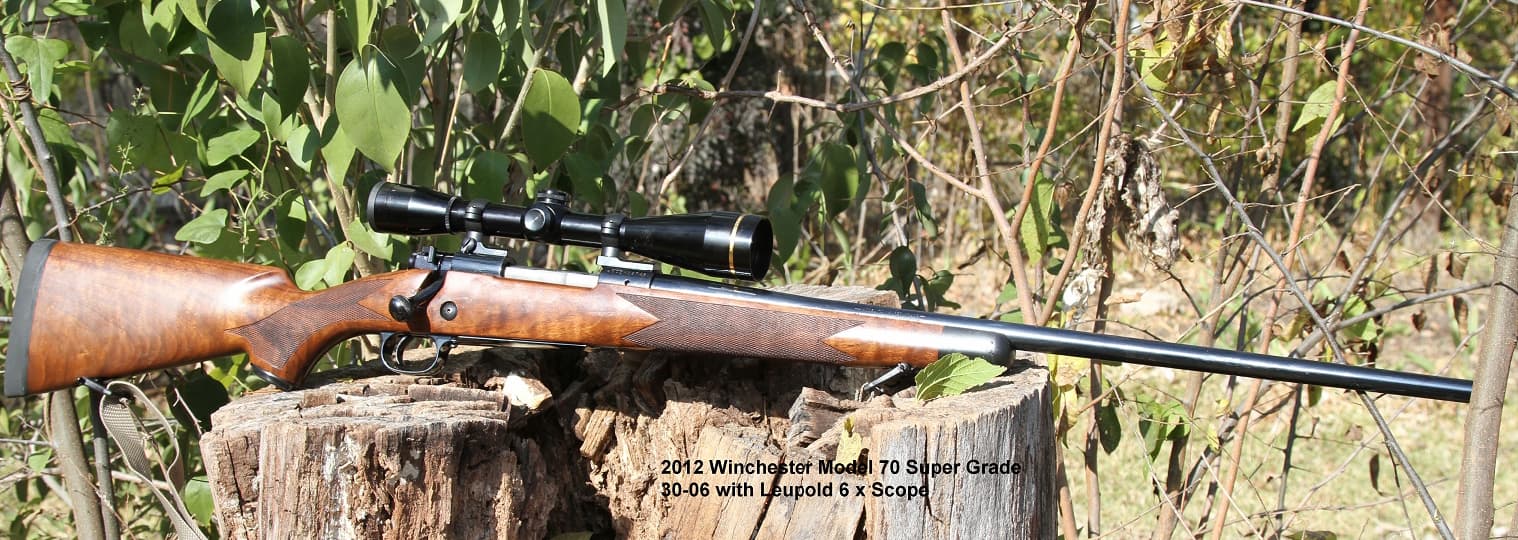
The rifles were produced in numerous configurations, including Standard, Super Grade, Featherweight, Alaskan, African, Westerner, Varmint, National Match, Target, and Bull Gun variants. Barrel lengths, chamberings, stocks, sights, and other components varied according to model and production period.[1]
The 1964 Redesign
Winchester introduced a substantially redesigned Model 70 in 1964. The new action replaced controlled-round feeding with a push-feed system.
In the push-feed action, the bolt moves the cartridge forward from the magazine and into the chamber. The extractor engages the cartridge rim as the bolt closes. This differs from the earlier system, in which the claw extractor takes control of the cartridge as it rises from the magazine.
The 1964 action uses a recessed bolt face, a smaller extractor, and a spring-loaded plunger ejector positioned in the bolt face. Winchester also replaced the earlier coned breech with a square-faced breech.[3][4]
Other production changes included:
- A receiver made from a steel forging rather than machined bar stock
- A separately manufactured bolt handle attached to the bolt body
- Revised magazine components
- Changes to the stock profile and checkering
- Altered trigger-guard and floorplate components on certain versions
The basic dual-front-locking-lug arrangement remained in use, and Winchester retained the Model 70’s three-position safety and trigger design.[4]
The 1968 Anti-Bind Revision
The 1964 push-feed action did not include the earlier rifle’s bolt-guiding arrangement. When lateral pressure was applied during operation, the bolt could bind against the receiver rails.
In 1968, Winchester introduced an anti-bind system involving a groove in the bolt head and a corresponding rail in the receiver. This arrangement helped guide the bolt during its travel and improved the action’s resistance to binding.[4]
The revision created a mechanical distinction between Model 70 rifles made from 1964 through approximately 1967 and the revised push-feed rifles produced from 1968 onward. The broad term “Post-’64” includes both configurations.
Later Push-Feed Production
The push-feed Model 70 remained in production for decades and appeared in numerous grades, action lengths, chamberings, and stock configurations.
Unlike the original rifle’s one-length receiver system, later Model 70 production included actions sized for different cartridge families. These eventually included standard-length, short, and super-short configurations.[3]
Winchester also changed barrel-manufacturing methods. Pre-’64 barrels were generally cut-rifled, while post-1964 production incorporated hammer-forged barrels.[3]
These production changes did not occur as a single uniform event across every Model 70 variation. Features may differ according to a rifle’s date, model designation, chambering, and production run.
Return of Controlled-Round Feeding
Winchester began returning the Pre-’64-style controlled-round-feed action to production in 1992. The company’s historical timeline identifies 1994 as the formal return of the design with claw extraction, controlled-round feeding, and fixed-blade ejection.[2][5]
Rifles using the revived action became known as Model 70 Classics. The Classic restored several major features associated with the original rifle:
- Controlled-round feeding
- A long claw extractor
- A receiver-mounted blade ejector
- A coned breech
The Classic action was not an exact reproduction of the Pre-’64 design. It retained later developments, including an anti-bind bolt guide, and was produced with modern machining methods. Winchester also offered receiver lengths suited to different cartridge families.[3]
Controlled-Round Push Feed
Not every Model 70 manufactured after the early 1990s used a conventional controlled-round-feed action. Winchester also produced rifles with a system described as controlled-round push feed.
This design combined a shorter extractor with a bolt face configured to allow the cartridge rim to move into position as the cartridge rose from the magazine. It also used a fixed blade ejector rather than the bolt-face plunger associated with the conventional push-feed action.
Winchester’s Model 70 manual states that rifles manufactured from 1992 onward may have controlled-round-feed, controlled-round-push-feed, or push-feed bolts.[6] Consequently, production date alone does not establish which feeding system an individual rifle uses.
Extractors and Ejectors
The extractor and ejector provide two of the clearest mechanical distinctions among Model 70 actions.
Pre-’64 and Classic controlled-round feed
- Long external claw extractor
- Cartridge rim engages the extractor during feeding
- Receiver-mounted blade ejector
- Ejection force varies with bolt speed
- Coned breech
Conventional push-feed
- Smaller extractor
- Recessed bolt face
- Extractor engages the case rim as the bolt closes
- Spring-loaded plunger ejector in the bolt face
- Square-faced breech
Controlled-round push feed
- Shorter extractor
- Bolt face permits the cartridge rim to enter from below
- Receiver-mounted blade ejector
- Features drawn from both primary Model 70 action types
Trigger Systems
Pre-2008 Model 70 rifles generally use versions of Winchester’s traditional trigger mechanism. Exact components and adjustments vary by production period.
Model 70 rifles manufactured from 2008 onward use Winchester’s three-lever M.O.A. Trigger System. Winchester specifies a pull-weight adjustment range of three to five pounds. The manufacturer describes the system as using a two-to-one mechanical advantage intended to reduce perceptible take-up, creep, and overtravel.[6][7]
Production Locations
For approximately the first 70 years of the model’s history, Model 70 production took place in New Haven, Connecticut. The New Haven plant closed in 2006.
Production subsequently resumed at a Herstal Group facility in South Carolina. Model 70 production later moved to Viana, Portugal. Winchester states that current country-of-origin information appears on the individual rifle’s barrel inscription and that present Model 70 production is based in Portugal.[8]
Current-production Model 70 rifles use controlled-round-feed actions. Winchester lists a claw extractor, fixed blade ejector, three-position safety, forged and machined steel receiver, and M.O.A. Trigger System among the design’s current features.[9]
Serial Numbers and Production Dates
Winchester publishes a serial-number reference covering Model 70 production through 1992. The company describes the information as providing a “fairly accurate” picture rather than a definitive record for every rifle because the reference was compiled from rough historical documents.[10]
For Model 70 rifles manufactured after 1992, Winchester directs owners to contact its Customer Service Department for date-of-manufacture information.[10]
Serial numbers establish only part of a rifle’s production history. Mechanical features, barrel inscriptions, proof and inspection marks, model designations, stocks, sights, and cataloged specifications provide additional evidence about its period and configuration.
Frequently Asked Questions
What is a Pre-’64 Winchester Model 70?
A Pre-’64 is a Model 70 made in the original configuration before Winchester’s 1964 redesign. These rifles generally use controlled-round feeding, a long claw extractor, and a fixed ejector.
How does push-feed differ from controlled-round feed?
Controlled-round feed captures the cartridge rim as the round rises from the magazine. Push-feed moves the cartridge into the chamber before the extractor engages its rim.
When did controlled-round feeding return to the Model 70?
Winchester began returning the Pre-’64-style action to production in 1992. Its official historical timeline identifies 1994 as the formal return of the controlled-round-feed design.
Are all Model 70 rifles made after 1992 Classics?
No. Winchester states that rifles from this period may use controlled-round-feed, controlled-round-push-feed, or push-feed bolts, so the individual rifle must be inspected.
How can a Winchester Model 70 be dated accurately?
Compare its serial number with Winchester’s official reference and verify that its mechanical features and markings agree with the proposed date. For rifles made after 1992, Winchester directs owners to contact Customer Service.
Sources
- American Rifleman, “The Model 70 Story: The Early Years,” originally published November 1980; republished May 23, 2019.
- Winchester Repeating Arms, “What Is the Historical Timeline for Winchester Firearms?”
- Rifle Magazine, “Winchester Post-’64 Model 70.”
- American Hunter, “The Model 70 Story: A Classic Advanced,” originally published December 1980; republished July 2, 2010.
- Winchester Repeating Arms, “Historical Timeline: 1950–1999.”
- Winchester Repeating Arms, “Model 70 Owner’s Manual.”
- Winchester Repeating Arms, “M.O.A. Trigger System.”
- Winchester Repeating Arms, “Where Are Winchester Firearms Manufactured?”
- Winchester Repeating Arms, “Model 70 Bolt-Action Rifles.”
- Winchester Repeating Arms, “What Year Was My Model 70 Manufactured?”
As a firearms enthusiast with a background in website design, SEO, and information technology, I bring a unique blend of technical expertise and passion for firearms to the articles I write. With experience in computer networking and online marketing, I focus on delivering insightful content that helps fellow enthusiasts and collectors navigate the world of firearms.
Comments
Be the first to leave a comment.
Be the first to read new editorial features, collector guides, and brand spotlights.