Key Takeaways
- The U.S. Model of 1917 was adapted from the British Pattern 1914 rifle to fire the American .30-06 cartridge.[1]
- Winchester, Remington, and Eddystone produced 2,422,529 rifles, making the Model 1917 the predominant U.S. service rifle in France during World War I.[1][2]
- Collectors should evaluate the complete rifle, receiver, barrel, component markings, finish, stock, and documented history, because matching manufacturer codes alone do not prove originality.
When the United States entered World War I in April 1917, the Army faced an immediate shortage of Model 1903 Springfield rifles. Winchester, Remington, and Remington’s Eddystone operation had recently manufactured the British Pattern 1914 rifle, leaving them with suitable machinery and experienced workers. Rather than retool those commercial plants for the Springfield, the War Department adapted the Pattern 1914 to fire the standard American .30-06 cartridge. The result was officially designated the “U.S. Rifle, Caliber .30, Model of 1917.”[1][2]
The decision transformed the Model 1917, commonly called the U.S. Enfield or American Enfield, into the principal American service rifle of the war. U.S. Army historical accounts state that approximately three out of four American soldiers in France carried the Model 1917.[2] Ordnance records cited by firearms historian Bruce N. Canfield show that 1,123,259 rifles had been shipped to France by the Armistice. Production continued into 1919 and ultimately reached 2,422,529 rifles.[1]
Recognizing the Model 1917
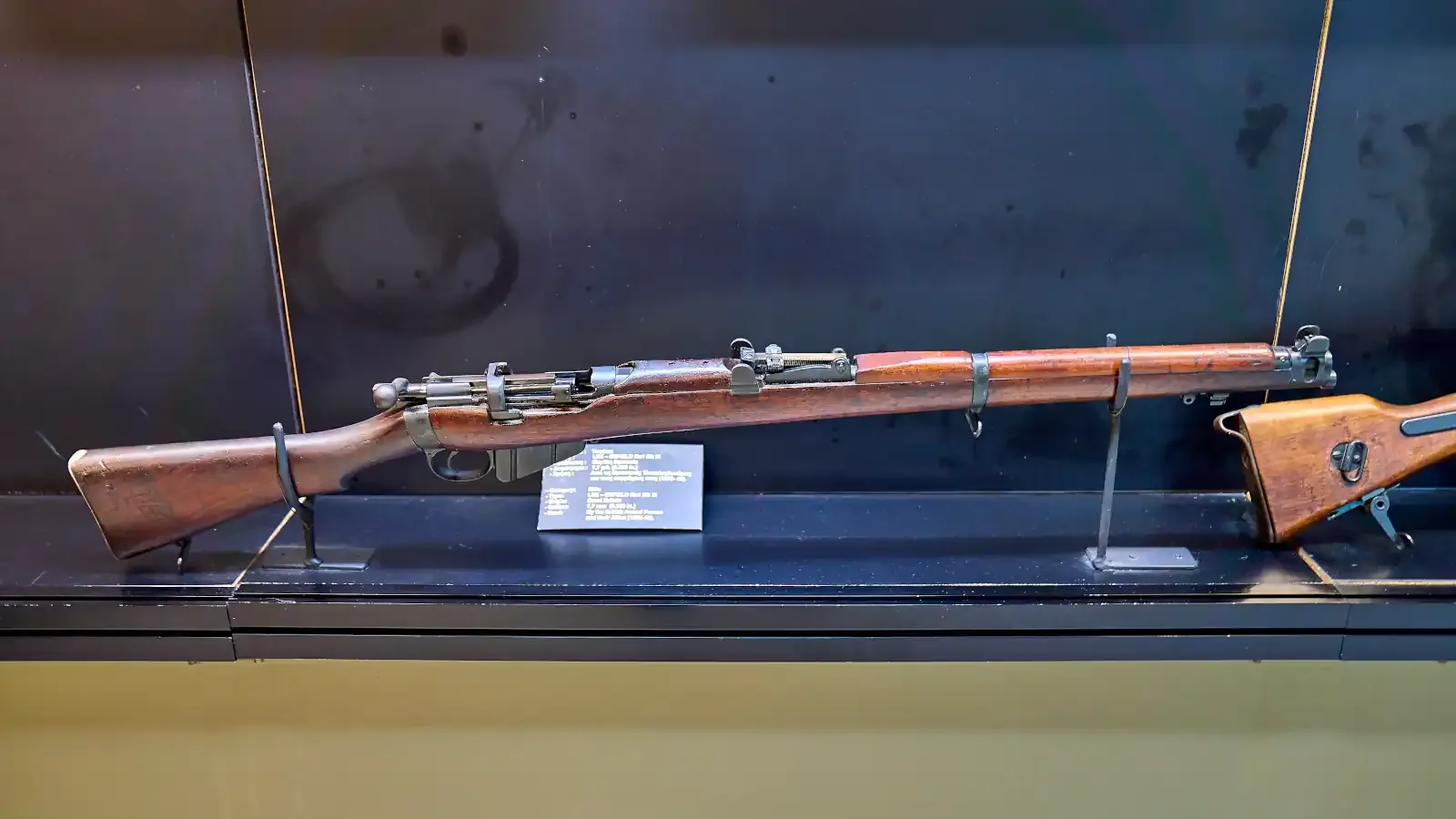
The Model 1917 is a substantial cock-on-closing bolt-action rifle. Standard specifications include a 26-inch barrel, an overall length of 46¼ inches, and a weight of approximately 9 pounds, 3 ounces. Its integral magazine holds six cartridges, although soldiers normally loaded it with the same five-round charger used with the Model 1903 Springfield.[1]
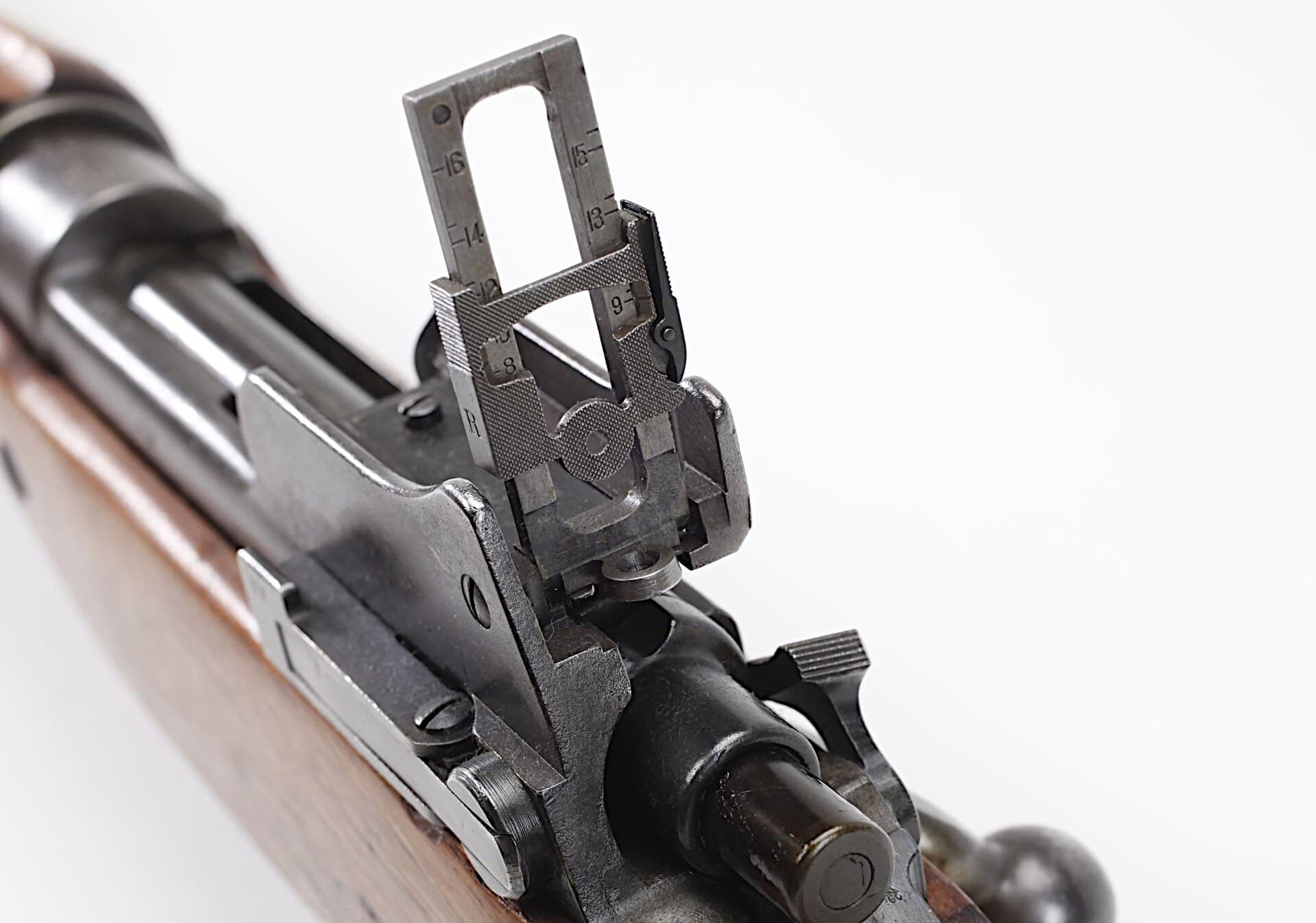
Its most recognizable features are the protective receiver-mounted sight ears, folding aperture rear sight, and distinctly curved bolt handle. The rear sight provides elevation adjustment but no mechanical windage adjustment. The rifle also lacks the magazine cutoff found on the Model 1903.[1]
A period War Department manual identifies the rifle’s principal assemblies and documents its military operation, disassembly, inspection, cleaning, and storage procedures. That manual remained in print during World War II, evidence of the rifle’s continued place in American military inventories long after World War I.[3][4]
Manufacturers and Markings
Model 1917 rifles were produced by three manufacturers:
- Winchester Repeating Arms Co. in New Haven, Connecticut
- Remington Arms-Union Metallic Cartridge Co. in Ilion, New York
- Remington’s Eddystone operation in Pennsylvania
The receiver ring normally bears the model designation, manufacturer, and serial number. The barrel was marked with its maker’s initial and production date, while numerous components received a single-letter manufacturer code: “W” for Winchester, “R” for Remington, and “E” for Eddystone.[1][5]
Approximately the first 5,000 Winchester rifles present an important variation. Their receiver rings were marked simply with a “W,” following the earlier British Pattern 1914 format. Winchester subsequently adopted the full company name on the receiver.[1]
Manufacturer agreement among the receiver, barrel, bolt, and smaller components may support a conclusion that a rifle retains its original production configuration, but matching letters alone are not conclusive proof. Parts could be replaced during service or subsequently exchanged. Conversely, mixed manufacturer codes do not automatically make a rifle incorrect: the Model 1917 remained subject to military maintenance long after its original manufacture. Evaluation should therefore consider the entire firearm, including its barrel date, finish, wear patterns, stock condition, and documented history.
What Collectors Should Examine
The receiver markings establish the rifle’s manufacturer and serial number and should be the starting point for any inspection. Altered characters, displaced metal, or an unusually soft or polished receiver surface may indicate refinishing or modification.
The barrel marking and date should then be compared with the receiver manufacturer and the rifle’s apparent period of production. A different manufacturer’s barrel or a substantially later date indicates that the barrel was replaced, but it does not establish when or by whom the work was performed. Claims of a specific arsenal rebuild require an identifiable inspection mark or supporting documentation.
The bolt deserves equally careful attention. Its manufacturer code should be recorded, and the locking lugs, bolt face, extractor, and raceways should be examined for corrosion, cracks, deformation, or improper alteration. Mechanical safety cannot be determined from maker codes or external appearance. A qualified gunsmith should inspect headspace and overall serviceability before any newly acquired Model 1917 is fired.
Wood condition is another major consideration. Inspect the stock and handguards for cracks, repairs, sanding, oil saturation, replaced sections, and softened contours. Original markings can be faint, and aggressive cleaning or refinishing may erase evidence needed to interpret the rifle. A stamp should not be identified from its general shape alone; partial markings are easily misread.
The bore, chamber, and muzzle crown should be inspected under good light. Corrosion and erosion affect shooting condition, while a recut crown, shortened barrel, enlarged aperture, altered stock, or removed sight ears materially changes the rifle from its military configuration.
The Model 1917 Bayonet
The proper companion is the U.S. Bayonet, Model of 1917, derived from the British Pattern 1914 bayonet and fitted with a 17-inch blade. American examples were manufactured by Remington and Winchester; Eddystone did not produce them. The United States also acquired some British Pattern 1914 bayonets and over-stamped them with American military markings.[1]
As with the rifle, markings and physical configuration should be considered together. A bayonet’s manufacturer, date, inspection marks, grips, finish, and scabbard must all support the claimed identity. American markings added to a British-produced bayonet can be historically correct, but their authenticity should be established from the object rather than assumed from an isolated stamp.
Collecting the Model 1917
A collector seeking an original-configuration rifle should favor a coherent combination of receiver, barrel, component markings, finish, and wear. A service-repaired example can be equally legitimate as a military artifact, but it should not be represented or priced as untouched factory production without persuasive evidence.
The Model 1917’s appeal lies in that evidence. Its markings connect an individual rifle to one of three American wartime production centers, while its configuration reflects the United States’ rapid industrial response to the demands of World War I. Careful inspection, not a single stamp, anecdote, or seller’s description, is the soundest basis for understanding what survives.
Frequently Asked Questions
Who manufactured the U.S. Model of 1917?
Winchester, Remington, and Remington’s Eddystone operation manufactured the rifle.[1]
How many Model 1917 rifles were produced?
Total production reached 2,422,529 rifles before manufacturing ended in 1919.[1]
What cartridge does the Model 1917 fire?
The Model 1917 is chambered for the .30-06 Springfield cartridge.[1][3]
What do the letters W, R, and E mean?
They identify Winchester, Remington, and Eddystone, respectively. These letters appear on many Model 1917 components, but matching letters alone do not establish that a rifle is entirely original.[1][5]
What bayonet belongs with the Model 1917?
The correct companion is the U.S. Bayonet, Model of 1917, manufactured in the United States by Remington and Winchester.[1] Some British Pattern 1914 bayonets were also acquired and over-stamped with American military markings.[1]
Sources
- Bruce N. Canfield, “The U.S. Model of 1917 Rifle,” American Rifleman, July 19, 2018.
- U.S. Army Center of Military History, “Joining the Great War, April 1917–April 1918,” The U.S. Army Campaigns of World War I.
- U.S. War Department, “Basic Field Manual: U.S. Rifle, Caliber .30, M1917,” FM 23-6, August 3, 1942.
- Library of Congress, “Series 23: Basic Weapons,” United States Army Field Manuals: A Resource Guide and Inventory.
- Bruce N. Canfield, “Winchester Goes to War,” American Rifleman, April 13, 2016.
As a firearms enthusiast with a background in website design, SEO, and information technology, I bring a unique blend of technical expertise and passion for firearms to the articles I write. With experience in computer networking and online marketing, I focus on delivering insightful content that helps fellow enthusiasts and collectors navigate the world of firearms.
Comments
Be the first to leave a comment.
Be the first to read new editorial features, collector guides, and brand spotlights.