Key Takeaways
- The Police Positive, Detective Special, and Diamondback share a related small-frame design, but differ in chamberings, sights, barrels, and intended use.
- Colt’s serial-number lookup provides an approximate year of manufacture, while an archive letter may document the original configuration and shipping details.
- Correct markings and period-style stocks do not prove originality. Finish, mechanical condition, component fit, and factory documentation must also be examined.
Colt’s Police Positive, Detective Special, and Diamondback belong to the company’s small-frame double-action revolver family. Although they share related mechanisms and dimensions, each served a different market. The Police Positive was conceived as a compact service revolver, the Detective Special adapted the Police Positive Special platform to concealed carry, and the Diamondback combined the small frame with adjustable sights and a ventilated-rib barrel.[1][2][3]
Police Positive and Police Positive Special
Colt introduced the Police Positive in 1907. Its name referred to Colt’s Positive Lock, an internal safety that prevented the hammer from moving fully forward unless the trigger was pulled. Early versions were chambered for cartridges including .32 Colt and .38 Colt New Police, Colt’s designation for a cartridge dimensionally equivalent to .38 S&W. Standard features included fixed sights and either blued or nickel finishes.[1]
In 1908, Colt lengthened the frame and cylinder to accommodate longer cartridges, principally .38 Special and .32-20 Winchester. This version became the Police Positive Special. The distinction is critical because the standard Police Positive and the Police Positive Special are not interchangeable descriptions. A revolver marked for .38 Colt New Police or .38 S&W must not be assumed to accept .38 Special ammunition.[1]
Early Police Positives generally wore checkered hard-rubber stocks. Colt changed to checkered walnut in 1924. The company also offered a target version with adjustable sights beginning in 1910. Changes to stocks, sights, barrel markings, and frame contours can help place an example within its production period, but none is sufficient by itself to establish a manufacturing date or original configuration.[1]
Detective Special
Introduced in 1927, the Detective Special was a six-shot, double-action revolver based on the Police Positive Special. Its defining initial configuration paired a 2-inch barrel with a .38 Special chambering. This gave Colt a compact revolver with one more chamber than the five-shot Smith & Wesson Chief Special that later became its principal competitor.[2]
Colt revised the Detective Special repeatedly. Early revolvers had an unshrouded ejector rod, while the version introduced in 1973 received a barrel shroud protecting the rod. Changes also appeared in the butt profile, stocks, cylinder latch, hammer, trigger, and barrel contour. Colt restored the model to production in the 1990s after its earlier discontinuation.[2]
These running changes make collector shorthand such as “first issue” or “third issue” useful, but the terms should not replace an examination of the firearm itself. A revolver can retain the correct frame and serial number while carrying replacement stocks, an altered finish, or a barrel installed later.
Diamondback
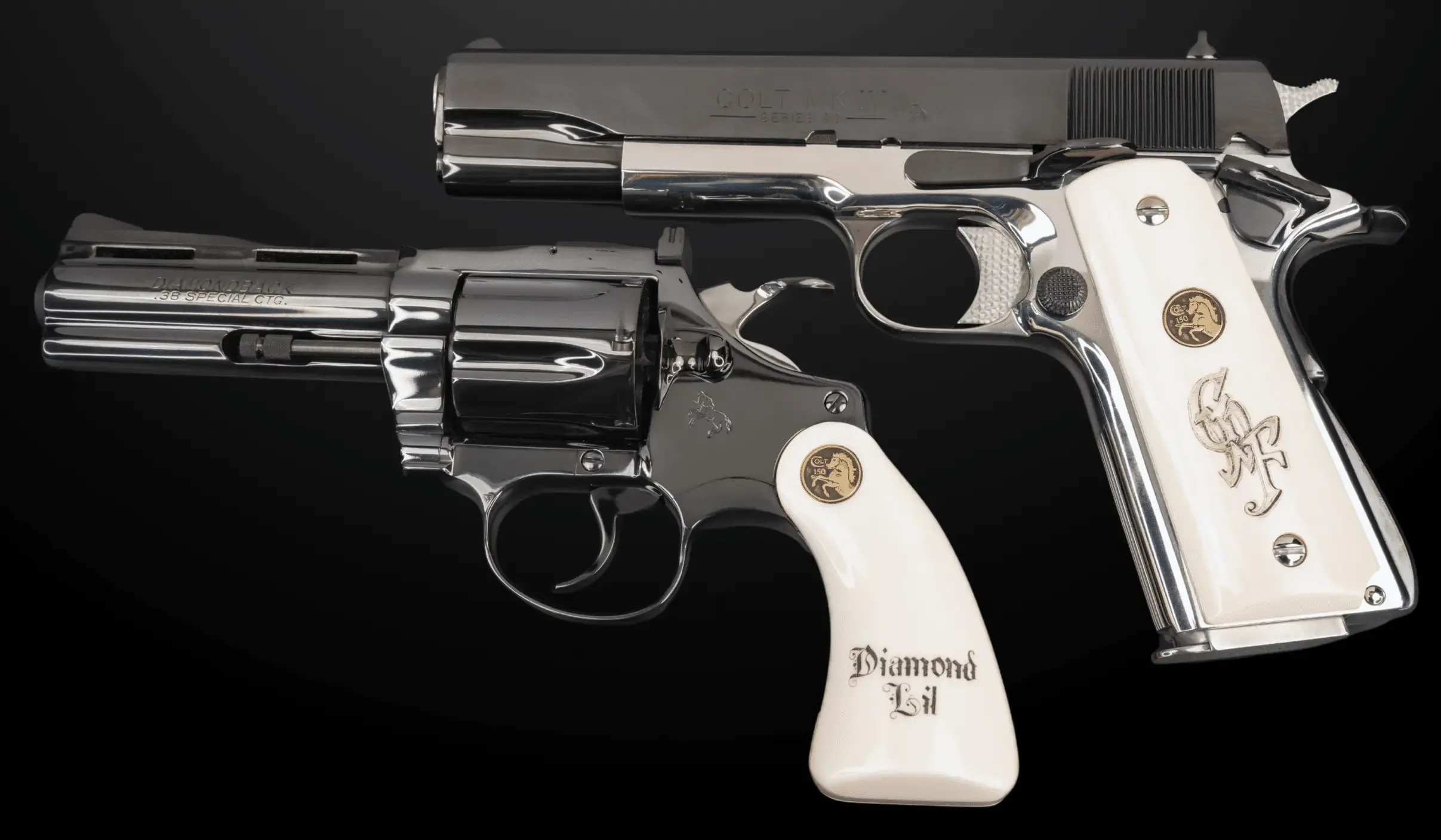
The Diamondback is readily distinguished from the fixed-sight Police Positive and Detective Special by its adjustable rear sight, ventilated barrel rib, and enclosed ejector rod. Colt offered the model in .22 Long Rifle and .38 Special, with barrel lengths that included 2½, 4, and 6 inches. The factory manual identifies it as a six-shot, double-action revolver and provides separate parts illustrations for the Diamondback and the related fixed-sight models.[3]
Despite its resemblance to the larger Python, the Diamondback belongs to Colt’s smaller revolver family. Its sights, ribbed barrel, and finish therefore do not make it a reduced-scale Python mechanically. Parts compatibility should be established from the exact model and production configuration, not from appearance alone.
Establishing Identity and Originality
The barrel inscription establishes the marked chambering and model designation, but collectors should also record the complete serial number and all markings inside the crane area. Colt’s online serial-number lookup can provide an approximate year of manufacture. Colt cautions that the database is not comprehensive, that serial numbers may appear under more than one model, and that its results should not be treated as definitive documentation.[4]
A Colt archive letter can provide the original shipping date, destination, caliber, barrel length, finish, stocks, and recorded special features when the corresponding factory record survives. The archive does not trace later ownership, and a letter describing the original configuration does not prove that every component presently on the revolver is original.[5]
Period-correct stocks are particularly easy to misidentify. Genuine Colt stocks were routinely replaced because of damage, wear, or owner preference. Correct material, medallions, checkering, and fit support an attribution, but factory documentation and consistency of wear provide stronger evidence than style alone.
Claims of factory engraving, special-order finishes, presentation use, or association with a notable owner require documentation specific to the firearm. Similarity to a published example is not proof of provenance.
Evaluating Condition
Examination should begin with the revolver completely unloaded. Colt’s manual directs the user to open the cylinder, visually inspect every chamber, and keep the muzzle pointed in a safe direction while handling the firearm.[3]
The following areas deserve particular attention:
- Finish and markings: Original rollmarks should remain legible, with defined edges. Rounded frame contours, shallow lettering, dished screw holes, and blurred junctions can indicate polishing before refinishing. Finish loss at the muzzle, cylinder, backstrap, and other exposed edges may instead reflect ordinary handling.
- Stocks: Check for cracks, altered contours, damaged screw escutcheons, and poor contact with the frame. Wear that differs sharply from the revolver may indicate replacement stocks, although matched wear alone does not prove originality.
- Cylinder and crane: The cylinder should open and close without binding. Inspect the crane for distortion and the cylinder for excessive fore-and-aft or lateral movement. The ejector rod should operate smoothly, and the extractor should return fully to its seated position.
- Timing and lockup: On each chamber, the cylinder should rotate into position and lock before the hammer reaches its firing position. A revolver that fails to carry fully, unlocks unexpectedly, or displays inconsistent timing requires examination by a qualified gunsmith familiar with older Colt double-action mechanisms.
- Bore and chambers: Look for corrosion, bulges, damaged rifling, heavy deposits, and erosion or cracking around the forcing cone. Deposits beneath the extractor can prevent it from seating and may interfere with cylinder rotation.
- Screws and fitted surfaces: Damaged slots, raised sideplate edges, and tool marks can reveal previous disassembly. Internal work cannot be evaluated reliably from external appearance, so an unusually light or irregular trigger pull deserves professional inspection.
Colt states that ammunition must match the caliber marked on the firearm and advises against +P ammunition in Colt models manufactured before 1980.[3][6] Mechanical condition remains decisive. A correct cartridge designation does not establish that an individual revolver is safe to fire.
The strongest collectible examples combine identifiable factory features, consistent physical condition, and documentation tied to the serial number. On these Colts, model names and approximate dates are only the beginning. The revolver itself, supported where possible by factory records, establishes what remains original.
Frequently Asked Questions
What is a Colt D-frame revolver?
The term identifies Colt’s small-frame double-action revolver family, which includes the Police Positive, Detective Special, and Diamondback.
How does the Police Positive Special differ from the Police Positive?
The Police Positive Special received a longer frame and cylinder to accommodate cartridges including .38 Special and .32-20 Winchester. A standard Police Positive marked .38 Colt New Police or .38 S&W must not be assumed to accept .38 Special ammunition.
What distinguishes a Colt Detective Special?
The Detective Special was introduced in 1927 as a compact six-shot revolver based on the Police Positive Special. Its original defining configuration combined a 2-inch barrel with .38 Special chambering.
How can collectors identify a Colt Diamondback?
The Diamondback typically has an adjustable rear sight, ventilated barrel rib, and enclosed ejector rod. Colt offered it in .22 Long Rifle and .38 Special with several barrel lengths.
Can Colt’s serial-number lookup confirm a revolver’s original configuration?
No. The lookup provides approximate manufacturing information, while a Colt archive letter may document the original caliber, barrel length, finish, stocks, shipping date, and destination.
Sources
[1] Campbell, Dave. “The Colt Police Positive: A Look Back.” American Rifleman, June 15, 2016.
[2] American Rifleman Staff. “This Old Gun: Colt Detective Special.” American Rifleman, November 18, 2020.
[3] Colt’s Manufacturing Company. Safety and Instruction Manual: Detective Special, Commando Special, Diamondback, Police Positive, Agent, Cobra, and Viper. n.d., 48 pp.
[4] Colt’s Manufacturing Company. “Serial Number Lookup.” Colt’s Manufacturing Company, n.d.
[5] Colt Archive Properties. “About the Archive Letter.” Colt Archive Properties, n.d.
[6] Colt’s Manufacturing Company. “Frequently Asked Questions.” Colt’s Manufacturing Company, n.d.
As a firearms enthusiast with a background in website design, SEO, and information technology, I bring a unique blend of technical expertise and passion for firearms to the articles I write. With experience in computer networking and online marketing, I focus on delivering insightful content that helps fellow enthusiasts and collectors navigate the world of firearms.
Comments
Be the first to leave a comment.
Be the first to read new editorial features, collector guides, and brand spotlights.