Key Takeaways
- Colt SAA production is divided into First, Second, and Third Generations, each with characteristic serial formats and construction details.
- The terms “black-powder frame” and “smokeless frame” describe base-pin retention systems, not ammunition suitability.
- No single marking proves originality. Serial numbers, components, finish, chambering, and factory documentation must agree.
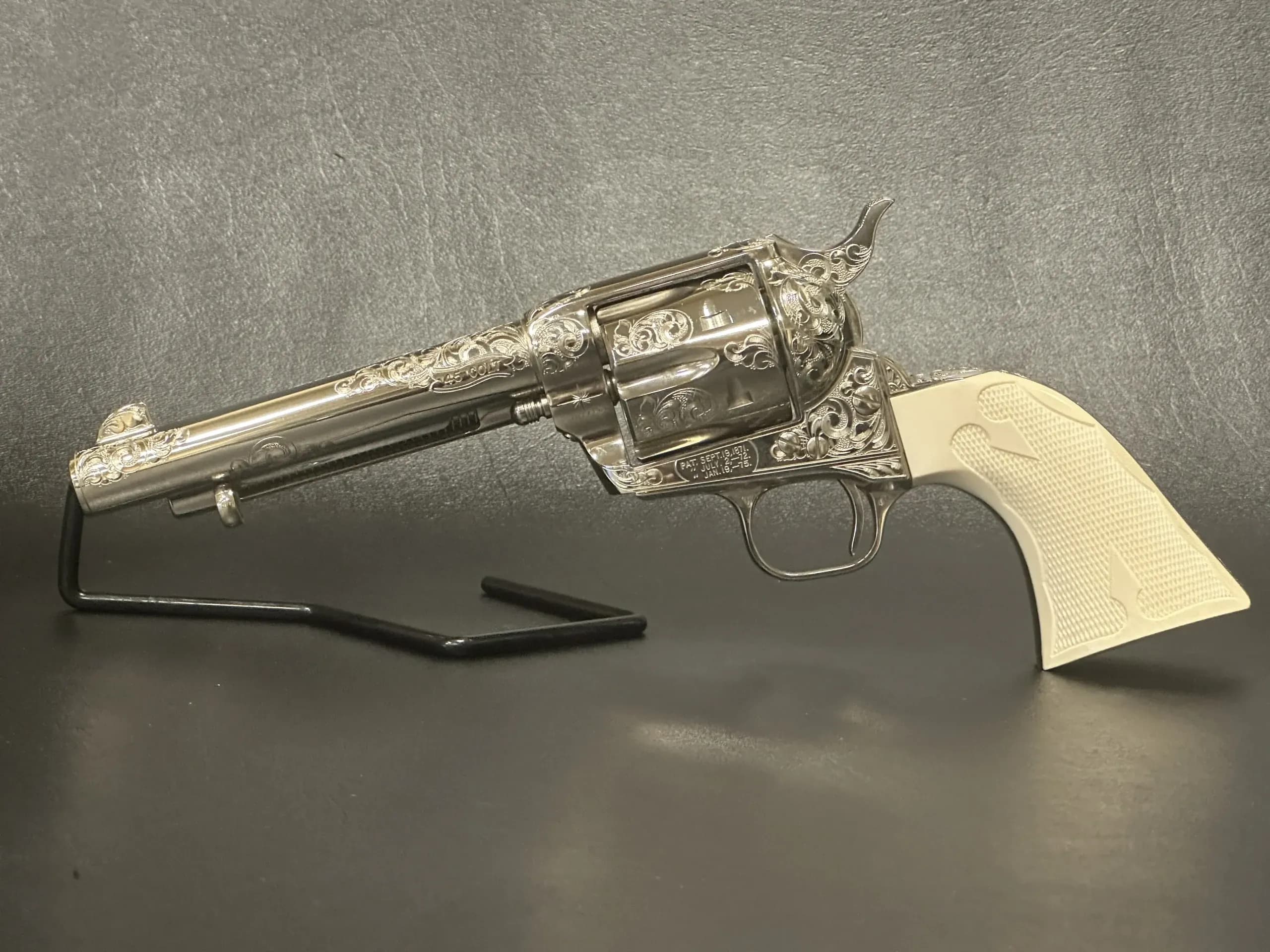
Introduced in 1873, the Colt Single Action Army is a six-shot, single-action revolver with a loading gate on the right side of the frame. Cartridges are loaded individually, and fired cases are removed one at a time with the ejector rod. The three barrel lengths most closely associated with the standard model are 7½, 5½, and 4¾ inches.[1] A .45-caliber example manufactured in 1874 and preserved by the Metropolitan Museum of Art has a 7½-inch barrel and an overall length of 13 inches.[2]
For collectors, identifying an SAA requires more than assigning a date to its serial number. Serial format, frame construction, cylinder bushing, barrel markings, chambering, finish, and assembly details must form a coherent whole.
The Three Production Generations
Collectors divide Colt SAA production into three principal generations.
First Generation production ran from 1873 to 1941 and concluded at serial number 357859. A small number of revolvers were assembled from remaining prewar components after World War II, but they remain associated with the original production sequence.[3]
Colt revived the SAA in the mid-1950s. These Second Generation revolvers used an “SA” serial-number suffix, beginning with 1001SA. Serial numbers were applied to the bottom of the frame ahead of the trigger guard and inside the trigger guard and backstrap. Second Generation cylinders were marked with the Rampant Colt at the rear and the final digits of the serial number at the front. Production ended in 1975 at serial number 73319SA.[3]
Third Generation production began in 1976 with serial number 80000SA. Colt changed the barrel and frame thread pitch from 20 to 24 threads per inch and replaced the earlier removable cylinder bushing with a press-fitted bushing. Current Third Generation revolvers have returned to a separate bushing. Colt began using an “SA” prefix in 1978, and revolvers produced after SA99999 employ serial numbers beginning with “S” and ending with “A.” Transitional examples exist, including Third Generation revolvers assembled with remaining Second Generation frames, so the serial number alone does not always settle the classification.[3]
Colt’s 2026 commercial catalog lists the SAA in .45 Colt with a six-round cylinder, a case-color and blue finish, and barrel lengths of 4¾, 5½, or 7½ inches.[4]
Base-Pin Retention and the “Black-Powder Frame”
Early SAA frames retain the cylinder base pin with a screw entering from the front of the frame. Around 1892, Colt began replacing that arrangement with a spring-loaded transverse latch. The change did not mark an immediate transition to smokeless-powder ammunition. Colt did not warrant its single-action revolvers for smokeless powder until 1900, beginning at serial number 192000.[3]
The collector terms “black-powder frame” and “smokeless frame” therefore describe two base-pin retention systems, not an authoritative determination of suitable ammunition. A revolver with the transverse latch may still predate Colt’s smokeless-powder warranty threshold.[3]
Latch style remains useful as a dating feature, but it must agree with the serial range and the revolver’s other components. Colt later reproduced the screw-retained frame for commemorative and special-order guns, so that feature does not by itself establish 19th-century manufacture.[3]
Barrel Lengths and Ejectorless Variants
The standard barrel lengths provide useful identification anchors. Colt introduced the 5½-inch commercial configuration in the 1870s, followed by the 4¾-inch version in 1879. Collectors commonly call the 7½-inch configuration the Cavalry Model, the 5½-inch configuration the Artillery Model, and the 4¾-inch version the Civilian Model, although these are collector classifications rather than universal factory model names.[3]
Standard revolvers have an ejector-rod housing on the right side of the barrel. Factory ejectorless revolvers are generally known among collectors as Sheriff’s or Storekeeper’s Models. Surviving factory examples frequently have barrels shorter than the standard 4¾-inch length.[5]
A short barrel without an ejector assembly is not automatically a factory ejectorless configuration. The barrel address, front sight, muzzle, frame, caliber markings, and documented shipping configuration should all support the attribution. A shortened standard barrel may superficially resemble a factory short-barreled revolver.
Chamberings and the Frontier Six Shooter
The SAA entered production in .45 Colt, but Colt subsequently offered the design in numerous cartridges. Among the principal early alternatives were .44-40 Winchester Center Fire, .38-40 Winchester, and .32-20 Winchester. Colt introduced the .38-40 and .32-20 chamberings in 1884.[3]
The .44-40 version acquired its own enduring barrel legend. Colt shipped early production .44-40 SAAs in late 1877. In January 1878, distributor J. P. Moore’s Sons asked Colt to place the name “Frontier Six Shooter” on forthcoming barrels. The first revolvers with the acid-etched “Colt Frontier Six Shooter” panel were shipped on February 6, 1878.[5]
The early etched panel was shallow and susceptible to wear. Colt adopted a more durable roll-die marking in 1889. An apparently unmarked early .44-40 barrel is not necessarily incorrect because an original etched panel may have worn away. Some early revolvers also carry a small “.44 CF” marking on the rear flat of the trigger guard.[5]
A Frontier Six Shooter barrel should correspond to a .44-40 chambering. Because barrels and cylinders can be exchanged, the barrel legend should be considered together with the cylinder chambers, trigger-guard markings, serial range, and factory documentation.
Military Markings
The U.S. Army selected the .45-caliber SAA following its 1872 trials, and the first order of 8,000 revolvers was delivered in 1873. Military revolvers had 7½-inch barrels, one-piece walnut stocks, blued components, and casehardened frames and hammers. The left side of the frame carried a “U.S.” marking after the patent dates, while inspectors’ cartouches and component stamps recorded government examination and acceptance.[3]
Military inspection markings require careful evaluation because their significance depends on the inspector, production period, component, and precise location. A genuine military frame does not prove that every component currently attached to it was part of the original accepted revolver. Many military SAAs were repaired or altered during service, and later commercial changes can further complicate their present configuration.
Fresh or sharply defined markings on a heavily polished surface merit scrutiny. So do inspection stamps that do not correspond to the claimed production period. Authentication should rely on comparison with documented examples and original records, not simply on the presence of initials or a “U.S.” stamp.
Serial Numbers, Finish, and Configuration
On a First Generation revolver, the serial numbers on the frame, trigger guard, and backstrap should be examined together. Matching numbers establish that those numbered components share an assembly identity, but they do not prove that the barrel, cylinder, grips, ejector assembly, or finish remains original.
Finish must also be judged as part of the complete firearm. First Generation SAAs were commonly supplied with blued components and a casehardened frame and hammer, while nickel plating became an established factory option during the 1870s.[3] Rounded edges, softened lettering, partially erased addresses, dished screw holes, or polishing beneath a bright finish can indicate refinishing. Strong finish by itself does not establish originality.
Grips should fit the frame and correspond to the period and claimed configuration. Military one-piece walnut stocks may carry inspection cartouches. Later production included other factory stock materials and configurations. A factory letter can be especially useful when a revolver is represented as originally engraved, nickel-plated, specially stocked, or shipped with a nonstandard barrel.
Establishing a Documented Configuration
Colt’s online serial-number lookup provides approximate manufacturing information and is not comprehensive. Colt advises users not to rely on it when definitive documentation is required.[6] A Colt Archive Letter may record the original caliber, barrel length, finish, stocks, engraving, shipment date, and destination, depending on what survives in the factory records.[7]
An archive letter documents recorded factory and shipping information. It does not establish that every component or finish presently on the revolver is original. That determination requires comparison between the document and the firearm itself.
A sound examination therefore proceeds from the whole configuration: serial format, numbered components, base-pin retention, cylinder bushing, barrel length, ejector arrangement, caliber markings, chamber dimensions, finish, grips, and documented factory specifications. No single feature can reliably authenticate every Colt Single Action Army.
Frequently Asked Questions
What are the three Colt SAA generations?
First Generation production ran from 1873 to 1941. Second Generation production began in the mid-1950s, and Third Generation production began in 1976.
How can a Colt SAA generation be identified?
Examine the serial-number format, cylinder bushing, barrel and frame construction, and component markings. Transitional revolvers mean that serial numbers should not be used alone.
What does “black-powder frame” mean?
The term describes an early frame that retains the cylinder base pin with a screw entering from the front. It does not independently determine which ammunition is safe for a specific revolver.
What does the Frontier Six Shooter marking indicate?
The marking was used on Colt revolvers chambered in .44-40 Winchester Center Fire. Early examples had an acid-etched panel, while Colt adopted a roll-die marking in 1889.
Can a Colt Archive Letter prove that an SAA is original?
An archive letter may document the revolver’s recorded factory specifications and shipping information. The firearm must still be examined to determine whether its current components and finish match those records.
Sources
[1] National Park Service. “1873 Colt Revolver.” Fort Smith National Historic Site, April 10, 2015.
[2] Metropolitan Museum of Art. “‘Peacemaker’ Colt Single-Action Army Revolver, Serial No. 4519.” Metropolitan Museum of Art, n.d.
[3] Hacker, Rick. “150 Years of the Colt Single Action Army.” American Rifleman, January 3, 2023.
[4] Colt’s Manufacturing Company LLC. 2026 Commercial Catalog. 2026, p. 9.
[5] McCombs, Paul. “Colt’s Frontier Six Shooter.” Bulletin of the American Society of Arms Collectors, no. 125, Spring 2022, pp. 5–13.
[6] Colt’s Manufacturing Company LLC. “Serial Number Lookup.” Colt’s Manufacturing Company LLC, n.d.
[7] Colt’s Manufacturing Company LLC. “Archive Services.” Colt’s Manufacturing Company LLC, n.d.
As a firearms enthusiast with a background in website design, SEO, and information technology, I bring a unique blend of technical expertise and passion for firearms to the articles I write. With experience in computer networking and online marketing, I focus on delivering insightful content that helps fellow enthusiasts and collectors navigate the world of firearms.
Comments
Be the first to leave a comment.
Be the first to read new editorial features, collector guides, and brand spotlights.