Key Takeaways
- A generation can be a collector’s label or a factory product name. Colt called the Single Action Army’s first generation that only after it resumed production, while Glock announced the G17 Gen5 and G19 Gen5 under its own generation name on August 30, 2017.
- A series can identify a marked production period rather than a fixed feature. Colt introduced its Series 70 pistols with a collet barrel bushing, but after Colt dropped the bushing, the pistols differed from a plain M1911A1 only in their markings.
- A revision records an engineering change, not necessarily a date. The “-7” in a Smith & Wesson Model 10-7 marks the seventh engineering change since 1957, and M1 rifle drawing numbers carry production revision suffixes, though some parts changed significantly without a new revision number.
Collector descriptions often use generation, series and revision as if they were interchangeable. Each term has its own origin, and the examples below show what each meant to the people who first applied it.
Generation
The Colt Single Action Army shows how a generation can be named after the fact. The NRA National Firearms Museum, describing a Single Action Army on loan from the Smithsonian Institution, explains that the revolver’s original production “has become known as” the First Generation because production was later resumed. [1]
After World War II, Colt did not resume the revolver, and in August 1949 the company announced in The American Rifleman that it would not return. It did return. Eight guns shipped in 1955, full production began in January 1956, and the revived revolvers carried serial numbers with an “SA” suffix beginning at 1001SA. Rick Hacker, writing in American Rifleman, uses the same retrospective wording for these guns and for the later Third Generation. [2]
Colt halted production in 1975 for retooling and resumed less than a year later. Hacker documents why the generation cannot always be read from a serial number. Between 1976 and 1978, some Third Generation revolvers were assembled on leftover Second Generation frames that still carried SA-suffix serials. In 1978, newly machined frames moved the “SA” to the front of the number. “Third Generation” also does not describe one fixed specification. Early Third Generation guns had the cylinder base-pin bushing pressed into the cylinder, while current production has returned to a separate bushing. [2]
Museums use the collector term when cataloging. Museums Victoria records a .357 Magnum Single Action Army, serial SA49500, made in 1981 and engraved by J.R. Brown, as “3rd Generation.” A Colt Archive Properties authentication letter supports its shipment from Colt to Frontier Arms Company of Canberra on July 22, 1981. [3]
Glock uses the word as a factory product name. On August 30, 2017, Glock, Inc. announced the G17 Gen5 and G19 Gen5. The company said more than twenty design changes distinguished them from their “Gen4 predecessors” and described the Gen5 pistols as a variation of the M pistol used by the FBI. The changes it highlighted included the Glock Marksman Barrel, the removal of finger grooves, an ambidextrous slide stop and a flared magazine well. [4]
Writers define the earlier Glock generations by grouping changes that accumulated over time. In a 2013 American Rifleman survey, B. Gil Horman places the start of the second generation in 1988, with the compact G19 and the long-slide G17L. He describes Gen3 as a “feature set” whose introduction began in 1996. It included checkered finger grooves, an accessory rail on Standard and Compact models, and an extractor shaped to serve as a loaded-chamber indicator. Some late Gen3 pistols had a dotted grip texture and curved slide serrations, and neither feature carried into Gen4. Gen4 arrived in 2010 with nine models, and its main internal change was a dual-spring recoil assembly. [5]
Series
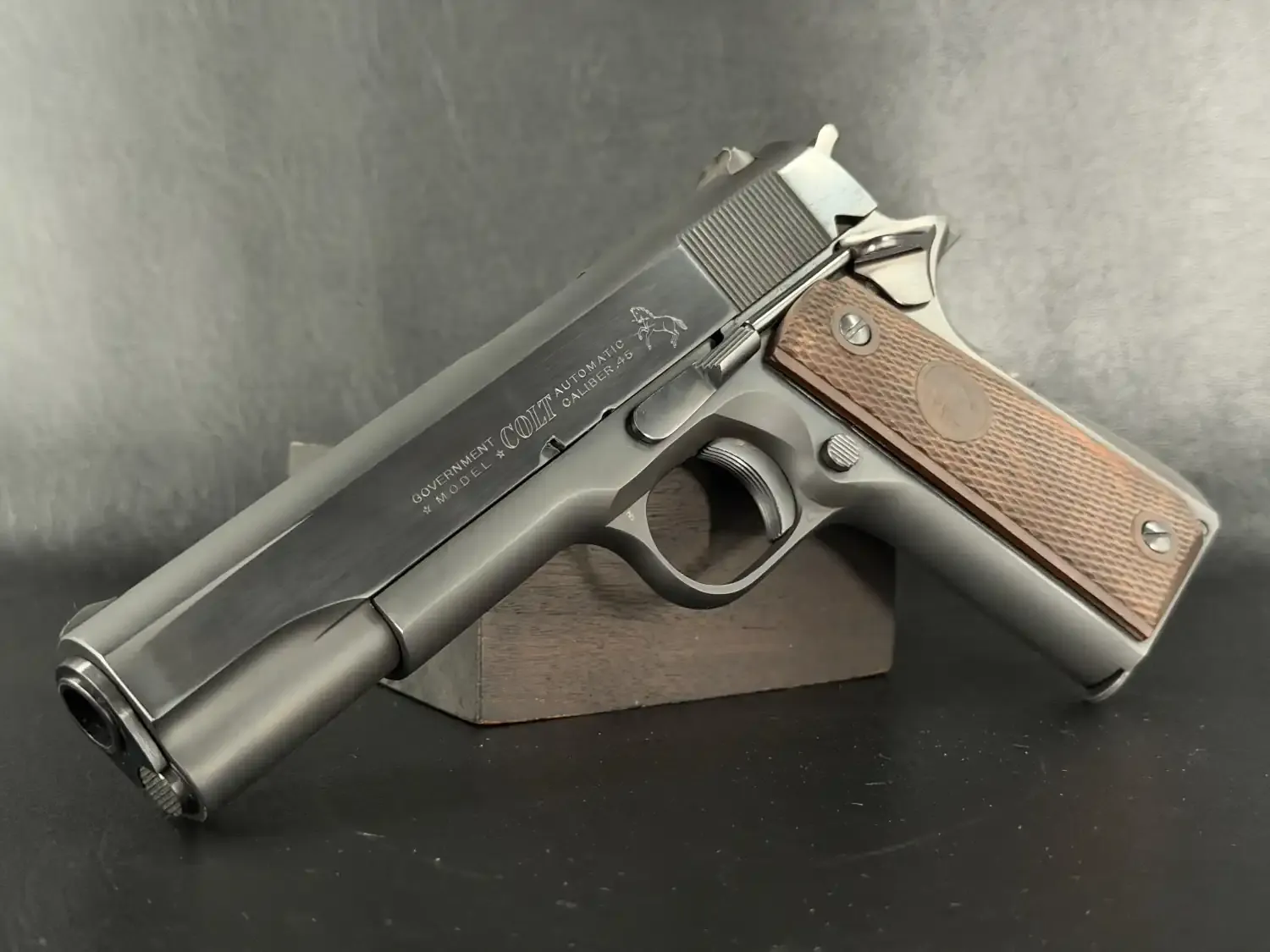
At Colt, “Series 70” began as a product-line marking. In the early 1970s, Colt updated the Government Model, Commander, Gold Cup, and other pistols with new features and Series 70 roll marks. The most important change was a barrel bushing with flexible collet fingers, intended to center the barrel more consistently. [6] Wiley Clapp reported that the fingers broke under the period's more powerful ammunition, causing warranty problems. Colt then dropped the collet bushing with little announcement, and afterward a Series 70 pistol differed from a plain M1911A1 only in its markings. [7] The series name therefore identifies a marked production period, not a guaranteed feature.
The Series 70 run ended in the early 1980s. Its successor, the Series 80, added a firing pin safety operated by trigger pressure that raised a spring-loaded plunger to clear the firing pin. [6] Clapp linked the change to drop-safety requirements in certain states. Later, after the Gunsite shooting school asked for pistols without the firing pin safety, Colt resumed production of certain Series 70 models, and by 2011 its catalog listed both types. [7] The reintroduced Series 70 pistols pass drop tests through a lighter firing pin and a slightly stronger firing pin spring. [6]
Later advertising extended the term further. In 2011, Clapp noted that several makers were promoting a “Series 70 Firing Pin Safety System,” although the original Series 70 pistols used the same firing pin system as 1911s made since 1911. In that advertising, the phrase referred to the lighter firing pin and stronger spring arrangement, not to anything Colt introduced in the 1970s. [6]
Revision
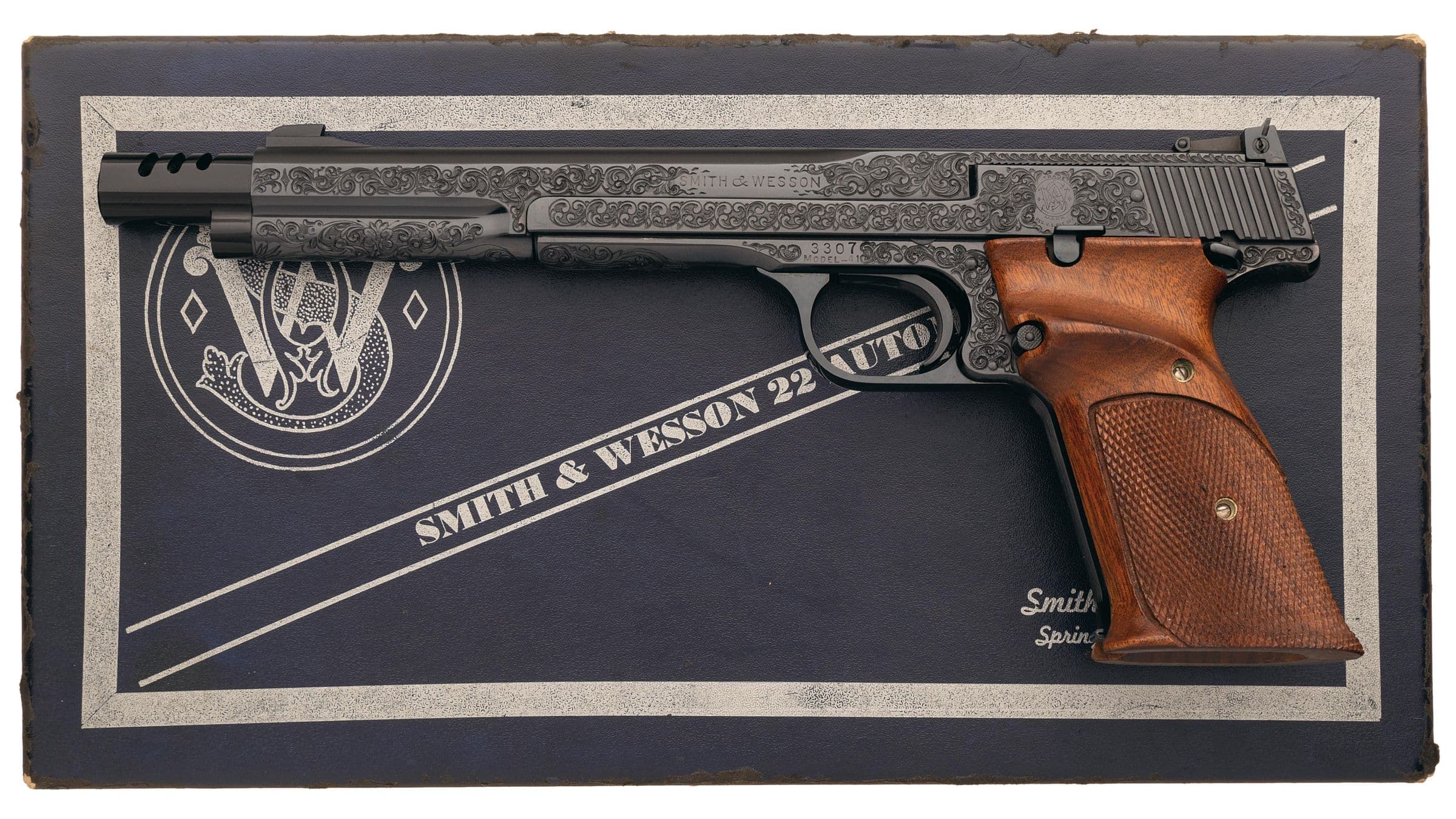
At Smith & Wesson, the revision is the dash number. Before 1957, the Model 10 was known as the .38 Military & Police, and the “-7” in a Model 10-7 marks the seventh engineering change made to the design since then. John W. Treakle dated one such revolver from two other features: the elimination of the barrel pin and the addition of a three-letter serial prefix, both in 1982. He also identified a number on its crane as an assembly number used to keep components matched during production. The serial number was on the butt. [8]
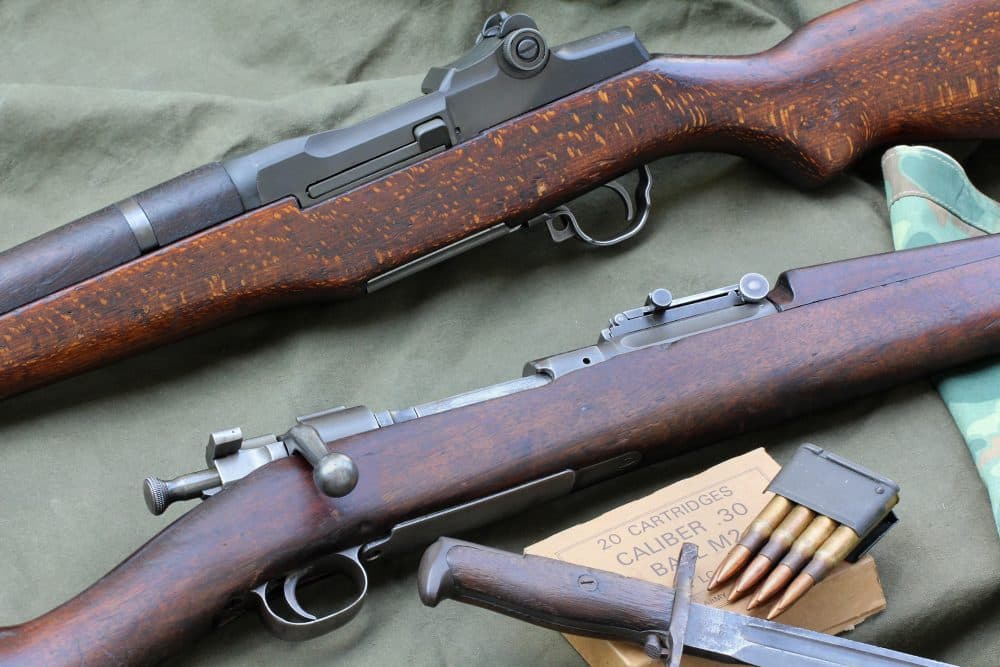
U.S. Ordnance drawing numbers on M1 rifle parts use “revision” in an engineering sense. Scott A. Duff explains the marking C46008-2 SA on a hammer: “C” indicates the physical size of the drawing, 46008 is the drawing number, “-2” is the production revision to the drawing, and “SA” shows manufacture at Springfield Armory. The marking format also changed over time. The rear sight cover went from B-8872 to B 8872, then B8872, and finally carried no number. [9]
A documented rifle shows these markings together. Rock Island Auction Company’s May 4, 2019, lot description for an early-1942 Springfield Armory M1, serial 533305, records a hammer marked C46008-2 SA, a bolt marked D28287-12SA, an operating rod marked D35382-3-SA, a trigger housing marked D28290-5-SA, and a receiver marking of “C 114B/D 28291-17.” [10] Using Duff’s breakdown, the hammer is the second production revision of drawing 46008. [9][10]
Revision numbers indicate sequence, but not consistently. Duff notes that lower revision numbers were generally produced first and higher ones later, though not in every case. On certain components, a significant physical change occurred without any change in the revision number. [9]
Frequently Asked Questions
Why is the original Colt Single Action Army called the First Generation?
The original production became known as the First Generation because Colt later resumed production. The revived revolvers, in full production from January 1956 with SA-suffix serial numbers, are called the Second Generation.
Can a serial number show whether a Colt Single Action Army is Second or Third Generation?
Not always, because between 1976 and 1978 Colt assembled some Third Generation revolvers on leftover Second Generation frames that still carried SA-suffix serials. Newly machined frames with SA-prefix serial numbers began in 1978.
What changed with the Glock Gen5?
Glock said more than twenty design changes distinguished the G17 Gen5 and G19 Gen5 from Gen4, including the Glock Marksman Barrel, no finger grooves, an ambidextrous slide stop and a flared magazine well. The company described the Gen5 pistols as a variation of the M pistol used by the FBI.
Does every Colt Series 70 pistol have a collet bushing?
No. Colt dropped the collet bushing after its flexible fingers broke under more powerful ammunition, leaving later Series 70 pistols different from a plain M1911A1 only in their markings.
What does the dash number on a Smith & Wesson revolver mean?
It records engineering changes to the design since 1957, so the “-7” in a Model 10-7 marks the seventh such change. The dash number does not date the revolver by itself; other features, such as the 1982 removal of the barrel pin, help establish when it was made.
Colt called the Single Action Army’s first generation that only after it
Sources
[1] NRA National Firearms Museum. “Colt Model 1873 Single Action Army Revolver (1).” NRA National Firearms Museum, n.d.
[2] Hacker, Rick. “Collecting Second Generation Colt Single Action Army Revolvers.” American Rifleman, November 12, 2022.
[3] Museums Victoria. “Revolver - Colt 1873 Single Action Army, 3rd Generation, 1981.” Museums Victoria Collections, item HT 4549, n.d.
[4] Glock, Inc. “GLOCK Introduces the Long-Awaited 5th Generation of Perfection.” Glock, Inc., August 30, 2017.
[5] Horman, B. Gil. “Glock’s Gen4 Pistols: The Evolution Of Perfection?.” American Rifleman, October 23, 2013.
[6] Clapp, Wiley. “M 1911 Series 70.” American Rifleman, January 24, 2011.
[7] Clapp, Wiley. “Colt Series 70 Model 1911.” American Rifleman, February 25, 2011.
[8] Treakle, John W. “Rifleman Q&A: Puzzled By S&W Revolver Markings.” American Rifleman, June 15, 2021.
[9] Duff, Scott A. The M1 Garand: World War II. Scott A. Duff Publications, 1993. Publisher excerpt: “What Is A Drawing Number??.”
[10] Rock Island Auction Company. “Lot 1559: Springfield Armory U.S. - M1-Garand.” Auction held at Rock Island, Illinois, May 4, 2019, catalog page 285. Lot description cited for markings only.
As a firearms enthusiast with a background in website design, SEO, and information technology, I bring a unique blend of technical expertise and passion for firearms to my writing. With experience in computer networking and online marketing, I deliver insightful content that helps fellow enthusiasts and collectors navigate the world of firearms.
Comments
Be the first to leave a comment.
Be the first to read new editorial features, collector guides, and brand spotlights.