

The Model 1 made Smith & Wesson's early proposition tangible: a small revolver built around a self-contained metallic cartridge rather than loose powder, ball, and percussion cap. Introduced in 1857 as a seven-shot .22 rimfire, it followed Horace Smith and Daniel B. Wesson's first partnership in Norwich, Connecticut, formed in 1852 to develop magazine arms, and their second partnership in Springfield, Massachusetts, in November 1856 to manufacture a cartridge revolver. Their earlier lever-operated magazine arm had been covered by U.S. Patent No. 10,535 in 1854. The later revolver depended on an exclusive license to Rollin White's U.S. Patent No. 12,648, whose claims included cylinder chambers extending through the rear for breech loading.
The decisive nineteenth-century shift was from the Model 1's small tip-up format to larger service arms. The Model 3 American appeared in 1870 as a large-caliber, center-fire revolver; its top-break frame ejected cases as the barrel opened, and the family included Russian-contract and Schofield forms. Joseph H. Wesson's 1896 patent addressed retention of a later swing-out cylinder on its pin and yoke. That solid-frame, hand-ejector architecture reached the .38 Military & Police in 1899, the revolver later numbered Model 10. For collectors, these transitions matter more than model names alone: they separate tip-up, top-break, and swing-out-cylinder systems, each with its own patent context, contract history, and pattern of factory variation.
The .44 Hand Ejector First Model, known as the New Century or Triple Lock, extended the swing-out system to the frame later called the N-frame. The first examples left the factory in 1908; the nickname refers to the additional lock between the yoke and barrel underlug, supplementing the two conventional cylinder locks. During the First World War, Smith & Wesson adapted its large-frame revolver to .45 ACP with half-moon clips for the U.S. Model 1917 contract. During the Second World War, the .38 Military & Police architecture became the basis of Victory-model revolvers supplied in U.S. and Commonwealth configurations. These contracts made military configuration, markings, chambering, finish, and subsequent conversion central questions of provenance.
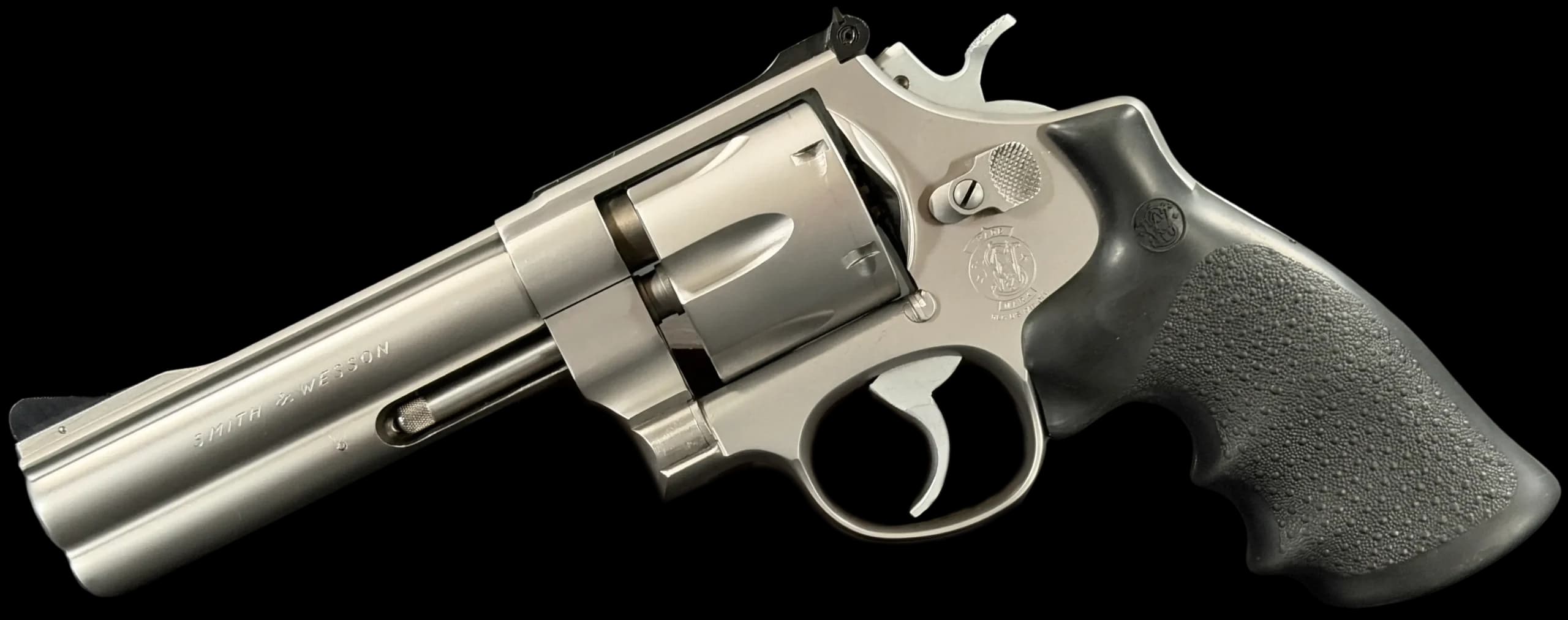
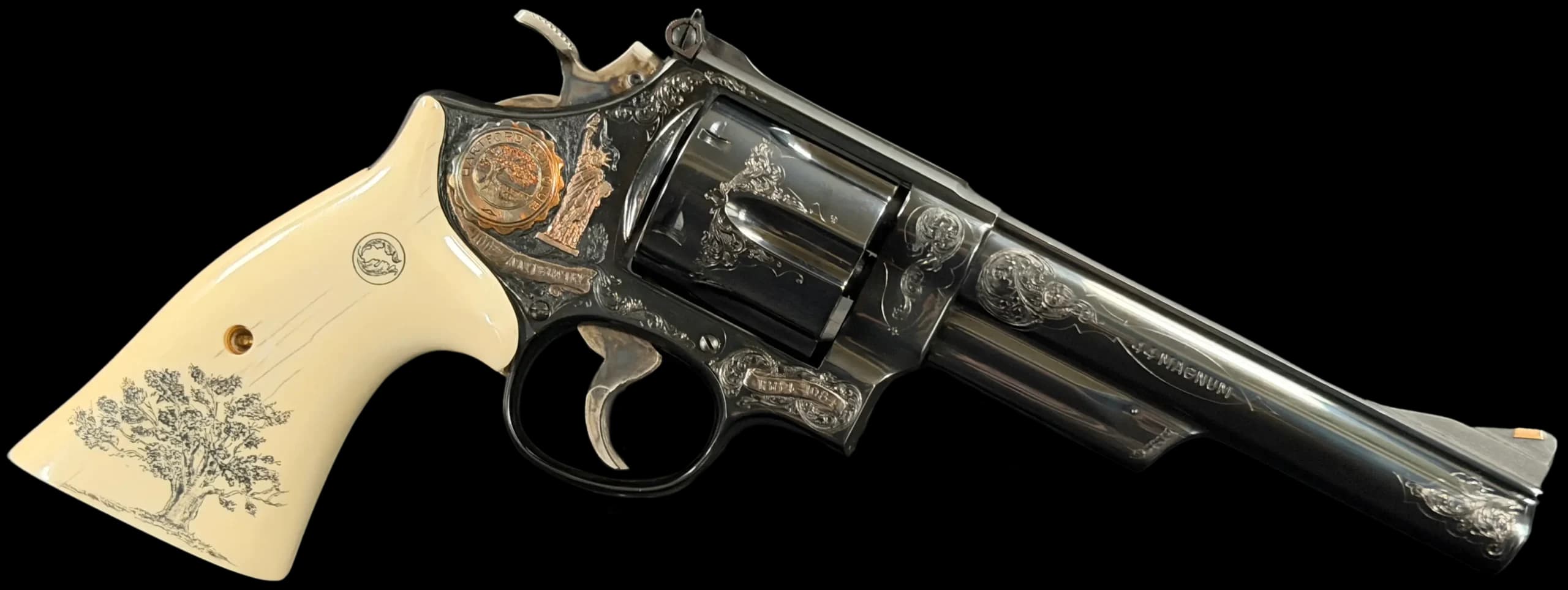
The post-war catalogue widened the company's mechanical vocabulary. The Chiefs Special introduced the J-frame in 1950; the .44 Magnum was completed in 1955 and received the Model 29 designation when Smith & Wesson adopted numerical model names in 1957; the target-oriented Model 41 also reached the public in 1957; and the Model 60 followed in 1965 as the company's first stainless-steel handgun. The Model 39 placed a double-action first shot, single-action subsequent shots, and a Browning-type tilting barrel in an American 9mm service pistol, then led into the higher-capacity Model 59 and later numbered generations. In revolvers, the 1935 .357 Magnum, later Model 27, and the 1980 L-frame family show the company's recurring method: pair a cartridge or duty requirement with a distinct frame and lockwork solution.
Corporate ownership changed repeatedly after the Wesson family sold the business to Bangor Punta in 1965. Lear Siegler acquired Bangor Punta in 1984; Forstmann Little acquired Lear Siegler in 1986 and sold Smith & Wesson shortly afterward to Tomkins. Saf-T-Hammer bought Smith & Wesson from Tomkins in May 2001 for $15 million, and the parent subsequently used the names Smith & Wesson Holding Corporation, American Outdoor Brands Corporation, and, from 2020, Smith & Wesson Brands, Inc. The company bought Thompson/Center Arms in early 2007 as an entry into hunting rifles, then separated its outdoor-products business in August 2020. Headquarters and substantial operations moved to Maryville, Tennessee, in 2023, while revolver, certain metal-pistol, and lever-action-rifle manufacture and assembly remained in Springfield; other production continues in Houlton, Maine. The result is an unusual collector landscape: nineteenth-century patent arms, contract revolvers, pre-numbered and numbered frame families, successive generations of metal and polymer pistols, and modern long guns all sit within one documented lineage.
History & Milestones
Smith and Wesson Form Partnership
Horace Smith and Daniel B. Wesson formed a Norwich partnership to develop magazine arms. The company uses 1852 as its founding year.
Model 1 Establishes Cartridge Revolver
The seven-shot .22 rimfire Model 1 entered production under the Rollin White patent licence. It gave the Springfield partnership a practical cartridge-revolver business.
Model 3 Moves Into Service Scale
Smith & Wesson introduced the large-calibre, centre-fire Model 3 American. U.S. cavalry and Imperial Russian purchases brought institutional and international weight to the family.
Military and Police Defines K-Frame
The .38 Military & Police combined a solid frame, swing-out cylinder, and hand ejector in the K-frame line later called Model 10. The architecture also underpinned wartime Victory variants.
Revolver Production Answers Wartime Shortage
The U.S. Army contracted Colt and Smith & Wesson for Model 1917 revolvers when M1911 supply could not meet wartime requirements. Smith & Wesson's version used clips to handle rimless .45 ACP ammunition.
The Magnum Era Begins with .357
Smith & Wesson introduced the .357 Magnum on its large N-frame. The revolver later received the Model 27 designation.
Stainless Steel Reaches Regular Production
The Model 60 translated the Chiefs Special into stainless steel. Its early polished finish was later changed to a brushed treatment after police objections to glare.
Saf-T-Hammer Acquires Smith and Wesson
Saf-T-Hammer purchased all Smith & Wesson shares from Tomkins for $15 million in May 2001. The parent later adopted the Smith & Wesson Holding Corporation name.
M&P Returns as Polymer Pistol
Smith & Wesson launched the modern M&P polymer-pistol line in December 2005, beginning with the M&P40. The M&P9 followed in 2006.
Headquarters Moves South to Maryville
Smith & Wesson completed the move of its headquarters and substantial operations to Maryville, Tennessee, while retaining specified manufacturing functions in Springfield. The current manufacturing footprint also includes Houlton, Maine.