Key Takeaways
- The M1903 replaced the Krag-Jorgensen and combined Mauser-derived features with a 24-inch barrel and five-round magazine.
- Receiver markings, manufacturer, serial number, sights, stock, and component construction help distinguish major variants.
- A serial number can indicate an approximate production period, but it does not prove military issue, combat use, or ownership.
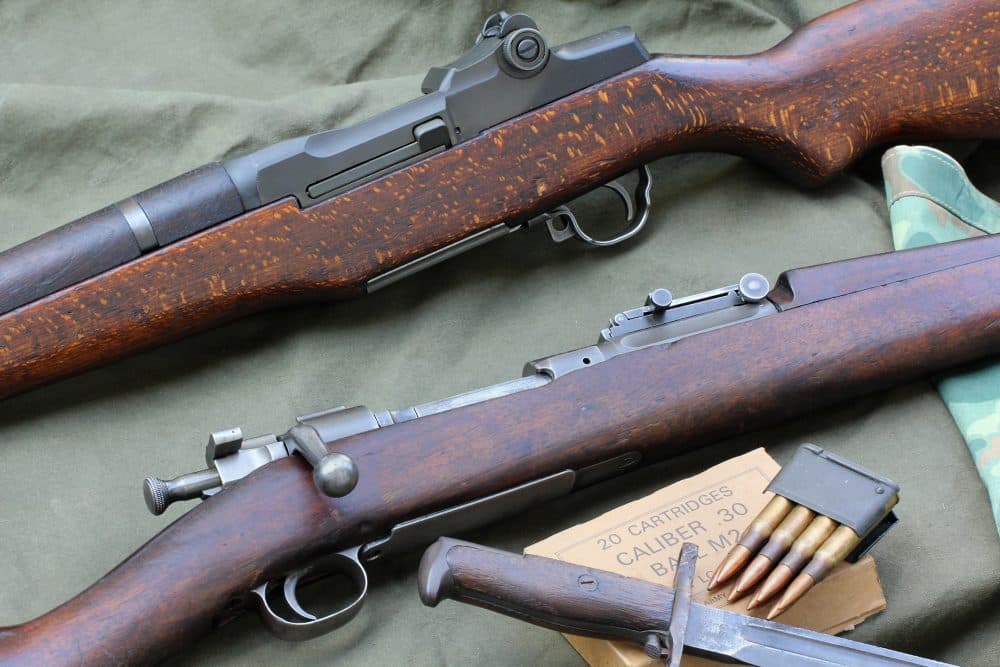
The United States formally adopted the M1903 Springfield rifle on June 19, 1903. Its development followed the Spanish-American War, during which the Army’s .30-40 Krag-Jorgensen proved inferior in several respects to the clip-loaded 7 mm Mauser rifles used by Spanish forces. Springfield Armory began developing a replacement during the conflict and subsequently produced the experimental Models 1900, 1901, and 1902. The Model 1901 incorporated a rimless cartridge and an action closely patterned on the Mauser system.[1][2]
Experiments with the Model 1902 showed that a 24-inch barrel could provide the required performance in a more compact rifle. The shorter barrel allowed one weapon to serve both infantry and cavalry, removing the need to manufacture a separate carbine. The resulting Model 1903 retained the 24-inch barrel.[1]
Early rifles were chambered for the .30-03 cartridge, which fired a heavy, round-nosed bullet. In 1906, the Army adopted a revised cartridge using a pointed 150-grain projectile. This ammunition became known as the .30-06 cartridge.[2]
The original M1903 also used a retractable rod bayonet. President Theodore Roosevelt objected to the arrangement, and the rifle was redesigned in 1905 to accept a knife-type bayonet.[2] The combination of the bayonet alteration and the subsequent ammunition change makes an untouched early configuration materially different from the standard M1903 familiar from later military service.
Design and Operation
The M1903 is a manually operated, bolt-action, magazine-fed rifle. Its internal magazine holds five cartridges and can be loaded from a charger. A magazine cutoff on the receiver permits the rifle to be operated as a single-loader while keeping the cartridges in the magazine available for later use.
The War Department’s 1940 field manual specified a weight of 8.69 pounds without the bayonet and approximately 43 inches in overall length. The rifle had a .30-inch bore, four-groove rifling with a right-hand twist of one turn in 10 inches, and a minimum trigger pull of 3 pounds.[3]
The standard M1903 rear sight is mounted on the barrel immediately ahead of the receiver. Its folding leaf incorporates open and aperture sighting elements, windage adjustment, and range graduations from 100 to 2,850 yards. With the leaf folded, the battle-sight notch was set for 547 yards. The Army manual placed the maximum rate of accurate fire at 10 to 15 rounds per minute, depending on the rifleman’s skill, firing position, and view of the target. It also noted that combat use beyond 600 yards was unusual.[3]
Between 1903 and 1936, Springfield Armory manufactured more than one million M1903 rifles. Rock Island Arsenal produced approximately another one-third million.[1] Production was not static. Changes in receivers, stocks, sights, small components, and manufacturing methods created numerous configurations within the broader M1903 family.
Production and Serial Numbers
Collector identification begins with the manufacturer’s marking and receiver serial number. Springfield Armory and Rock Island Arsenal maintained separate serial-number sequences, so a number has meaning only when considered with the maker marked on the receiver.[4]
The National Park Service places the introduction of improved receiver heat treatment at approximately serial number 800,000 for Springfield Armory and 285,507 for Rock Island Arsenal. Nickel-steel receivers began at approximately Springfield serial number 1,275,767 and Rock Island serial number 319,921.[4]
These manufacturing thresholds identify receiver-production changes. They do not establish the date or origin of every other component presently fitted to a rifle. The National Park Service also describes its annual serial ranges as approximate and states that Springfield Armory did not retain records showing where individual firearms went after leaving the production line.[4] A serial number can place a receiver within an approximate production period, but it does not ordinarily prove unit issue, combat use, or individual ownership.
World War I Service
The M1903 was the Army’s standard rifle when the United States entered World War I, but Springfield Armory and Rock Island Arsenal could not produce enough rifles for the rapidly expanding force. The Army therefore used the M1903 alongside the Model 1917 rifle. The Model 1917 equipped the majority of American soldiers in France, while M1903 rifles were issued principally to Regular Army divisions deployed to the fighting fronts.[5]
The Marine Corps began receiving M1903 rifles in 1908 and employed them in combat during the 1912 campaign in Nicaragua. Before the 1914 Veracruz operation, the Corps had largely replaced its Krag rifles with the M1903. Marines also carried the Springfield in France during World War I.[2]
The rifle became closely connected with Marine Corps marksmanship training. Recruits were instructed in its parts, functioning, maintenance, sight adjustment, firing positions, and care. This institutional emphasis on rifle proficiency continued well beyond the First World War.[2]
The M1903 Mark I and Pedersen Device
One of the most distinctive variations is the M1903 Mark I, which was modified to accept John D. Pedersen’s semiautomatic conversion device. The device replaced the rifle’s conventional bolt and fired pistol-size .30-caliber cartridges from a 40-round detachable magazine.[6]
The most obvious external identifier of a Mark I is the ejection port machined into the left side of the receiver. Additional internal alterations accommodated the device. Once the Pedersen Device was removed and the standard bolt replaced, the rifle could again function as a conventional M1903.[6]
The Mark I receiver alone does not establish that a surviving rifle retains its complete original configuration. Nor does it prove that a Pedersen Device accompanying the rifle was historically issued with that particular receiver. Those questions require documentation or persuasive physical evidence beyond the model marking.
National Match and Pistol-Grip Rifles
Springfield Armory began producing specially prepared National Match M1903 rifles in 1921. These rifles were intended for formal service-rifle competition and were built or selected to higher standards than ordinary service examples.[7]
The National Park Service identifies an M1903A1 National Match example fitted with the “C” type pistol-grip stock. The pistol grip is an important identification feature, but it is not sufficient by itself to authenticate a National Match rifle.[7] Stocks and other components could be replaced during service, repair, or later civilian ownership.
The War Department distinguished the M1903A1 from the original M1903 principally by its stock configuration. The later M1903A4 technical manual describes the M1903A1 stock as having a pistol grip, while the original M1903 stock lacked one.[8]
The M1903A3
Remington Arms resumed M1903-family production during World War II. Smith-Corona also manufactured the M1903A3. The National Park Service places Remington M1903 production in the 3,000,001 to 3,348,085 serial range and identifies subsequent Remington and Smith-Corona serial blocks for the M1903A3.[4]
The M1903A3 can be distinguished from the earlier rifle by several documented features. Its aperture rear sight is mounted on the receiver bridge rather than on the barrel. The sight provides elevation and windage adjustment, with each windage click corresponding to one minute of angle.[8]
The M1903A3 also uses a longer barrel guard because the earlier barrel-mounted sight and its fixed base were eliminated. Its stacking swivel, lower-band swivel, magazine assembly, trigger guard, and floor plate incorporated stamped sheet-metal construction in place of several machined M1903 components. The trigger guard and magazine were combined with the floor plate as a single staked and welded assembly.[8]
Stocks varied. The War Department manual stated that a pistol grip was optional on the M1903A3, whereas the original M1903 did not have one.[8] Stock shape alone therefore cannot identify every wartime rifle or determine whether its current furniture is original to the receiver.
The M1903A4 Sniper Rifle
The M1903A4 was the sniper version of the wartime rifle. The War Department described it as substantially identical to the M1903A3, with several defining exceptions. A telescopic sight replaced the receiver-mounted aperture sight, the front-sight group was removed, and the rifle used a pistol-grip stock of the M1903A1 pattern.[8]
In September 1943, the Army identified the Weaver No. 330C as the telescope then being installed on the M1903A4. The manual listed the Lyman Alaskan as an alternate, although it did not provide technical details for that sight.[8]
The National Park Service records Remington M1903A4 production in three serial blocks: 3,407,088 to 3,427,087; 4,992,001 to 4,997,045; and Z4,000,000 to Z4,002,920.[4] An authentic M1903A4 must therefore be evaluated through its receiver markings, serial range, absence of conventional sights, scope mounting, stock, bolt configuration, and other construction details. A scoped M1903 or M1903A3 outside the documented A4 serial ranges is not a factory-produced M1903A4.
Frequently Asked Questions
When was the Springfield M1903 adopted?
The United States formally adopted the M1903 on June 19, 1903. Its development followed shortcomings observed in the Krag-Jorgensen during the Spanish-American War.
What cartridge does the M1903 fire?
Early rifles were chambered for the .30-03 cartridge. The Army adopted the pointed-bullet .30-06 cartridge in 1906.
What distinguishes the M1903A3 from the original M1903?
The M1903A3 has a receiver-mounted aperture sight, a longer handguard, and several stamped components. The original M1903 uses a barrel-mounted folding-leaf rear sight and more machined parts.
What is an M1903 Mark I?
The Mark I is an M1903 modified to accept the Pedersen Device. Its clearest external identifier is an ejection port machined into the left side of the receiver.
How can an authentic M1903A4 be identified?
Identification requires examining the receiver markings, documented serial range, scope mounting, stock, bolt, and absence of conventional sights. A scoped M1903 or M1903A3 is not automatically a factory-produced M1903A4.
Sources
[1] Springfield Armory National Historic Site. “The 1903 Springfield Rifle.” National Park Service, February 26, 2015.
[2] Houde, Alfred V., Jr. “Every Marine a Rifleman: The M1903 Springfield Rifle.” Fortitudine, vol. XXXI, no. 2, 2004, p. 11.
[3] War Department. Basic Field Manual: U.S. Rifle, Caliber .30, M1903. FM 23-10, 1940, pp. 1–3.
[4] Springfield Armory National Historic Site. “U.S. Springfield Model 1903 Production.” National Park Service, March 20, 2025.
[5] Center of Military History. The Great War: U.S. Army Artifacts. U.S. Army, n.d., p. 21.
[6] Springfield Armory National Historic Site. “Automatic Pistol.” National Park Service, February 26, 2015.
[7] Springfield Armory National Historic Site. “The National Matches.” National Park Service, February 26, 2015.
[8] War Department. U.S. Rifle, Cal. .30, M1903A4 (Sniper’s): Characteristics and Operation; and Use of Telescopic Sight. TM 9-270, September 28, 1943, pp. 2–14.
As a firearms enthusiast with a background in website design, SEO, and information technology, I bring a unique blend of technical expertise and passion for firearms to the articles I write. With experience in computer networking and online marketing, I focus on delivering insightful content that helps fellow enthusiasts and collectors navigate the world of firearms.
Comments
Be the first to leave a comment.
Be the first to read new editorial features, collector guides, and brand spotlights.