Key Takeaways
- Beretta’s documented history begins with Bartolomeo Beretta’s 1526 delivery of 185 arquebus barrels to the Venetian Arsenal.
- The Model 92 entered production in 1975, and its military derivative was selected as the U.S. M9 in 1985.
- Model names alone do not establish rarity or originality; proof marks, serial numbers, configuration, condition, and provenance must be examined together.
Beretta’s documented history begins with barrels rather than complete firearms. On October 3, 1526, Bartolomeo Beretta of Gardone Val Trompia delivered 185 arquebus barrels to the Venetian Arsenal and received 296 ducats. The surviving payment record is preserved in the State Archives of Venice and is the earliest known documentary evidence connecting the Beretta family with firearms manufacture.[1]
Beretta uses 1526 as its foundation date, but the document does not record the creation of a modern company. It shows that Bartolomeo was already recognized as a master barrel maker and was supplying the Republic of Venice. The enterprise that became Fabbrica d’Armi Pietro Beretta developed over successive generations in Gardone Val Trompia.
From Barrel Maker to Firearms Manufacturer
In the early nineteenth century, Pietro Antonio Beretta expanded the family business, traveled through Italy seeking orders, and registered the name Fabbrica d’Armi Pietro Beretta. His son Giuseppe developed international trade relationships, promoted exports, renewed the company’s machinery, and concentrated increasingly on higher-grade firearms.[1]
The company’s transformation accelerated around the turn of the twentieth century. Under Pietro Beretta, modern machinery and production methods were introduced, and the company pursued patents covering firearm mechanisms and manufacturing processes.[1]
Several important designs followed. Beretta introduced the Model 1915 semiautomatic pistol during the First World War. In 1933 the company completed the SO1 over-and-under shotgun, the precursor to its later high-grade SO-series guns. The S55 over-and-under appeared in 1955 as Beretta’s first fully industrialized shotgun with internal locks.[2]
These developments established a pattern that continued throughout Beretta’s modern history: industrial production for military, sporting and civilian markets alongside the manufacture of higher-grade shotguns requiring substantially more hand finishing.
For collectors, the distinction is important. Two firearms bearing the Beretta name may differ considerably in production method, finish, rarity and historical significance. The maker’s name is only the starting point; the individual model, configuration, markings, condition and documentation determine the firearm’s place in the market.
The Model 92
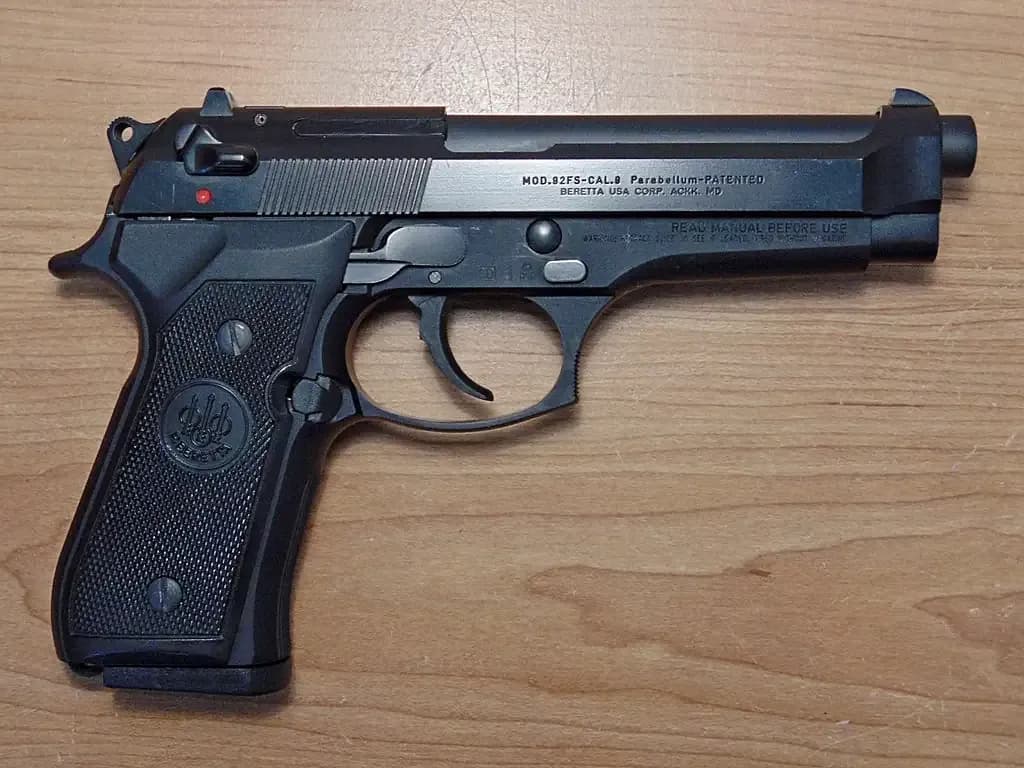
Beretta placed the 9×19 mm Model 92 into production in 1975.[1] The series uses short-recoil operation with a falling locking block. Beretta’s manual for later 92-series pistols also documents a double-action trigger system and a staggered-column magazine.[3]
The 92 evolved through several configurations. The original Model 92, 92S, 92F and 92FS differ in details including safety location, magazine-release position, sights, frame configuration and internal safety features. Later 92FS-pattern pistols incorporate an automatic firing-pin safety, a slide-mounted safety-decocking lever and an enlarged hammer-pin head intended to arrest excessive rearward slide movement.[3]
These variations matter to collectors. An open-top slide identifies the broader design family, but it does not establish the exact variant. Identification should be based on the complete model marking, safety arrangement, magazine-release location, frame and slide features, serial number, and proof or importer marks.
Adoption of the M9
The Model 92 family’s most consequential military success came in the United States. Following a test and evaluation program involving pistols from American and foreign manufacturers, Beretta USA was selected in 1985 to supply the new standard 9 mm handgun for the Army, Navy, Air Force, Marine Corps and Coast Guard.[4]
The initial five-year contract called for 315,930 pistols. The military handgun, designated M9, was selected to replace an inventory that included the M1911A1 pistol and several revolvers. The Army reported that the Beretta met or exceeded the mandatory test requirements and was judged to offer the lowest overall cost among the qualifying submissions.[4]
A commercial 92FS and a military M9 are closely related, but the designations should not be used indiscriminately. Contract markings, inspection marks, configuration, and documented military disposition are necessary to establish that a particular pistol is an issued or contract M9. A commercial pistol resembling an M9 is not thereby a documented military firearm.
Brazilian Production and the Taurus Connection
The relationship between Beretta and Taurus is often reduced to the statement that Taurus copied the Model 92. The documented corporate history is more specific.
Beretta operated a manufacturing facility in São Paulo under a Brazilian military contract. In 1980, after Beretta completed that work, Taurus purchased the São Paulo operation, including machinery, tooling, technical specifications, and the experienced workforce. Taurus subsequently developed the PT92 and PT99 pistols from the earlier Beretta-pattern design.[5]
This history does not make a Taurus PT92 a Beretta, nor does it mean that later Taurus pistols are mechanically identical to contemporary Beretta 92 variants. It does establish a direct industrial connection between Beretta’s Brazilian operation and Taurus’s subsequent semiautomatic-pistol production.
Collectors should identify Brazilian examples through their actual markings and configuration. An Italian Beretta, a Brazilian-made Beretta and a Taurus PT92 may share significant design ancestry, but they are distinct products with different manufacturer markings, production histories and collector classifications.
The S55 and Beretta Over-and-Unders
Introduced in 1955, the S55 marked an important stage in Beretta’s postwar shotgun production. Beretta identifies it as the company’s first fully industrialized over-and-under shotgun with internal locks.[2]
The S55 should not, however, be treated as mechanically identical to every later Beretta over-and-under. The company produced numerous subsequent series and variants, each of which must be identified on its own evidence.
On a collectible shotgun, record the model and serial number as well as all markings found on the barrels, monoblock, action and forend iron. Check whether numbered components correspond, where applicable. Replacement wood, refinishing, rebluing, altered chokes, non-original recoil pads and substituted barrels can materially change both originality and collector interest.
Mechanical condition is separate from cosmetic appearance. Locking surfaces, hinge condition, ejector operation, stock cracks and evidence of corrosion or improper repair require direct inspection. An attractive exterior does not establish mechanical soundness or originality.
The A300 Name
Beretta’s postwar history also includes the A300 semiautomatic shotgun. The original A300 belongs to the company’s mid-twentieth-century development, while the designation has since been reused for modern semiautomatic models.[1]
The current A300 Ultima is a gas-operated semiautomatic shotgun using a falling-block locked breech, a gas valve, cylinder, and piston. Beretta’s manual states that the gas system vents excess pressure produced by more powerful cartridges.[6]
Those current specifications should not be projected backward onto every firearm bearing an A300 designation. Model-family names can remain in use while actions, materials, dimensions, and individual components change. The exact variant and its corresponding factory literature must be established before describing its specifications.
Proof Marks and Date Evidence
Official proof marks are among the most useful forms of evidence on an Italian-made firearm. Italy’s Banco Nazionale di Prova was established by royal decree in 1910, with proof facilities associated with Gardone Val Trompia and Brescia. Its published records distinguish earlier Italian proof marks from the unified marks used under the Permanent International Commission for the Proof of Small Arms system.[7]
Proof marks indicate that the firearm or marked pressure-bearing component underwent the applicable proof procedure. They should not automatically be described as factory inspection marks, military-acceptance marks or manufacturing dates.
A proof date and a manufacturing date may be close, but they are not necessarily the same event. Replacement barrels or other components may also bear proofs applied at a different time from those on the original firearm. Every marked component must therefore be considered separately.
Collectors should use the official Banco Nazionale di Prova tables rather than relying on unidentified charts reproduced online. Marking systems changed over time, and a code should be interpreted under the rules applicable when it was stamped.
U.S. Importer Marks
Firearms imported into the United States carry another category of identifying evidence. The Bureau of Alcohol, Tobacco, Firearms and Explosives identifies the required information as including the serial number, model when designated, caliber or gauge, manufacturer information, country of manufacture for imported firearms, and the importer’s name, city and state.[8]
An importer’s mark does not establish that the importer manufactured the firearm. It records the licensed entity responsible for its importation. It may also help establish that the firearm entered the United States during a particular importer’s period of operation, but it does not by itself prove an exact production date.
All visible markings should be transcribed exactly. Photographs should include the frame or receiver, slide or barrels, barrel flats, monoblock, action flats, and any hidden surfaces exposed during ordinary disassembly. Faint or partially removed marks may be significant evidence of refinishing or alteration.
Evaluating a Collectible Beretta
A defensible evaluation begins with the firearm itself and proceeds to documentary evidence. Record the following:
- Manufacturer and manufacturing location
- Exact model designation
- Serial number
- Caliber or gauge
- Proof and inspection marks
- Importer information
- Numbers on major components
- Mechanical configuration
- Finish, engraving and stock details
- Alterations, repairs and replacement parts
- Accompanying case, accessories and documents
The evidence should tell a consistent story. A claimed production period must agree with the model’s documented features and markings. A claim of factory originality must account for the finish, engraving, wood, barrels and numbered components. A claim of military or police use requires more than resemblance to an issued model.
Provenance must connect the firearm to a particular owner, organization or event through reliable documentation. A seller’s recollection may provide a useful lead, but it is not documented provenance. Likewise, terms such as “rare,” “museum quality” and “all original” should not be accepted without specific evidence.
Beretta’s long history gives collectors an unusually broad field, extending from early sporting arms and military pistols to postwar shotguns and modern service weapons. That breadth also makes generalizations unreliable. The Beretta name provides context; the individual firearm supplies the evidence.
Frequently Asked Questions
When did Beretta begin manufacturing firearms?
Beretta traces its documented history to October 3, 1526, when Bartolomeo Beretta supplied 185 arquebus barrels to the Venetian Arsenal. The record documents an established barrel-making operation, not the formation of a modern company.
When was the Beretta Model 92 introduced?
Beretta placed the 9×19 mm Model 92 into production in 1975. Later variants changed features such as the safety, magazine release, sights, and internal components.
When did the U.S. military adopt the Beretta M9?
Beretta USA was selected in 1985 to supply the new standard 9 mm military pistol. The initial contract covered 315,930 pistols.
What is the connection between Beretta and the Taurus PT92?
Taurus purchased Beretta’s São Paulo operation in 1980, including its machinery, tooling, technical specifications, and workforce. Taurus subsequently developed the PT92 and PT99 from the earlier Beretta-pattern design.
How should collectors identify a Beretta firearm?
Collectors should examine the exact model, serial number, proof marks, importer information, mechanical configuration, and numbered components. Claims of originality, rarity, or provenance require supporting evidence.
Sources
- Fabbrica d’Armi Pietro Beretta, “Beretta Since 1526”
- Fabbrica d’Armi Pietro Beretta, Sustainability Report 2021
- Beretta, Series 92 Pistol User Manual
- U.S. Army Materiel Command, “Army Selects New 9mm Pistol,” Army Research, Development & Acquisition Bulletin, March–April 1985
- Taurus USA, “Company History”
- Beretta, A300 Shotgun User Manual
- Banco Nazionale di Prova, “Official Historical Proof Marks”
- Bureau of Alcohol, Tobacco, Firearms and Explosives, “Properly Identify a Firearm for the Purpose of Tracing”
As a firearms enthusiast with a background in website design, SEO, and information technology, I bring a unique blend of technical expertise and passion for firearms to the articles I write. With experience in computer networking and online marketing, I focus on delivering insightful content that helps fellow enthusiasts and collectors navigate the world of firearms.
Comments
Be the first to leave a comment.
Be the first to read new editorial features, collector guides, and brand spotlights.