Key takeaways
- A Colt Archive Letter and a Smith & Wesson Letter of Authenticity report the original configuration, the shipment date, and the first shipping destination recorded for one serial number. Both are written from records, not from an examination of the firearm. [1][3][4][5]
- The date in a letter is a shipment date. Smith & Wesson did not ship in serial-number order and Colts were almost never shipped that way, so serial number lookups give approximations. [1][8][9]
- Smith & Wesson’s records normally name a wholesaler or distributor, and individual names are very sparse in Colt’s shipping ledgers. Engraving added after shipment, later ownership, and present finish fall outside the letter and rest on other records and on examination of the firearm. [1][8][11][15]
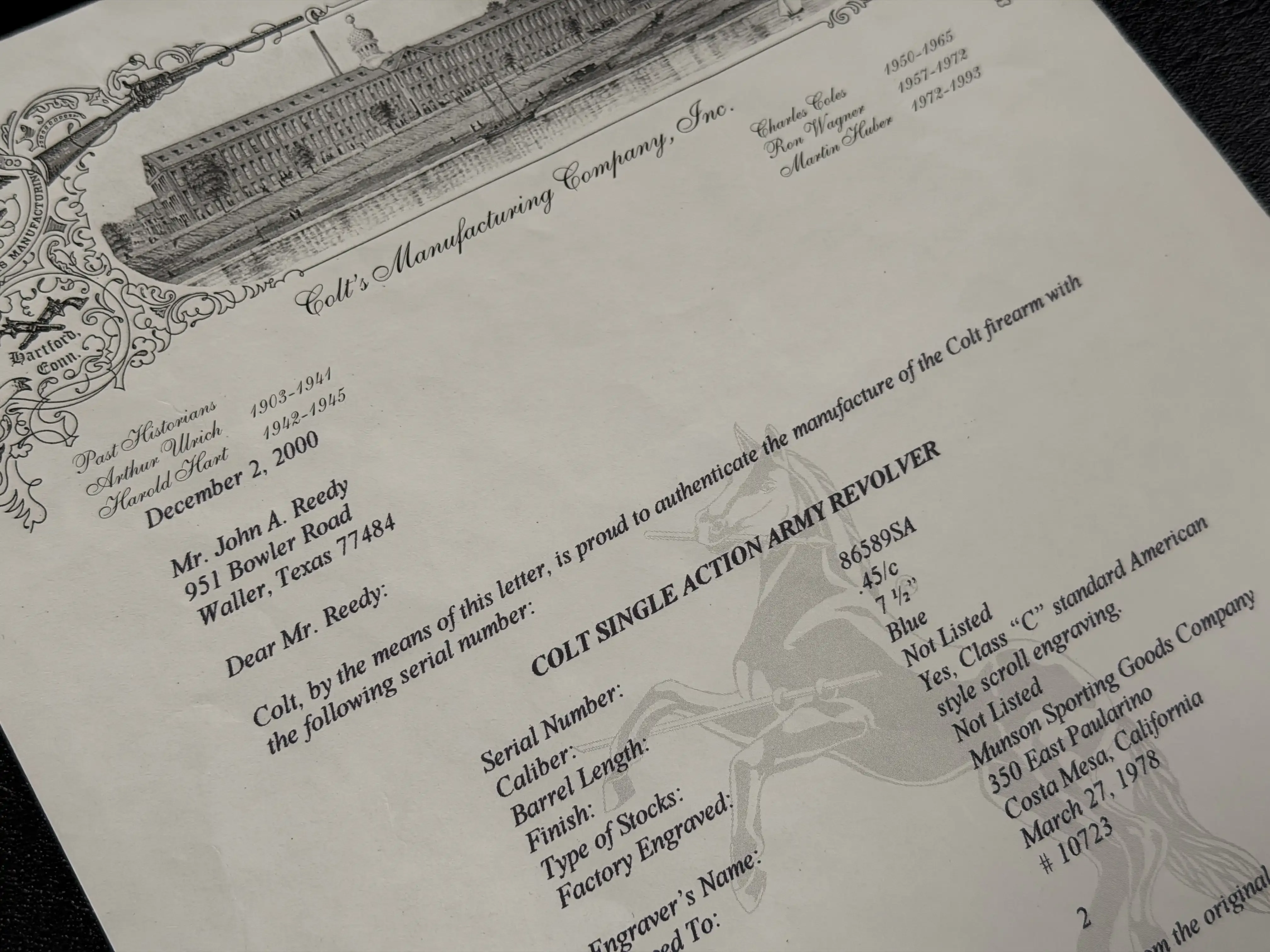
A firearm factory letter reports what a manufacturer's surviving records say about a serial number when it left the plant. Colt Archive Properties defines the Colt Archive Letter as a statement of original shipping details: the original configuration, the shipping date, and the original shipping destination. [1] The Smith & Wesson Historical Foundation, which in 2016 took over the letters previously issued by Smith & Wesson, [2] describes the Smith & Wesson Letter of Authenticity in similar terms. For most manufacturing periods it gives the original factory specifications, including finish, barrel length, and grip style, with the initial shipping destination and the date the firearm left the factory. [3]
Both letters are written from records, not from the firearm. Colt asks the owner for a model and serial number. [4] The Foundation's request form asks for a written description of the gun and, optionally, a photograph or sketch. [5]
Two Public Samples, Side by Side
Colt publishes three sample Archive Letters, and the Foundation publishes one sample Letter of Authenticity. [3][4]
Colt's Single Action Army sample is dated October 30, 2015, and signed by Beverly Jean Haynes, Historian. It withholds the serial number and then sets out the record line by line: caliber .44/40, barrel length 4¾ inches, finish blue, type of stocks not listed. It names two parties, the buyer (Winchester Repeating Arms Company of New Haven, Connecticut) and the destination (E. J. Post and Company of Albuquerque, Territory of New Mexico). The shipment date is November 12, 1898, and the letter counts two guns of the same type in the shipment. It has no line for special features, no model history, and no copy of the ledger. [6]
Every line is an entry for the individual revolver, drawn, as the letter states, from the original Colt shipping records. Where the record holds nothing, the letter says so: all three Colt samples give the type of stocks as not listed. A special-features line appears only on the Python sample, a 2½-inch bright stainless revolver recorded with a ported barrel and shipped on December 21, 1996, to Lew Horton Distr. Company, Inc., of Westboro, Massachusetts, in a shipment of 59. [6]
The Smith & Wesson sample is dated January 1, 2025, and signed by Michael Helms as Historian and Secretary/Treasurer. It concerns a .45 Hand Ejector Model of 1917, serial number 100000. [7] The Foundation describes its letter as two elements: a historical analysis of the model, and information from the company archives on the particular firearm. [3] In the sample, the model history comes first and takes up most of the text. It covers the Model of 1917's introduction, deliveries to the U.S. government from 1917 to 1919, inspection marks, a 1937 Brazilian contract, and production totals, and none of it refers to serial number 100000. [7]
The record for the individual revolver is a single paragraph. It lists the caliber as .45 ACP and states that the revolver shipped from the Stockbridge Street factory in Springfield on August 22, 1918, and was delivered to the United States Armory in Springfield, Massachusetts. The configuration is the standard military one: 5½-inch barrel, forged round-blade front sight, fixed notch rear sight, blued finish, lanyard ring, and plain walnut stocks on a square-butt grip frame. The paragraph names no separate buyer and gives no count of guns in the shipment. The third page reproduces the ledger line itself, which carries the serial number, the date written as 8 22 18, and the entry U S GOVT. [7]
Manufacture Date, Shipment Date, Consignee, and Owner
The date in either letter is a shipment date. The Foundation's letters give no manufacture date. Parts were made in large batches before final assembly; shipping documents are the most consistently preserved records, and the Foundation treats the shipping date as a firearm's "born on date." [8] Its example is the .44 Double Action revolver: every frame was completed before 1898, yet the model stayed in the catalog into the early 1910s. [8]
Serial numbers do not close the gap. Smith & Wesson did not ship firearms in serial-number order. [8] Colt Archive Properties states that Colts were almost never assembled or shipped in consecutive serial order, and that every serial number lookup, including the one on Colt's website, relies on approximations. [1] Colt's lookup returns a model and a manufacture year and is labeled approximate. [9] Colt Archive Properties lists dates of manufacture as a separate item on its research price list [10], and it identifies the dates stamped on a Colt as patent dates. [1]
The consignee is the party the factory shipped to, and Colt's records can distinguish the buyer from the destination, as the Single Action Army sample does. The Model 1911 sample draws the same line: it was sold to the United States Government and shipped to the U.S. Marine Corps in Philadelphia on May 29, 1917, as one of 200 pistols of the same type in the shipment. [6]
Neither entry identifies the person who first owned or carried the gun. The Foundation states that Smith & Wesson's records typically document the initial shipment destination, normally a wholesaler or distributor, and that documentation of later sales rests with the businesses that made them. [8][11] A direct agency purchase appears in the records as an organizational purchase, without individual assignments. An agency purchase made through a dealer or distributor appears only as the commercial shipment. [8] Colt Archive Properties states that ownership is not traced through its records and that individual names in its shipping ledgers are very sparse. [1]
A first owner appears in a letter only when the factory's own records name one. [1][8] Colt's price list sets a separate charge when the shipping destination is a company executive, a Colt family member, or a figure such as Buffalo Bill or Bat Masterson. [10] On the Smith & Wesson side, Rock Island Auction Company's record for a New Model No. 3 cataloged as Theodore Roosevelt's, offered on December 9, 2022, states that the accompanying factory letter shows shipment to Colonel Roosevelt on May 12, 1898. [12]
When the Factory File Is Silent
Engraving. A Colt Archive Letter can describe custom engraving [4], and Colt's price list adds a charge by engraving grade when the records note that feature. [10] Colt Archive Properties also names aftermarket engraving and fancy grips, along with caliber, barrel, and finish changes, as common alterations to older firearms. [1] Engraving not mentioned in the shipping record must be documented from another source.
A second factory record can be that source. Rock Island Auction Company's record for a Colt Single Action Army offered on December 5, 2020, describes a factory letter showing shipment to Murta Appleton & Company of Philadelphia on October 24, 1912, and a Colt special order handgun ledger entry dated October 10, 1912, that specifies the engraving and carved ivory grip and marks the order for Col. Roosevelt. According to the same record, the revolver's own serial number, 324642, does not appear in the shipping records, and the factory letter lists the shipment under 342642. [13]
Decoration applied after shipment lies outside the factory file. The Metropolitan Museum of Art's Smith & Wesson New Model No. 3, serial number 25120, is recorded in the Smith & Wesson archives as shipped to Tiffany & Co. on November 11, 1888; its etched silver grip was added in New York. [14] For independent engravers, the engraver's own records can settle authorship. The Met holds the workbook of New York engraver Louis D. Nimschke, which contains hundreds of inked impressions taken directly from firearms he engraved, including Colts and Smith & Wesson. Because Nimschke signed his work only occasionally, the museum treats the workbook as a reference for identifying his unsigned pieces. [15] It attributes an Evans lever-action musket of about 1876 to him from impressions preserved on page 66. [16]
Later ownership. Both archives stop at the first shipment. [1][8] The Foundation acknowledges that owners sometimes hold family statements or other provenance records, but it confines its letters to information its own archives can verify. [8] Later ownership is documented elsewhere: in the sales records of distributors and retailers [8] and in collection, exhibition, and publication history. The lot record for the Roosevelt Smith & Wesson lists four named collections, museum loans from about 1998 to 2022, and a series of published references. [12]
Present condition. A letter describes the firearm as shipped. The Foundation documents the original configuration and states that it does not verify whether a current finish matches factory specifications. [8] Colt Archive Properties, explaining why a letter's specifications may differ from the gun in hand, notes that many older firearms have been changed from their original configuration. Colt's shipping records also omit assembler, inspector, military, and government markings, as well as original packaging. [1]
Factory service is only partly recoverable. The Foundation's service records are a partial collection, and a missing record does not mean that no factory work was done. [8] Its digitized records for 1920 through 1946 contain correspondence, invoices, and miscellaneous documents; those for 1947 through 1967 contain invoices only, including a few repair and refinish invoices. [11] Copies of any additional documents preserved for a firearm are included with the letter. [3] The firearm's present state is a matter for examination and photographs, the same information the Foundation's request form asks the owner to supply. [5][8]
A letter also depends on a record being available. Colt's percussion-era research is offered only within stated serial ranges: 98,000 to 132,000 for the 1851 Navy, 1 to 12,000 for the 1861 Navy, and 1 to 140,000 for the 1860 Army. The same price list provides for first-generation Single Action Army revolvers for which no record is available. [10]
Frequently Asked Questions
What does a firearm factory letter document?
It reports what the maker’s surviving records show for one serial number at shipment: the original configuration, the shipment date, and the first shipping destination. [1][3]
Does a factory letter give the date of manufacture?
No. Both letters give a shipment date, and Colt Archive Properties lists dates of manufacture as a separate research item. [8][10]
Does a factory letter identify the first owner?
Usually not. The records name the party the factory shipped to, normally a wholesaler or distributor for Smith & Wesson, and Colt Archive Properties states that individual names in its shipping ledgers are very sparse. [1][11]
Can a factory letter confirm that engraving is original?
Only when the factory record notes it: a Colt Archive Letter can describe custom engraving recorded at shipment. [4] Engraving added after shipment has to be documented from other records, such as an engraver’s own workbook. [15]
Does a factory letter prove a firearm is in original condition?
No. The letter describes the firearm as shipped: the Smith & Wesson Historical Foundation does not verify whether a current finish matches factory specifications, and Colt Archive Properties notes that many older firearms have been altered. [1][8]
Sources
[1] Colt Archive Properties, LLC. "About The Archive Letter." Colt Archive Properties, LLC, n.d.
[2] Smith & Wesson Historical Foundation. "About Us." Smith & Wesson Historical Foundation, n.d.
[3] Smith & Wesson Historical Foundation. "Letters." Smith & Wesson Historical Foundation, n.d.
[4] Colt's Manufacturing Company LLC. "Archive Services." Colt's Manufacturing Company LLC, n.d.
[5] Smith & Wesson Historical Foundation. S&WHF Letter of Authenticity Request Form. Revised July 8, 2025, p. 1.
[6] Colt Archive Properties, LLC. "Sample Letters." Sample Colt Archive Letters for a Model 1911, a Python, and a Single Action Army, Office of the Historian, Colt Archive Properties, LLC, March 16, 2015, and October 30, 2015, pp. 1-3.
[7] Smith & Wesson Historical Foundation. "Sample Letter of Authenticity: Smith & Wesson .45 Hand Ejector Model of 1917." Smith & Wesson Historical Foundation, January 1, 2025, pp. 1-3.
[8] Smith & Wesson Historical Foundation. "Frequently Asked Questions." Smith & Wesson Historical Foundation, n.d.
[9] Colt's Manufacturing Company LLC. "Serial Number Lookup." Colt's Manufacturing Company LLC, n.d.
[10] Colt Archive Properties, LLC. Research Service Price List. February 1, 2024, pp. 1-2.
[11] Smith & Wesson Historical Foundation. "Smith & Wesson Historical Foundation." Smith & Wesson Historical Foundation, n.d.
[12] Rock Island Auction Company. "Lot 84: Documented Colonel Theodore Roosevelt Smith & Wesson No. 3." Premier Firearms Auction #87, December 9, 2022. Pre-sale estimate: $800,000 to $1,400,000.
[13] Rock Island Auction Company. "Lot 1210: Theodore Roosevelt Factory Engraved Colt Single Action Revolver." Premier Firearms Auction #81, December 5, 2020. Pre-sale estimate: $350,000 to $550,000.
[14] The Metropolitan Museum of Art. "Smith and Wesson .44 New Model No. 3 Single-Action Revolver, serial no. 25120." The Metropolitan Museum of Art, object no. 2007.477, n.d.
[15] The Metropolitan Museum of Art. "Workbook Recording the Engraved Firearms Ornament of Louis D. Nimschke (1832-1904)." The Metropolitan Museum of Art, object no. 2018.856.19, n.d.
[16] The Metropolitan Museum of Art. "Evans Repeating Rifle Co. Transition Model Lever Action Musket." The Metropolitan Museum of Art, object no. 2021.162, n.d.
As a firearms enthusiast with a background in website design, SEO, and information technology, I bring a unique blend of technical expertise and passion for firearms to the articles I write. With experience in computer networking and online marketing, I focus on delivering insightful content that helps fellow enthusiasts and collectors navigate the world of firearms.
Comments
Be the first to leave a comment.
Be the first to read new editorial features, collector guides, and brand spotlights.