Key Takeaways
- Practical shooting helped drive demand for improved 1911 sights, triggers, controls, and gripping surfaces.
- Wilson Combat uses teams of specialists, while Nighthawk Custom assigns each pistol to one gunsmith.
- Documentation connecting a pistol’s serial number to its builder is stronger evidence than appearance or recognizable features alone.
John M. Browning’s U.S. Patent No. 984,519 was filed on February 17, 1910, and issued on February 14, 1911. It describes a recoil-operated, self-loading pistol with a slide, detachable magazine, manual safety, grip safety, and barrel-locking system recognizable in the M1911 platform.[1] The U.S. Army replaced the M1911 and M1911A1 as its standard service pistol when it adopted the 9 mm Beretta M9 in 1985, after variants of Browning’s pistol had served the American military for nearly three-quarters of a century.[2]
The modern custom 1911 developed from a different branch of that history. Competitive and defensive shooters wanted sights they could see, triggers they could control, and pistols configured for more demanding forms of practical shooting. Their requirements created sustained work for specialist pistolsmiths and eventually supported companies devoted to building complete premium-grade pistols.
Practical Shooting and the Custom Pistol
Retired Marine lieutenant colonel Jeff Cooper helped organize the early Leatherslap matches at Big Bear Lake, California. Those competitions evolved from an annual event into regular matches conducted by the Bear Valley Gunslingers and later the Southwest Combat Pistol League. Competitors including Cooper, Jack Weaver, Ray Chapman, Elden Carl, John Plahn, and Thell Reed used the matches to develop techniques that became part of Cooper’s Modern Technique of the Pistol.[3]
The early contests placed few restrictions on stance or technique. Jack Weaver’s two-handed, push-pull stance demonstrated that competitors could combine speed with deliberate sight use. The resulting Modern Technique incorporated the Weaver stance, flash sight picture, compressed surprise trigger break, reloading, malfunction clearance, and structured gun handling.[3]
Equipment changed alongside technique. Original military-pattern pistols had small sights and controls intended for service use. Practical shooters commissioned larger sights, improved triggers, reshaped controls, checkered gripping surfaces, and other alterations suited to competition or defensive carry. The work of individual pistolsmiths established many of the features later incorporated into factory and semi-custom 1911s.
Armand Swenson and Wayne Novak
Armand Swenson was among the pistolsmiths associated with the formative custom-1911 period. Wayne Novak worked for Swenson for two years after graduating from the Colorado School of Trades. During that employment, Novak designed an early rear sight and learned Swenson’s method of installing a larger front sight by machining a slot in the slide and silver-brazing the sight in place.[4]
Novak subsequently developed a dovetailed front-sight installation after a silver-brazed sight separated from one of his pistols. His LoMount rear sight combined a sloping, snag-resistant profile with a dovetailed mounting system. The design became widely used on production and custom pistols, and the associated slide cut became sufficiently standardized to be identified in later patent literature as the “Novak-style” or “Novak notch” dovetail.[4][5]
This progression illustrates how the custom 1911 evolved. Features now treated as ordinary production options often began as solutions to specific problems encountered by working pistolsmiths and competitive shooters.
Wilson Combat: A Team-Built Custom Pistol
Bill Wilson entered the firearms trade in 1974 with Sportsman’s Headquarters, a retail store in Berryville, Arkansas. Trained as a watchmaker, he developed Wilson Combat from a one-man gunsmithing operation and began specializing in custom 1911 work in 1977.[6]
Wilson Combat’s present production method divides work among specialist gunsmiths. Its 1911s are built to order, with different specialists responsible for defined stages of fitting, assembly, finishing, inspection, and test firing. The company states that its current pistols use parts machined from bar stock or forgings and that machining, gunsmithing, finishing, and test firing take place at its Berryville facility.[6]
That system differs from the traditional one-pistol-smith commission. A coordinated production team can offer repeatable configurations while retaining manual fitting and inspection. The customer generally selects a model and chooses from established options rather than directing every dimension and mechanical detail of a one-off build.
Nighthawk Custom: One Gun, One Gunsmith
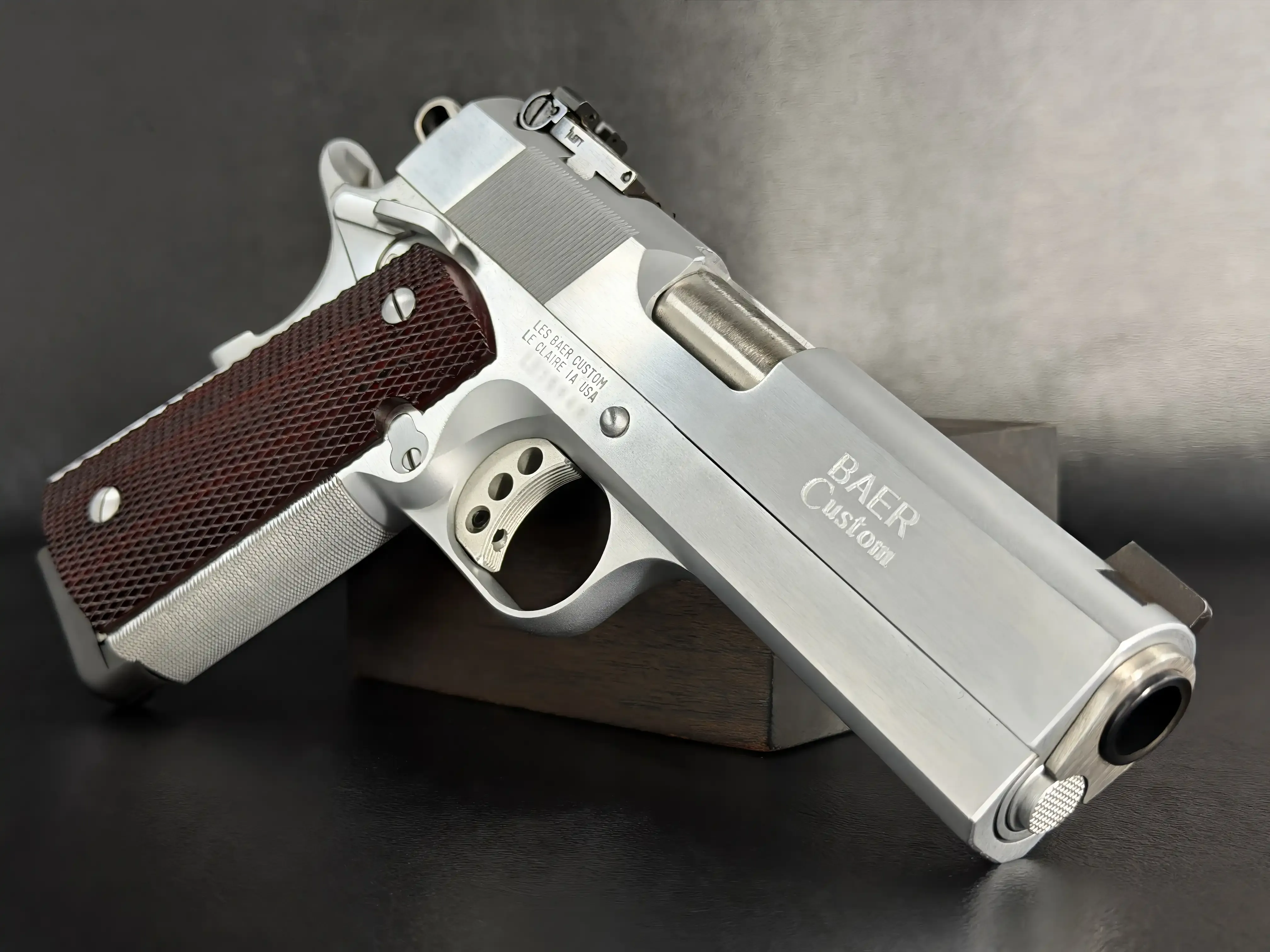
Nighthawk Custom was founded in Berryville in 2004. Its production philosophy is summarized by the trademarked phrase “One Gun, One Gunsmith.” Under this system, a single gunsmith builds an individual pistol from beginning to completion, hand-fitting and polishing its oversized machined components.[7]
The distinction is organizational rather than merely promotional. Wilson Combat assigns stages of a build to a team of specialists, while Nighthawk assigns primary responsibility for an entire pistol to one craftsperson. Nighthawk’s owner’s manual states that the responsible gunsmith stamps his initials beneath the left grip panel after completing the pistol.[8]
Both methods combine computer-controlled manufacture with hand fitting. CNC machinery establishes the initial dimensions of major components, while manual work determines the final relationship between parts such as the slide, frame, barrel, bushing, extractor, safeties, and fire-control components. The presence of machining does not by itself define a pistol as either production-grade or custom. The relevant questions are who performs the final fitting, how much individual fitting is required, and whether the pistol follows a fixed specification or an individual commission.
Cabot Guns and Parts-Level Precision
Cabot Guns approached the 1911 through precision manufacturing. Its pistols debuted at the 2011 National Rifle Association annual meeting. Their development involved Penn United Technologies, a Pennsylvania precision manufacturer serving industries that include aerospace, medical equipment, and carbide tooling.[9]
Cabot’s early manufacturing model emphasized dimensional control and interchangeability. Frames and slides were produced from billet steel using waterjet cutting, CNC machining, grinding, and electrical-discharge machining. Finished components were then measured at critical dimensions with computer-controlled inspection equipment.[9]
This method contrasted with the conventional practice of producing slightly oversized components and removing material by hand until a particular slide, frame, and barrel fitted together. Cabot sought to produce parts close enough to their intended dimensions that components could be interchanged while maintaining a close mechanical fit. The company later expanded its catalog to include hand-fitted and individually decorated pistols, but precision machining remains central to its identity.
Cabot also owns Alchemy Custom Weaponry. Alchemy, led by pistolsmith Rob Schauland, uses a more traditional gunsmith-built approach. Its Prime model, for example, is a Government-size 1911 with hand-fitted components, checkered gripping surfaces, an extended thumb safety, and low-profile sights.[10] The two brands demonstrate that common ownership does not necessarily mean a common production philosophy.
Understanding the Custom Categories
“Custom” has no single technical definition in the 1911 trade. The term can describe an altered factory pistol, a built-to-order model assembled from a manufacturer’s option list, or a one-off commission developed with an individual pistolsmith.
A modified factory pistol retains its original frame and slide but receives selected changes. Depending on the work, those changes may include sights, controls, grip treatment, barrel fitting, refinishing, or alterations to the fire-control system.
A built-to-order or semi-custom pistol begins with an established model. The buyer selects from available chamberings, finishes, sights, grips, safety arrangements, and cosmetic details. Although the configuration is individualized, its principal dimensions and construction remain within the maker’s established system.
A full-custom pistol is commissioned directly from a builder and may involve substantial changes to dimensions, parts, materials, finish, engraving, or mechanical configuration. The category includes both restrained working pistols and elaborately decorated collector pieces. The amount of decoration does not establish the quality of the mechanical work.
Evaluating a Collectible Custom 1911
Attribution is central when assessing an older custom pistol. A recognizable style or component is not proof that a particular gunsmith performed the work. Novak-pattern sights, ambidextrous safeties, checkering, reshaped trigger guards, and other once-distinctive modifications have been copied or adopted by numerous makers.
Useful documentation can include an original invoice, work order, dated correspondence, test target, shipping record, factory letter, signed specification sheet, or a maker’s identifying marks. Records should connect the firearm’s serial number to the named builder and the work described. Later replacement parts and refinishing should be distinguished from the original commission.
Condition must also be considered in context. Wear may be consistent with a pistol built for competition or daily carry, while a highly decorated example may have been intended primarily for display. Mechanical inspection should determine whether later alterations changed the pistol’s original configuration. For historically significant work, documented authorship and an intelligible chain of ownership carry more evidentiary weight than an undocumented resemblance to another pistol.
The modern premium 1911 encompasses several legitimate manufacturing traditions. Wilson Combat uses coordinated teams of specialists. Nighthawk assigns an individual gunsmith to each pistol. Cabot emphasizes parts-level precision and advanced machining, while Alchemy preserves a more traditional hand-built format. Each represents a different answer to the same problem: how to control the fit, function, finish, and authorship of a design first patented more than a century ago.
Frequently Asked Questions
Who designed the original 1911 pistol?
John M. Browning designed the pistol associated with U.S. Patent No. 984,519, issued on February 14, 1911.
How did practical shooting influence the custom 1911?
Practical competitors sought more visible sights, controllable triggers, improved controls, and gripping surfaces suited to faster, more deliberate shooting.
What is the difference between a semi-custom and full-custom 1911?
A semi-custom pistol follows an established model with selected options. A full-custom pistol is individually commissioned and may include substantial changes to its dimensions, components, materials, or finish.
How do Wilson Combat and Nighthawk Custom differ?
Wilson Combat divides construction among specialist gunsmiths. Nighthawk Custom assigns primary responsibility for each pistol to a single gunsmith.
What documentation matters when evaluating an older custom 1911?
Useful evidence includes serial-numbered invoices, work orders, factory letters, correspondence, test targets, and signed specification sheets. Recognizable features alone do not prove who built or modified a pistol.
Sources
[1] Browning, John M. “Firearm.” U.S. Patent No. 984,519, filed February 17, 1910, issued February 14, 1911.
[2] Canfield, Bruce N. “General Officer’s Pistols.” American Rifleman, May 22, 2024.
[3] Aagaard, Finn. “Jeff Cooper: The Man Behind the ‘Modern Technique’.” American Rifleman, April 1, 2020. Originally published October 1993.
[4] Clough, Jeremy. “The Story Behind Novak Sights.” American Handgunner, 2022.
[5] Yates, Richard A. “Adjustable Rear Pistol Sight and Sight Mounting and Adjustment Method.” U.S. Patent No. 7,526,890, filed August 23, 2004, issued May 5, 2009.
[6] Wilson Combat. “About Us.” Wilson Combat, n.d.
[7] Nighthawk Custom. “About Nighthawk Custom.” Nighthawk Custom, n.d.
[8] Nighthawk Custom. Safety and Instruction Manual. Nighthawk Custom, 2021, p. 2.
[9] Clough, Jeremy. “Cabot Guns: Reinventing the 1911.” American Handgunner, n.d.
[10] Mastison, Fred. “Range Review: Alchemy Custom Weaponry Prime 1911.” Shooting Illustrated, February 12, 2020.
As a firearms enthusiast with a background in website design, SEO, and information technology, I bring a unique blend of technical expertise and passion for firearms to the articles I write. With experience in computer networking and online marketing, I focus on delivering insightful content that helps fellow enthusiasts and collectors navigate the world of firearms.
Comments
Be the first to leave a comment.
Be the first to read new editorial features, collector guides, and brand spotlights.