Key Takeaways
- Zastava Arms traces its founding to October 27, 1853, in Kragujevac, Serbia.
- Zastava manufactured Mauser-pattern rifles and actions sold under other brands, including the Remington Model 798.
- Model, serial, proof, and importer markings should be examined together when identifying a collectible Zastava firearm.
Zastava occupies an unusual place in firearms history. The Serbian manufacturer’s catalog has encompassed artillery, Mauser-pattern bolt actions, military Kalashnikov derivatives, sporting rifles, and modern semiautomatic firearms for export. That breadth makes markings, mechanical features, and import information particularly important when identifying a Zastava firearm.
Origins in Kragujevac
The enterprise now known as Zastava Arms traces its foundation to October 27, 1853, when a military factory was established in Kragujevac in the Principality of Serbia. Serbia’s Ministry of Defense describes the factory as an important center of the country’s industrial and technological development, while Zastava continues to list Kragujevac as its headquarters.[1][2]
Over time, the works produced weapons under several states and political systems. Its products therefore appear with Serbian, Yugoslav, military-factory, commercial-export, and modern corporate markings. Collectors should not treat “Zastava” as a single configuration or production period; the name connects firearms made for markedly different customers across more than 170 years.
The Mauser Connection
Zastava’s association with Mauser-pattern rifles is central to its history. The company produced military and commercial bolt actions derived from the Mauser system, later supplying actions and complete rifles for sale under foreign brands.
One well-documented example is the Remington Model 798. Remington identifies the 798 as a Mauser 98-action rifle manufactured by Zastava in Serbia. Introduced in 2006 and discontinued in 2008, it was offered in chamberings ranging from .243 Winchester and .308 Winchester to .375 H&H Magnum and .458 Winchester Magnum.[3]
Zastava continues to manufacture commercial bolt-action rifles and barreled actions. Its catalog separates standard-length M70 actions from the shorter M85 and lists multiple chamberings and bolt-face dimensions.[4] The sporting-rifle designation “M70” should not be confused with the company’s military M70 Kalashnikov family; the same model number has been used for substantially different firearms.
For collectors, the maker’s mark, commercial brand, caliber inscription, proof marks, serial number, and importer’s identification must be considered together. A rifle sold as a Remington, Interarms, or another export brand may nevertheless have been manufactured wholly or partly by Zastava.
From the Military M70 to the American ZPAP
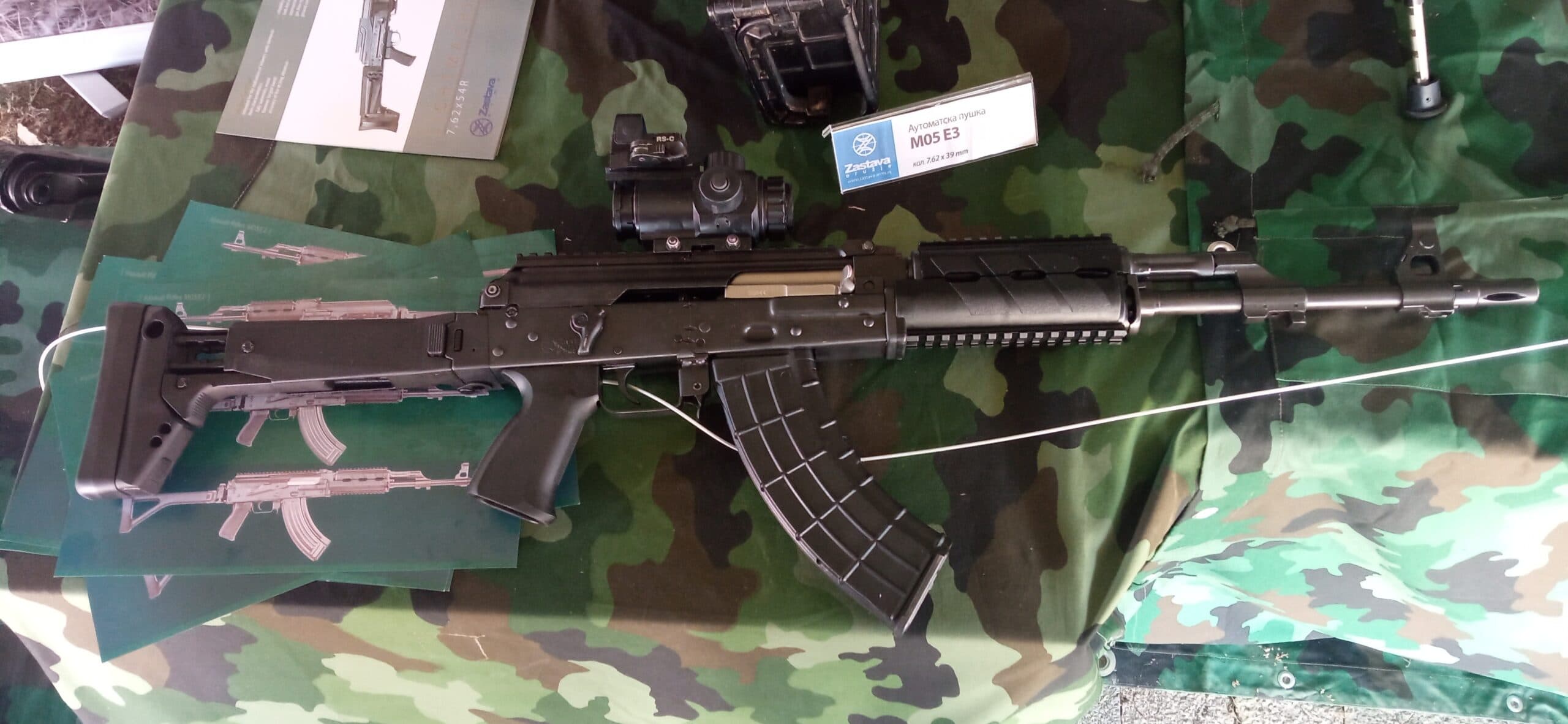
Zastava’s best-known modern export firearm is the ZPAP M70, a semiautomatic 7.62×39 mm rifle derived from the Yugoslav M70 Kalashnikov pattern. The underlying military family uses gas operation and a rotating bolt; Zastava’s published military catalog lists the M70B3 with a 415 mm barrel, 30-round magazine, and selective-fire capability.[5] These military specifications must not be attributed wholesale to American commercial rifles, which are semiautomatic-only firearms built for a different market.
The current commercial ZPAP M70 retains several conspicuous Yugoslav-pattern characteristics. American Rifleman documented a 1.5 mm stamped receiver, a bulged front trunnion, a chrome-lined barrel, a locking mechanism for the receiver cover, and furniture dimensions that differ from standard AKM components.[6] Zastava’s owner’s manual identifies the commercial rifle as the ZPAP M70 in 7.62×39 mm and provides the manufacturer’s parts identification and handling instructions.[7]
The distinction between military and commercial bolt-hold-open arrangements also matters. Earlier Yugoslav development included a mechanical bolt-hold-open system, but the commercial ZPAP examined by American Rifleman relied on a magazine follower to hold the bolt rearward after the last round. Removing that magazine allowed the bolt to close. The rifle also had a notch in the selector lever that could manually retain the bolt.[6] A collector should verify the actual magazine and selector fitted to an individual rifle rather than assume that every M70-pattern firearm operates identically.
PAP, N-PAP, O-PAP, and ZPAP
The PAP name has been applied to several generations of Zastava semiautomatic firearms imported into the United States. Specifications changed with the model, importer, and production period, so the prefix alone is not a dependable description.
The commonly encountered N-PAP and O-PAP differ in receiver and front-trunnion construction, while later ZPAP M70 production adopted the heavier 1.5 mm receiver and bulged trunnion documented on the current pattern.[6] Because rifles may also have replacement furniture, magazines, fire-control components, or muzzle devices, identification should rest on the firearm’s markings and construction, not an online seller’s abbreviated model description.
Zastava’s other American-market PAP firearms include the ZPAP92 in 7.62×39 mm and the ZPAP85 in 5.56×45 mm. The manufacturer’s manual identifies both as semiautomatic pistols and confirms their respective chamberings.[8] Similar names do not imply parts interchangeability, particularly where caliber, receiver dimensions, barrel assemblies, and furniture differ.
Why Import Marks Matter
Federal regulations require licensed importers to place identifying information on imported firearms. Depending on the applicable marking rules and the firearm’s existing markings, this information includes the importer’s name and place of business, model, caliber or gauge, foreign manufacturer, country of manufacture, and an individual serial number.[9]
An importer’s mark is therefore more than a cosmetic feature. It can establish the company that brought a particular firearm into the United States and provide a boundary for researching its import period. It does not, by itself, prove the exact year of manufacture, military service, originality, or ownership history.
Import markings may appear on the receiver or another legally permitted component, including the barrel or pistol slide where applicable.[9] Their wording and location can vary, so generalized lists of stamp locations should be treated cautiously. The complete inscription should be recorded exactly as marked.
Evaluating a Collectible Zastava
A sound examination begins with the firearm itself. Record the manufacturer and model inscriptions, serial number, caliber, country of origin, importer’s mark, proof and inspection marks, and any numbered major components. Clear photographs should be taken before cleaning or disassembly.
Matching numbers can support the conclusion that numbered components have remained together, but they do not automatically establish an untouched military configuration. Arsenal refurbishment, export conversion, later repair, and owner modification may all alter a firearm while leaving some original numbered parts in place.
On a ZPAP or earlier PAP-pattern rifle, inspect the receiver thickness and front-trunnion profile, the configuration of the selector and receiver-cover lock, and the stock and handguard interfaces. Yugoslav-pattern furniture is not generally interchangeable with standard AKM furniture, a difference specifically noted in published examination of the ZPAP M70.[6]
On a Mauser-pattern sporting rifle, identify both the selling brand and the underlying manufacturer. The Remington 798 demonstrates why: its receiver carries the commercial identity of an American brand, but Remington’s own historical record identifies Zastava as the Serbian manufacturer.[3]
Zastava firearms are best understood through physical evidence and model-specific documentation. The company’s long history is genuine, but that history also produced overlapping names, export brands, and configurations. Careful identification, not broad assumptions about the Zastava name, is what separates a documented collectible from an incorrectly described rifle.
Frequently Asked Questions
When was Zastava Arms founded?
Zastava Arms traces its foundation to October 27, 1853. Its historic manufacturing center is in Kragujevac, Serbia.
What is the Zastava ZPAP M70?
The ZPAP M70 is a semiautomatic 7.62×39 mm rifle derived from the Yugoslav M70 Kalashnikov pattern. Documented features include a 1.5 mm stamped receiver and bulged front trunnion.
Did Zastava manufacture rifles for other brands?
Yes. Remington identifies its Model 798 as a Mauser 98-action rifle manufactured by Zastava in Serbia.
Are ZPAP M70 parts interchangeable with standard AKM parts?
Not universally. The ZPAP M70 uses Yugoslav-pattern dimensions, so items such as stocks and handguards generally require compatible Yugo-pattern parts.
What can an importer mark reveal?
An importer mark identifies the licensed company that imported the firearm and may help narrow its import period. It does not independently establish the firearm’s manufacturing date, originality, or ownership history.
Sources
- Republic of Serbia, Ministry of Defence, “Zastava Oružje Marks Its 170th Anniversary,” 2023.
- Zastava Arms, “Company Profile.”
- Remington, “Model 798,” Firearm History.
- Zastava Arms, “Hunting and Sporting Firearms Catalogue,” pp. 14–15.
- Zastava Arms, “Military Guns Catalogue,” p. 15.
- Bruce N. Canfield, “Zastava ZPAP M70: An Authentic AK for the U.S. Market,” American Rifleman, October 27, 2020.
- Zastava Arms USA, “ZPAP M70 Owner’s Manual and Safety Instructions.”
- Zastava Arms USA, “ZPAP92 and ZPAP85 Owner’s Manual and Safety Instructions.”
- Bureau of Alcohol, Tobacco, Firearms and Explosives, “27 C.F.R. § 478.92—Identification of Firearms and Armor-Piercing Ammunition.”
As a firearms enthusiast with a background in website design, SEO, and information technology, I bring a unique blend of technical expertise and passion for firearms to the articles I write. With experience in computer networking and online marketing, I focus on delivering insightful content that helps fellow enthusiasts and collectors navigate the world of firearms.
Comments
Be the first to leave a comment.
Be the first to read new editorial features, collector guides, and brand spotlights.