Key Takeaways
- The Gewehr 98 and Karabiner 98k share the Model 98 action but differ significantly in length, sights, bolt handles, and stock configuration.
- Large-ring, small-ring, and intermediate Mauser actions must be identified through measurements and mechanical features, not appearance alone.
- Receiver codes, serial numbers, acceptance marks, and components should form a historically consistent combination before originality is claimed.
Few bolt-action designs have proved as durable or influential as Paul Mauser’s Model 98. Germany adopted the Gewehr 98 on April 5, 1898, and the action subsequently appeared in military, sporting, and target rifles produced around the world.[1] For collectors, however, the Mauser name alone establishes very little. Correct identification depends on the rifle’s dimensions, mechanical features, markings, and configuration, and on whether those elements agree.
From the Gewehr 98 to the Karabiner 98k
The Gewehr 98 was a long infantry rifle chambered for Germany’s 7.92 mm service cartridge. Its recognizable features include a 740 mm barrel, straight bolt handle, and, on its original configuration, the distinctive Lange Visier rear sight. The rifle served Germany during the First World War and provided the mechanical foundation for later Model 98 variants.[2]
Germany adopted the substantially shorter Karabiner 98k in 1935. A surviving 1941 example in the Imperial War Museums collection measures 110 cm overall, with a 60 cm barrel, and is attributed to J. P. Sauer & Sohn.[3] A wartime U.S. Army intelligence manual likewise identifies the Karabiner 98k by its approximately 23.4-inch barrel and records it as the German Army’s standard shoulder weapon.[4]
The two rifles are generally easy to distinguish in original configuration. A standard Gewehr 98 has a straight bolt handle and long sight radius. The Karabiner 98k has a turned-down bolt handle seated in a stock recess, a tangent rear sight, and side-mounted sling arrangements. These indicators should be considered together: individual parts have been exchanged, refurbished, or reproduced on many surviving rifles.
Why the Model 98 Action Endured
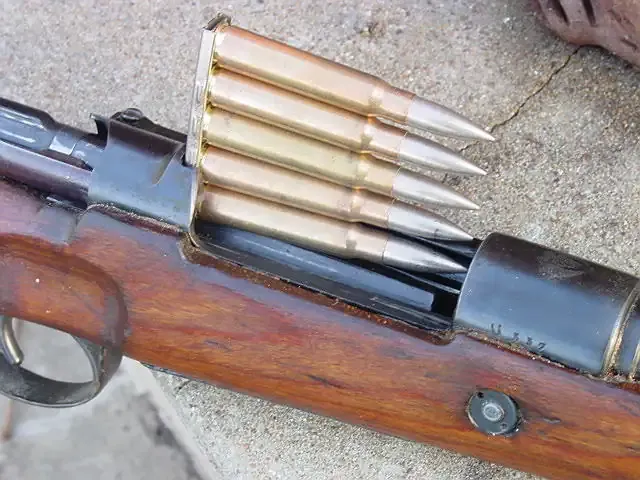
The Model 98 is a cock-on-opening, manually operated action with two forward locking lugs and a third lug near the rear of the bolt. The rear lug normally carries no firing load; it serves as a reserve if the primary locking system fails. Other protective features include gas-relief openings, a flanged bolt sleeve intended to deflect escaping gas, and firing-pin geometry designed to prevent the pin from reaching the primer before the bolt is locked.[1]
Its long, nonrotating claw extractor controls the cartridge as it rises from the magazine, enters the chamber, and is withdrawn. This controlled-round-feed arrangement became one of the action’s defining characteristics. It remains visible in later sporting designs: Winchester describes its Model 70 controlled-round-feed system as using a claw extractor to retain the cartridge from magazine to ejection, while Ruger has explicitly described the M77 Hawkeye as employing “Mauser-type controlled feeding.”[5][6]
The large-ring Model 98 receiver measures approximately 1.410 inches across the front ring. Its internal collar provides a shoulder against which the barrel seats, while the receiver’s integral recoil lug transfers firing forces into the stock. Contemporary technical commentary places the weight of a complete large-ring action, without barrel, stock, or sights, at approximately three pounds.[1]
These features explain the design’s reputation, but they do not make every old Model 98 action suitable for firing. Corrosion, improper heat treatment, altered locking surfaces, mismatched bolts, excessive headspace, and undocumented conversions can materially affect safety.
Large Ring, Small Ring, and Action Length
“Large ring” and “small ring” refer to the outside diameter and profile of the receiver’s front ring, not simply to the rifle’s overall size. Brownells’ dimensional guide gives approximately 1.410 inches for a large-ring receiver and 1.300 inches for a small-ring receiver. A large-ring action normally shows a visible step where the front ring meets the receiver body; a small-ring action has a more nearly continuous exterior profile.[7]
Action length is a separate measurement. The standard-length Model 98 action is approximately 8.75 inches long. Intermediate actions, including certain Mexican and Yugoslav patterns, are about 8.5 inches long. Original Mauser commercial Kurz actions are approximately 8.125 inches long and use specialized components that generally do not interchange with standard actions.[7]
Collectors should therefore avoid identifying an action from a single measurement. Ring diameter, receiver length, screw spacing, magazine dimensions, barrel-shank dimensions, bolt construction, and markings must be evaluated together. The term “Mauser action” encompasses numerous national, commercial, and military patterns that are not universally interchangeable.
Stocks, Finish, and Configuration
Stock construction can help identify a rifle, but it is not a dependable date code by itself. Karabiner 98k production included solid walnut stocks as well as laminated stocks. Hardware, buttplate pattern, sling fittings, stock disassembly disk or substitute fittings, handguard configuration, and acceptance markings changed during production.
Claims that late-war rifles normally used solid beech stocks oversimplify the surviving record. Laminated stocks were an important part of Karabiner 98k production, and wood appearance alone is easily misread after decades of oiling, refinishing, repair, or replacement. A stock should be assessed by its construction, inletting, hardware, serial markings, inspection stamps, and compatibility with the barreled action.
Original stock cartouches and Waffenamt acceptance marks can provide useful evidence, but their presence does not automatically prove that a stock has remained with a particular rifle since manufacture. Conversely, weak or absent markings may result from service wear, arsenal work, sanding, or replacement. Fresh-looking stamps on worn or refinished wood warrant particular caution.
Receiver Codes, Dates, and Serial Numbers
German military manufacturers used coded markings to obscure the identity of production facilities. Early Karabiner 98k receivers may carry an “S/” manufacturer code with a letter indicating the production year: “K” for 1934 and “G” for 1935. Later rifles used numeric or alphabetic manufacturer codes in combination with year markings, but the precise format varied by factory and production period.[8]
A code should never be interpreted in isolation. The receiver marking, serial number and suffix, barrel markings, proof and acceptance stamps, bolt number, stock number, and numbered small parts should form a historically plausible combination. A correct-looking code does not prove originality if the remainder of the rifle is inconsistent.
Matching numbers can materially affect collectibility, but “matching” requires more than agreement between the receiver and bolt. Numbering practices differed by manufacturer and year, and some parts carried complete serial numbers while others received abbreviated numbers. Re-stamped components and force-matched postwar rebuilds also exist. Assertions of complete originality should be supported by detailed physical examination and an appropriate production reference.
Evaluating a Surviving Rifle
A responsible examination begins with identification rather than valuation:
- Confirm the model and action pattern through receiver dimensions and mechanical features.
- Record every visible manufacturer code, date, serial number, suffix, proof, and acceptance mark.
- Check whether the bolt, floorplate, trigger guard, stock, and other numbered components agree with the receiver.
- Compare the sights, stock, buttplate, bands, and fittings with documented examples from the same maker and period.
- Look for refinishing, sanding, welded bolt handles, drilled scope holes, replaced barrels, altered chambers, and newly applied markings.
- Treat stories of battlefield capture, notable ownership, or rare factory configuration as unproven unless supported by documents tied directly to the rifle.
The Model 98’s long production history is part of its appeal and the principal source of identification errors. A rifle assembled from authentic period components is not necessarily an original, factory-matching example. A postwar conversion may be historically interesting, but it should not be represented as an untouched German service rifle.
The strongest collectible examples are coherent. Their metalwork, stock, markings, wear, and mechanical configuration tell the same story. Learning to test that story, rather than relying on a familiar silhouette or a receiver code, is the essential discipline of collecting Mauser 98 rifles.
Frequently Asked Questions
What is the primary difference between the Gewehr 98 and Karabiner 98k?
The Gewehr 98 is a longer infantry rifle with a straight bolt handle in its original configuration. The Karabiner 98k is shorter and normally has a turned-down bolt handle and tangent rear sight.
How can I distinguish a large-ring Mauser action from a small-ring action?
A large-ring receiver measures approximately 1.410 inches across the front ring, while a small-ring receiver measures about 1.300 inches. Measurements should be considered alongside the receiver profile and action length.
What do the codes on a Karabiner 98k receiver mean?
They can identify the manufacturer and production period. Their format changed over time, so each code must be checked against the rifle’s date, serial number and physical configuration.
Do matching serial numbers prove that a Mauser 98 is completely original?
No. Re-stamped parts, force-matched rebuilds and later component substitutions mean that markings and physical evidence must be evaluated together.
What should collectors inspect before buying a Mauser 98?
Examine the codes, serial numbers, acceptance marks, stock, sights, numbered parts and overall finish for consistency. Also check for refinishing, replacement barrels, drilled holes and other alterations.
Sources
- American Rifleman, “The Mauser Model 98: Truly Great,” 2023.
- American Rifleman, “At the Range: Gewehr 98,” October 17, 2020.
- Imperial War Museums, “Karabiner 98k, Catalogue No. FIR 7771,” collection record.
- U.S. War Department, Military Intelligence Service, “German Infantry Weapons, Special Series No. 14,” May 25, 1943, U.S. Army Combined Arms Research Library.
- Winchester Repeating Arms, “Model 70 Owner’s Manual,” controlled-round-feed system description.
- Sturm, Ruger & Co., “Ruger M77 Hawkeye Rifle Features,” January 20, 2011.
- Brownells, “The Long and Short of Mauser Actions,” technical guide.
- American Rifleman, “Identifying Mauser Markings,” June 13, 2011.
As a firearms enthusiast with a background in website design, SEO, and information technology, I bring a unique blend of technical expertise and passion for firearms to the articles I write. With experience in computer networking and online marketing, I focus on delivering insightful content that helps fellow enthusiasts and collectors navigate the world of firearms.
Comments
Be the first to leave a comment.
Be the first to read new editorial features, collector guides, and brand spotlights.