Key Takeaways
- The original Colt Cobra was an aluminum-frame D-frame revolver produced from 1950 through 1981.
- First Issue Cobras have an exposed ejector rod, while Second Issue revolvers have a heavier barrel and integral ejector-rod shroud.
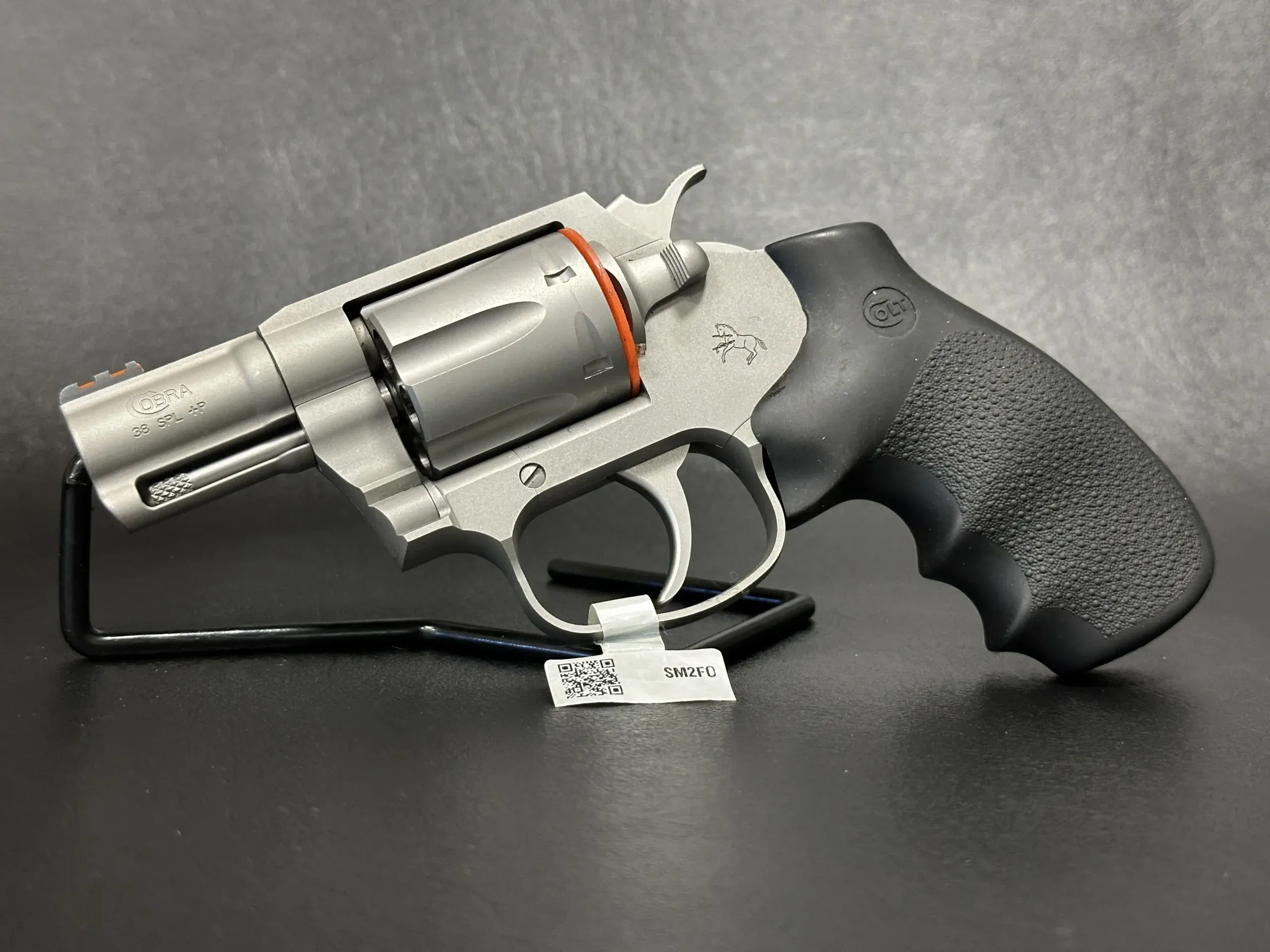
- The 2017 Cobra is a redesigned stainless-steel revolver chambered for .38 Special and .38 Special +P.
Colt introduced the Cobra in 1950 as a lightweight counterpart to its steel-frame Detective Special. The two revolvers shared Colt’s compact D-frame dimensions, fixed sights, six-shot cylinder, and single-action and double-action operation. An aluminum-alloy frame reduced the two-inch Cobra’s unloaded weight to approximately 15 ounces, about six ounces less than the contemporary Detective Special.[1][2]
The Original Cobra
The original Cobra retained a steel barrel and cylinder. Its aluminum frame and six-round capacity distinguished it from several competing compact revolvers, which commonly held five cartridges. Early examples have a slender barrel and an exposed, full-length ejector rod. The rod provides enough travel to push fired cases completely from the cylinder, although its exposed position offers less protection against damage than a shrouded design.[2]
Although .38 Special accounted for most sales, Colt also produced Cobras chambered in .22 Long Rifle, .32 Colt New Police, and .38 Colt New Police. Two-inch barrels were the most common, while three-inch and four-inch versions were also available.[2]
Colt offered a separate hammer shroud for its D-frame revolvers. The accessory covered most of the exposed hammer spur to reduce snagging during a draw while leaving enough of the spur accessible for manual cocking.[2]
Collector terminology generally divides the original Cobra into two issues. First Issue revolvers, manufactured from 1950 through 1972, have the exposed ejector rod and comparatively light barrel profile. Colt introduced the Second Issue in 1973. These later revolvers are recognizable by their heavier barrel and integral ejector-rod shroud. Colt discontinued the Cobra in 1981.[2]
The ejector shroud is the clearest external distinction between the two issues, but it should not be the only feature considered when examining an individual revolver. Barrel markings, chambering, barrel length, stocks, serial number, and finish should be evaluated together, particularly when determining whether a surviving example remains in its original configuration.
The M13 Aircrewman
The U.S. Air Force M13 Aircrewman was closely related to the Cobra but was not a standard commercial Cobra. Colt constructed the M13 with an aluminum-alloy frame and cylinder combined with a two-inch steel barrel. The revolvers were marked “Aircrewman” on the left side of the barrel and “Property of U.S. Air Force” on the backstrap. Their Air Force identification numbers ran from A.F. 1 through A.F. 1189.[3]
Because of its aluminum cylinder, the M13 was intended for a specially developed, reduced-pressure .38 Special cartridge designated M41. Standard .38 Special ammunition could create unsafe pressures in the aluminum cylinder. The Air Force withdrew the M13 revolvers from service in 1959 and ordered them destroyed. Most were cut apart, leaving relatively few intact examples.[3]
The M13’s limited survival has made authentication especially important. Original examples should exhibit the correct Aircrewman barrel marking, Air Force property marking, special identification number, aluminum cylinder, and appropriate military configuration. Bruce N. Canfield has also documented the existence of altered, partially restored, and fabricated specimens.[3]
The 2017 Cobra
Colt revived the Cobra name in 2017, but the new revolver was not a continuation of the original aluminum-frame D-frame design. The reintroduced model used stainless-steel construction, a redesigned action, and contemporary production methods intended to reduce the extensive hand-fitting associated with earlier Colt double-action revolvers.[1][4][5]
The 2017 Cobra is a six-shot, single-action and double-action revolver chambered for .38 Special and .38 Special +P. Colt’s operator’s manual specifies an overall length of 7.25 inches, a 2.1-inch barrel with a one-turn-in-14-inch left-hand rifling twist, and an unloaded weight of 1.55 pounds. The barrel incorporates a full-length ejector shroud and an interchangeable front sight.[5]
Its lockwork also differs materially from the original Cobra. A transfer bar carries the hammer’s energy to a frame-mounted firing pin only while the trigger remains pressed. This arrangement prevents the hammer from striking the firing pin unless the trigger is held to the rear.[5]
The modern revolver retains several traditional Colt operating characteristics. Its six-shot cylinder rotates clockwise, and its cylinder-release latch must be pulled rearward to open the action. The rear sight is a fixed notch in the frame’s topstrap, while the interchangeable front sight permits replacement without changing the barrel.[5][6]
The 2017 model was originally supplied with a two-inch barrel, rubber grip, and fiber-optic front sight. Colt expressly rated it for both standard-pressure and +P .38 Special ammunition.[4][5] These specifications provide several immediate ways to distinguish the modern revolver from an original Cobra, most notably its stainless-steel frame, heavier weight, transfer-bar action, and factory .38 Special +P designation.
Collector Identification
An original Cobra should be identified through a combination of physical features and factory documentation. The principal features include the serial number, chambering, barrel length, frame material, ejector-rod configuration, finish, stocks, and model markings. The difference between an exposed ejector rod and an integral shroud provides a practical starting point for distinguishing First Issue and Second Issue revolvers.[2]
A Colt archive letter may establish the firearm’s original caliber, barrel length, finish, stocks, custom features, shipping date, and shipping destination. Colt Archive Properties cautions that online serial-number dates are approximate because Colt firearms were not necessarily assembled or shipped in consecutive numerical order.[7]
An archive letter does not trace later ownership, and it may reveal that a revolver’s present configuration differs from the way Colt originally shipped it. For a collector evaluating a refinished revolver, replacement barrel, changed stocks, or other nonstandard features, the factory shipping information provides a documented reference point.[7]
The Cobra name therefore covers two mechanically distinct families. The original was an aluminum-frame D-frame revolver produced from 1950 through 1981 in several chamberings and barrel lengths. The modern Cobra, introduced in 2017, is a redesigned stainless-steel .38 Special +P revolver that retains the six-shot capacity and several operating conventions associated with earlier Colt double-actions.[1][2][4][5]
Frequently Asked Questions
When was the Colt Cobra introduced?
Colt introduced the Cobra in 1950 as a lightweight counterpart to the steel-frame Detective Special.
What chamberings were available for the original Colt Cobra?|
Colt produced original Cobras in .38 Special, .38 Colt New Police, .32 Colt New Police, and .22 Long Rifle.
How can First Issue and Second Issue Cobras be distinguished?
First Issue revolvers have a slender barrel and exposed ejector rod. Second Issue revolvers, introduced in 1973, have a heavier barrel and integral ejector-rod shroud.
Is the modern Colt Cobra the same design as the original?
No. The 2017 Cobra uses stainless-steel construction, redesigned lockwork, and a transfer-bar firing system.
What information can a Colt archive letter provide?
An archive letter may confirm the original caliber, barrel length, finish, stocks, custom features, shipping date, and shipping destination. It does not document subsequent ownership.
Sources
[1] Colt’s Manufacturing Company LLC. “Timeline.” Colt’s Manufacturing Company LLC, n.d.
[2] Scarlata, Paul. “Colt’s Cobra: First of the Lightweight Serpents.” Shooting Times, January 3, 2011.
[3] Canfield, Bruce N. “America’s Military Revolvers.” American Rifleman, May 1997, online edition October 6, 2016.
[4] Colt’s Manufacturing Company LLC. “Colt Announces the New Cobra Double-Action Revolver.” Colt’s Manufacturing Company LLC, May 5, 2017.
[5] Colt’s Manufacturing Company LLC. Operator’s Manual for Colt Cobra Revolver. 2017, pp. 7-11.
[6] Clapp, Wiley. “Colt’s Cobra: The Wheel, Rediscovered.” American Rifleman, April 24, 2017.
[7] Colt Archive Properties. “About the Archive Letter.” Colt Archive Properties, n.d.
As a firearms enthusiast with a background in website design, SEO, and information technology, I bring a unique blend of technical expertise and passion for firearms to the articles I write. With experience in computer networking and online marketing, I focus on delivering insightful content that helps fellow enthusiasts and collectors navigate the world of firearms.
Comments
Be the first to leave a comment.
Be the first to read new editorial features, collector guides, and brand spotlights.