Key Takeaways
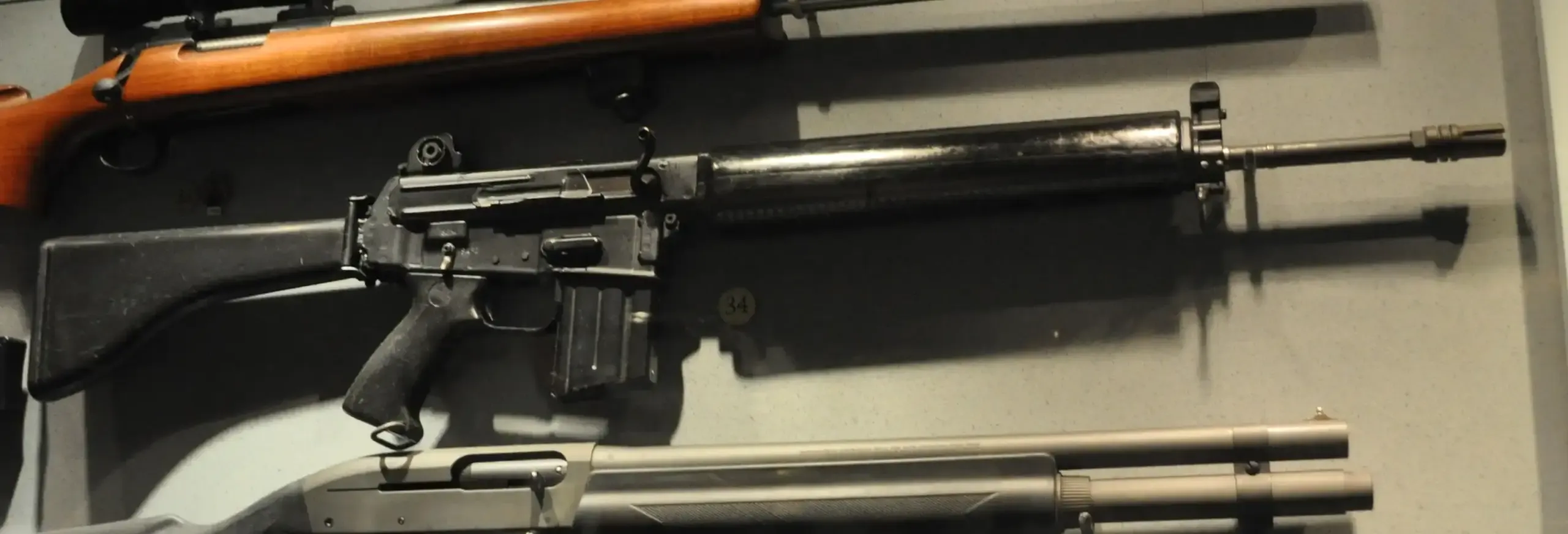
- Verified Fact: The AR-18 combined a short-stroke piston, rotating bolt, and receiver-contained dual-action springs with welded, stamped-steel receivers.
- Verified Fact: Manufacturers in California, Japan, and England produced 20,307 AR-180 rifles between 1969 and 1985.
- Verified Fact: The AR-18’s mechanical architecture influenced later designs, including Britain’s SA80 family.
The ArmaLite AR-18 never displaced the M16, and its semiautomatic counterpart, the AR-180, achieved only modest commercial success. Yet the design’s compact operating system and straightforward construction gave it an influence disproportionate to its production numbers.
A New Direction for ArmaLite
ArmaLite developed the selective-fire AR-18 in the early 1960s after selling the AR-15 manufacturing rights to Colt. Eugene Stoner had left the company in 1961, and the new rifle was designed under Arthur Miller, then ArmaLite’s chief designer. Introduced in 1963, the 5.56 mm AR-18 was substantially derived from Stoner’s earlier 7.62 mm AR-16 concept.[1]
The AR-18 departed visibly and structurally from the AR-10 and AR-15. Instead of receivers made from aluminum forgings, it used welded sheet-steel stampings. This approach was intended to reduce dependence on extensive precision machining and make the rifle practical for factories without the specialized equipment required for forged-aluminum receivers.[1]
Miller’s work included a lightweight gas-operated push-rod system covered by U.S. Patent 3,246,567. Filed on June 15, 1964, and issued on April 19, 1966, the patent describes a barrel-mounted piston-and-cylinder assembly acting through a flexible push rod on a self-loading mechanism.[2]
The Operating System
The AR-18 is gas-operated, using a short-stroke piston above the barrel. When a cartridge is fired, propellant gas enters the piston assembly and delivers a brief impulse through the operating rod to the bolt carrier. The carrier then continues rearward through its operating cycle.
A rotating bolt locks into the barrel extension. Two guide rods and their associated action springs sit above and alongside the carrier assembly, rather than extending into the buttstock. This self-contained arrangement permits the use of a side-folding stock without the receiver extension, buffer, and stock-mounted action spring found on the AR-15.[1]
The charging handle is attached directly to the bolt carrier and moves with it during operation. A spring-loaded dust cover protects the receiver opening when the handle is forward. The rifle also incorporates a receiver-mounted dovetail for ArmaLite’s proprietary optical-sight mount.[1]
These features gave the AR-18 a compact mechanical package: a short-stroke piston, rotating bolt and recoil system contained entirely within the receiver. That combination—not merely the presence of a piston—is the design’s most recognizable legacy.
From AR-18 to AR-180
ArmaLite introduced the AR-180, a semiautomatic commercial version, in 1969. It retained the AR-18’s basic operating system, stamped-steel receivers, reciprocating charging handle and folding stock, but omitted selective fire.[1]
Standard rifles had an 18-inch barrel with a 1:12-inch rifling twist intended for the 55-grain ammunition then in common use. Their iron sights consisted of an adjustable front post and a receiver-mounted aperture rear sight. The AR-18 and AR-180 used a magazine catch arrangement different from that of the AR-15, although AR-15 magazines could be modified for use in the rifles.[1]
Production was divided among three principal sources. ArmaLite manufactured 1,171 AR-18s and 4,018 AR-180s in Costa Mesa, California, between 1969 and 1972. Howa Machinery produced 3,927 AR-180s in Japan from 1970 through 1974, while Sterling Armaments of Dagenham, England, manufactured 12,362 from 1979 through 1985. The resulting documented total for AR-180 production is 20,307 rifles; the frequently quoted figure of 21,478 combines those AR-180s with the 1,171 Costa Mesa AR-18s.[1]
The manufacturing source is normally evident from the receiver markings. Those markings, together with serial number, configuration and surviving factory features, are central to identifying a collectible example. Costa Mesa, Howa and Sterling rifles should not be treated as interchangeable merely because they share the AR-180 designation.
Military Trials and Limited Adoption
The AR-18 underwent U.S. testing at Aberdeen Proving Ground in 1964. Reports identified reliability and accuracy problems with different ammunition lots and called for further changes. British Ministry of Defense testing in 1966 also found deficiencies under mud and sand conditions. ArmaLite revised the design, but the rifle faced a market already dominated by the M16 and did not secure a major military contract.[1]
Limited numbers nevertheless entered foreign military, security, and law-enforcement service. The rifle also became closely associated with the Provisional Irish Republican Army during the Northern Ireland Troubles, although that illicit use should not be confused with formal adoption by a national armed force.[3]
A Lasting Mechanical Legacy
The AR-18’s commercial record was limited; its engineering afterlife was not. Published examinations of the British SA80 development program identify clear AR-18 mechanical ancestry, while specialist histories also associate the same general operating architecture with the Singaporean SAR-80, Japanese Howa Type 89 and German Heckler & Koch G36.[3][4]
The relationship should be stated carefully. These later rifles are not simple copies, and each incorporates its own engineering decisions. Their connection to the AR-18 lies principally in the use or adaptation of its compact short-stroke-piston and bolt-carrier arrangement.
Brownells made that lineage explicit with its BRN-180 upper-receiver assemblies. Designed for compatible AR-15-pattern lower receivers, the BRN-180 uses a short-stroke piston and an operating system contained within the upper receiver, eliminating the need for a conventional AR-15 buffer tube.[5]
Evaluating a Collectible AR-180
An original AR-180 should be judged first by what can be documented. Receiver markings establish the manufacturer, while the serial number and physical configuration help determine whether the rifle is consistent with the relevant production period.
Collectors should examine the stamped receivers, welds, folding-stock hinge, charging handle, dust cover, proprietary scope-mount dovetail, sights and magazine interface. Replaced furniture, altered magazines and damaged stock hinges can materially affect collectibility. Assertions of originality should be supported by period-correct components and, where available, factory documentation rather than by appearance alone.
The AR-18 and AR-180 were not overlooked masterpieces denied an inevitable military triumph. Contemporary trials exposed genuine shortcomings, and sales remained limited. Their importance rests elsewhere: ArmaLite produced a compact, economical operating architecture whose underlying layout continued to appear in successful rifles long after AR-18 and AR-180 production had ended.
Frequently Asked Questions
What is the difference between the AR-18 and AR-180?
Verified Fact: The AR-18 is the selective-fire military design, while the AR-180 is its semiautomatic commercial counterpart.
Who designed the ArmaLite AR-18?
Verified Fact: Arthur Miller led the AR-18’s development after Eugene Stoner left ArmaLite. The design was substantially derived from Stoner’s earlier AR-16 concept.
How many AR-180 rifles were produced?
Verified Fact: Documented production totaled 20,307 AR-180s. The often-cited total of 21,478 also includes 1,171 selective-fire AR-18s made in Costa Mesa.
Where were AR-180 rifles manufactured?
Verified Fact: ArmaLite produced them in Costa Mesa, California; Howa Machinery manufactured them in Japan; and Sterling Armaments produced them in England.
Why is the AR-18 historically significant?
Verified Fact: Its compact piston-operated mechanism and receiver-contained recoil system influenced later rifle development despite its limited commercial and military success.
Sources
- Dave Campbell, “A Look Back at the ArmaLite AR-18/180,” American Rifleman, August 9, 2018.
- Arthur Miller, “Operating Rod for Self-Loading Firearm, U.S. Patent 3,246,567,” filed June 15, 1964; issued April 19, 1966.
- Hayden Foster, “This Old Gun: ArmaLite AR-18,” American Rifleman, March 11, 2020.
- N.R. Jenzen-Jones and Jonathan Ferguson, “British Enfield SA80 Part 1: Mock-ups,” Armament Research Services, June 15, 2017.
- Brownells, “BRN-180 Upper Receiver Assembly Manual,” product manual.
As a firearms enthusiast with a background in website design, SEO, and information technology, I bring a unique blend of technical expertise and passion for firearms to the articles I write. With experience in computer networking and online marketing, I focus on delivering insightful content that helps fellow enthusiasts and collectors navigate the world of firearms.
Comments
Be the first to leave a comment.
Be the first to read new editorial features, collector guides, and brand spotlights.