
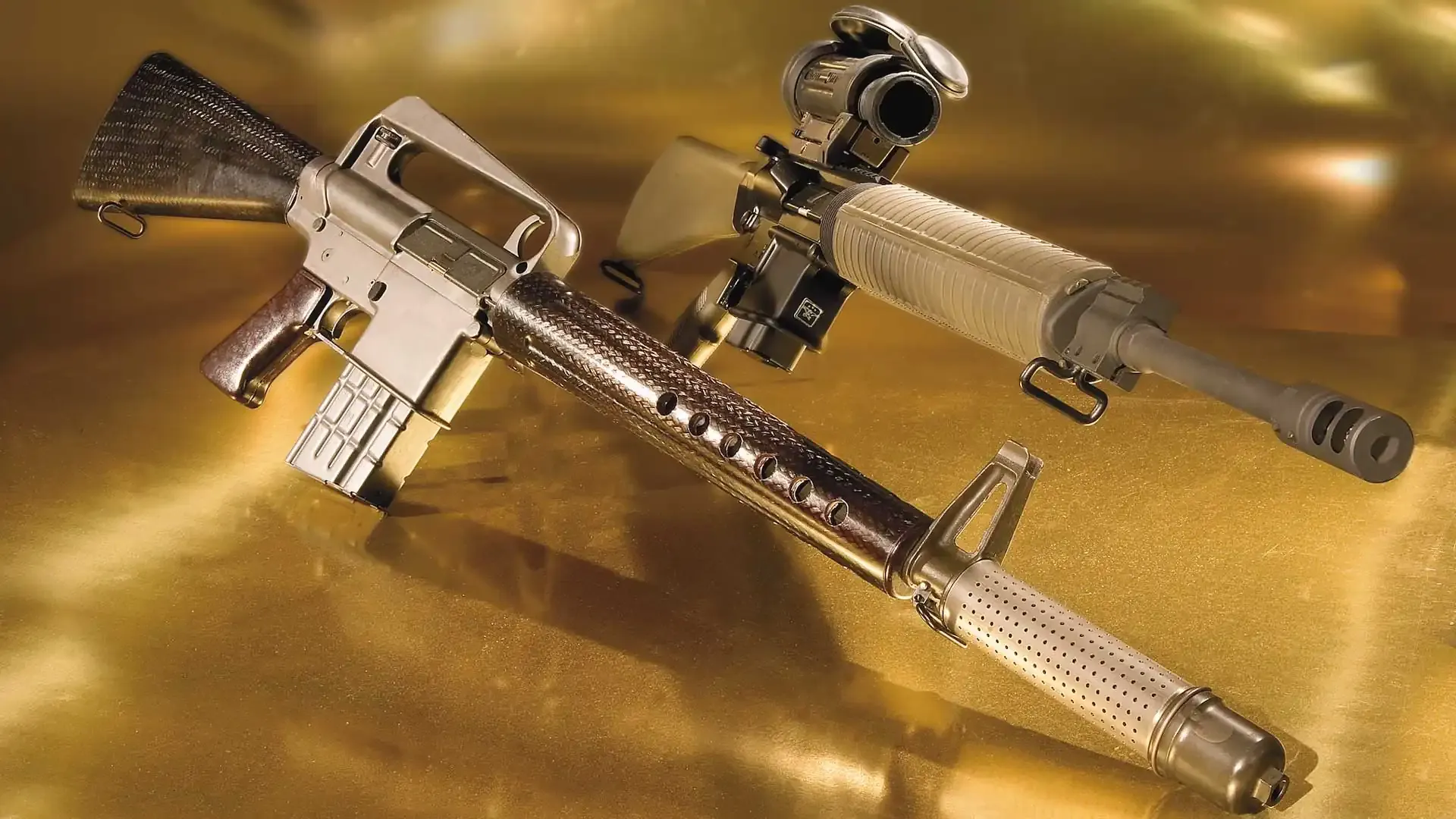

Eugene Stoner was not yet famous when he joined a small engineering skunkworks inside Fairchild Engine and Airplane Corporation in the mid-1950s. George Sullivan had pitched Fairchild's leadership on a simple idea: apply aerospace materials and manufacturing thinking to small arms, which had changed little since the Second World War. The division they created, ArmaLite, had a light footprint, a workshop, a handful of engineers, and an appetite for experimentation. What it produced in the next five years would define American military and civilian rifle design for the rest of the century.
Stoner's approach broke cleanly from the prevailing orthodoxy. He worked with aluminum receivers and fiberglass stocks when other designers were still committed to walnut and steel. The AR-10, chambered in 7.62x51mm NATO, emerged from this thinking as a rifle that was lighter than its competitors while maintaining full-power cartridge performance. When the U.S. military began its trials for a new battle rifle in the mid-1950s, the AR-10 was a serious contender, though it ultimately lost the contract to the M14. The Springfield Armory trials exposed real weaknesses in ArmaLite's prototype; a barrel failure during testing damaged the program irreparably, but the underlying design logic was sound, and it would prove itself elsewhere. Adopted in small numbers by Sudan, Portugal, and the Netherlands, the AR-10 established that Stoner's platform worked.
The AR-15 came from a direct request: scale the AR-10 down to an intermediate cartridge, the .223 Remington, and produce something lighter still. The resulting rifle weighed roughly six pounds unloaded. The U.S. Air Force evaluated it, then bought it. The Army eventually followed, designating it the M16. But ArmaLite, strapped for capital, had already sold the AR-15 rights to Colt's Patent Fire-Arms Manufacturing Company in 1959, the same year it sold the AR-10 manufacturing rights. The company that created the most significant American rifle of the twentieth century would not be the company that built it.
The original ArmaLite division wound down, and the name went dormant. What followed was a long interlude. Various licensing arrangements carried derivatives of Stoner's designs into production in the Philippines and elsewhere, but ArmaLite itself was not a going concern. The name was revived in the 1990s when Mark Westrom established ArmaLite, Inc. in Geneseo, Illinois, bringing the brand back into domestic production. The reconstituted company focused on AR-10 and AR-15 platform rifles, building on the original design heritage with modern manufacturing. Westrom's ArmaLite developed a reputation for quality at a price point below the premium tier, a production rifle rather than a custom one, but built carefully.
For collectors, ArmaLite occupies an unusual position. The original-era rifles, genuine pre-1959 AR-10s and early AR-15 production pieces, are legitimately rare and historically important, the physical artifacts of a design moment that changed the industry. The current production rifles are a different category: competent modern platform guns that carry the name but share no corporate continuity with Stoner's shop. A collector who wants a piece of ArmaLite's actual history is looking at a very short production window, a handful of surviving military-contract examples, and prices that reflect scarcity. A shooter who wants a well-made AR in the ArmaLite tradition has considerably more options.
History & Milestones
ArmaLite Division Established Within Fairchild
George Sullivan founded ArmaLite as an engineering division of Fairchild Engine and Airplane Corporation in Hollywood, California. The premise is to apply aircraft-industry materials and methods to small arms design.
Eugene Stoner Joins as Chief Designer
Stoner brings aerospace engineering thinking to the firearms bench, pioneering aluminum receivers and composite stocks at a time when the industry defaulted to steel and wood. His collaboration with Sullivan defines ArmaLite's brief but consequential output.
AR-10 Enters Military Trials
The 7.62x51mm AR-10 competes against the T44 (future M14) for the U.S. military's new battle rifle contract. A barrel failure during testing at Springfield Armory damages ArmaLite's prospects; the contract goes to the M14. Small quantities of AR-10s are subsequently sold to Portugal, Sudan, and the Netherlands.
AR-15 Developed and Demonstrated
Stoner scales down the AR-10 concept to .223 caliber at the request of CONARC (Continental Army Command). The U.S. Air Force evaluates the AR-15 and purchases initial quantities, marking the first military adoption of what would become the M16 family.
Colt Acquires AR-10 and AR-15 Rights
ArmaLite, undercapitalized, sells manufacturing and licensing rights for both the AR-10 and AR-15 to Colt's Patent Fire-Arms Manufacturing Company. This transaction effectively transfers the era's most significant rifle designs from the company that created them. ArmaLite continues in reduced form but never regains the same design momentum.
AR-18 Introduced as Piston Alternative
The AR-18, designed by Stoner and Arthur Miller, features a gas-piston operating system and a stamped-steel receiver intended for lower-cost manufacturing. Licensed to Howa (Japan) and Sterling Armaments (UK), it sees limited military adoption, but its mechanical influence extends to several later designs.
Original ArmaLite Division Ceases Operations
The original Fairchild-derived ArmaLite winds down. The name enters dormancy. Various licensed AR-10 derivatives continue to be produced elsewhere, particularly by Elisco Tool in the Philippines.
ArmaLite Inc. Reestablished in Geneseo, Illinois
Mark Westrom revives the ArmaLite name and establishes domestic production of AR-10 and AR-15 platform rifles in Illinois. The reconstituted company builds a reputation for production-quality rifles at a competitive price point, particularly in the AR-10 segment, where it becomes one of the more established names.
Westrom Sells ArmaLite to Strategic Armory Corps
The Illinois company changes hands as part of broader consolidation in the firearms industry. Production continues in Geneseo; collectors note the transition as a potential quality-watch moment, as is common with ownership changes in this segment.