Key Takeaways
- The No. 4 Mk I was approved in 1939 after development and trials during the preceding decade.
- Wartime production took place in factories in Britain, Canada, and the United States.
- Evaluate model markings, bolt-release configuration, barrel, sight, and other components together because documented wartime rifles show considerable variation.
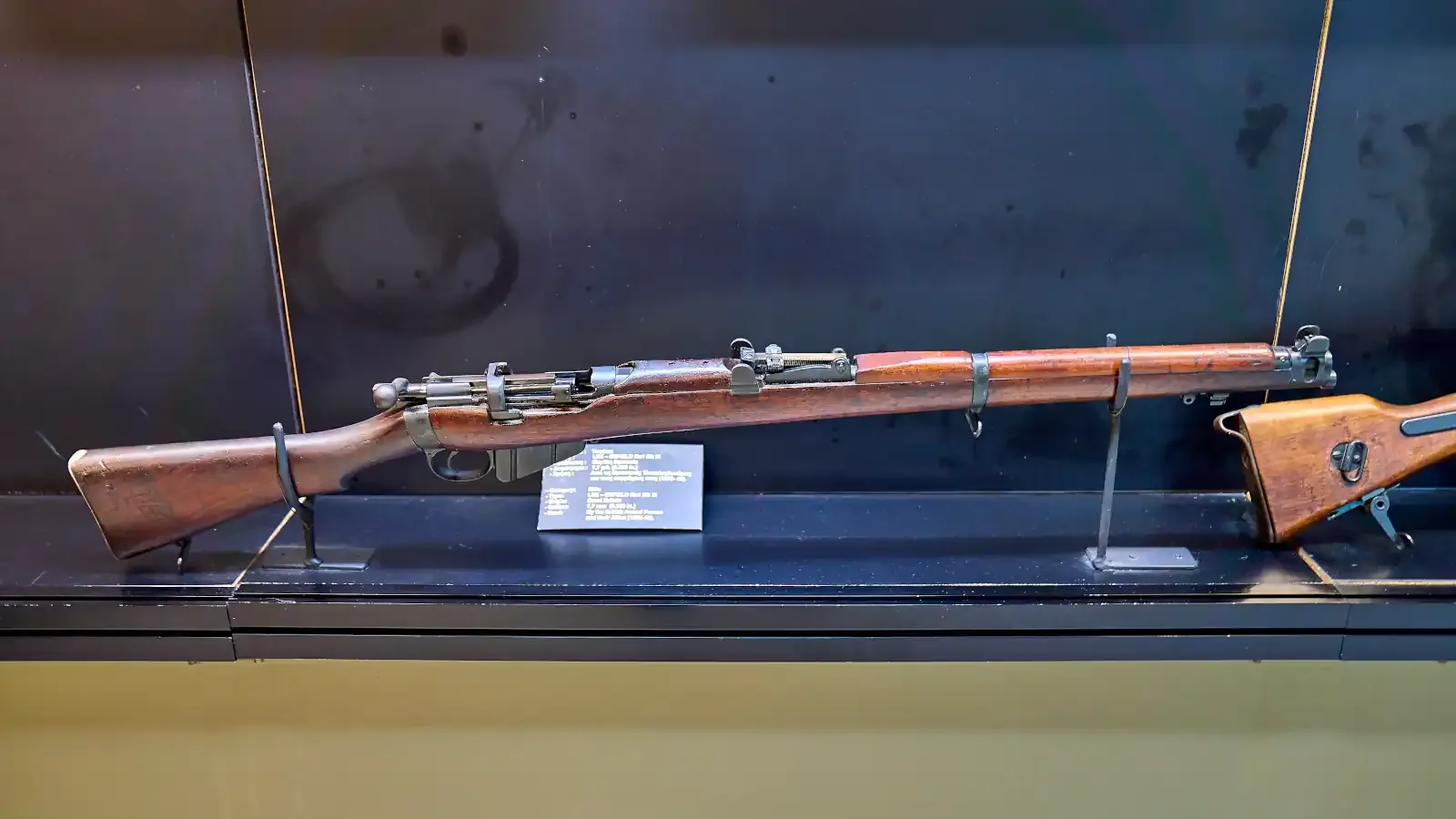
The Lee-Enfield No. 4 Mk I was approved on November 15, 1939, and became the British Army’s standard rifle during the Second World War. It retained the .303 British cartridge and established Lee-Enfield operating system while incorporating structural and manufacturing changes intended for wartime production.[1][2]
Development and Design
British trials of the No. 4 design began in 1931. Development continued through the decade as engineers refined the rifle and prepared manufacturing processes based on interchangeable components. Production remained limited before the war, and British factories did not begin delivering substantial quantities until 1941.[2]
The No. 4 Mk I was a manually operated bolt-action rifle with a detachable ten-round magazine. Five-round chargers could be inserted through guides machined into the top of the receiver, allowing the magazine to be replenished while it remained attached to the rifle.[1][2]
Compared with the earlier No. 1 rifle, the No. 4 had a strengthened receiver with flatter, squared surfaces that required less machining. Its one-piece charger bridge replaced the rounded bridge of the No. 1. The earlier rifle’s complicated nose cap was also replaced by simpler barrel bands and a separate front-sight protector.[1]
The 25-inch barrel projected beyond the fore-end. Rifles were produced with both five-groove and two-groove rifling, with two-groove barrels appearing during wartime manufacture. An Imperial War Museums example made by Royal Ordnance Factory Fazakerley measures 112 centimeters overall, has a 64-centimeter barrel, and is chambered for the .303 cartridge.[2][3]
The receiver-mounted aperture rear sight was one of the model’s most recognizable changes. The original milled Mk I sight incorporated a 300-yard battle aperture and a folding elevation slide graduated to 1,300 yards. Wartime production also introduced simpler stamped sights, including a two-position aperture regulated for 300 and 600 yards.[1]
The barrel’s projecting muzzle accepted the socket-mounted No. 4 spike bayonet. This replaced the long-bladed Pattern 1907 bayonet associated with the No. 1 rifle and reduced the amount of material and manufacturing work required.[2]
Wartime Production
British production was concentrated at Royal Ordnance Factory Fazakerley, Royal Ordnance Factory Maltby, and Birmingham Small Arms Company’s Shirley plant. All three began producing No. 4 rifles in 1941. Although the Royal Small Arms Factory at Enfield had participated in the design’s development, it did not undertake mass production of the wartime No. 4 Mk I.[1]
North American manufacture took place at Small Arms Limited in Long Branch, Ontario, and at the Savage operation in the former J. Stevens Arms Company factory in Chicopee Falls, Massachusetts. The British government contracted with Savage in early 1941, before the United States entered the war. Savage rifles supplied through Lend-Lease were marked “U.S. PROPERTY,” although they were not issued to American military forces.[1][2]
The Canadian War Museum holds a 1941 rifle manufactured by Small Arms Limited. Its inscription includes “Long Branch No.4 Mk.1 1941,” and the museum associates the rifle with the Canadian Army and Royal Canadian Ordnance Corps.[4]
Mk I and Mk I* Identification
The principal mechanical distinction between the No. 4 Mk I and Mk I* concerns bolt removal. On the Mk I, the bolt head passes over a separate release catch at the rear of the receiver raceway. On the Mk I*, the bolt head is aligned with a notch cut into the receiver rail and rotated upward. The revised arrangement eliminated the Mk I release catch, spring, and plate, reducing both machining and the number of components.[1]
The star is therefore part of the official model designation. It does not signify condition, accuracy, or quality. The simplified Mk I* configuration is closely associated with wartime production by Savage and Long Branch, while the British factories produced the Mk I.[1]
Production Variation
Wartime No. 4 rifles were not manufactured with one unchanging combination of barrel, sight, wood, and finish. Component substitutions and simplified parts appeared as production requirements changed.
An early Maltby No. 4 Mk I in the Australian War Memorial is dated 1941. Its documented features include a two-groove barrel, painted metalwork, beech furniture, and a simplified 300- and 600-yard rear sight. The rifle also has a Long Branch bolt head and a Singer-manufactured bolt, providing a documented example of components from several manufacturers appearing on the same rifle.[5]
For collector identification, the model designation, manufacturer, date, serial number, bolt-release arrangement, barrel, and rear sight must be considered together. The Australian War Memorial rifle demonstrates why two-groove rifling, simplified sights, painted finishes, or mixed manufacturer markings cannot be judged independently from the rest of the firearm.[5]
The No. 4 Mk I also provided the basis for the No. 4 Mk I (T) sniper rifle, which was configured for the No. 32 telescopic sight. Most British wartime conversions were undertaken by Holland & Holland.[2] A No. 4 Mk I (T) should consequently be evaluated as a distinct military conversion, not simply as a standard rifle equipped with a telescope.
Frequently Asked Questions
When was the Lee-Enfield No. 4 Mk I approved?
The rifle was approved on November 15, 1939, with substantial British production beginning in 1941.
What caliber is the No. 4 Mk I?
The standard No. 4 Mk I is chambered for the .303 British cartridge and uses a ten-round detachable magazine.
What distinguishes the Mk I from the Mk I*?
The Mk I uses a separate bolt-head release, while the Mk I* uses a notch in the receiver rail that eliminates several components.
Where was the No. 4 rifle manufactured during the war?
British production came from Fazakerley, Maltby, and BSA Shirley, while Small Arms Limited at Long Branch and Savage produced rifles in North America.
Did every wartime No. 4 Mk I have the same components?
No. Documented rifles show differences in rifling, sights, finishes, furniture, and component manufacturers.
Sources
[1] NRA Staff. “Lee-Enfield No. 4 Rifle.” American Rifleman, February 25, 2010.
[2] Schreier, Philip. “The Lee-Enfield No. 4 Mk 1 Rifle.” Shooting Illustrated, December 15, 2022.
[3] Imperial War Museums. “Rifle, No 4 Mk 1.” Imperial War Museums, n.d.
[4] Canadian War Museum. “Centre-Fire Rifle.” Canadian War Museum, n.d.
[5] Australian War Memorial. “Lee-Enfield No 4 Mk I Rifle.” Australian War Memorial, n.d.
As a firearms enthusiast with a background in website design, SEO, and information technology, I bring a unique blend of technical expertise and passion for firearms to the articles I write. With experience in computer networking and online marketing, I focus on delivering insightful content that helps fellow enthusiasts and collectors navigate the world of firearms.
Comments
Be the first to leave a comment.
Be the first to read new editorial features, collector guides, and brand spotlights.