Key Takeaways
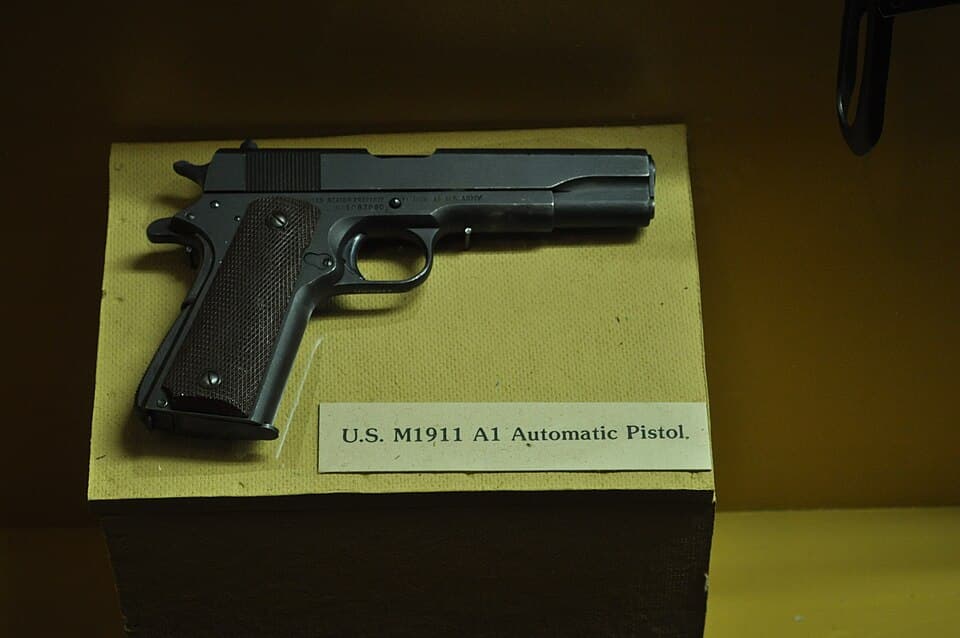
- The M1911A1 added a shorter trigger, frame relief cuts, an arched mainspring housing, improved sights, and changes intended to reduce hammer bite.
- Colt, Remington Rand, Ithaca, Union Switch & Signal, and Singer manufactured M1911A1 pistols during World War II.
- Many surviving military pistols contain replacement or mixed-manufacturer parts, so identification requires examining the receiver, markings, components, finish, and documentation together.
The M1911A1 was a revised form of John M. Browning’s M1911, the .45-caliber semiautomatic pistol adopted by the U.S. Army in March 1911. Colt manufactured the adopted Browning design, which replaced the Army’s .38-caliber service revolvers.[1] Browning’s U.S. Patent 984,519, filed on February 17, 1910, and issued on February 14, 1911, documented the recoil-operated, locked-breech mechanism underlying the pistol.[2]
“Colt M1911A1” is often used informally for the entire military pattern, but Colt was only one of five companies that manufactured complete M1911A1 pistols for the U.S. government during World War II. Remington Rand, Ithaca Gun Company, Union Switch & Signal, and Singer Manufacturing Company also participated in the wartime production program.[3]
From M1911 to M1911A1
The revisions that distinguished the M1911A1 addressed handling rather than introducing a new operating system. The flat mainspring housing became arched. The trigger was shortened, and semicircular relief cuts were machined into both sides of the frame behind it. The grip-safety tang was lengthened, while the hammer spur was shortened to reduce the likelihood of the hammer pinching the web of the shooter’s hand. A wider front sight and simplified grip panels completed the principal visible changes.[3]
The modifications began appearing during the 1920s, but the formal distinction between the two military designations was established in 1926. Ordnance Committee Item 5453, dated May 17, 1926, assigned the M1911 designation to pistols with serial numbers below 700,000 and the M1911A1 designation to pistols beginning at serial number 700,000. Relatively few new pistols were required during the interwar period because the armed services retained substantial stocks of M1911s. Colt did not resume quantity production of the revised model until 1937.[4]
This serial-number distinction remains useful to collectors. A slide can be replaced, while the receiver retains the pistol’s serial identity. A government pistol assembled with an earlier receiver and later slide should not be classified solely from the slide inscription.
The Operating System
The M1911A1 is a single-action, recoil-operated semiautomatic pistol chambered for the .45 ACP cartridge. It is fed from a single-column, seven-round detachable magazine. The barrel and slide remain locked together during the first stage of recoil. A pivoting link then lowers the rear of the barrel, disengaging the barrel’s locking lugs from the slide.[2][5]
Once unlocked, the slide continues rearward, extracting and ejecting the fired cartridge case, cocking the hammer, and compressing the recoil spring. The spring then drives the slide forward. The slide strips a cartridge from the magazine, chambers it, and returns the barrel and slide to their locked position.[2][5]
The pistol incorporates a manually operated thumb safety, an automatic grip safety, and a slide stop that holds the action open after the last cartridge has been fired.[3][5] The A1 revisions altered the shape and dimensions of several external components, but the pistol retained Browning’s short-recoil, tilting-barrel operating principle.
World War II Production
American mobilization transformed the M1911A1 from a limited-production interwar arm into a mass-produced service pistol. Singer received an educational order for 500 pistols, serial numbered S800001 through S800500. The company completed the order but did not proceed into sustained M1911A1 production.[6]
Remington Rand, known principally for office equipment, received a government order for 125,000 pistols in March 1942. Production took place at the company’s Syracuse, New York, facility, with the first deliveries made later that year. Manufacturing was temporarily halted in 1943 to correct problems with parts interchangeability. After production resumed, Remington Rand became the largest wartime producer, manufacturing almost 900,000 M1911A1 pistols.[6]
Union Switch & Signal of Swissvale, Pennsylvania, received an initial order for 200,000 pistols, but the requirement was reduced so the company could concentrate on M1 carbine components. The company ultimately completed 55,000 M1911A1s, with production ending on November 27, 1943.[6]
Ithaca began M1911A1 production in December 1942. Unlike the office-equipment and railway-signal companies brought into the program, Ithaca was already an established firearms manufacturer. It produced 335,466 M1911A1 pistols during the war.[6]
The five wartime manufacturers together produced 1,878,742 M1911A1 pistols. Large numbers of older M1911s also remained in service and were inspected, repaired, refinished, and reissued beside newly manufactured M1911A1s.[4][6]
Service After 1945
No additional government-contract M1911A1 pistols were manufactured after 1945. The large wartime inventory instead supported continued service through inspection, repair, and arsenal rebuilding. Pistols undergoing overhaul could receive replacement slides, barrels, grips, and small components without regard to preserving the original manufacturer combination. Rebuilt pistols were normally refinished, and the facility responsible for the work could stamp its initials on the receiver.[4]
The M1911A1 remained in broad U.S. military use until the adoption of the 9 mm M9. A Naval History and Heritage Command collection record describes the M1911A1 as serving extensively through the 20th century before its replacement by the M9 in 1986.[7]
Collector Identification
Identification should begin with the receiver serial number and its relationship to the manufacturer’s assigned production range. The slide inscription, inspection marks, barrel markings, grips, finish, and small parts should then be evaluated individually. No single component establishes that the complete pistol survives in its original factory configuration.
A mismatched slide does not automatically indicate recent alteration. Government rebuild programs routinely combined serviceable components from different manufacturers. Bruce Canfield notes that many pistols remaining in later military service were rebuilt several times.[4] The Civilian Marksmanship Program reports that 98 percent of the surplus Army pistols it receives are mixed-component examples, including pistols with frames and slides from different manufacturers. Some contain commercial replacement parts.[8]
Terms such as “matching,” “original,” and “unissued” therefore require more than a correct-looking slide and receiver. A credible assessment should account for the serial number, manufacturer markings, inspection stamps, finish, component types, and any rebuild markings. Documented ownership or military provenance may add historical context, but it does not by itself prove that every component remained with the pistol from manufacture.
Singer’s 500-pistol order is numerically distinct from the much larger production runs of the other wartime manufacturers, but the production figure alone cannot authenticate a Singer-marked pistol. The serial number, markings, inspection stamps, finish, and components must conform to the documented production group.[6]
The M1911A1 is best understood as a Colt-developed military pistol standardized for production across several American industries. Its outward differences from the M1911 are readily identifiable, but decades of military maintenance make the history of an individual example dependent on the evidence preserved in its receiver, markings, components, finish, and documentation.
Frequently Asked Questions
What distinguishes the M1911A1 from the original M1911?
The M1911A1 has a shorter trigger, frame relief cuts, an arched mainspring housing, improved sights, a longer grip-safety tang, and a shorter hammer spur. Its basic operating system remained Browning’s recoil-operated, locked-breech design.
Did Colt manufacture every military M1911A1?
No. Remington Rand, Ithaca Gun Company, Union Switch & Signal, and Singer also manufactured M1911A1 pistols for the U.S. government during World War II.
How does the M1911A1 operate?
The M1911A1 is a single-action, short-recoil-operated pistol with a locked breech and tilting barrel. It feeds .45 ACP cartridges from a seven-round detachable magazine.
Why do military M1911A1 pistols often have mismatched parts?
Government arsenals replaced worn components and refinished pistols during service overhauls. A receiver and slide from different manufacturers can therefore reflect legitimate military rebuilding.
What should collectors examine when identifying an M1911A1?
Collectors should examine the receiver serial number, manufacturer markings, inspection stamps, slide, barrel, grips, finish, and rebuild marks. Claims of originality should be supported by consistent physical evidence and documentation.
Sources
[1] U.S. Army. “Arming the Army, John M. Browning.” U.S. Army, n.d.
[2] Browning, John M. “Firearm.” U.S. Patent 984,519, filed February 17, 1910, issued February 14, 1911.
[3] Campbell, Dave. “Colt History: A Look Back at the 1911.” American Rifleman, March 7, 2011.
[4] Canfield, Bruce N. “Rifleman Q&A: G.I. M1911 Production.” American Rifleman, February 25, 2022.
[5] Australian War Memorial. “Colt Model M1911A1 Pistol: North Vietnamese Forces.” Australian War Memorial, n.d.
[6] Canfield, Bruce N. “The G.I. .45 M1911 in World War II.” American Rifleman, April 6, 2011.
[7] Naval History and Heritage Command. “Moitoret’s M1911A1 Pistol.” Naval History and Heritage Command, n.d.
[8] Civilian Marksmanship Program. “Surplus U.S. Army 1911 Information.” Civilian Marksmanship Program, n.d.
As a firearms enthusiast with a background in website design, SEO, and information technology, I bring a unique blend of technical expertise and passion for firearms to the articles I write. With experience in computer networking and online marketing, I focus on delivering insightful content that helps fellow enthusiasts and collectors navigate the world of firearms.
Comments
Be the first to leave a comment.
Be the first to read new editorial features, collector guides, and brand spotlights.