Key Takeaways
- A serialized lower receiver identifies the firearm but does not prove that its upper receiver, barrel, or other components are original.
- Restricted law-enforcement markings indicate a regulatory period; they do not establish police ownership or service history.
- Factory records, physical evidence, and documented provenance provide stronger support than seller claims or period-correct appearance alone.
Two Colt AR-15s may share the same basic operating system yet differ substantially in configuration, production period, and collector interest. An early SP1, a ban-era law-enforcement carbine, and a current M5 belong to the same broad family, but they should not be evaluated by the same standards.
The safest approach is to read the rifle as a collection of physical evidence. Receiver markings, serial number, controls, barrel markings, sight arrangement, internal features, and documented provenance matter more than a seller’s description.
Start With the Receiver
Begin by recording the complete model designation, serial number, manufacturer and location markings, caliber marking, and any restricted-use language. Photograph both sides of the lower receiver before examining individual components.
Colt’s online serial-number lookup can provide an approximate model and year, but Colt cautions that the database is not comprehensive and should not be used when definitive documentation is required. When provenance or originality materially affects value, a Colt Archive Letter may provide information drawn from surviving factory records, although the details available vary by firearm.[1][2]
The lower receiver establishes the serialized identity of the firearm. It does not prove that the upper receiver, barrel, bolt-carrier group, stock, or fire-control components remain in their original configuration. Each component must therefore be evaluated independently.
Recognizing the Major Configurations
Collectors commonly divide Colt AR-15 production into broad visual generations.
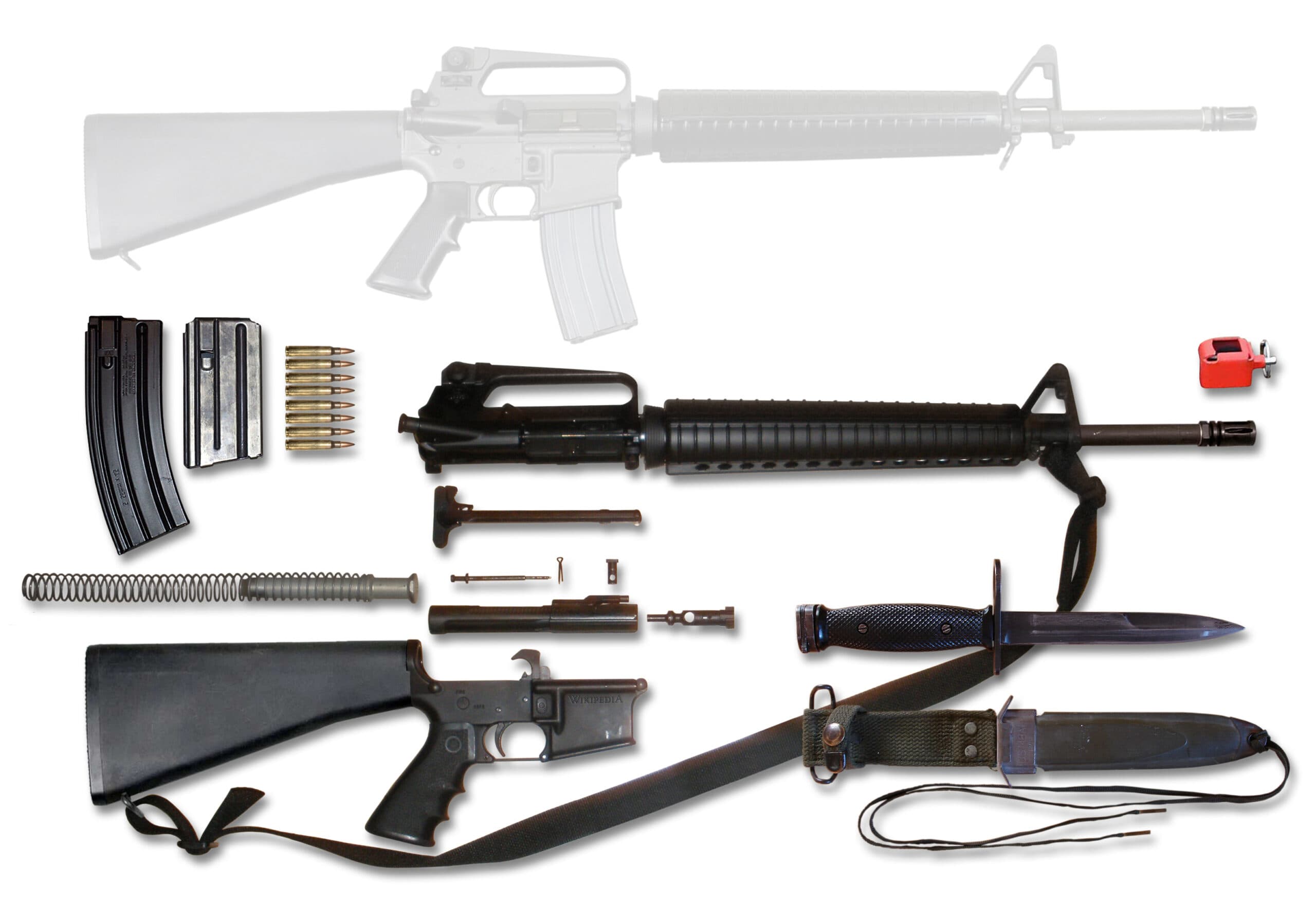
Early “slab-side” rifles generally lack the protective fence around the magazine release. Subsequent configurations added features such as the forward assist, revised receiver fencing, and later a case deflector. A2-pattern rifles are commonly identified by their adjustable rear sight, revised furniture, and associated receiver profile. A4-pattern rifles replace the integral carrying handle with a Picatinny rail and detachable rear-sight assembly.
These labels are useful shorthand, but they are not proof of factory configuration. Colt produced numerous commercial, military, export, and law-enforcement variants, and individual rifles may have been repaired or rebuilt during decades of ownership.
Inspect whether the upper receiver, barrel profile, front-sight base, handguards, stock, and controls make sense together. A period-correct collection of parts is not necessarily an original factory assembly.
Pins, Internal Blocks, and Parts Compatibility
Older commercial Colt rifles can differ from later AR-pattern rifles in pivot-pin and fire-control-pin dimensions. Some also contain internal receiver features intended to obstruct the installation of automatic-fire components. These may appear as a raised internal shelf or a separately pinned block.
Do not identify these features from the model nickname alone. With the rifle unloaded and the upper receiver separated according to the manufacturer’s instructions, inspect the lower receiver directly. Measure the pins if replacement parts or a different upper receiver are contemplated.
A pivot-pin adapter may permit certain mismatched upper and lower receivers to be joined, but its presence is evidence that the components were not designed around the same pivot dimension. Likewise, a replacement trigger must be compatible with the individual lower receiver. Colt advises that replacement parts be installed correctly and warns against repairs or modifications without appropriate expertise.[3]
For collectors, originality should take priority over convenience. Cutting an internal block, enlarging holes, or otherwise modifying a serialized receiver can permanently impair both historical integrity and value.
Read the Barrel and Upper Receiver Separately
Barrel markings can help establish the stated chambering, rifling twist, inspection history, and manufacturer. Their location varies, and handguards or free-floating rails may conceal them. Record the complete marking exactly as applied rather than translating it from memory.
A Colt-marked barrel does not prove that the entire upper receiver left the factory as one assembly. Similarly, small symbols on a forged upper receiver generally identify a forging source; they should not be treated as a production date without independent documentation.
Check the front-sight base or gas block for alignment, the muzzle crown for damage, and the barrel extension and feed ramps for irregular wear or obvious alteration. Compare finish, wear, staking, and tool marks across adjoining parts. Perfectly matching appearance is not required, but conspicuous differences deserve an explanation.
Inspecting the Bolt-Carrier Group
Colt’s current military and law-enforcement literature identifies features such as high-pressure and magnetic-particle inspection, chrome-lined carriers, and staked gas keys on specified M5 and Enhanced Patrol Rifle configurations.[4] Those specifications apply to the listed factory products; they do not authenticate an unmarked carrier found in an older rifle.
During inspection, look for displaced metal securing the gas-key screws, even bearing wear along the carrier, damage to the bolt lugs, erosion around the bolt face, and a chipped or visibly damaged extractor. Any suspected crack, unsafe wear pattern, or uncertain component should be evaluated by a qualified armorer before firing.
Follow the applicable Colt manual when disassembling or maintaining the rifle. Colt’s AR-15 manual provides the manufacturer’s safety and operating instructions, while the LE6940 manual documents the procedures and specifications for that particular carbine family.[5][6]
Understanding Law-Enforcement Markings
Many Colt receivers manufactured during the 1994–2004 federal restrictions bear language such as “RESTRICTED LAW ENFORCEMENT/GOVERNMENT USE ONLY.” Federal regulations required the prescribed marking on covered semiautomatic assault weapons manufactured after September 13, 1994.[7]
The federal restrictions expired on September 13, 2004. ATF subsequently confirmed that the affected firearms no longer required the restricted-use marking and that, under federal law, otherwise lawful firearms bearing it could be transferred to and possessed by civilians. State and local restrictions remained unaffected.[8]
The marking is therefore evidence of a regulatory period, not proof of agency issuance or service. Claims that a particular rifle was police-issued require supporting records, property markings, departmental documentation, or other credible provenance.
Model Codes in Context
The LE6920 became a familiar designation for Colt’s 16-inch M4-pattern semiautomatic carbine. In 2017, Colt introduced the LE6920-R Trooper with a 16.1-inch barrel and a 13-inch Centurion Arms free-floating M-LOK handguard.[9] The later CR6920 designation belongs to Colt’s commercial carbine nomenclature, but a model code alone should never substitute for inspecting the rifle’s actual configuration.
Colt’s current military and law-enforcement catalog shows how far the platform has developed. The M5 incorporates a free-floating M-LOK handguard, an uninterrupted top rail, an improved barrel-retention interface, and ambidextrous selector, magazine, and bolt controls. Current M5 listings include 10.3-, 11.5-, 14.5-, and 16.1-inch configurations. The Enhanced Patrol Rifle II family includes 11.5- and 16.1-inch models with free-floating rails and ambidextrous controls.[10]
These current specifications should not be projected backward onto older rifles. Colt has changed configurations, suppliers, markings, and commercial packages over time.
A Disciplined Inspection Sequence
Before handling any firearm, obtain the owner’s permission, point it in a safe direction, remove the magazine, open the action, and verify that the chamber is empty.
Then proceed in a fixed order:
- Record the lower-receiver markings and serial number.
- Compare the serial information with Colt’s lookup and any available factory documentation.
- Examine the upper-receiver type, sights, barrel profile, gas system, handguards, and stock.
- Record every visible barrel and component marking.
- Inspect pivot and fire-control pins for nonstandard dimensions or alteration.
- Examine the lower receiver for an internal shelf or pinned block.
- Check the bolt, carrier, gas key, extractor, feed ramps, bore, and crown for damage or inconsistent wear.
- Look for refinishing, restaking, replaced fasteners, adapter bushings, or other evidence of alteration.
- Function-check the controls only in accordance with the correct manual.
- If originality or safety remains uncertain, stop and obtain an expert examination.
Short-barreled configurations require particular care. Under federal law, a shoulder-fired rifle with a barrel shorter than 16 inches is generally subject to the National Firearms Act, as is a weapon made from a rifle that falls below the applicable barrel or overall-length threshold. Configuration and registration questions should be resolved before possession or assembly, not afterward.[11]
Why Documentation Matters
A collectible Colt is more than its rollmark. Its value and historical significance depend on the relationship between the serialized receiver, its installed components, its condition, and its documented history.
A credible evaluation distinguishes among three different propositions: the parts are Colt-made, the parts are appropriate for the production period, and the rifle retains its original factory configuration. Those propositions are not interchangeable.
Measure rather than assume. Record markings rather than paraphrase them. Treat undocumented stories as stories. When originality carries a premium, factory or institutional documentation is stronger evidence than appearance alone.
Frequently Asked Questions
Can a Colt serial number confirm a rifle’s original configuration?
Not by itself. Colt describes its online serial-number database as approximate, while an archive letter may provide more definitive factory information when records survive.
Does a Colt-marked barrel prove the upper receiver is original?
No. It establishes the barrel’s marking but does not prove that the barrel and upper receiver were assembled together at the factory.
What does a “Restricted Law Enforcement/Government Use Only” marking mean?
The marking generally identifies a receiver made under requirements associated with the 1994–2004 federal restrictions. It does not prove that the firearm was issued to or used by a law-enforcement agency.
Why should collectors inspect pin dimensions and internal receiver features?
Some older commercial Colt receivers use dimensions or internal features that affect parts compatibility. Direct inspection and measurement are more reliable than assumptions based on a model nickname.
What is the best evidence of an original Colt AR-15?
The strongest assessment combines physical examination, consistent period-correct components, and credible factory or institutional documentation. No single marking proves complete factory originality.
Sources
- Colt’s Manufacturing Company, Serial Number Lookup.
- Colt’s Manufacturing Company, Archive Services.
- Colt’s Manufacturing Company, Service and Parts Guidance.
- Colt’s Manufacturing Company, 2024 Military and Law Enforcement Overview.
- Colt’s Manufacturing Company, Colt AR-15 Semiautomatic Rifles and Carbines Manual.
- Colt’s Manufacturing Company, LE6940 Advanced Law Enforcement Carbine Manual.
- Bureau of Alcohol, Tobacco, Firearms and Explosives, Implementation of Public Law 103-322.
- Bureau of Alcohol, Tobacco, Firearms and Explosives, Sunset of the Federal Semiautomatic Assault-Weapons and Large-Capacity Magazine Bans.
- Colt’s Manufacturing Company, Colt Introduces the Trooper Patrol Carbine.
- Colt’s Manufacturing Company, 2026 Military and Law Enforcement Catalog.
- Bureau of Alcohol, Tobacco, Firearms and Explosives, National Firearms Act Questions and Answers.
As a firearms enthusiast with a background in website design, SEO, and information technology, I bring a unique blend of technical expertise and passion for firearms to the articles I write. With experience in computer networking and online marketing, I focus on delivering insightful content that helps fellow enthusiasts and collectors navigate the world of firearms.
Comments
Be the first to leave a comment.
Be the first to read new editorial features, collector guides, and brand spotlights.