Key Takeaways
- The Astra Model 400 used a fixed barrel and direct-blowback action, requiring a heavy slide and powerful recoil spring.
- Star’s early service pistols used a locked-breech system influenced by the Colt M1911 but remained distinct Spanish designs.
- Serial numbers, proof marks, original components, and documented provenance are essential when evaluating contract pistols.
Spain’s early 20th-century service pistols emerged from the Basque Country, one of Europe’s most concentrated gunmaking regions. Astra and Star became its best-known handgun manufacturers, but they approached the same military market from different mechanical directions. Astra relied on a fixed barrel and direct-blowback action; Star developed locked-breech pistols influenced by the Colt M1911.
The result was two recognizable families of Spanish arms whose histories encompass government procurement, the Spanish Civil War, German wartime contracts, and decades of commercial export.
The Basque Gunmaking Industry
Star was the commercial brand of Bonifacio Echeverría’s company in Eibar, Gipuzkoa. The business was established in 1908, although the Echeverría family had manufactured firearms earlier. It adopted the Star name in 1919.[1]
Astra originated with Esperanza y Unceta, founded in Eibar by Juan Esperanza and Pedro Unceta. The company relocated to Gernika-Lumo in 1913, placing its principal factory west of Eibar.[2] Both firms operated within a regional industrial network that supplied military, police, and civilian customers in Spain and abroad.
The companies’ defining service pistols were chambered for 9 mm Largo, commonly designated 9×23 mm. This was the cartridge used in Spain’s Campo-Giro service pistol before the adoption of the Astra Model 1921.[3] Despite their similar bullet diameters, 9 mm Largo and 9×19 mm Luger are dimensionally distinct cartridges and should not be treated as interchangeable.
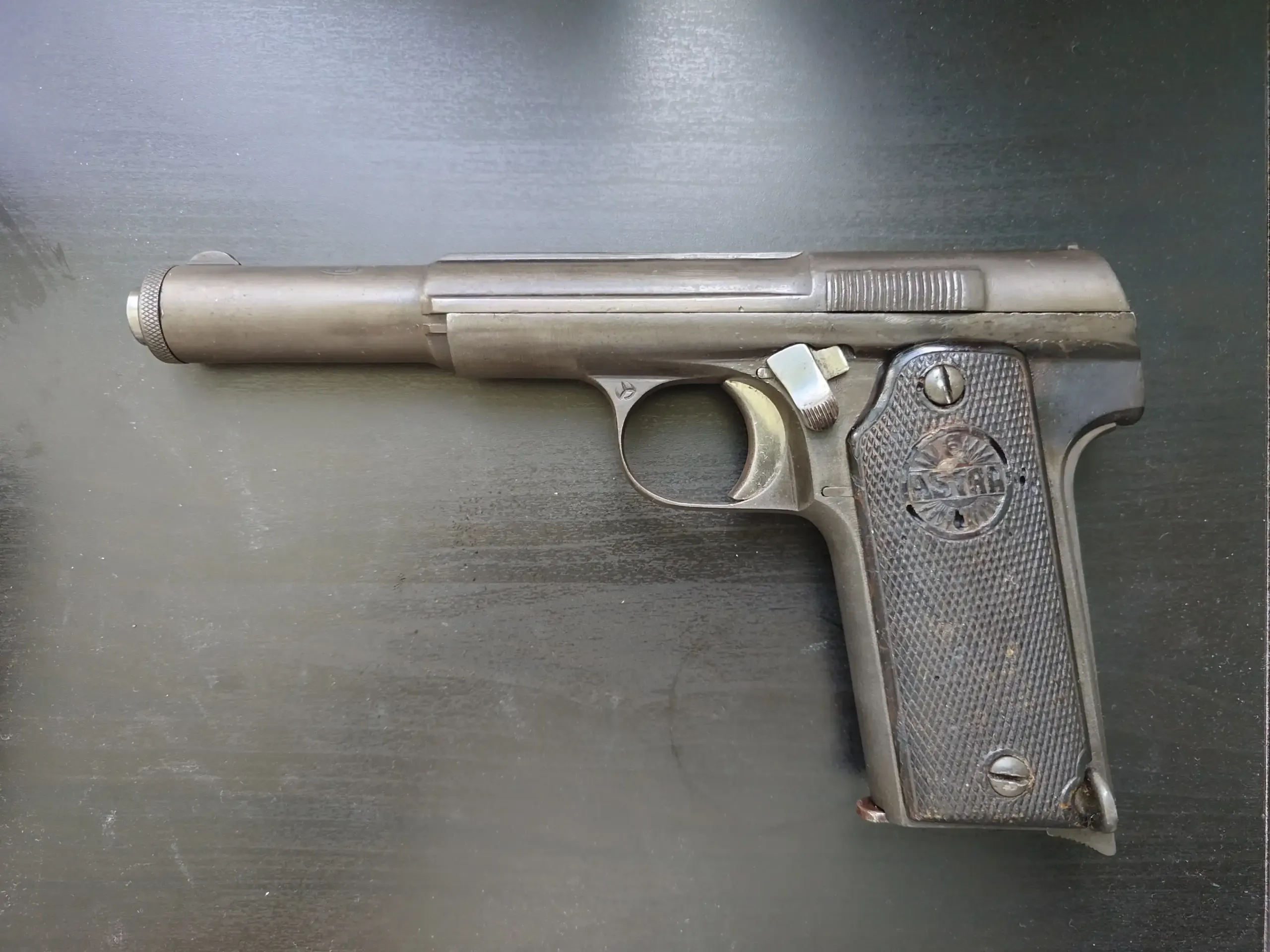
The Astra Model 1921, or Model 400
In 1921, the Spanish government evaluated replacements for the Campo-Giro. Astra submitted the pistol that became known commercially as the Model 400, while Star entered its Model 1920 and Model 1921 designs. The Astra prevailed, and a Royal Order dated September 26, 1921, adopted it as the “Astra Model 1921 Pistol.” The Royal Carabiner Corps, prison service, and Spanish Navy subsequently adopted it as well.[2]
The Model 400 is a substantial, all-steel pistol with a fixed barrel, internal hammer, tubular slide, and direct-blowback operation. The breech is held closed by the mass of the slide and the resistance of the recoil spring rather than by a locked barrel-and-slide assembly.
Applying this system to the 9 mm Largo service cartridge required a heavy slide and powerful recoil spring. These features account for the pistol’s characteristic weight and the effort needed to retract its slide.[3] Its mechanical simplicity distinguished it from locked-breech military pistols such as Star’s competing designs.
The Astra factory in Gernika came under the control of the Basque government during the Spanish Civil War. Model 400 production was directed to the Republican war effort until Nationalist forces captured the area in 1937. The model was ultimately used by both sides of the conflict.[4]
Collectors should interpret surviving Model 400 pistols through their complete physical configuration. Serial numbers, manufacturer inscriptions, proof marks, grips, finish, and other features are most useful when considered together. Political control of the factory changed during production, and the company’s markings also evolved. No single marking should establish a pistol’s history without corroborating evidence.
The Astra 300: A Compact Derivative
Astra extended the Model 400 concept into a smaller pistol designated the Model 300. Chambered in 7.65 mm Browning (.32 ACP) and 9 mm Corto (.380 ACP), it retained the fixed-barrel, direct-blowback layout and rounded profile of the larger pistol.[3]
The Model 300 measured slightly more than six inches overall and weighed approximately 22 ounces. Its smaller dimensions and internationally common chamberings made it more practical for police, military, and commercial use than the full-size Model 400.
German forces acquired Model 300 pistols in both calibers during the Second World War. Accepted examples may bear German military inspection marks.[3] The presence of such a mark, however, should agree with the pistol’s other production characteristics before it is accepted as evidence of a wartime contract.
The Astra 600/43 and the German Contract
German procurement requirements led Astra to adapt the Model 400 system to the standard German 9×19 mm cartridge. The resulting Model 600/43 retained a steel frame and slide, fixed barrel, internal hammer, concentric recoil spring, and direct-blowback action. It was shorter than the Model 400 and used a redesigned eight-round magazine.[5]
Astra sent 50 evaluation pistols to Germany in early 1944. German authorities subsequently placed a larger order, but the changing military situation in France interrupted deliveries. Only 10,500 Model 600/43 pistols reached German control before the delivery route closed. These German-accepted examples bear a WaA/D20 inspection mark on the right side of the frame.[5]
Astra continued manufacturing the pistol in Spain. After the war, the company sold Model 600/43 pistols to several foreign governments, with West German police becoming the largest postwar customer.[5]
The model’s history therefore includes several materially different groups: pistols accepted by Germany during the war, wartime production that could not be delivered, and pistols distributed under postwar contracts. Distinguishing among those groups is essential when assessing provenance and collector significance.
Star’s Locked-Breech Alternative
Star followed a different engineering path. Its early full-size service pistols took visible inspiration from the Colt M1911, but they were not interchangeable copies. Their construction, chambering, controls, and dimensions established a separate family of Spanish pistols.
The Star Model 1920 was a locked-breech, single-action pistol chambered for 9 mm Largo. Although it did not win the army competition, the Guardia Civil adopted the Star pattern. Star revised the design rapidly. The early series included changes to its safety arrangement, and the commercial Model A developed from these service pistols.[6]
Star’s locked-breech action allowed the barrel and slide to recoil together briefly before separating. The Astra Model 400, by contrast, kept its barrel fixed and depended upon slide mass and spring resistance. The two systems provide a direct comparison of how neighboring manufacturers addressed the same service cartridge and procurement environment.
Identification within the early Star family requires care. Sellers and collectors sometimes use “Model A” broadly for several related pistols. A defensible attribution should consider the safety arrangement, slide profile, extractor, frame contours, proof date, markings, and serial number.
Guardia Civil pistols may display a crowned “GC” emblem. That marking can be historically significant, but it should be evaluated with the pistol’s remaining features rather than treated as sufficient evidence by itself.
Evaluating Collectible Examples
Correct identification begins with the chambering. A Model 400 marked for 9 mm Largo should not be assumed to use 9 mm Luger simply because both cartridges are nominally 9 mm. The Astra 600/43 was specifically redesigned for 9×19 mm, while the Astra 300 was manufactured in .32 ACP and .380 ACP.[3][5]
Matching serial numbers, original magazines, intact proof marks, and an unaltered finish generally preserve more historical information than cosmetic appearance alone. Refinishing can soften or remove markings needed to place a pistol within its proper production period. Replacement grips, magazines, springs, and other components also affect originality and should be identified.
Contract attribution demands an especially high evidentiary standard. German acceptance marks, Guardia Civil emblems, naval markings, and other institutional stamps may be important, but they should correspond with documented production characteristics. Provenance is strongest when physical evidence is supported by period paperwork, factory records, or an established institutional collection.
Astra and Star pistols remain significant because they preserve two competing solutions to Spain’s interwar service-pistol requirements. The Astra Model 400 is a notable example of a full-size military pistol using direct blowback with a service cartridge. Star’s early service line demonstrates how an Eibar manufacturer adapted a locked-breech, single-action pattern to Spanish requirements.
Their importance extends beyond mechanical design. Properly documented examples preserve evidence of Basque industrial history, Spanish government procurement, civil-war production, and international arms contracts. For collectors, that evidence—not an unsupported story attached to a pistol—is the foundation of historical and monetary value.
Frequently Asked Questions
- What is the difference between the Astra Model 400 and Star’s early service pistols?
The Astra Model 400 used direct-blowback operation with a fixed barrel. Star used a locked-breech system in its full-size service-pistol line. - What cartridge does the Astra Model 400 use?
The Model 400 was chambered for 9 mm Largo, commonly designated 9×23 mm. It should not be confused with 9×19 mm Luger. - Why is the Astra Model 400’s slide difficult to retract?
Its direct-blowback system requires a heavy slide and powerful recoil spring to manage the 9 mm Largo cartridge. - Why was the Astra 600/43 developed?
Astra developed it to meet German demand for a pistol chambered in 9×19 mm. It retained the Model 400’s direct-blowback operating principle. - How should collectors evaluate an Astra or Star contract pistol?
They should examine the complete firearm, including its serial number, proof and acceptance marks, finish, and original components. Contract provenance is strongest when supported by reliable records or period documentation.
Sources
- Arms Industry Museum of Eibar, “Star Shotgun Damasquined by Lucas Alberdi.”
- Arms Industry Museum of Eibar, “Astra Model 1921 Semi-Automatic Pistol.”
- American Rifleman, “I Have This Old Gun: Astra A300,” April 14, 2021.
- Eibar Civil War Front Interpretation Project, “Weapons Used and Remains Found at Akondia.”
- Martin K. A. Morgan, “I Have This Old Gun: Astra 600/43,” American Rifleman, October 9, 2023.
- Ian McCollum, “Star Model A Carbine,” Forgotten Weapons, January 21, 2017.
As a firearms enthusiast with a background in website design, SEO, and information technology, I bring a unique blend of technical expertise and passion for firearms to the articles I write. With experience in computer networking and online marketing, I focus on delivering insightful content that helps fellow enthusiasts and collectors navigate the world of firearms.
Comments
Be the first to leave a comment.
Be the first to read new editorial features, collector guides, and brand spotlights.