Key Takeaways
- The Model 1903 was chambered in .32 ACP, while the closely related Model 1908 used .380 ACP.
- “Hammerless” refers to the pistol’s smooth exterior profile; its hammer is enclosed within the slide.
- Reliable authentication requires consistent physical features and supporting documentation, particularly for claimed government-service pistols.
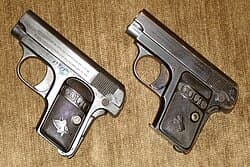
John M. Browning’s Colt Pocket Hammerless is among the most recognizable American pocket pistols of the early 20th century. Colt introduced the .32-caliber version in 1903 and manufactured it through 1945. The closely related .380-caliber pistol followed in 1908.[1][2] Collectors generally identify them as the Model 1903 and Model 1908, while Colt literature called the design its Pocket Model or Model M.[1][3]
Browning’s Concealed-Hammer Design
“Hammerless” describes the pistol’s exterior profile rather than its firing mechanism. The Model M has a conventional hammer, but the rear of the slide completely encloses it. Browning’s patent describes a firearm in which the firing mechanism, apart from the trigger, is enclosed and concealed.[4] Eliminating an exposed hammer spur gave the pistol a smooth profile appropriate for pocket or concealed carry.
The Model M is a blowback-operated semiautomatic. When a cartridge is fired, rearward movement of the slide extracts and ejects the empty case, cocks the hammer, and compresses the recoil spring. The spring then drives the slide forward, stripping another cartridge from the magazine and chambering it. The trigger must be pressed separately for each shot.[3][4]
Browning’s patent emphasized simplicity, reliability, safety and tool-free barrel removal. It describes a barrel rigidly held to the frame during operation but readily detachable for cleaning or maintenance. The patent also explains how the slide, breechblock and recoil spring work together during the operating cycle.[4] These features contributed to a compact design with relatively few external projections.
The principal user-operated controls are a frame-mounted manual safety, a grip safety and a heel-mounted magazine catch. The manual safety can also retain the slide in the position required for disassembly. The grip safety must be depressed before the trigger can complete its movement. Colt’s factory instructions illustrate the controls, loading procedure and takedown sequence for both calibers.[3]
The standard Model 1903 has a 3¾-inch barrel, an overall length of approximately 6¾ inches and an unloaded weight of about 24 ounces. Its detachable magazine holds eight 32 ACP cartridges. Fixed sights, a narrow slide and the enclosed hammer kept the pistol’s exterior compact and comparatively free of projections.[1]
Model 1903 and Model 1908
The Model 1903 is chambered for .32 ACP, while the Model 1908 fires .380 ACP. Externally, the two pistols are closely related and share the same basic operating system. Internally, however, Colt configured their barrels, slides, recoil systems, and magazines for different cartridges. Components should therefore be identified by model and caliber rather than assumed interchangeable because they appear similar.[3]
The .380 version entered production in 1908. According to a history published by the United States Marine Corps, Browning and William M. Thomas of the Union Metallic Cartridge Company collaborated on the .380 cartridge’s development.[2] The new chambering allowed Colt to offer the established Pocket Hammerless format with a larger-diameter cartridge while retaining the design’s compact proportions.
Period Colt advertising emphasized the pistol’s flat, smooth-sided construction. One particularly effective phrase described it as “flat as a book.”[2] That language captured the Model M’s principal commercial advantage: it provided a repeating semiautomatic mechanism in a package designed around discreet carriage rather than military holsters or target shooting.
Production Changes and Collector Types
The Model M was not mechanically or cosmetically static. Colt made changes during its long production life, and collectors now group Model 1903 pistols into several types. Distinguishing features include barrel and barrel-bushing construction, slide length, slide serrations, extractor form and safety configuration. Grip materials, medallions and slide inscriptions also changed.[1]
The earliest Model 1903 pistols used a separate barrel bushing. Colt later adopted a barrel with an integral forward lug, eliminating the separate bushing. The fixed sights remained deliberately small, consisting of a low front blade and a correspondingly modest rear notch. The magazine continued to be retained by a latch at the heel of the grip.[1]
Grip panels are another useful, but not conclusive, dating feature. Earlier pistols commonly have molded hard-rubber grips bearing Colt’s rampant-horse trademark. Walnut grips with Colt medallions became customary later in production. Special-order grip materials were also available.[1] Because grips are readily replaced, their style must agree with the pistol’s other characteristics before it can support a claim of originality.
Museum records demonstrate the importance of evaluating several features together. The Imperial War Museums’ description of a documented 1921 Model 1903 separately identifies its slide inscriptions, triangular serrations, safety pattern, extractor, grips, proof marks and government markings.[5] That method is more reliable than assigning a date or type from one conspicuous feature.
The same caution applies to finish. Blue was the typical commercial finish, although other factory finishes existed. Some pistols were subsequently refinished during government service or in private ownership.[1][5] Refinishing may soften frame contours, round slide edges, reduce the depth of inscriptions or leave polishing patterns inconsistent with factory work. A finish should be judged in relation to the pistol’s markings, configuration and documented history.
Documented Government Service
Although the Model M originated as a commercial pocket pistol, documented examples entered government service. Imperial War Museums records that Britain’s War Office purchased 3,300 Model 1903 pistols from commercial stocks in 1921, apparently for anticipated service in Ireland. Many were later transferred to the Royal Air Force during the Second World War, and some may also have been associated with the Special Operations Executive.[5]
The museum’s collection example bears British ownership, Enfield inspection and Royal Air Force markings. It also retains a serial number and a combination of physical features that allow the institution to identify its production date and configuration.[5] Such a documented pistol illustrates why genuine government provenance depends on more than a property stamp: the markings, serial number, finish and physical features must form a historically coherent whole.
In the United States, Model 1903 pistols were issued as general-officer sidearms beginning in the 1940s and remained in that role until 1972. Model M pistols also saw wartime use through the Office of Strategic Services.[1] These associations have made government-marked examples especially desirable, but they have also created an incentive for added or misleading markings. A marking is evidence only when its form, placement, age, and relationship to the rest of the pistol can withstand scrutiny.
The National Museum of the Marine Corps holds a Model 1908, serial number 97058, formerly owned by Major General Douglas C. McDougal. The pistol entered the museum through McDougal’s family in 1974 with a notation stating that it had been taken from a murderer in Nicaragua in 1930.[2]
The museum’s treatment of that account is appropriately restrained. Its curators preserved the family notation but acknowledged that the circumstances under which McDougal obtained the pistol remain unknown.[2] For collectors, the distinction is fundamental: a documented family attribution is part of an object’s provenance, but it does not independently prove every event described in the accompanying story.
Evaluating a Pocket Hammerless
Evaluation should begin with the pistol itself. Record the serial number, caliber marking, slide inscriptions, grip style, safety configuration, extractor form, slide serrations, and finish. These characteristics should be compared as a group with documented examples and established production types.[1][5] A single apparently correct component cannot authenticate an otherwise inconsistent pistol.
The serial number must be present and legible, but it should not be treated as complete evidence by itself. A plausible manufacturing date does not prove that the slide, barrel, grips, magazine or finish are original to the frame. Conversely, a replaced grip panel or magazine does not necessarily invalidate an otherwise significant pistol. The collector’s task is to identify what remains original, what may have been replaced, and whether any alteration has been accurately disclosed.
Magazine identity also deserves attention. The .32 and .380 pistols require caliber-appropriate magazines.[3] Inspect the magazine’s caliber marking, body, feed lips, follower, and floorplate rather than relying solely on whether it enters the grip. An incorrect or altered magazine affects both function and the completeness of a collector example.
Mechanical condition should be considered independently from cosmetic condition. The manual safety and grip safety should operate correctly, while the slide, frame and barrel should be examined for cracks, deformation, excessive wear or inappropriate modification. A pistol can retain substantial original finish yet be mechanically deficient; another may show honest carry wear while remaining internally coherent.
Claims of military ownership, presentation, special order or association with a notable person require proportionately strong evidence. Period records, institutional documentation, authenticated correspondence and an uninterrupted ownership history carry more weight than an uncorroborated account. The McDougal pistol demonstrates both sides of responsible provenance: its ownership by the general is documented, while the story of its acquisition in Nicaragua remains qualified.[2]
The strongest Model M examples are internally consistent. Their markings, finish, grips and mechanical features agree with one another and with reliable historical records. Documented provenance may elevate an otherwise standard pistol, but an appealing story cannot substitute for evidence. The lasting importance of the Model 1903 and Model 1908 rests on Browning’s compact engineering, Colt’s long production history and the survival of individual pistols whose physical details can still be examined against contemporary documentation.
Frequently Asked Questions
Who designed the Colt Pocket Hammerless?
John M. Browning designed the pistol’s operating system and concealed-hammer configuration.
What is the difference between the Model 1903 and Model 1908?
The Model 1903 is chambered in .32 ACP, while the Model 1908 is chambered in .380 ACP. Although closely related, their caliber-specific parts and magazines should not be treated as interchangeable.
Is the Colt Pocket Hammerless truly hammerless?
No. It has a hammer, but the slide encloses it to create a smooth exterior profile.
Did governments use the Colt Pocket Hammerless?
Yes. Documented examples served with British and American government organizations, including use as United States general-officer sidearms.
What should collectors examine before buying one?
Collectors should compare the serial number, markings, finish, grips, safety configuration, extractor, and slide serrations. Claims of military service or notable ownership require credible supporting documentation.
Sources
- Campbell, Dave. “The 1903 Colt: A Look Back.” American Rifleman, March 18, 2010.
- Houde, Alfred V., Jr. “In the Wrong Hands: A Colt Pocket Pistol.” Fortitudine, vol. 34, no. 1, 2009, pp. 11–12. United States Marine Corps History Division.
- Colt’s Patent Fire Arms Manufacturing Company. “Automatic Pistol, Pocket Model, Calibers .32 and .380 Hammerless: Instructions for Operation and Care.” Colt factory instruction manual.
- Browning, John M. “Automatic Firearm, U.S. Patent No. 747,585.” Filed April 3, 1902; issued December 22, 1903.
- Imperial War Museums. “Colt M1903 Pocket Hammerless (Model M).” Collection record FIR 3069.
As a firearms enthusiast with a background in website design, SEO, and information technology, I bring a unique blend of technical expertise and passion for firearms to the articles I write. With experience in computer networking and online marketing, I focus on delivering insightful content that helps fellow enthusiasts and collectors navigate the world of firearms.
Comments
Be the first to leave a comment.
Be the first to read new editorial features, collector guides, and brand spotlights.