Key Takeaways
- The British Army adopted the .455 Webley Mk I in 1887, beginning a six-model service series that culminated in the Mk VI.
- Adopted in 1915, the Mk VI featured a six-inch barrel, squared grip, six-shot cylinder, and simultaneous extraction.
- Collectors should verify markings, matching components, mechanical condition, provenance, and whether the cylinder was altered for .45 ACP ammunition.
Few British firearms are as immediately recognizable as a Webley service revolver. Press the stirrup-shaped latch, tip the barrel and cylinder downward, and the extractor rises to clear all six chambers. This top-break system, combined with a substantial frame and double-action lockwork, defined a succession of British military revolvers from the late Victorian era through the First World War.
Birmingham Origins
The business that became Webley & Scott traced its origins to William Davies, a Birmingham maker of bullet molds who established his concern around 1790. Philip Webley, Davies’s son-in-law, joined the family enterprise during the 1830s. The resulting business, eventually known as P. Webley & Son, developed from component production into the manufacture of complete firearms.[1]
This history belongs to Birmingham’s wider gun trade, where specialized barrel makers, lock filers, actioners, finishers, and stockers operated within a concentrated manufacturing district. Webley became particularly associated with revolvers, while W. & C. Scott & Son built its reputation largely on sporting guns.
The two firms did not merge in 1857, as some modern accounts claim. P. Webley & Son, W. & C. Scott & Son, and Richard Ellis & Son combined in 1897 to form the Webley & Scott Revolver & Arms Company Limited.[1] Surviving company records covering the period from 1897 onward are held by the Library of Birmingham, with their accession documented by Britain’s National Archives.[2]
The British Service Revolvers
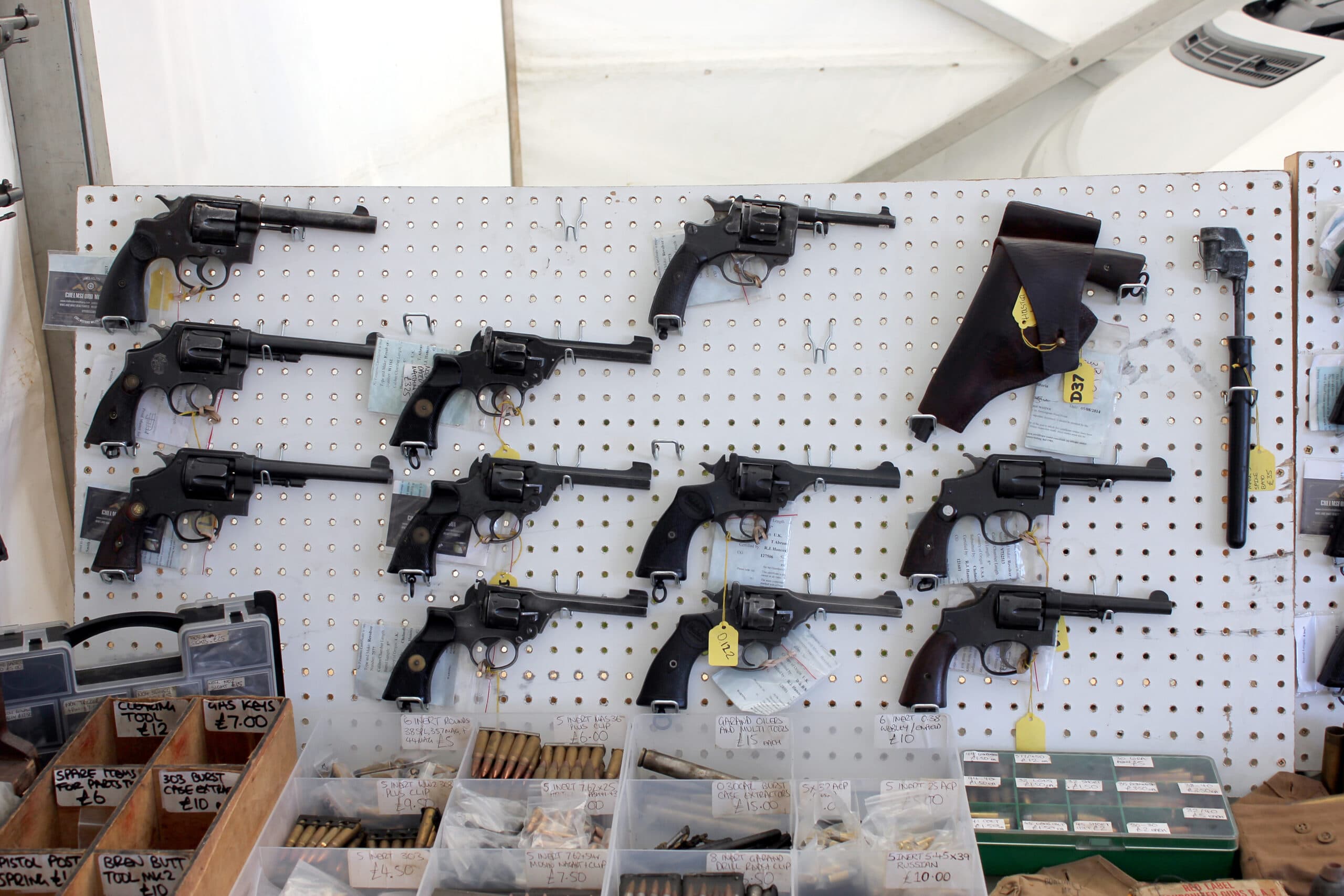
The British Army adopted the first .455-inch Webley service revolver, the Mk I, in November 1887. Five subsequent Marks followed, culminating in the Mk VI in 1915.[3] Although details changed, the principal service models shared a recognizable architecture: a hinged frame, simultaneous extraction, a six-shot cylinder, and a lock that permitted both double-action fire and deliberate single-action shooting.
When the latch was operated and the barrel tilted downward, a star extractor lifted the cartridge cases from the cylinder. Closing the action returned the extractor and locked the barrel assembly to the frame. The system allowed six chambers to be emptied in one movement rather than requiring each case to be removed separately.[4]
The sequence from Mk I through Mk V reflected continuing changes in ammunition and military requirements. The Royal Armouries records that the original .455 service cartridge was introduced as a black-powder round in 1892, followed by a cordite loading in 1894. The shorter-cased .455 Mk II cartridge, adopted in 1897, used a round-nosed bullet and became the standard loading associated with the Mk VI.[4]
The Mk VI
Adopted during the First World War, the Mk VI was the final and best-known member of the large-frame .455 service series. Its distinguishing features included a six-inch barrel, squared grip, removable front sight, six-round cylinder, and automatic extractor. A surviving 1916 example in the National Army Museum confirms the model’s wartime manufacture and .455-inch chambering.[5]
The Mk VI differed visibly from the Mk V, which had a shorter barrel and rounded “bird’s-head” grip. Its longer barrel and more angular grip gave the later revolver a larger profile, while its double-action mechanism still allowed the hammer to be cocked manually for a more deliberate trigger pull.[3][4]
The revolver became closely associated with British service during the First World War, although earlier Webley Marks and privately purchased handguns remained in use. Royal Armouries records describe Webley revolvers as standard arms for personnel including machine-gun crews, aircrew, raiding parties, tank crews, and naval personnel.[4]
Webley-manufactured Mk VI revolvers appeared from 1915 into the early 1920s. Production of the pattern also began at the government-owned Royal Small Arms Factory at Enfield in 1921 and continued there through 1926.[3] National Army Museum records include Enfield-made .455 Mk VI revolvers of the 1921 pattern, including an example manufactured in 1926 and another issued to the Royal Artillery in 1941.[6] An Enfield-marked Mk VI is therefore a government-produced example of the service pattern, not a Webley commercial product.
Although Britain moved toward smaller .380/200 service revolvers between the wars, .455 Mk VI revolvers remained in British and Commonwealth inventories during the Second World War. Royal Armouries places the broader Webley service family in military use from 1887 into the 1960s.[4]
Evaluating a Collectible Webley
A collectible Webley should be evaluated as an individual firearm rather than solely by its model designation. Markings, mechanical condition, originality, and documented provenance can be more consequential than generalized claims about a particular Mark.
The first step is precise identification. The collector should record the maker’s inscription, model designation, serial numbers, caliber marking, proof and inspection stamps, ownership marks, and any unit or issue markings. These should be compared across the frame, barrel, and cylinder. A historically plausible marking is not, by itself, proof of a particular service history or individual owner.
Mechanical examination should include the barrel-to-frame lockup, cylinder alignment, timing, extractor operation, bore, chambers, firing mechanism, and evidence of replaced or altered parts. Refinishing may soften edges, obscure markings, or change the appearance of surfaces that originally carried military inspection stamps.
American-market examples require particular attention. Many imported .455 Webleys had the rear of the cylinder machined to accommodate .45 ACP cartridges held in moon clips or .45 Auto Rim ammunition. This alteration can remove or partially erase markings around the rear of the cylinder and generally reduces collector interest compared with an otherwise equivalent, unaltered example.[3][7]
The alteration does not establish that ordinary factory-loaded .45 ACP ammunition is appropriate for the revolver. Published technical guidance warns that standard .45 ACP loads may generate excessive pressure for a Webley designed around the .455 service cartridge.[3] Ammunition decisions for any antique or historic revolver should follow a physical inspection by a qualified gunsmith familiar with the model.
Provenance should be treated just as carefully. A holster, lanyard, inscription, or family account may provide useful evidence, but association requires documentation connecting the firearm to the claimed owner or unit. The National Army Museum’s 1916 Mk VI attributed to Captain Claude Walter Thurston, for example, is supported by the museum’s cataloged acquisition record—not merely by the type of revolver or its date.[5]
Enduring Significance
The Webley service revolver’s importance lies less in legend than in continuity. Beginning with the Mk I in 1887, the British military adopted six successive large-frame Marks built around the same practical top-break and simultaneous-extraction concept. The Mk VI represented the mature form of that system: a six-shot, .455-caliber service revolver developed for wartime requirements and manufactured in both Birmingham and Enfield.
For collectors, these revolvers reward disciplined examination. Manufacturer and government markings distinguish Webley production from Enfield production; serial numbers and proofs help establish identity; and alterations such as a machined cylinder materially affect originality. Properly interpreted, those details place each surviving revolver within a documented history of British arms manufacture and military service.
Frequently Asked Questions
When did the British Army adopt the first Webley service revolver?
The British Army adopted the .455 Webley Mk I in November 1887.
What distinguishes the Webley Mk VI from earlier models?
The Mk VI has a six-inch barrel, squared grip, removable front sight, six-shot cylinder, and automatic extractor. Britain adopted it during the First World War in 1915.
Were all Mk VI revolvers manufactured by Webley?
No. Webley manufactured the Mk VI in Birmingham, while the Royal Small Arms Factory at Enfield produced the service pattern from 1921 through 1926.
Why do some Webley cylinders accept .45 ACP ammunition?
Many revolvers imported into the United States had their cylinders machined to accept .45 ACP cartridges in moon clips. This modification generally reduces collector interest and does not make standard-pressure .45 ACP ammunition safe for the revolver.
What should collectors inspect before buying a Webley?
Collectors should examine the markings, serial numbers, proofs, mechanical condition, finish, component originality, and cylinder configuration. Any claimed military or personal provenance should be supported by reliable documentation.
Sources
- University of Oxford, Pitt Rivers Museum, “London Gunmakers,” The Other Within: Analysing the English Collections at the Pitt Rivers Museum.
- The National Archives, “Major Accessions to Birmingham Archives and Heritage Service, 2006,” Webley & Scott Ltd. records, 1897–2006.
- James, Garry, “The Webley Mk VI: Construction & Disassembly,” American Rifleman, June 18, 2020.
- Royal Armouries, “Arms of the First World War,” Webley Mark VI Revolver collection profile.
- National Army Museum, “Webley Mk VI .455 Inch Service Revolver, 1916,” accession no. NAM.2003-06-55-1.
- National Army Museum, “Online Collection: Enfield .455-Inch Mk VI Service Revolvers,” collection records for the 1921 pattern.
- Schreier, Philip, “Classic Guns: Webley Mk V Revolver,” American Rifleman, January 30, 2020.
As a firearms enthusiast with a background in website design, SEO, and information technology, I bring a unique blend of technical expertise and passion for firearms to the articles I write. With experience in computer networking and online marketing, I focus on delivering insightful content that helps fellow enthusiasts and collectors navigate the world of firearms.
Comments
Be the first to leave a comment.
Be the first to read new editorial features, collector guides, and brand spotlights.