Key Takeaways
- Browning introduced the sporting BAR in 1967 following development by Bruce Browning and an FN design team led by Marcel Olinger.
- The 1993 Mark II added a revised gas system, a removable cross-pinned trigger group, and a separate bolt-lock control.
- Reliable identification requires agreement among the serial code, chambering, mechanical generation, finish, furniture, and magazine configuration.
The sporting Browning BAR is a gas-operated, semiautomatic hunting rifle, not a civilian version of the selective-fire M1918 Browning Automatic Rifle. The two firearms share a name and a manufacturer’s lineage, but they were developed for different purposes and use distinct mechanisms.[1]
Development of the Sporting BAR
Bruce Browning, grandson of John Moses Browning, was the principal figure behind the sporting BAR. He worked with an FN design team led by Marcel Olinger. Full-scale development of the project, designated “Carbine 66,” took place during 1966 in preparation for the rifle’s 1967 introduction.[1]
The original sporting BAR used a gas-operated action and a rotating bolt. Early rifles had scalloped receivers, a trigger assembly that required removal of the buttstock before it could be withdrawn, and either a right- or left-handed safety that was not reversible. Browning built every chambering on a long-action receiver.[1]
Browning commonly divides early production into two collector categories. Rifles made before 1976 are known as Type I models, while those made from 1976 through 1992 are generally called Type II rifles. The Mark II series followed in 1993.[1] Browning’s serial-number guide identifies the model code 137 for 1976 through 1992 BAR High Power rifles. For 1993 through 1997, code 107 denotes the Mark II Safari and code 1D7 identifies the Mark II Lightweight.[2]
These codes should be considered alongside the rifle’s markings, configuration, and period catalog information. Stocks, finishes, sights, and other components can be replaced, while the serial number and model code provide a more dependable starting point for identification.
The Mark II Revision
The 1993 Mark II incorporated several substantive mechanical and serviceability changes. Browning retained the trigger assembly with two transverse receiver pins, redesigned the gas system, and added a separate bolt-lock control that could hold the action open with or without a magazine installed. The hinged floorplate and removable magazine arrangement of the earlier rifle remained in production.[1]
The Mark II owner’s manual confirms that the rifle fires one cartridge with each pull of the trigger and locks its bolt open after the final cartridge has been fired. The magazine is attached to a hinged floorplate but can be removed from it by pulling the magazine away from the floorplate.[3]
These features provide practical identification points. A prospective collector examining an unloaded rifle can look for the two trigger-group pins, the separate bolt lock, and the hinged magazine assembly. Browning locates the Mark II serial number on the left side of the receiver above the trigger guard.[3]
ShortTrac and LongTrac
Browning introduced the BAR ShortTrac and LongTrac lines in 2004. Both used aluminum-alloy receivers, hammer-forged barrels, lighter profiles, and a shim system that allowed adjustment of stock dimensions.[4]
The ShortTrac was configured for shorter cartridges, while the LongTrac accommodated longer cartridges. A representative ShortTrac cataloged in 2009 was available in .243 Winchester, .308 Winchester, .270 Winchester Short Magnum, 7mm Winchester Short Magnum, and .300 Winchester Short Magnum. Contemporary LongTrac chamberings included .270 Winchester, .30-06 Springfield, 7mm Remington Magnum, and .300 Winchester Magnum.[5] Chambering selections changed during production, so a period catalog remains preferable to a generalized model list when documenting a particular rifle.
The ShortTrac and LongTrac retained the BAR’s gas operation and seven-lug rotating bolt. In the ShortTrac examined by American Rifleman, propellant gas acted on a short-stroke piston, which transferred movement through an inertia piece and action bars to unlock and cycle the bolt. The rifle had an aluminum receiver, a polymer trigger housing and floorplate, and a magazine attached to the hinged floorplate.[5]
Factory magazine capacity depended on both cartridge and BAR generation. Browning lists four-round magazines for several standard chamberings, including .243 Winchester, .308 Winchester, .270 Winchester, and .30-06 Springfield, while many magnum configurations use two- or three-round magazines. The company’s chart treats ShortTrac, LongTrac, Mark II, Lightweight Stalker, and Mark III magazines as separate model categories.[6] A spare magazine should therefore be matched to the rifle’s exact model and chambering rather than selected by cartridge name alone.
Safari, Lightweight, and Field Variants
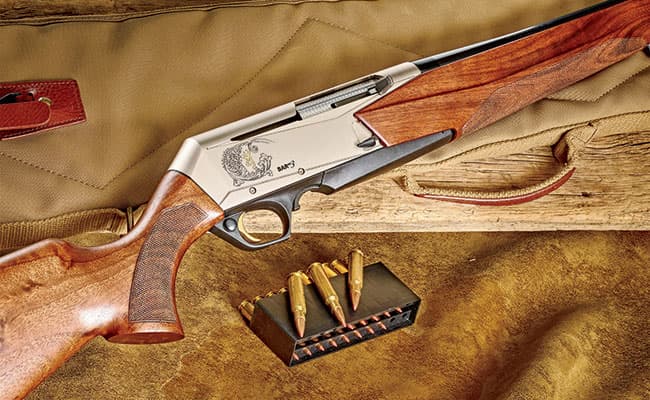
The Safari name is associated with traditional steel-receiver BARs, usually combining walnut furniture with engraved receiver surfaces. Browning’s serial-number records specifically identify the Mark II Safari under model code 107.[2] Condition assessment should distinguish normal handling wear from refinishing, buffing, recutting, or replacement wood. Softened engraving edges, rounded receiver contours, mismatched surface finishes, and damaged screw slots can indicate previous work.
Lightweight and Stalker configurations reduced weight or emphasized weather-resistant field finishes. The ShortTrac and LongTrac later extended that approach with alloy receivers and contemporary stock geometry.[4][5] Because Browning changed trim details and chambering combinations over time, model names alone do not establish a rifle’s original configuration. Receiver markings, serial-number coding, factory packaging, and the applicable catalog year should agree.
Some Mark II rifles were factory-equipped with Browning’s Ballistic Optimizing Shooting System, or BOSS. The system uses an adjustable muzzle weight to alter barrel vibration for a particular load. Browning issued separate BOSS component listings for BAR Mark II rifles in .243 Winchester, .270 Winchester, .308 Winchester, .30-06 Springfield, 7mm Remington Magnum, .300 Winchester Magnum, and .338 Winchester Magnum.[7]
On a BOSS-equipped rifle, the muzzle assembly should be checked for damaged threads, missing components, and evidence that a nonfactory device has been installed. Browning specifies that the threaded barrel is intended only for the corresponding BOSS components.[7]
The Current Mechanical Lineage
The BAR design has continued beyond the Mark II, ShortTrac, LongTrac, and Mark III families. Browning’s current BAR Mark 4 uses an aluminum-alloy receiver, a gas-operated action, and a seven-lug rotating bolt that locks into the barrel. It also retains a detachable box magazine carried on a hinged floorplate.[8]
The Mark 4 differs from earlier generations in its barrel-to-receiver interface. Browning threads the barrel into the receiver, a configuration the company states provides a more precise relationship among the barrel, chamber, and locking lugs. The action also incorporates an inertia-block linkage and an internal buffer intended to limit vibration, wear, and operating stress.[8]
These changes make “BAR” an insufficient description when ordering magazines, stocks, scope bases, or internal parts. Type I, Type II, Mark II, ShortTrac, LongTrac, Mark III, and Mark 4 rifles should be treated as distinct configurations.
Evaluating a Used Sporting BAR
Inspection begins with the magazine removed, the action open, and the chamber verified empty. Browning warns that removing the magazine does not establish that the chamber is unloaded.[3]
The serial number, model code, caliber marking, receiver finish, stock pattern, sights, and muzzle configuration should be recorded before assessing originality. Factory boxes, end labels, manuals, and dated sales documents can help establish configuration, but each should correspond to the firearm’s serial number and physical features.
The magazine should fit securely on its floorplate, and the floorplate should close without excessive movement. Feed lips should be even and undamaged, while the follower should travel freely. On ShortTrac and LongTrac rifles, the polymer components should be examined for cracking around the latch, hinge, and trigger housing.[5]
The bolt should move smoothly through its full travel. On Mark II and later hinged-floorplate models, the bolt lock and last-round hold-open function should be checked with appropriate inert testing materials or by a qualified gunsmith. Live ammunition is unnecessary for an initial mechanical inspection.
The bore, chamber, and muzzle crown should be examined for corrosion, fouling, damage, or an obstruction. Scope-base screws also deserve attention. Browning cautions that screws extending too far into the receiver can interfere with bolt movement.[3]
Oil-darkened or softened wood around the receiver and stock junction can signal excessive lubrication. Browning directs owners to use only a light film of oil and warns that oil poured into the receiver can drain into the wood, soften it, and loosen the stock.[3] Cracks around the wrist, forearm attachment points, and inletting should be evaluated before firing.
Browning permits removal of the Mark II trigger group by withdrawing its two receiver pins, but the company warns against further disassembly of the trigger group or bolt mechanism. Work beyond the procedures in the correct owner’s manual belongs with a qualified gunsmith.[3]
For collectors, the strongest sporting BARs are not defined by a single trim name. They are examples whose serial coding, chambering, mechanical generation, finish, furniture, magazine, and documented history form a consistent whole.
Frequently Asked Questions
Is the sporting Browning BAR related to the military M1918 BAR?
The rifles share the Browning name and design lineage, but they are mechanically distinct firearms developed for different purposes. The sporting BAR is a semiautomatic hunting rifle.
When was the sporting Browning BAR introduced?
Browning introduced the sporting BAR in 1967 after full-scale development during 1966.
What is the difference between Type I, Type II, and Mark II BAR rifles?
Browning generally identifies pre-1976 rifles as Type I and rifles made from 1976 through 1992 as Type II. The Mark II arrived in 1993 with changes to the gas system, trigger-group retention, and bolt-lock control.
What do ShortTrac and LongTrac mean?
The ShortTrac was configured for shorter cartridges, while the LongTrac accommodated longer cartridges. Browning introduced both lines in 2004 with aluminum-alloy receivers and adjustable stock shims.
What should collectors examine on a used sporting BAR?
Confirm that the serial coding, chambering, receiver, stock, magazine, and mechanical features correspond to the claimed model and production period. Also inspect the bore, crown, stock inletting, floorplate, magazine, scope-mounting screws, and operating controls.
Sources
[1] Browning. “A Brief History of the Browning BAR.” Browning, July 26, 2009.
[2] Browning. “BAR High-Power Rifle.” Browning, n.d.
[3] Browning. Browning BAR Mark II Rifle Owner’s Manual. n.d.
[4] Browning. “Historic Timeline.” Browning, n.d.
[5] NRA Staff. “Browning BAR ShortTrac .270 WSM.” American Rifleman, May 12, 2009.
[6] Browning. “What’s the Magazine Capacity of the BAR?.” Browning, n.d.
[7] Browning. BOSS Owner’s Manual. n.d.
[8] Browning. “BAR Mark 4 Overview.” Browning, n.d.
As a firearms enthusiast with a background in website design, SEO, and information technology, I bring a unique blend of technical expertise and passion for firearms to the articles I write. With experience in computer networking and online marketing, I focus on delivering insightful content that helps fellow enthusiasts and collectors navigate the world of firearms.
Comments
Be the first to leave a comment.
Be the first to read new editorial features, collector guides, and brand spotlights.