Key Takeaways
- Matching numbers support originality, but they do not prove that every component remains in its issued configuration.
- Condition should be judged through the bore, mechanics, finish, stock, markings, and evidence of repairs or refinishing.
- Buttplate tags, accessories, and uncommon markings add historical value only when their connection to the rifle can be verified.
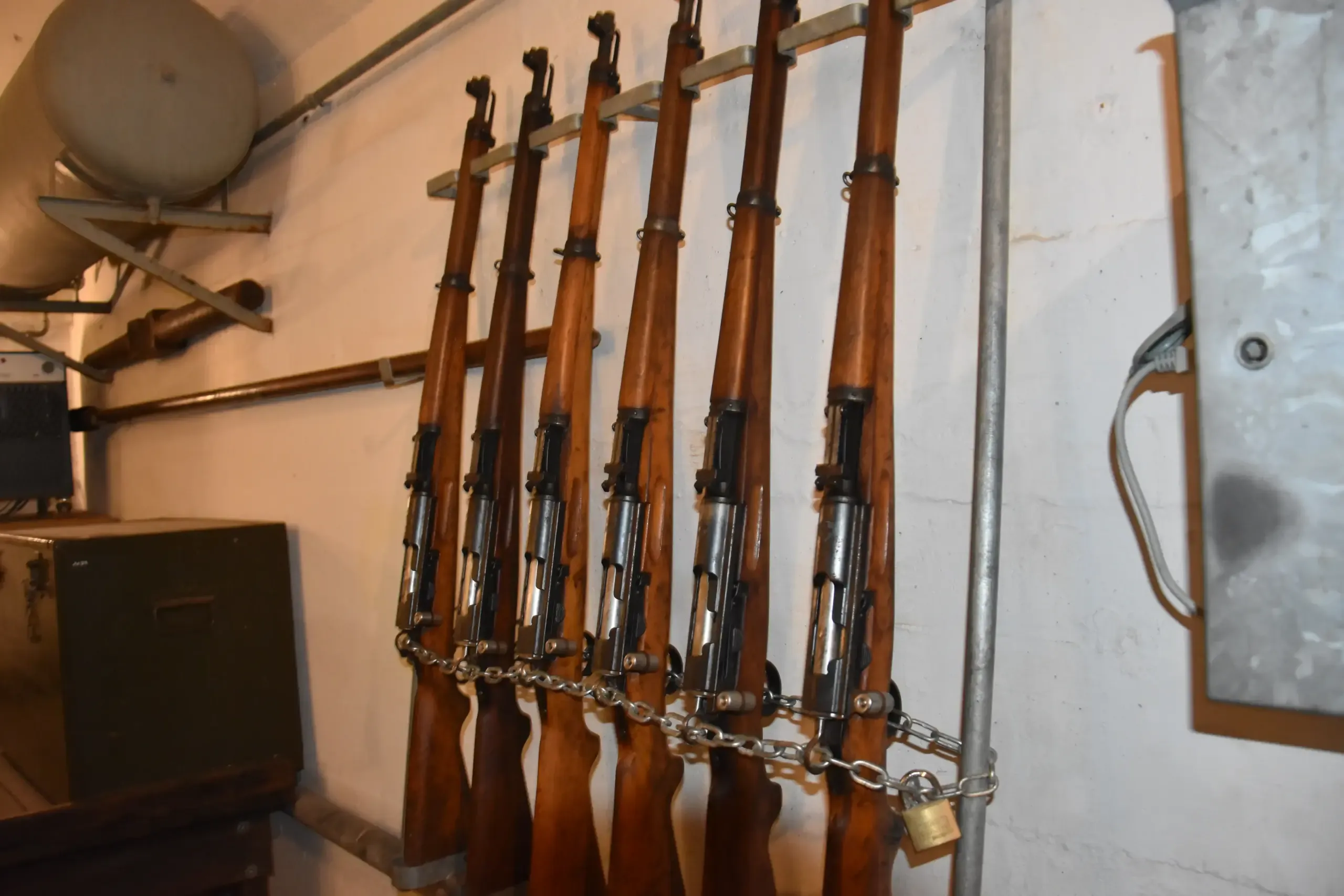
The Swiss Karabiner 31, commonly called the K31, is a straight-pull service rifle chambered for Switzerland’s 7.5 mm cartridge. Its careful manufacture, distinctive mechanism, and long association with Swiss military marksmanship have made it one of the most recognizable European service rifles on the collector market.
Although the K31 belongs to the broader lineage of Swiss straight-pull rifles, calling it a “Schmidt-Rubin” can be misleading. Rudolf Schmidt developed the action associated with Switzerland’s earlier Model 1889 rifle, while Eduard Rubin’s work contributed to the country’s small-caliber military ammunition. The K31 was a later federal design with a substantially revised, shorter locking system.
The K31 in Swiss Service
The K31 was already recognized as an authorized service arm in Swiss military regulations issued in 1939. Those regulations listed it alongside the Model 1911 carbine and the Models 1889, 1896/11, and 1911 rifles for designated personnel.[1]
A 1967 Swiss Army armorer’s manual described the K31 as an individual soldier’s repeating weapon fitted with a straight-pull action. The manual also treated it as a precision arm and documented its use with specialized launchers for rifle grenades and smoke grenades.[2]
The rifle remained connected to Switzerland’s shooting culture after newer service arms appeared. Current Swiss Army regulations still identify approved sights, slings, bolt handles, stock extensions, and magazines for the K31 and other regulation rifles used in federal shooting programs.[3]
Mechanical and Physical Specifications
The K31’s action is operated by drawing the bolt handle directly rearward and then pushing it forward. Internal helical surfaces translate that linear movement into the rotation required to unlock and lock the bolt.
According to the 1967 Swiss Army manual, the standard K31 has:
- A 652 mm barrel
- A nominal caliber of 7.51 mm
- Four-groove, right-hand rifling with a 270 mm twist
- A 568 mm sighting radius
- A tangent rear sight graduated from 100 to 1,500 meters
- An unloaded weight of approximately 4 kilograms[2]
The detachable box magazine is part of the rifle’s normal operating system, but Swiss instructions depict routine loading from the top with a cartridge charger. The same manual lists the stock, barrel, receiver, bolt, and magazine as the rifle’s principal assemblies.[2]
For collectors, mechanical smoothness alone is not proof of sound condition. The bolt, locking components, firing mechanism, chamber, and bore should be examined by a qualified gunsmith before a newly acquired rifle is fired.
Evaluating a K31
A disciplined inspection begins with the rifle itself rather than a seller’s description.
Serial Numbers and Parts
Record the complete receiver serial number and compare it with the numbered components present on the rifle. Matching numbers can support originality, but they do not by themselves establish that the rifle remains in its precise issued configuration. Replaced parts, refinishing, and later alterations must be evaluated separately.
Published serial-number tables can help estimate a manufacturing period, but any date attributed through such a table should be identified as a table-based date unless supported by a factory or military record for the individual rifle.
Metal Finish and Markings
Inspect the receiver, barrel, bolt assembly, magazine, and small parts under neutral light. Original finish normally shows wear consistent with handling and service. Rounded edges, polished markings, uneven color, or finish covering old pits can indicate refinishing.
Swiss crosses and other inspection marks may appear on numerous components. A mark should not be assigned to a particular inspector, year, or proof procedure without a reliable reference that reproduces and explains that exact stamp. Similar-looking marks can serve different functions, and confident interpretations based only on collector folklore are unsafe.
Stock Condition
The stock deserves the same attention as the metal. Look for cracks around the wrist, tang, recoil-bearing surfaces, and handguard. Check for oil saturation, repaired splits, missing wood, and excessive sanding.
Sharp edges, legible stock marks, and surfaces standing correctly around the buttplate and metal fittings can support an assessment of limited alteration. Conversely, softened contours and metal sitting noticeably proud of the wood often indicate that material has been removed. Neither appearance alone establishes when or why the work was performed.
Swiss Army instructions made the individual soldier responsible for maintaining the rifle and required cleaning after firing. They also prohibited unauthorized alteration of the weapon or its parts.[2] Honest service wear is therefore consistent with the rifle’s intended history; aggressive restoration is a separate matter.
Bolt, Bore, and Controls
With the rifle confirmed unloaded, check that the bolt moves through its full travel without binding and locks completely. Examine the extractor, firing components, locking surfaces, bolt sleeve, and operating track for damage or improper modification.
The Swiss armorer’s inspection procedure specifically called for examination of the barrel, ejector, firing pin, striker spring, extractor, locking components, trigger mechanism, sights, magazine retention, and general external condition.[2] That remains a useful framework for a collector’s preliminary inspection, although it does not replace professional evaluation.
Inspect the bore for corrosion, bulges, damaged rifling, and excessive muzzle wear. A bright bore is desirable, but appearance alone cannot establish dimensional condition or safe headspace.
Buttplate Tags and Provenance
Some surviving K31 stocks contain handwritten paper tags beneath their buttplates. When present, a tag may preserve a name, address, unit notation, or other identifying information. It should be treated as an artifact associated with that particular rifle, not automatic proof of the rifle’s complete service history.
Removal of the buttplate carries a risk of damaging screws, surrounding wood, or fragile paper. Any discovered tag should be photographed in place and handled as little as possible. Names and abbreviations should be verified through contemporary Swiss military or civil records before they are published as provenance.
A tag’s evidentiary value depends on its physical association with the rifle and the ability to corroborate its contents. A loose tag, modern transcription, or undocumented translation is not equivalent to an official service record.
Import Marks
An American importer’s marking is separate from the rifle’s original Swiss military and manufacturing marks. Federal regulations require licensed importers to identify imported firearms with specified information, including the importer, place of business, caliber or gauge, and applicable foreign-manufacturer and country information.[4]
Accordingly, an import mark does not show when the rifle was accepted by Switzerland or to whom it was issued. Collectors may prefer a discreet mark, but its position or appearance should not be confused with Swiss provenance.
Accessories and Alterations
Period-compatible accessories can strengthen a collection, particularly an appropriate sling, muzzle cover, bayonet, cartridge chargers, and cleaning equipment. The 1967 Army manual lists a cleaning kit, muzzle cover, and bayonet as equipment issued with each K31.[2]
Accessories require independent inspection. A correct type is not necessarily original to a particular rifle, and an unnumbered accessory cannot establish a continuous association without documentation.
Modern sights, replacement bolt handles, extended magazines, and stock extensions also exist. Swiss shooting regulations expressly permit several modern accessories for competition use.[3] Their presence may make sense on a shooter, but collectors seeking an issued configuration should distinguish reversible additions from permanent alterations.
Choosing the Right Example
The best K31 is not automatically the rifle with the brightest finish. A serious collector should weigh mechanical condition, bore quality, matching components, unaltered surfaces, legible markings, stock integrity, documented provenance, and the credibility of any accompanying accessories.
A worn but coherent service rifle can be more historically persuasive than a cosmetically perfect example assembled from refinished or replaced parts. The sound approach is simple: inspect the physical evidence, separate documentation from tradition, and pay only for rarity or provenance that can be demonstrated.
Frequently Asked Questions
Is the Swiss K31 a Schmidt-Rubin rifle?
The K31 belongs to the broader Swiss straight-pull lineage, but it uses a later federal design substantially different from Rudolf Schmidt’s original action.
What cartridge does the K31 use?
The K31 was designed for Switzerland’s 7.5 mm GP11 service cartridge, commonly designated 7.5×55 mm Swiss.
Do matching serial numbers prove a K31 is original?
No. Matching numbers support originality, but replaced parts, refinishing, and other alterations must still be assessed independently.
What does a paper tag beneath the buttplate prove?
A tag may identify a former soldier or unit, but it does not independently establish the rifle’s complete service history. Its information should be corroborated with contemporary records.
Does an American import mark reduce a K31’s collectibility?
Collector preferences vary, and a discreet mark may be more desirable than an obtrusive one. An import mark is a legally required importer identification, not a Swiss military acceptance mark.
Sources
- Swiss Federal Military Department, Implementing Provisions for the Ordinance on Auxiliary Services, April 3, 1939.
- Swiss Army, Der Karabiner 31 und die Zielfernrohrkarabiner 31/42 und 31/43: Anleitung für den Waffenmechaniker, June 9, 1967.
- Swiss Armed Forces, Regulation 27.132: Approved Auxiliary Equipment, 2025 edition.
- Bureau of Alcohol, Tobacco, Firearms and Explosives, 27 C.F.R. § 478.92, Identification of Firearms and Armor-Piercing Ammunition.
As a firearms enthusiast with a background in website design, SEO, and information technology, I bring a unique blend of technical expertise and passion for firearms to the articles I write. With experience in computer networking and online marketing, I focus on delivering insightful content that helps fellow enthusiasts and collectors navigate the world of firearms.
Comments
Be the first to leave a comment.
Be the first to read new editorial features, collector guides, and brand spotlights.