Key Takeaways
- The P7 uses propellant gas to delay the slide while retaining a fixed barrel.
- Its front-strap lever cocks the striker when squeezed and decocks it when released.
- Magazine capacity, caliber, grip width, and magazine-release location distinguish the principal variants.
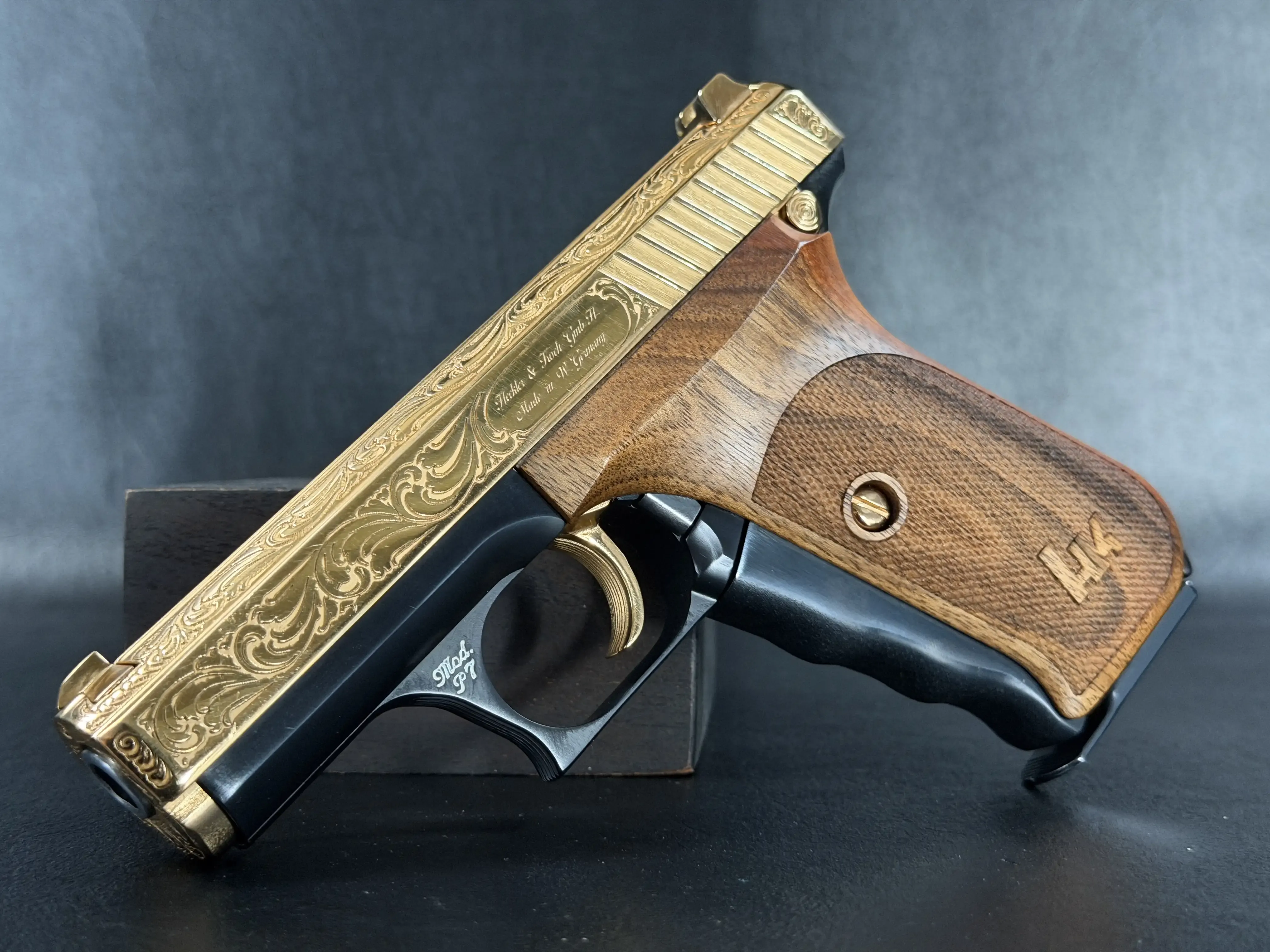
The Heckler & Koch P7 is a compact, striker-fired pistol distinguished by two interconnected systems: gas-delayed blowback operation and a front-strap cocking lever. The original design appeared in 1976 under the PSP designation, derived from Polizei-Selbstlade-Pistole, or police self-loading pistol.[1]
Bavaria adopted the P7 as a police sidearm in 1979. When the Bavarian government announced a replacement program in January 2018, it reported that approximately 34,000 armed personnel were still equipped with the model. The announcement also confirmed that P7 production had ended in 2008, creating a growing problem with pistol and replacement-part availability.[2]
Gas-Delayed Blowback Operation
Most 9×19mm service pistols use a locked-breech, short-recoil system in which the barrel and slide move together briefly after firing. The P7 instead has a barrel fixed rigidly to the frame and uses propellant gas to delay the slide.
When a cartridge is fired, gas passes through a port near the chamber into a cylinder beneath the barrel. A piston attached to the slide enters this cylinder. Pressure inside the cylinder resists the slide’s initial rearward movement; after the bullet leaves the barrel and pressure declines, the slide completes its operating cycle.[3]
This system eliminates the need for a tilting barrel or separate mechanical locking assembly. It also permits a comparatively low bore axis because the design does not require a locking mechanism beneath the chamber.
The P7’s chamber contains longitudinal flutes that allow gas to flow around the cartridge case during extraction. The fixed barrel uses polygonal rifling, and the standard 9×19mm model has a barrel measuring approximately 3⅞ inches.[1][3]
The gas system produces a practical limitation. Heat generated around the cylinder transfers into the frame above the trigger guard during sustained firing. Later M-series pistols incorporate a polymer heat shield in this area, but the shield does not prevent the frame from becoming hot after repeated magazines.[3]
The Squeeze-Cocking System
The P7’s defining control is the hinged lever forming the front strap of the grip. Squeezing this lever cocks the striker; releasing it decocks the pistol. The pistol therefore remains uncocked until the lever is deliberately compressed.
Once cocked, the mechanism requires substantially less pressure to remain in that position than it does during the initial squeeze. This allows the shooter to hold the pistol ready without maintaining the full cocking force.[1]
The lever also functions as a slide release. After a loaded magazine is inserted while the slide is locked open, squeezing the lever allows the slide to travel forward and chamber a cartridge.[3]
Helmut Weldle’s patent describes the arrangement of the grip-mounted cocking lever, striker spring, trigger mechanism, and gas brake. Filed in the United States in 1977 and granted on January 2, 1979, the patent was assigned to Heckler & Koch GmbH.[4]
The patented mechanism was intended to combine rapid readiness with an uncocked resting condition. Releasing the grip lever removes the striker spring’s firing tension, eliminating the need for a conventional external safety lever.[4]
Principal Variants
PSP and P7
The original PSP and subsequent P7 are chambered in 9×19mm and use an eight-round, single-column magazine. These pistols have a magazine catch at the heel of the grip rather than beside the trigger guard.[1][3]
For identification, collectors should examine the actual slide and frame markings rather than relying exclusively on a seller’s terminology. “PSP” is commonly used for early production and for the heel-release configuration generally, but surviving pistols should be documented according to their factory markings.
P7M8
The P7M8 retains the 9×19mm chambering and eight-round, single-column magazine. Its principal external differences include ambidextrous magazine-release paddles behind the trigger guard, an enlarged trigger guard with a heat shield, and a lanyard loop at the base of the grip.[3]
The relocated magazine release required changes to both the frame and magazine. Original heel-release P7 magazines and P7M8 magazines are therefore not interchangeable.[3]
P7M13
The P7M13 is a wider 9×19mm variant using a 13-round, double-column magazine. It retains the M-series trigger-guard magazine release and heat shield. Its broader grip and magazine distinguish it readily from the eight-round P7M8.[1][3]
P7M10
The P7M10 is chambered in .40 S&W and uses a 10-round, double-column magazine. Its substantially enlarged slide provides additional mass for the .40 S&W cartridge. The result is a visibly taller and heavier upper assembly than those of the 9×19mm models.[3]
P7K3
The P7K3 is a compact, caliber-convertible member of the family. It was offered in .22 LR, .32 ACP, and .380 ACP configurations and operates by straight blowback rather than the gas-delayed system used by the service-size 9×19mm pistols.[3]
Factory caliber conversions require the appropriate barrel, magazine, and related operating components. A purported complete set should therefore be evaluated by its model-correct components and accessories, not simply by the number of barrels accompanying the pistol.
Production and Commercial Context
The P7’s unconventional mechanism required extensive machining and a different manual of arms from more conventional service pistols. By the late 1980s, Heckler & Koch had concluded that the model’s price restricted its ability to compete in the American commercial and law-enforcement markets.[5]
The company’s subsequent USP project followed a more conventional design approach and placed greater emphasis on affordability, magazine capacity, familiar controls, and adaptability. Helmut Weldle, identified as the designer of the P7 pistols, also led the USP design team.[5]
Heckler & Koch ended P7 production in 2008.[1][2] The company now classifies the P7 series and P7K3 among its discontinued legacy products and states that its American repair department no longer services them because of limited spare-part availability.[6]
Collector Identification
The model designation, caliber marking, magazine-release position, grip width, and slide profile provide the clearest initial distinctions among P7 variants. A heel-mounted magazine catch indicates the original P7 pattern, while trigger-guard paddles and a heat shield identify an M-series configuration. The P7M13 has a wider grip than the P7M8, and the P7M10 is identified by its .40 S&W marking and enlarged slide.
Heckler & Koch states that the manufacturing date appears as a two-letter code on the left side of its pistols. The company’s coding system assigns the digits 0 through 9 to the letters A, B, C, D, E, F, G, H, I, and K, respectively.[6]
A complete examination should also address serial-number consistency, proof and import markings, finish, mechanical condition, and evidence of refinishing or replacement parts. Factory boxes, manuals, test targets, magazines, cleaning equipment, gas-cylinder scraper, and caliber-conversion components should be recorded individually. Because magazines and several major components differ among variants, an accessory that fits the pistol is not necessarily factory-correct for it.
Frequently Asked Questions
What does HK P7 stand for?
The pistol was initially called the PSP, meaning Polizei-Selbstlade-Pistole, or police self-loading pistol. It subsequently received the P7 designation.
How does the HK P7 operate?
Most P7 variants use gas-delayed blowback operation. Gas entering a cylinder beneath the barrel resists the slide’s initial rearward movement.
What does the P7’s squeeze-cocking lever do?
Squeezing the front-strap lever cocks the striker. Releasing it decocks the pistol.
What is the difference between the P7M8 and P7M13?
The P7M8 uses an eight-round, single-column magazine. The P7M13 has a wider grip containing a 13-round, double-column magazine.
When did HK stop producing the P7?
Heckler & Koch ended P7 production in 2008. Bavaria later cited the lack of new pistols and replacement parts when arranging a successor.
Sources
- Guy J. Sagi, “Heckler & Koch P7: H&K’s ‘Squeeze-Cocking’ Pistol,” American Rifleman, September 25, 2021.
- Bavarian State Government, “New Service Pistol for the Bavarian Police,” January 9, 2018.
- Heckler & Koch, “P7 Series Operator’s Manual,” revised March 2007.
- Helmut Weldle, “Self-Loading Pistol, U.S. Patent No. 4,132,023,” assigned to Heckler & Koch GmbH, January 2, 1979.
- Charles Q. Cutshaw, “HK USP: Past, Present & Future, Part I,” Small Arms Review, September 1998.
- Heckler & Koch USA, “Frequently Asked Questions,” legacy-product service policy and factory date-code reference.
As a firearms enthusiast with a background in website design, SEO, and information technology, I bring a unique blend of technical expertise and passion for firearms to the articles I write. With experience in computer networking and online marketing, I focus on delivering insightful content that helps fellow enthusiasts and collectors navigate the world of firearms.
Comments
Be the first to leave a comment.
Be the first to read new editorial features, collector guides, and brand spotlights.