Key Takeaways
- The SIG P210, HK P7, Walther P5, and Korriphila HSP 701 each represent a different part of postwar European firearms development.
- Serial numbers, proof marks, institutional markings, original accessories, and supporting records are central to proper identification.
- Rarity and provenance should be supported by reliable documentation rather than seller descriptions or repeated online claims.
Postwar Europe produced a wide range of distinctive pistols for military, police, commercial, and private use. Among them are the Swiss SIG P210, Heckler & Koch P7, Walther P5, and Korriphila HSP 701.
This is not a ranking of Europe’s most collectible pistols, nor is it a complete survey. It is a focused list of four mechanically interesting models with established collector followings and histories that can be studied through official records, patents, museum collections, and period publications.
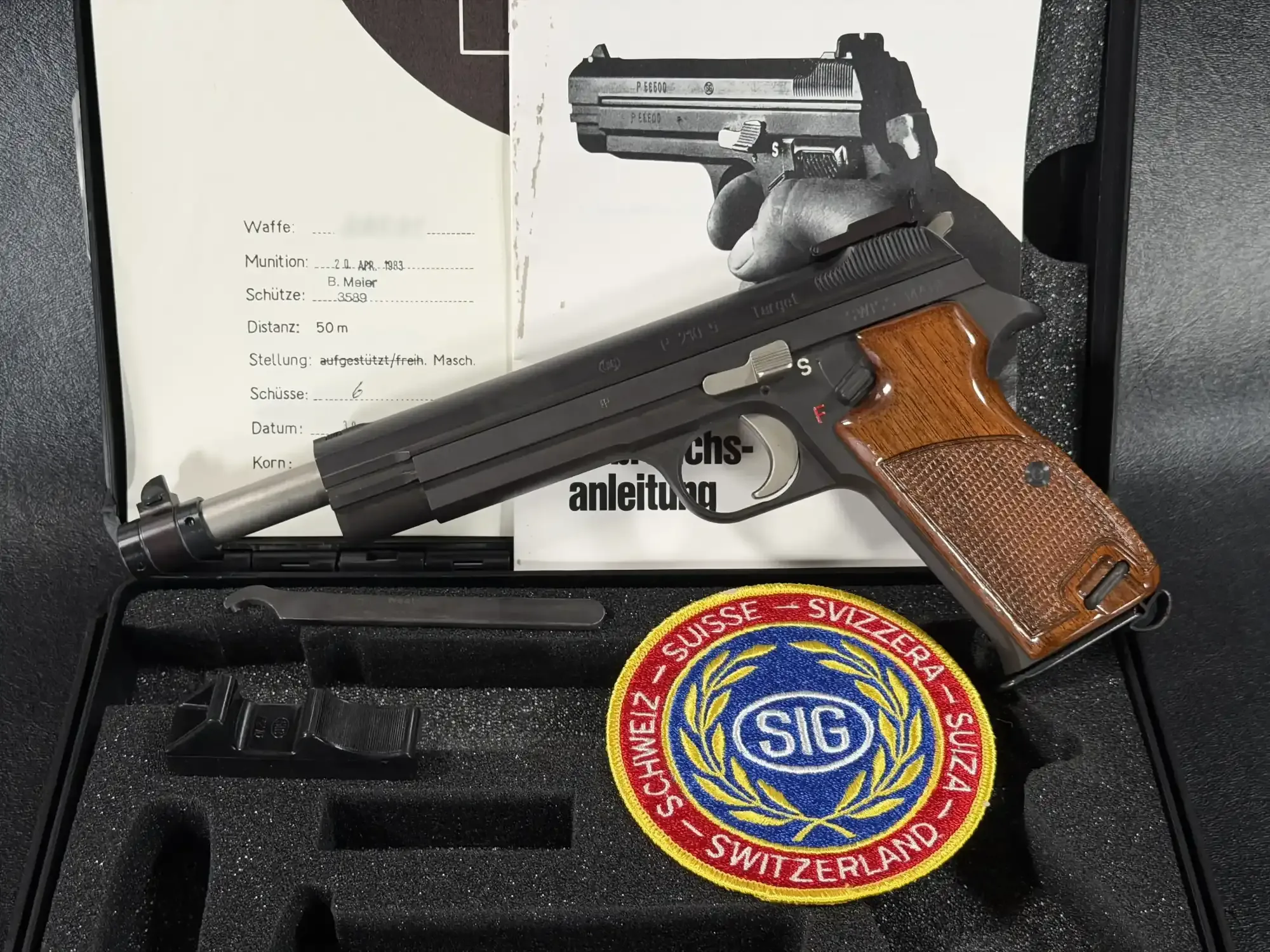
SIG P210
The P210 developed from the work of Swiss-born designer Charles Gabriel Petter. In 1937, Schweizerische Industrie Gesellschaft acquired rights to Petter’s pistol system, which France had adopted as the Modèle 1935A. SIG subsequently adapted the design while Switzerland evaluated replacements for its 7.65mm Parabellum service pistols.[1]
The resulting P47/8 was formally adopted on October 14, 1948, as the Ordonnanzpistole 49, commonly called the Pistole 49 or P49. SIG manufactured Swiss military examples from 1949 through 1975 and delivered 113,110 pistols, according to the Military History Institute Prague.[1]
A later Swiss Arms company history states that 180,000 P210 pistols were placed in Swiss service.[2] The difference illustrates why production figures should be tied to a clearly defined model, contract, or recipient rather than presented as a universal total.
Mechanically, the original P210 is a single-action, locked-breech pistol. Its slide travels inside the frame rails, and its lockwork can be removed as an assembled unit. The Swiss service version was chambered in 9×19mm, while commercial and sporting configurations were also offered in 7.65mm Parabellum and .22 Long Rifle.
Denmark adopted its own version as the m/49. Danish authorities initially ordered 16,607 pistols, followed by a final delivery of 3,600, bringing the documented contract sequence to 20,207 examples.[1] Contract markings, including HTK and the later FKF marking, are relevant to identification and collector classification.
Collectors should distinguish original Swiss production from the American-made P210 introduced by SIG Sauer in the United States. The modern pistol preserves the internal slide-rail arrangement but incorporates revised controls, including a side-mounted magazine release, enlarged safety, extended beavertail, and different barrel lockup.[3][4] It is a modern interpretation rather than a continuation of the original Swiss military configuration.
A military P210 should be evaluated through its serial number, acceptance and property markings, finish, grips, magazine, and evidence of later alteration. A private-property mark may be historically relevant, but the mark alone does not establish the pistol’s complete service or ownership history.
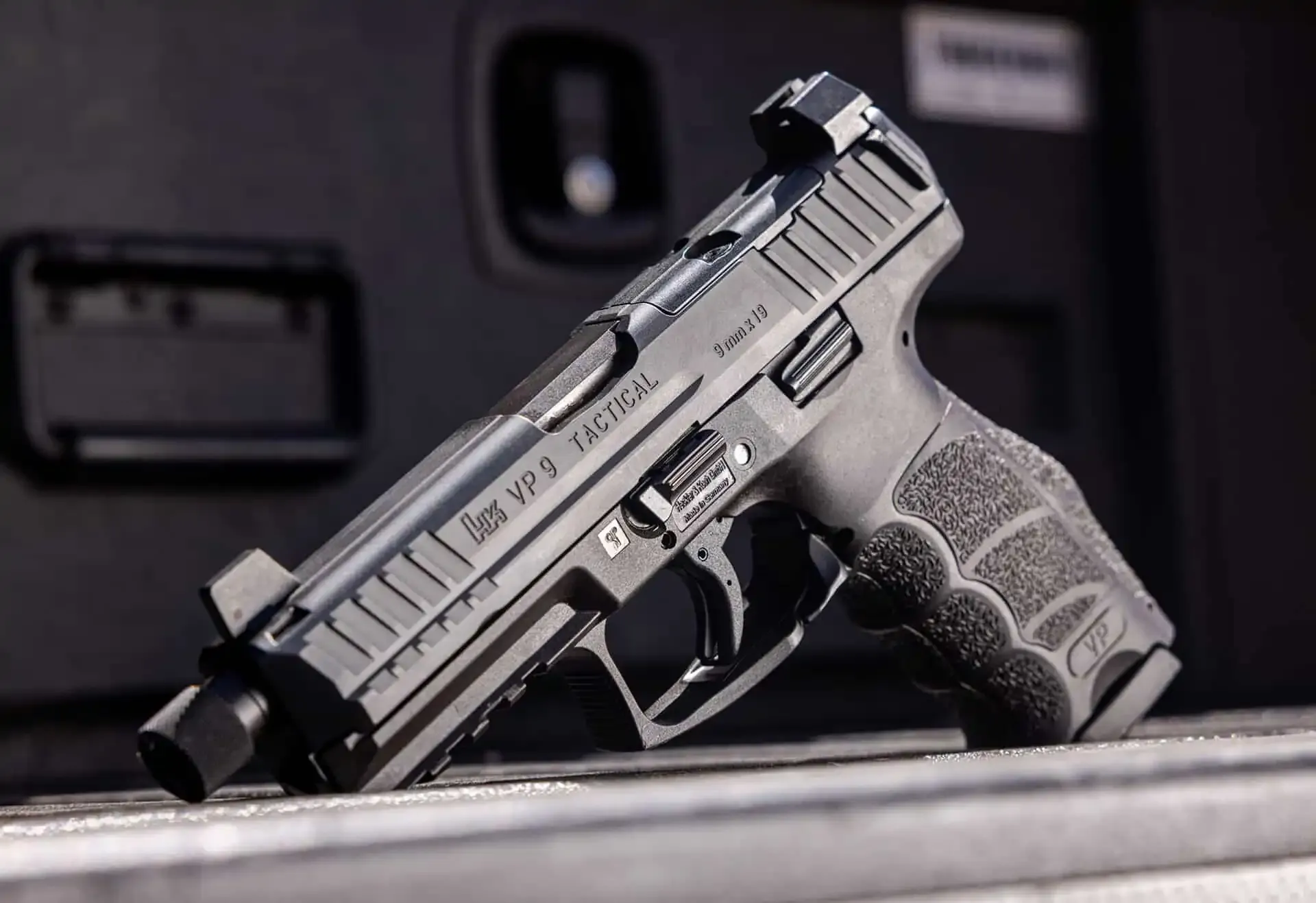
Heckler & Koch P7
The P7 emerged from West Germany’s search for a compact 9×19mm police pistol during the 1970s. Heckler & Koch introduced its candidate in 1976 as the PSP, Polizei-Selbstlade-Pistole, and the design subsequently received the police designation P7.[5]
Its defining feature is the squeeze-cocking lever forming the front of the grip. Compressing the lever cocks the striker; relaxing the grip decocks the pistol. The system allowed the P7 to be carried with a chambered cartridge while remaining uncocked until deliberately gripped. It also provided a consistent trigger pull after the pistol had been cocked.[5][6]
The operating system is equally distinctive. The barrel remains fixed while gas tapped through a port near the chamber acts against a piston beneath it, delaying the slide’s rearward movement. Chamber flutes assist extraction. These features give the P7 a different mechanical arrangement from conventional short-recoil service pistols.[6]
The original P7 uses a heel-mounted magazine catch and an eight-round, single-column magazine. The later P7M8 retains an eight-round capacity but adds a trigger-guard magazine release and other revisions. The wider P7M13 uses a 13-round, double-column magazine; a documented example is held by the Smithsonian’s National Museum of American History.[7] Other factory variants include the .40 S&W P7M10 and the P7K3, which was offered in smaller calibers.[6]
Heat is an inherent consequence of the gas cylinder’s location above the trigger area. It is less consequential during limited police firing than during extended range sessions. Prospective owners should inspect the gas cylinder and piston, chamber flutes, squeeze-cocking mechanism, magazines, and overall mechanical condition.
Police-property marks and German date codes deserve careful reading. They may connect a pistol to an issuing authority, but a marking should not be expanded into a detailed service narrative without supporting records. Original packaging, manuals, tools, and matching factory labels can add documentary value.
Walther P5
The Walther P5 was another product of the West German police-pistol program. Rather than discard the P38 system, Walther modernized it. The P5 retained a locked-breech action using a vertically moving locking block and two recoil springs while enclosing the barrel within a full-length slide.
Walther also relocated the principal operating controls to the frame. A single lever serves as both the decocker and slide release. The pistol’s most immediately recognizable mechanical feature is left-side ejection, an unusual but intentional part of the design.
The P5 found its largest documented service role in the Netherlands. An April 2011 letter from the Dutch minister of security and justice stated that Dutch police had used the 9×19mm P5 since 1979. More than 40,000 remained in use at that time, most delivered between 1980 and 1983.[8] The same government record described the pistols as nearing the end of their technical service lives and confirmed that normal production had ceased.[8]
That history makes Dutch-service P5s of particular interest to collectors who value institutional provenance. Inventory marks, finish wear, and replaced components should be interpreted as evidence from the individual firearm; however, they are not proof that every police-return pistol retained its original issued configuration.
The standard P5 is supplemented by the shorter P5 Compact and the scarce long-barreled P5 Lang. Published totals for minor variants are inconsistent, so rarity claims should not rest on an unattributed online census. A prospective buyer should instead examine the pistol’s serial number, proof marks, barrel and slide configuration, grips, magazine release, and any accompanying factory or agency documentation.
Korriphila HSP 701
Edgar Budischowsky’s HSP 701 differs from the three service pistols above. It was not developed around a major government contract. Instead, it was a low-volume pistol built around an unusual delayed-blowback mechanism and offered in multiple configurations.
Budischowsky filed the relevant German patent application in May 1978. Published as DE2822914A1 in 1979, it describes a semirigid breech mechanism using a roller, sliding locking element, and angled engagement surfaces to delay opening.[9] The patent provides primary evidence for the mechanism’s authorship and operating principle, although it does not establish the production history of every HSP 701.
The production pistol uses a fixed barrel and roller-delayed action. HSP 701s are encountered in different barrel lengths, chamberings, trigger systems, finishes, and grip configurations. Specifications applicable to one documented pistol should therefore not be assumed to apply to every example.
Claims that total production reached a particular number are frequently repeated, but no complete, publicly accessible factory ledger has been identified. The defensible conclusion is that production was limited and configurations varied. Specific production totals should be treated as estimates unless supported by factory or proof-house documentation.
Authentication should begin with the firearm itself: serial number, German proof marks and date code, mechanical configuration, inscriptions, finish, and any accompanying test target or correspondence. Because parts and authoritative records are scarce, originality and mechanical condition are especially important. A seller’s description documents how a pistol was marketed; it does not independently prove the pistol’s history.
Evaluating Collectible European Pistols
These four pistols represent only a small portion of the European collector market. Each offers a different area of study: Swiss and Danish military contracts for the P210, West German police engineering for the P7, Dutch institutional service for the P5, and low-volume private manufacture for the HSP 701.
Whatever the model, originality and documentation generally deserve as much attention as cosmetic condition. Boxes, factory targets, manuals, tools, matching magazines, military paperwork, and police-release records can help establish that a pistol and its accessories belong together.
Markings should be interpreted conservatively. A military acceptance mark can identify an institutional relationship, and a police inventory number may identify an issuing body. Neither automatically proves who carried the firearm, where it served, or how it was used.
Import marks, refinishing, replaced sights, altered grips, and non-original magazines should be identified before purchase. These changes do not necessarily make a pistol undesirable, particularly if it is intended for regular shooting, but they should be reflected in its description and valuation.
Rarity should be demonstrated rather than advertised. Official records, period manuals, patents, proof marks, and documented physical examples provide the strongest evidence. Collector surveys can assist research, but they should not be presented as factory records.
Frequently Asked Questions
Which collectible European pistols does the article cover?
The article covers the SIG P210, Heckler & Koch P7, Walther P5, and Korriphila HSP 701. It is a focused list, not a ranking or complete survey of collectible European pistols.
Why is the SIG P210 historically significant?
The original P210 was developed from Charles Gabriel Petter’s pistol system and adopted by Switzerland as the Ordonnanzpistole 49. Denmark also adopted a contract version designated the m/49.
What makes the Heckler & Koch P7 mechanically distinctive?
The P7 combines a squeeze-cocking lever with a fixed barrel and gas-delayed blowback action. Its design differs substantially from conventional short-recoil service pistols.
How can collectors identify a documented Walther P5?
Collectors should examine the serial number, proof marks, configuration, institutional markings, and accompanying records. A police marking can indicate an agency relationship but does not establish the pistol’s complete service history.
How rare is the Korriphila HSP 701?
Available evidence supports describing the HSP 701 as a limited-production pistol offered in varied configurations. A precise production total cannot be confirmed without a complete factory or proof-house record.
Sources
- Military History Institute Prague, “Danish Army Pistol m/49 (SIG P210),” museum collection record.
- SAN Swiss Arms AG, “Armed Forces & Law Enforcement Catalogue 2018,” company historical chronology, pp. 1–2.
- SIG Sauer, “SIG Sauer Releases Legendary, American Made P210 Standard Pistol,” April 23, 2019.
- Wiley Clapp, “Tested: SIG Sauer’s Made-in-America P210 Pistol,” American Rifleman, December 21, 2018.
- Philip Schreier, “The Classics: The Heckler & Koch P7,” Shooting Illustrated, March 23, 2023.
- NRA Staff, “Heckler & Koch P7 Pistol,” American Rifleman, February 25, 2010.
- Smithsonian National Museum of American History, “H&K P7 M13 Semiautomatic Pistol,” catalog no. 1987.0906.07.
- Netherlands Ministry of Security and Justice, “Letter to the House of Representatives Concerning the New Dutch Police Pistol,” Parliamentary Paper 29 628, no. 245, April 5, 2011.
- Edgar Budischowsky, “Semirigid Lock for a Small-Firearm Breechblock,” German patent application DE2822914A1, published November 22, 1979.
As a firearms enthusiast with a background in website design, SEO, and information technology, I bring a unique blend of technical expertise and passion for firearms to the articles I write. With experience in computer networking and online marketing, I focus on delivering insightful content that helps fellow enthusiasts and collectors navigate the world of firearms.
Comments
Be the first to leave a comment.
Be the first to read new editorial features, collector guides, and brand spotlights.