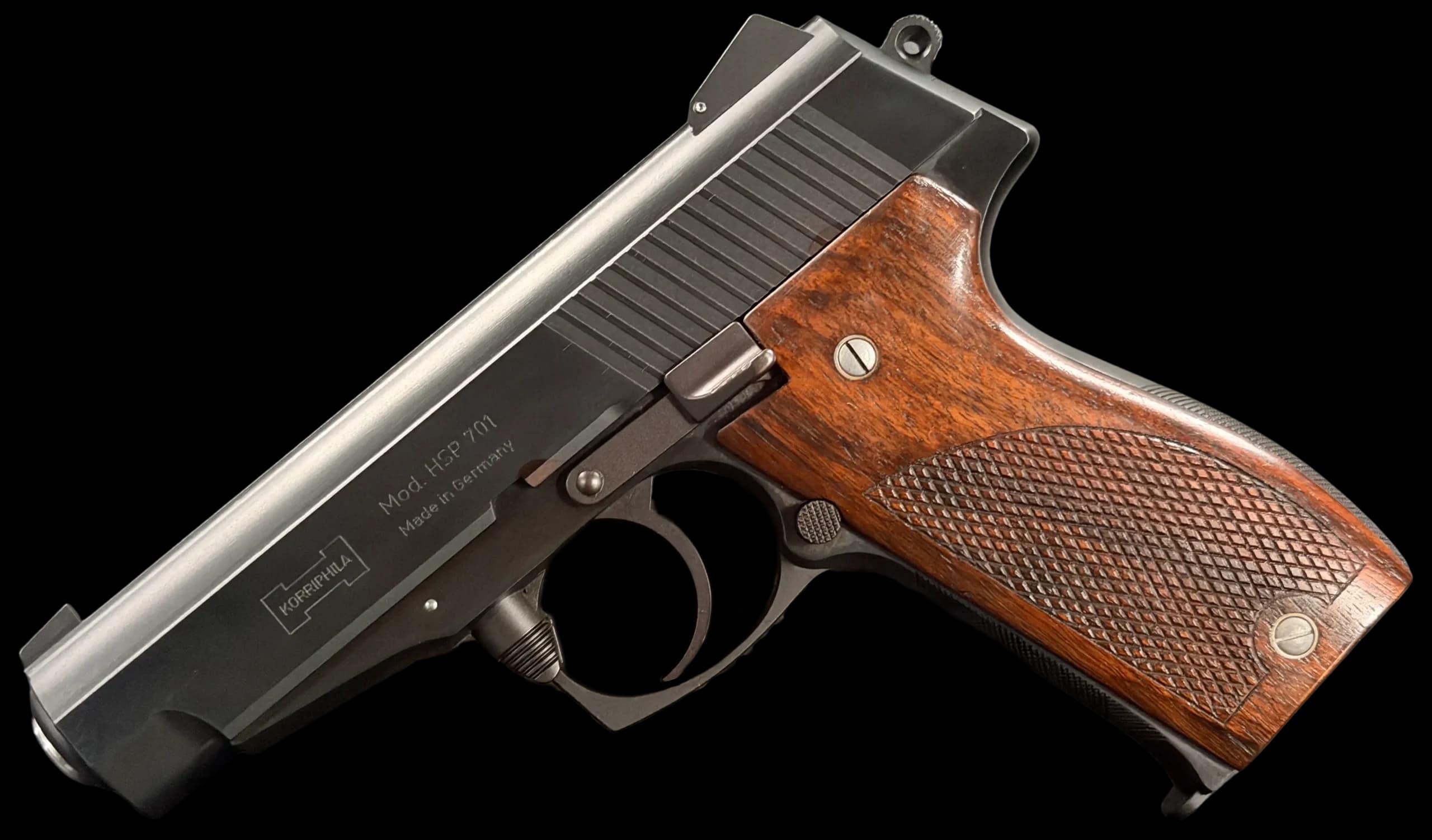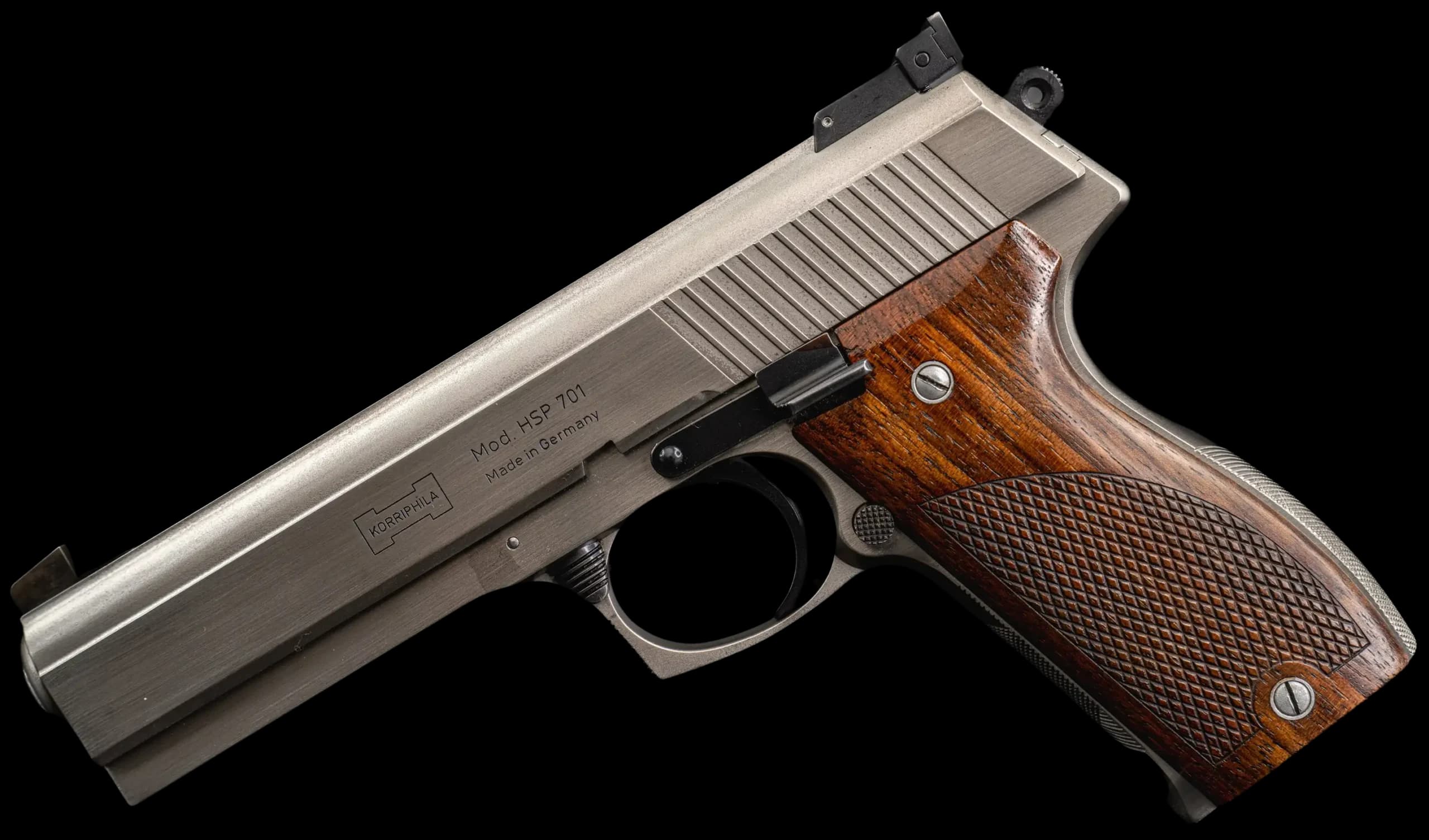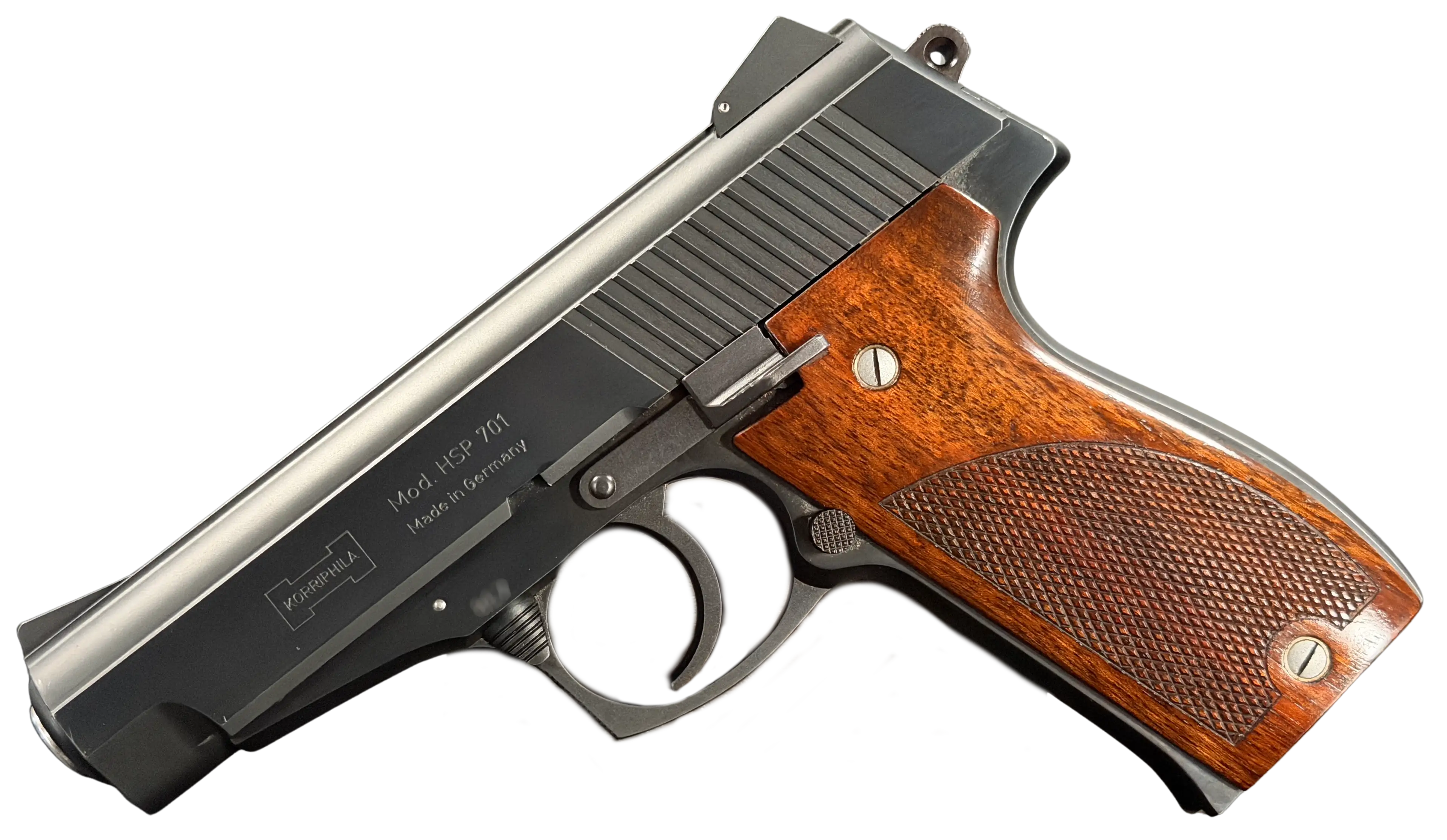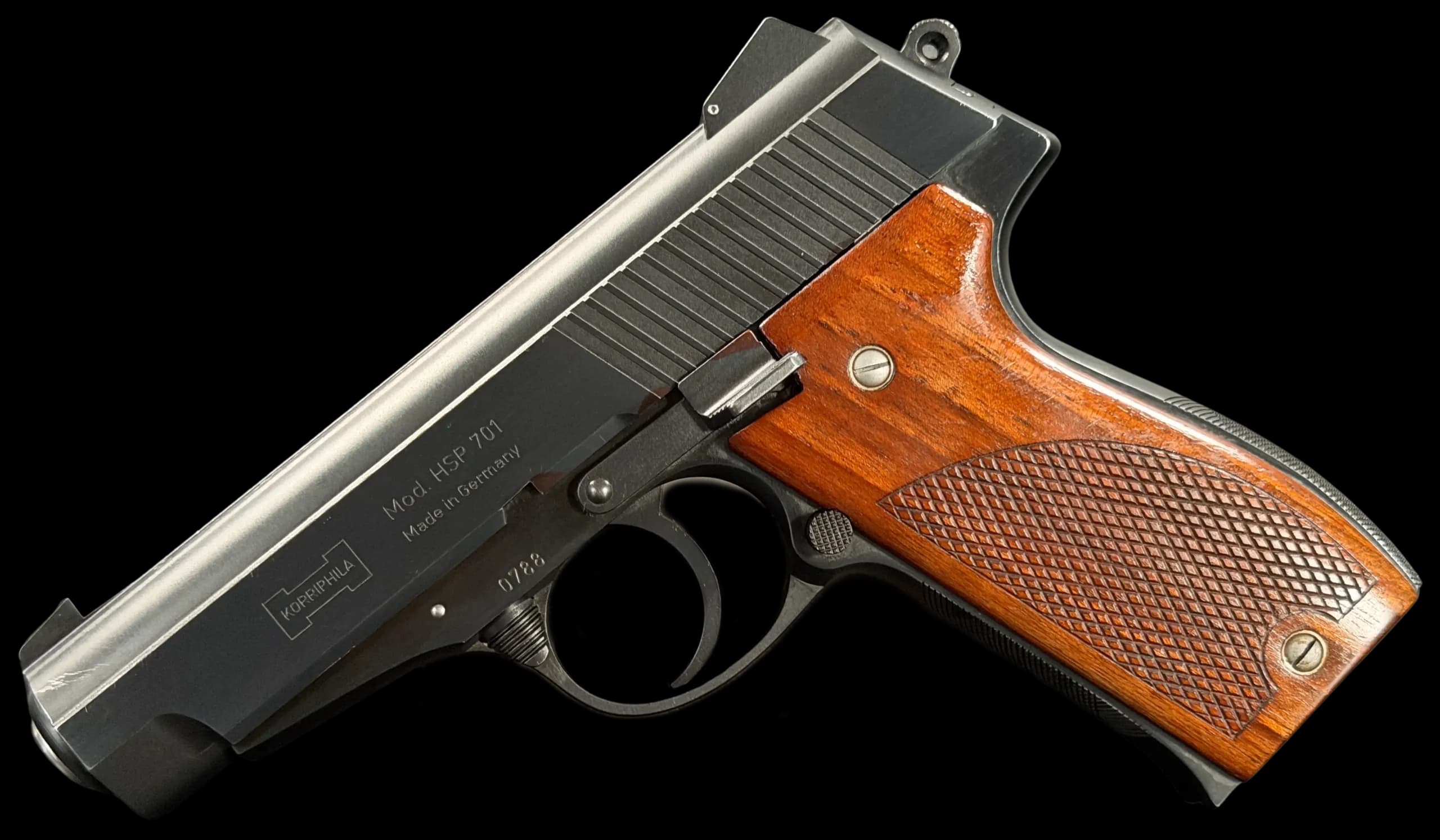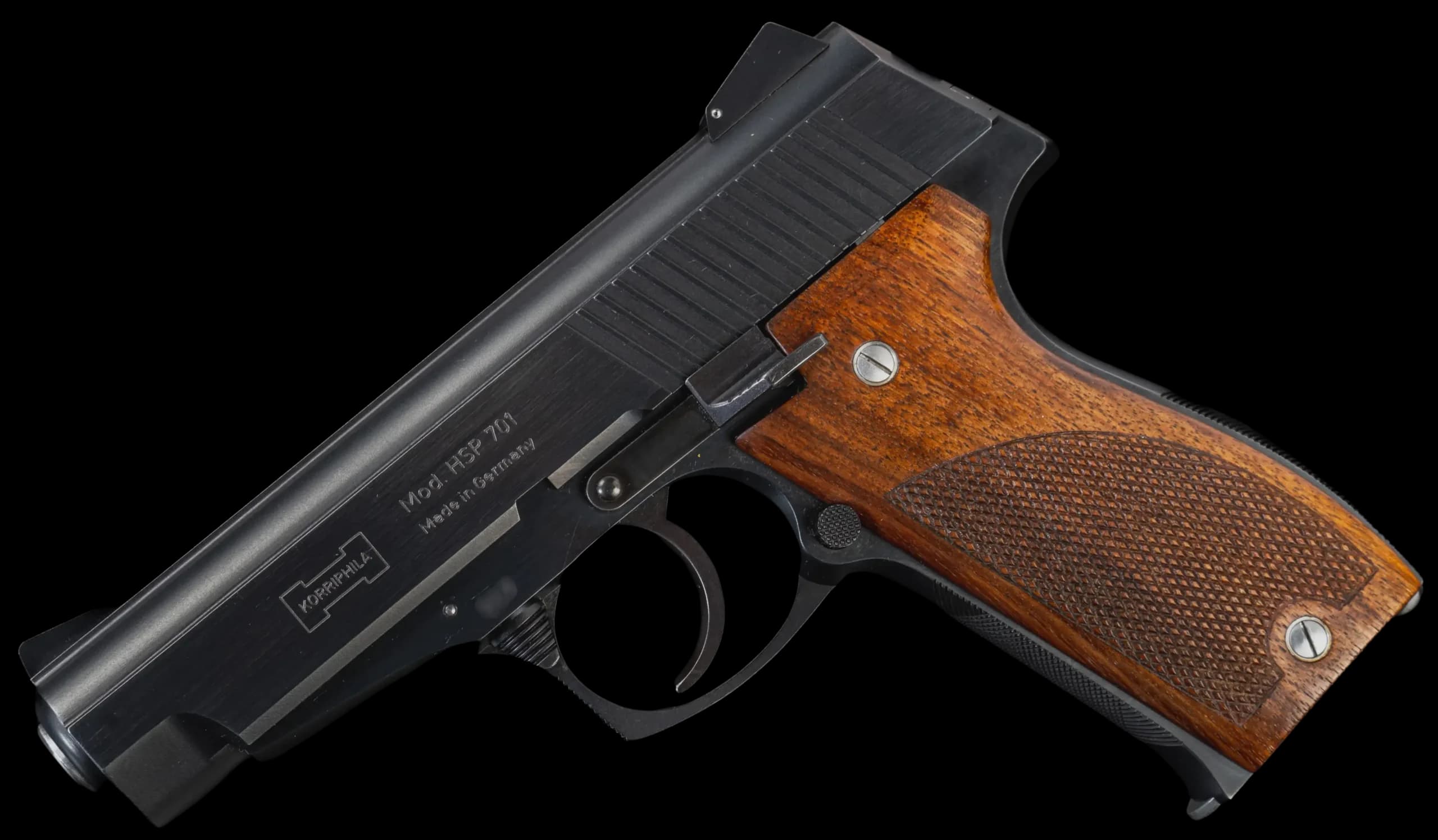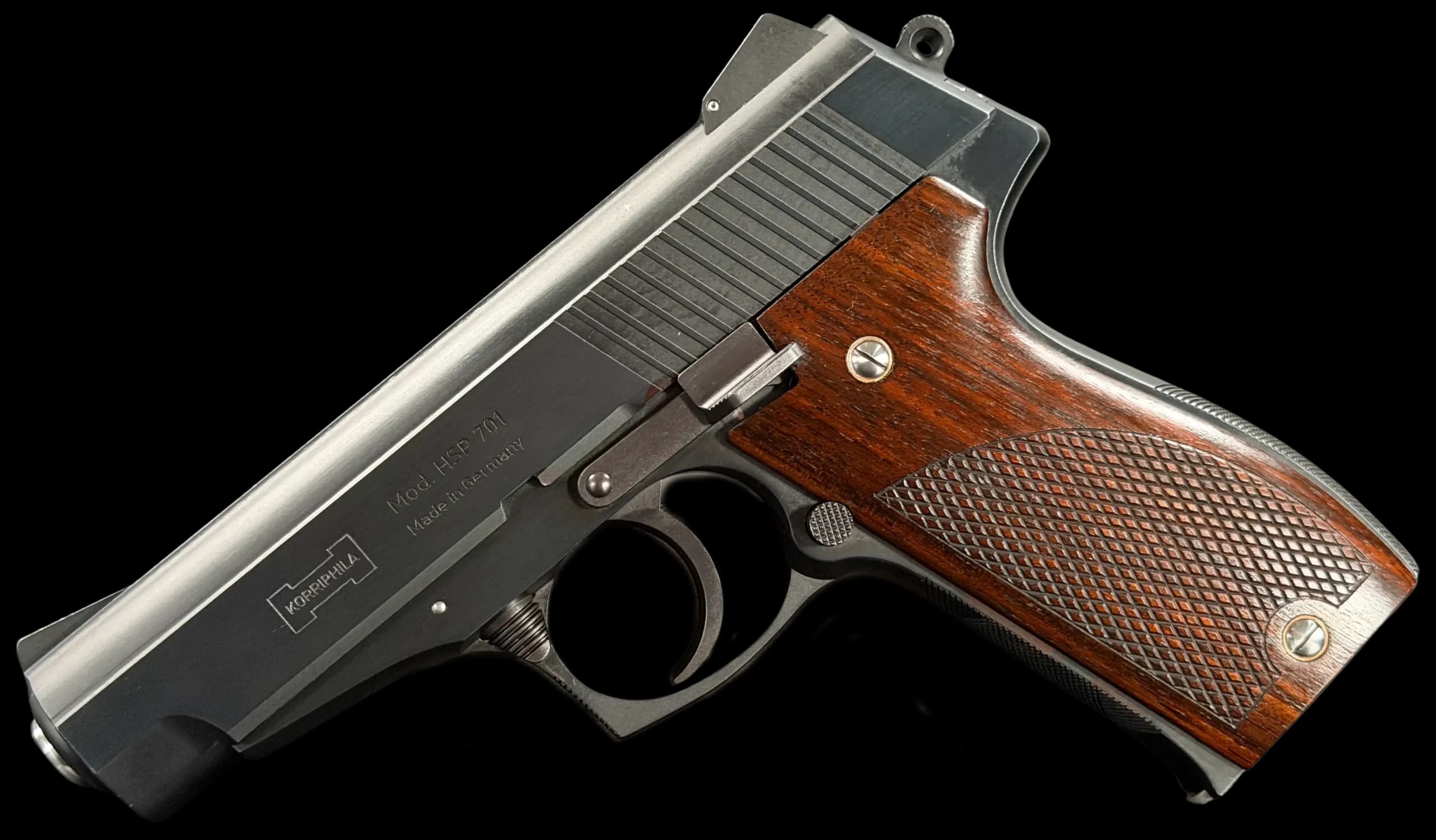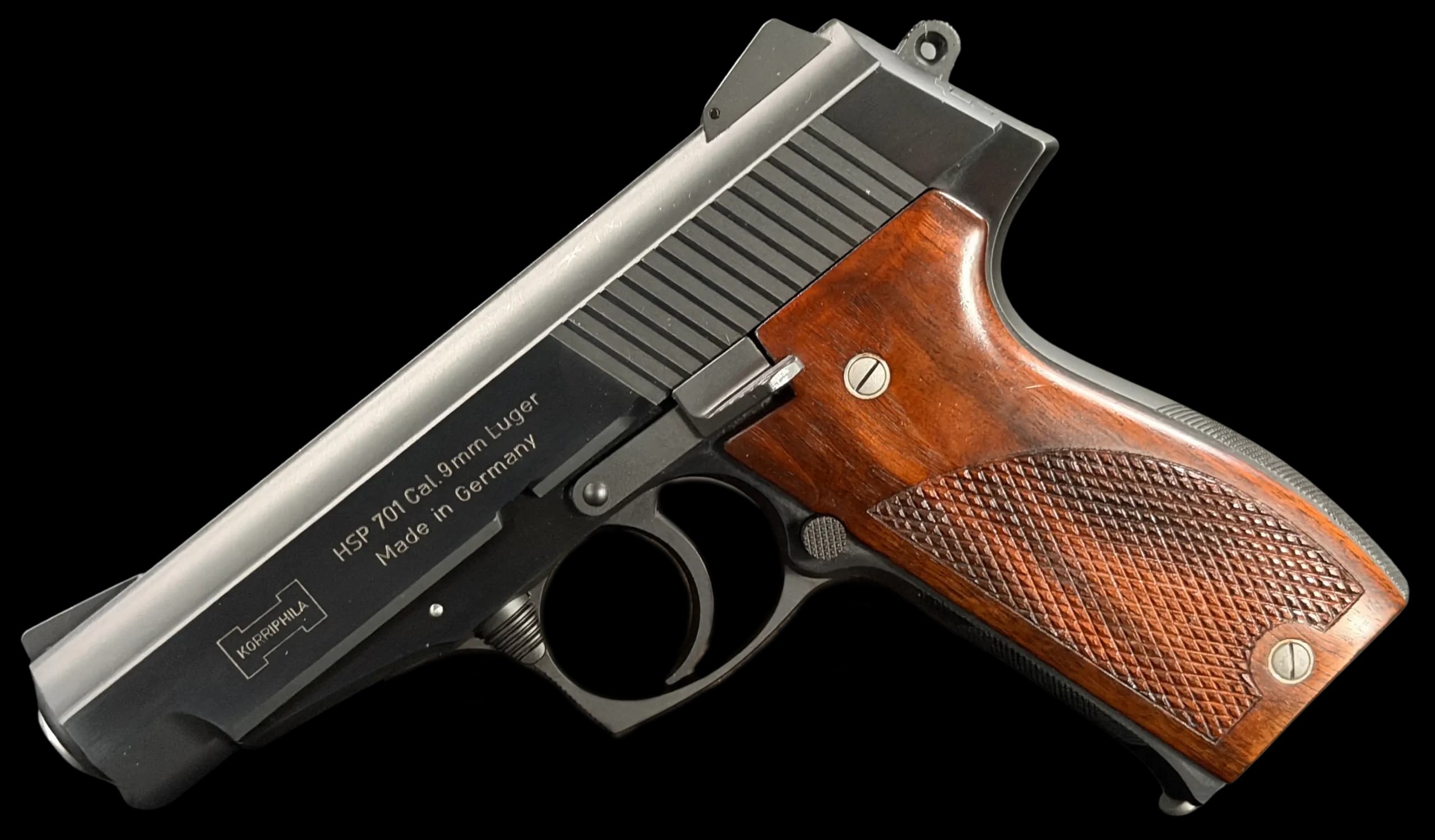
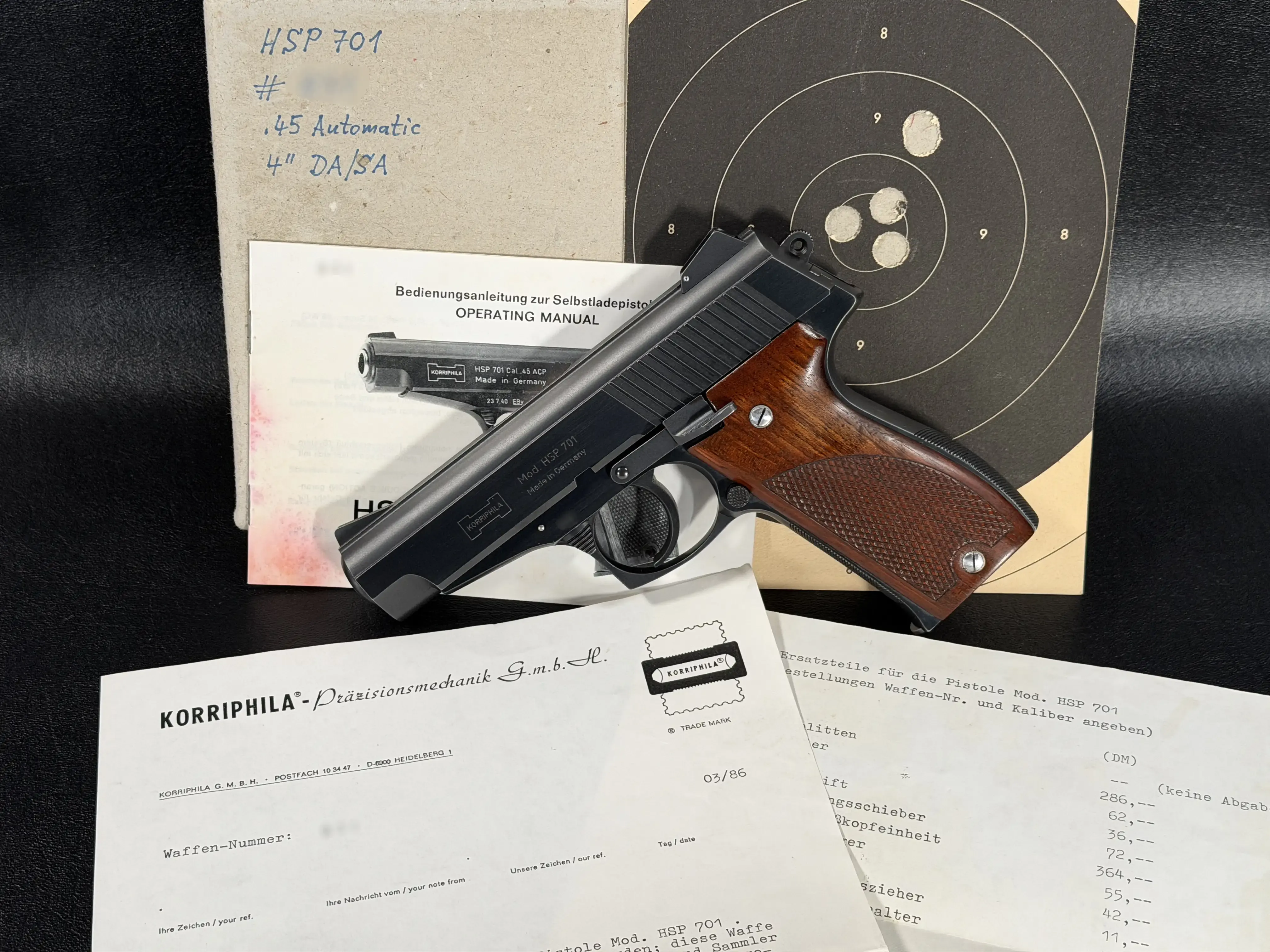

Fewer than 400 examples of the Korriphila HSP-701 were ever produced, each one ordered to a buyer's specification and hand-fitted in a small Heidelberg workshop rather than pulled from a production line. That scarcity was not a marketing decision. It was simply how Edgar Budischowsky, the Czech-born designer behind the pistol, chose to work.
Budischowsky registered his firearms business in Ulm an der Donau in the late 1960s, and the earliest documented Korriphila products are pocket pistols proofed around 1970. The first of these, the TP-70, was a compact double-action .22 LR and .25 ACP design that borrowed elements from both Colt and Walther thinking. It found a wider audience than anything else to carry the Korriphila name: from 1973 to 1977, Norton Armament Corporation of Mount Clemens, Michigan, built it under license as the "Budischowsky" TP-70. Collectors generally rate the Michigan-made guns above the later runs produced after Norton relocated production to Florida and then Utah, where fit and finish declined. In Germany, the company operated for a few years as Budischowsky-Waffen GmbH before returning to the Korriphila name in the late 1970s.
The design Budischowsky is remembered for came next. The HSP-701 was patented in 1979 and entered production in 1984, a fixed-barrel, roller-delayed blowback pistol with a single-stack magazine and a strikingly minimal control layout: one lever does double duty as slide release and decocker, and there is no separate manual safety. It arrived in a market that was newly serious about defensive pistolcraft, the same years that produced IPSC and Jeff Cooper's Gunsite, and it answered that moment with a single-stack .45 ACP built to a fit and trigger quality closer to a target gun than a service pistol.
Buyers could specify 4 or 5-inch barrels, DA/SA, single-action-only, or double-action-only trigger configurations, and calibers beyond the standard .45 ACP, including 9mm Parabellum, .30 Luger, .38 Super, and .38 Special Wadcutter for competition use. At least one example is documented in a Damascus-steel finish, marketed as the "Odin's Eye" variant, though this detail comes from a single collector source and is worth confirming before it goes on the page.
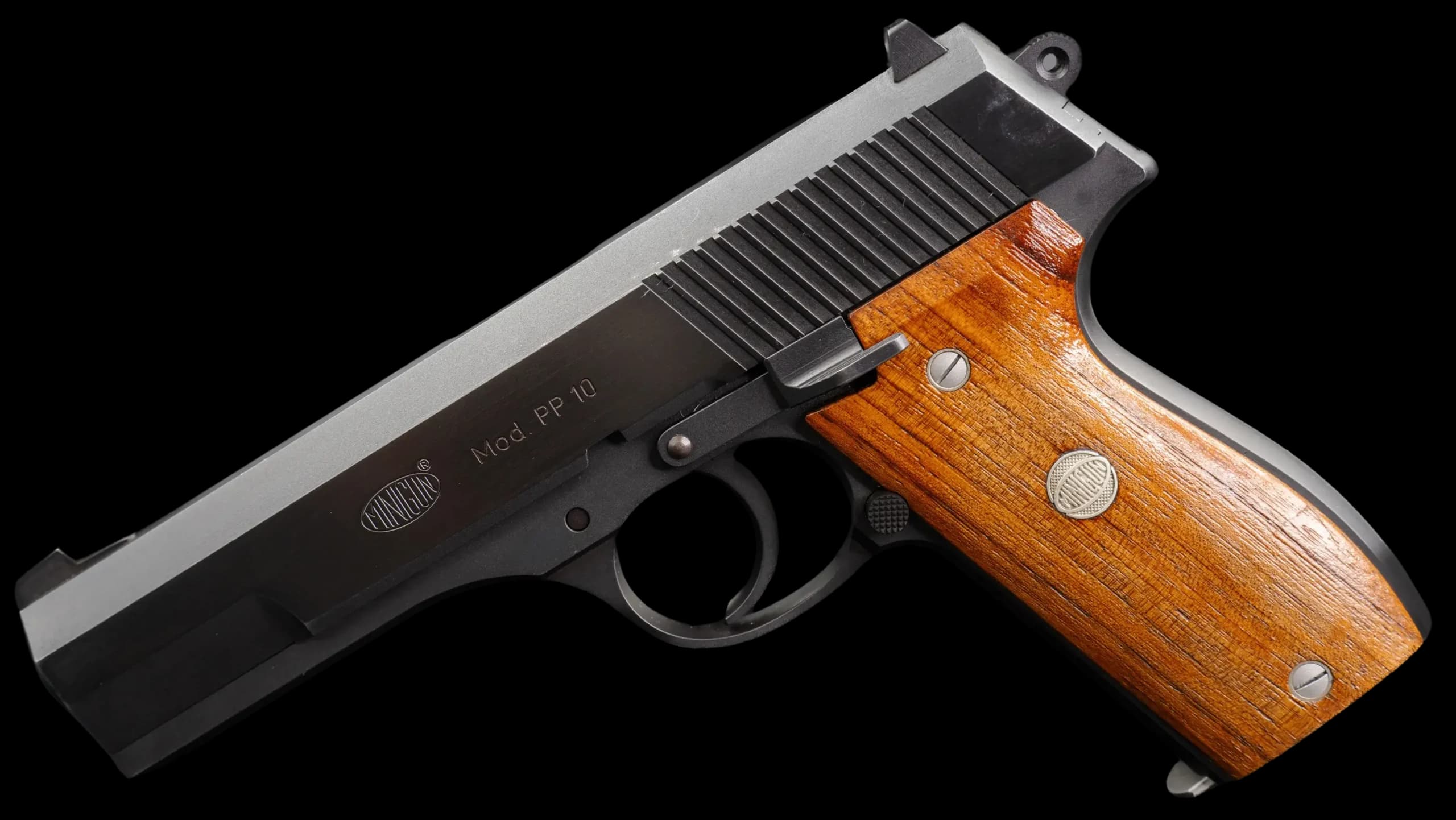
Budischowsky later adapted the platform for the 10mm Auto cartridge as the PP-10 "Minigun," reinforcing the bolt head, slide stop, and buffer assembly to handle the round's higher pressures. Production was limited to roughly 20 units, making it rarer still than the HSP-701 it was built from.
Korriphila changed hands over the following decades, and production effectively stopped, which is part of why secondary-market prices have climbed: a standard HSP-701 sold at the Hermann Historica auction house for approximately €30,000 in 2024. The trademark is now held by Luxus Capital, LLC of Bradenton, Florida, with Budischowsky's own endorsement of the company as steward of the name. In August 2025, Luxus Capital announced that Korth Germany, the Lollar, Hesse revolver and pistol maker founded in 1954, would build a limited-edition Korriphila pistol from Budischowsky's original drawings, the first time in decades the design has returned to active manufacture rather than existing solely as a collected object.
History & Milestones
Edgar Budischowsky establishes the company in Ulm
Budischowsky, a Czech-born firearms designer working in West Germany, registers Korriphila GmbH in Ulm an der Donau.
TP-70 pocket pistol enters production
The compact .22 LR / .25 ACP double-action pistol becomes Korriphila's first widely distributed product, with early examples proofed that year.
TP-70 licensed to Norton Armament in Michigan
Norton begins building the design in Mount Clemens, Michigan as the "Budischowsky" TP-70, introducing the pistol to a wider American audience until the arrangement ends in 1977.
HSP-701 design patented
Budischowsky patents the roller-delayed blowback mechanism that would define the company's signature model.
HSP-701 production begins in Heidelberg
The full-size, single-stack .45 ACP pistol enters custom production, built to order with a target-grade trigger and minimal external controls.
HSP-701 sells for approximately €30,000 at auction
A standard example sells at Hermann Historica, illustrating how collector demand has moved since production ended.