Key Takeaways
- Mastershop production comprised three documented categories: Sport, Prestige, and Individual.
- The workshop produced specialized P210- and P226-based pistols before Eckernförde production ended in 2020.
- No single marking authenticates every Mastershop pistol; collectors should examine factory records, markings, configuration, originality, and provenance together.
SIG Sauer’s German Mastershop occupies an unusual place in modern firearms collecting. It was not a separate manufacturer, and “Mastershop” was never a model designation that appeared uniformly on every pistol associated with it. It was a specialist operation within SIG Sauer GmbH’s Eckernförde facility, producing competition pistols, elaborately finished presentation arms, and individually commissioned pieces.
That distinction matters. A pistol’s configuration, markings, documentation, and provenance must be evaluated together. No isolated stamp, grip style, case, or seller’s description is sufficient to authenticate a Mastershop firearm.
Three Branches of Mastershop Production
SIG Sauer divided its Mastershop program into three principal categories: Sport, Prestige, and Individual.
The Sport division concentrated on performance modifications, including work on triggers, sights, grips, barrel weights, and compensators. SIG Sauer’s 2020 catalog described these pistols as either standardized packages or individually tuned firearms configured around an owner’s requirements.[1]
Prestige covered pistols distinguished by engraving, surface treatment, decorative materials, and specialized finishing. Individual represented the most exclusive category: one-of-a-kind commissions refined by master engravers rather than ordinary catalog configurations.[1]
These categories could overlap in practice. A mechanically specialized competition pistol might also receive extensive decorative treatment, while an Individual commission could begin with an established Sport or Prestige configuration. Consequently, the category name alone does not establish precisely how a surviving firearm left the factory.
The P226 and the X-Series
The P226 supplied the Mastershop with its other principal foundation. Developed for the U.S. military’s XM9 service-pistol competition, the P226 was one of the candidates evaluated during trials that began in 1984. The Beretta 92SB-F and SIG Sauer P226 emerged as the principal successful competitors, but the Army selected Beretta’s pistol as the M9.[3]
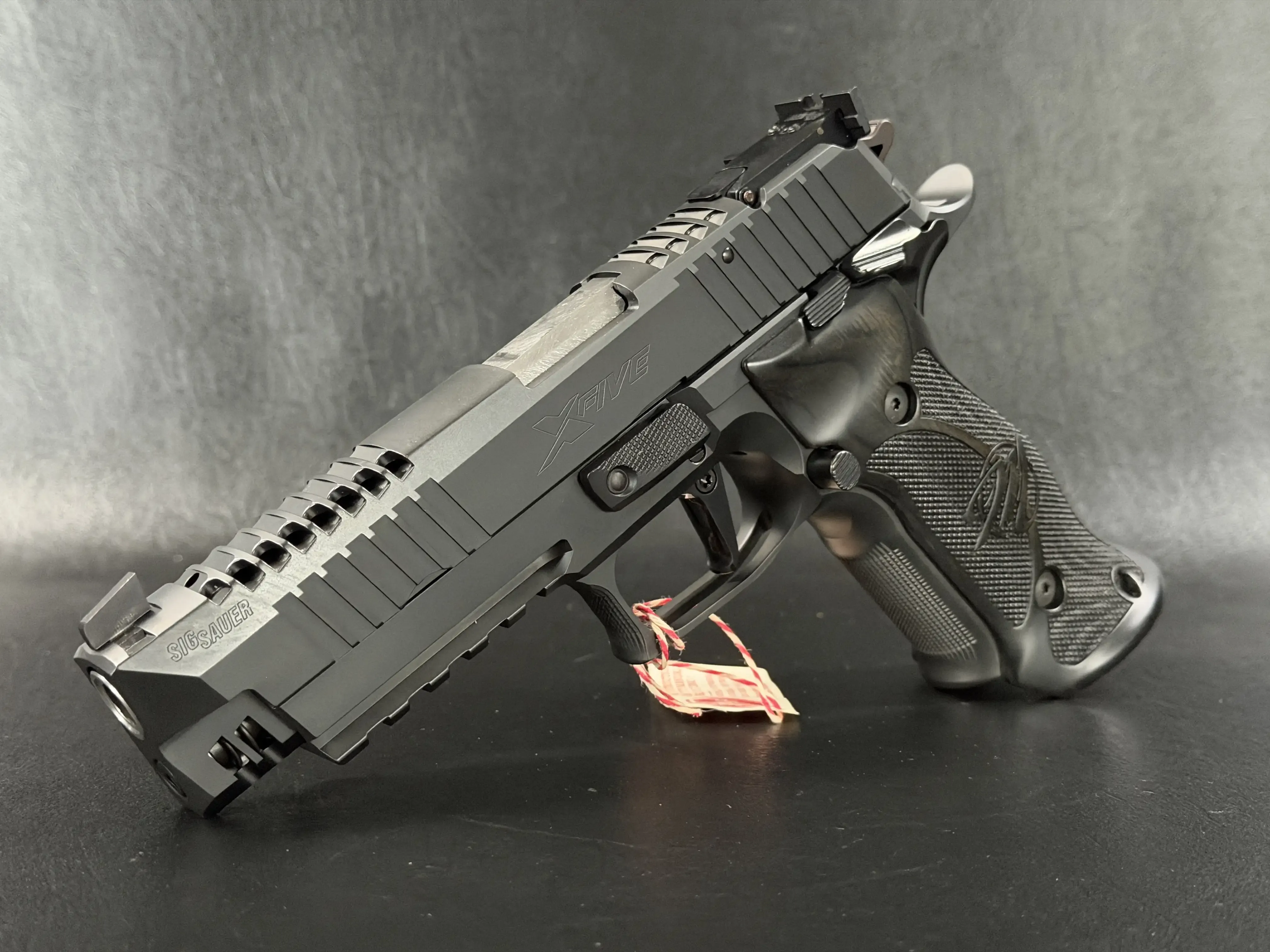
SIG Sauer subsequently developed the P226 into numerous service, sporting, and commercial configurations. In Eckernförde, the platform became the basis for the P226 X-Five and X-Six families, named for their nominal five- and six-inch barrels. These generally combined all-steel construction with single-action triggers, adjustable sights, extended controls, and competition-oriented fitting.
The X-Series encompassed numerous configurations, finishes, and limited treatments over its production life. Names encountered on individual pistols do not necessarily identify a wholly different mechanical model. Some designate a finish, grip treatment, or specialized package applied to an established X-Five or X-Six foundation. The applicable period catalog and the firearm’s original records are therefore more useful than assumptions based on a name alone.
The Mastershop’s Final Models
The IWA OutdoorClassics exhibition in Nuremberg in March 2019 provided one of the clearest public views of the late Mastershop program. SIG Sauer presented four notable pistols: the P226 X-Five Performance, P226 Facettes, P210 Skeleton, and P210 Midnight.[4]
The X-Five Performance was a competition-oriented P226 with an adjustable single-action trigger and extensively textured controls. The Facettes used the P226 platform but emphasized geometric decorative treatment across the pistol’s exterior.
The P210 Skeleton and Midnight extended the Mastershop program onto the German P210. The Skeleton incorporated substantial machining of the slide and frame, a six-inch barrel, an adjustable rear sight, and an eight-round 9×19 mm magazine. The Midnight combined a dark exterior finish with contrasting gold-colored components.[1]
The P210 models were especially significant because contemporary coverage identified them as the Mastershop’s first offerings based on that platform.[4] Their arrival also came near the end of firearms production at Eckernförde.
The Closure of SIG Sauer GmbH
On June 4, 2020, SIG Sauer GmbH informed employees that the Eckernförde operation would close. Contemporary reporting placed the number of affected positions at approximately 125.[5]
SIG Sauer attributed the decision to economic and strategic conditions in Germany, including restrictions affecting sporting firearms and disadvantages in government procurement. A statement from SIG Sauer AG in Switzerland expressly rejected reports that the German company was bankrupt and said the closure would not affect Swiss operations.[6]
Production at Eckernförde had ceased by the end of November 2020, although a reduced staff remained to wind down the site.[7] The closure ended nearly seven decades of firearms manufacturing at the location, which J. P. Sauer & Sohn had established in 1951.[5]
The German closure also must not be confused with the activities of SIG Sauer Inc. in the United States or SIG Sauer AG in Switzerland. Those were separate operating companies, and both continued after the Eckernförde facility closed.[6]
What Collectors Should Examine
Mastershop attribution should rest on accumulated evidence. The strongest examples retain an original invoice, factory certificate, test target, catalog-matched case and accessories, or other records connecting the pistol to its original configuration.
The firearm itself should then be compared with period documentation. Relevant evidence includes:
- Exact slide and frame markings
- Serial numbers and proof marks
- Barrel length and caliber
- Trigger, sight, safety, and control configuration
- Engraving or surface-treatment pattern
- Grip material and manufacturer markings
- Matching case, magazines, tools, and paperwork
A catalog can demonstrate that SIG Sauer offered a particular configuration, but it cannot prove that a specific pistol is original. Conversely, the absence of a feature shown in one catalog does not automatically establish that a pistol is false; commissioned and transitional firearms may differ from standard catalog examples. Any such difference requires documentation rather than speculation.
Seller terminology also deserves scrutiny. “Mastershop,” “custom,” “X-Series,” and “German-made” are not interchangeable descriptions. A German P226 X-Five may be collectible without being an Individual commission, while a refinished production pistol does not become a factory Prestige firearm merely because its decoration resembles one.
Collecting the Surviving Pistols
The closure of Eckernförde fixed the supply of pistols completed there. It did not, by itself, establish the authenticity, rarity, or value of every firearm advertised as a Mastershop example.
Collectibility depends on the specific model, documented configuration, originality, condition, completeness, and provenance. Particularly elaborate Individual commissions and short-lived late models may attract greater attention, but their significance must be demonstrated firearm by firearm.
That evidentiary discipline is central to understanding the Mastershop. Its importance lies not in a single identifying mark but in a documented body of specialist German production, from competition-tuned P226 pistols to individually finished presentation arms and the final P210-based models. The workshop is gone; the task now is to distinguish accurately what it left behind.
Frequently Asked Questions
What was the SIG Sauer Mastershop?
It was a specialist operation within SIG Sauer GmbH’s Eckernförde facility. It produced competition-tuned, decoratively finished, and individually commissioned pistols.
What were the three Mastershop categories?
SIG Sauer identified them as Sport, Prestige, and Individual. They covered performance-oriented work, decorative firearms, and one-of-a-kind commissions, respectively.
Which pistol platforms did the Mastershop use?
The Mastershop is documented as producing specialized pistols based principally on the P226 and, in its final period, the German P210. Not every German-made P210 or P226 was a Mastershop firearm.
Does a particular stamp prove Mastershop authenticity?
No single stamp, grip, box, or seller’s description establishes authenticity by itself. The complete firearm and its documentation must be evaluated together.
When did the Eckernförde operation close?
SIG Sauer announced the closure on June 4, 2020, and production had ceased by the end of November. A reduced staff remained afterward to wind down the site.
Sources
- SIG Sauer GmbH, 2020 Product Catalog, “Mastershop Sport,” “Mastershop Prestige,” and “Mastershop Individual,” pp. 48–61. View catalog
- SIG Sauer Inc., “History,” corporate history of the SIG P49/P210 and SIG Sauer organization. View source
- American Rifleman, “The Beretta M9: 25 Years of Service,” January 19, 2010. View article
- Franco Palamaro, “SIG Sauer Mastershop: New P226 and P210-Based Models,” all4shooters.com, March 13, 2019. View article
- Deutsche Welle, “SIG Sauer to Shutter German Weapons Factory,” June 4, 2020. View article
- SIG Sauer AG, “Statement on Closure of the Location in Eckernförde,” 2020. View statement
- Kieler Nachrichten, “Sig Sauer in Eckernförde steht vor der Stilllegung,” December 25, 2020. View article
As a firearms enthusiast with a background in website design, SEO, and information technology, I bring a unique blend of technical expertise and passion for firearms to the articles I write. With experience in computer networking and online marketing, I focus on delivering insightful content that helps fellow enthusiasts and collectors navigate the world of firearms.
Comments
Be the first to leave a comment.
Be the first to read new editorial features, collector guides, and brand spotlights.