Key Takeaways
- Winchester identifies serial number 2,700,000 as the beginning of post-1964 Model 94 production.
- Angle Eject, introduced in 1982, allows a conventional scope to be mounted over the receiver.
- Serial numbers provide a starting point, but originality requires examining the rifle’s complete configuration and available factory records.
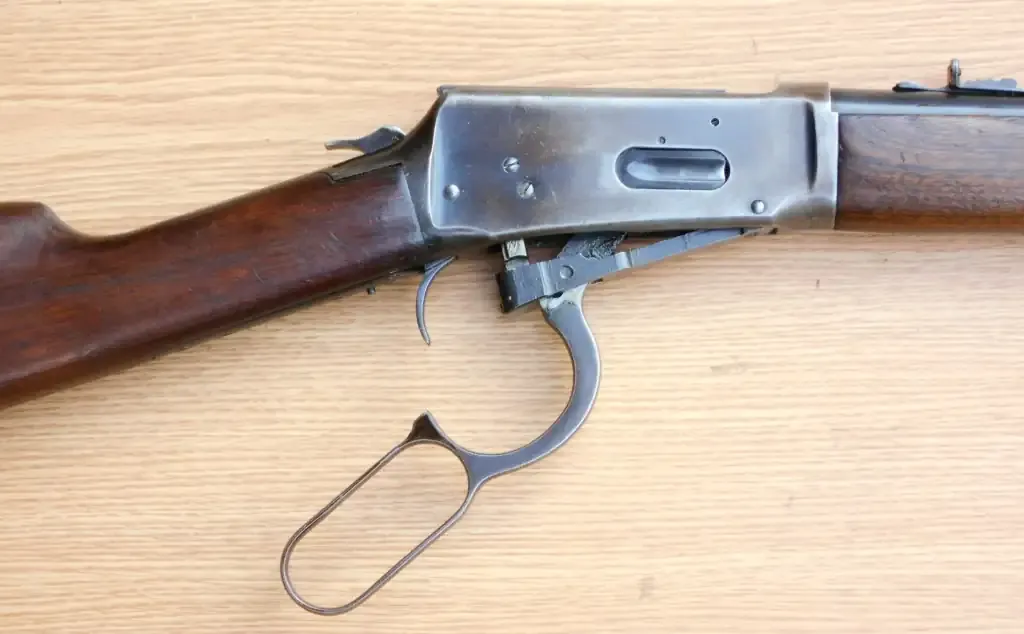
The Winchester Model 94 is one of the most recognizable American sporting rifles. Its compact receiver, exposed hammer, tubular magazine, and underlever remained in production, with an interruption after 2006, for more than a century. For collectors, however, “Model 94” describes a large family of configurations and mechanical variations. Correctly identifying those differences is essential when assessing originality, condition, and intended use.
Browning’s Model 1894
John M. Browning designed the action that became the Winchester Model 1894. His patent application, filed on January 19, 1894, described a compact magazine firearm intended to be simple, reliable, and capable of accommodating a longer cartridge than comparable actions with receivers of similar length. The patent was assigned to Winchester Repeating Arms Company and issued as U.S. Patent No. 524,702 on August 21, 1894.[1]
Winchester introduced the Model 1894 in .32-40 and .38-55, both established black-powder cartridges. In 1895, the company added the smokeless-powder .25-35 Winchester and .30 Winchester Center Fire. The latter became widely known as the .30-30 Winchester.[2]
The action uses a vertically moving locking block positioned behind the breechbolt. A hinged lower receiver assembly pivots downward as the lever opens, contributing to the rifle’s compact mechanism and distinctive profile.[3]
Early production included rifles with 26-inch round or octagonal barrels and saddle-ring carbines with 20-inch barrels. Winchester also offered takedown actions, nonstandard barrel lengths, engraving, checkering, and other special-order features.[3] More than seven million Model 94s were manufactured before the New Haven factory closed in 2006.[2]
What “Pre-’64” Means
The most consequential dividing line for collectors is 1964. That year, Winchester changed the Model 94’s manufacturing procedures to reduce production costs. The revisions created the collector terms “pre-’64” and “post-’64.”[3]
Winchester’s serial-number reference identifies 2,700,000 as the beginning of post-1964 Model 94 production.[4] A lower serial number is important evidence of pre-’64 manufacture, but it does not establish that the entire rifle remains in its original configuration. Barrels, stocks, sights, magazine components, and other parts may have been replaced during decades of use.
A pre-’64 rifle is most desirable when its features are consistent with its production date and show no evidence of later alteration. Inspect the barrel address, caliber marking, sights, stock profile, buttplate, magazine arrangement, and finish as a complete assembly. A correct serial number cannot make mismatched or refinished components original.
Winchester’s published serial-number tables are useful for preliminary dating, but the company warns that many older records are incomplete and that some listed dates are estimates.[4] When surviving factory records cover a particular firearm, the Cody Firearms Records Office may be able to confirm its manufacturing date and, for some early serial-number ranges, original details such as caliber, barrel type, trigger and special-order features.[5]
Top Ejection and Angle Ejection
Traditional Model 94s eject fired cases through the top of the receiver. This system is characteristic of pre-’64 rifles and many later examples, but it makes mounting a conventional scope directly over the action difficult.
U.S. Repeating Arms introduced the Angle Eject system in 1982. It directed cases upward and to the right, permitting a conventional scope to be mounted over the receiver.[3] The resulting receiver opening and ejection path provide readily visible identification points.
Collectors seeking a traditional configuration generally favor top-eject rifles. A hunter who intends to use a centrally mounted scope may find an Angle Eject example more practical. Neither arrangement is inherently correct for every buyer; the choice depends on whether historical configuration or optical-sight compatibility matters more.
Safety Systems as Dating Clues
For much of its production history, the Model 94 used an exposed hammer with a half-cock position. It also incorporated a lever-actuated trigger stop intended to prevent firing unless the lever was fully closed.
Later Model 94s received a manual crossbolt safety. Winchester replaced that system with a tang-mounted safety in 2003.[3] Current-style tang-safety rifles are therefore mechanically and visibly distinct from both traditional half-cock examples and crossbolt-safety production.
Safety type is a useful identification clue, but it is not a substitute for examining the serial number, markings and complete configuration. Transitional production, repaired firearms and replaced parts can complicate conclusions based on one feature alone.
Rifles, Carbines and Special Configurations
The Model 94 carbine most familiar to modern collectors normally has a 20-inch round barrel, barrel bands and a straight-grip stock. Traditional rifle configurations generally used longer barrels, frequently 26 inches, with round or octagonal profiles. Early production also included takedown rifles and short-barreled carbines.[3]
Terms such as “rifle,” “carbine,” “takedown,” and “trapper” describe configurations rather than barrel length alone. A scarce factory variation requires stronger evidence than visual resemblance. Period Winchester literature, surviving factory records and examination by a qualified Winchester specialist are preferable to conclusions drawn solely from an online serial-number table.
Winchester entered the commemorative market with the Wyoming Diamond Jubilee Model 94 in 1964.[3] Numerous commemorative editions followed. Limited production does not by itself guarantee substantial collector value: condition, originality, subject matter, factory packaging and market demand remain important.
Chamberings and Big Bore Models
The Model 94 began in .32-40 and .38-55. Winchester added .25-35 Winchester and .30 WCF in 1895, followed by .32 Winchester Special in 1902.[2][3] Later production expanded into additional rifle and handgun cartridges.
The modified Model 94 Big Bore was offered in .307 Winchester, .356 Winchester and .375 Winchester, with .444 Marlin added later.[6] These firearms should not be identified solely by their general resemblance to standard Model 94s. The barrel marking, receiver configuration, and other model-specific features must agree.
Ammunition must match the exact chambering marked on the barrel. Because cartridges lie end to end in the tubular magazine, Winchester instructs owners to use ammunition designed for centerfire tubular-magazine rifles. Its manual specifies flat-point, hollow-point, round-nose flat-point or similar bullets and warns against pointed or conical-point bullets in this application.[6]
Evaluating a Used Model 94
Begin by confirming that the firearm is unloaded, keeping the muzzle pointed in a safe direction and removing live ammunition from the inspection area. Winchester’s manual should govern operation and safety checks for the applicable version.[6]
A systematic inspection should include the following:
- Record the complete serial number and compare it with Winchester’s published production information.
- Confirm that the barrel’s caliber marking matches the ammunition intended for the rifle.
- Inspect the bore for corrosion, obstructions, bulges or damaged rifling.
- Examine the receiver, tangs and stock head for cracks, deformation or improper repairs.
- Check the screws, pins, barrel bands and magazine tube for damage or signs of repeated disassembly.
- Compare the sights, buttplate, stock, barrel and magazine configuration with period references or available factory records.
- Look for softened markings, uneven receiver edges, dished screw holes and altered wood-to-metal fit—possible signs of polishing or refinishing.
- Have a qualified gunsmith evaluate an unfamiliar rifle’s lockup, headspace, feeding, extraction, ejection and safety operation before it is fired.
Original finish should not be confused with an attractive finish. A professionally refinished rifle may be visually appealing, but it belongs in a different collecting category from an otherwise comparable example retaining its documented factory surfaces. Conversely, honest use-related wear does not necessarily make a Model 94 undesirable when its principal components and configuration remain correct.
New Haven and Japanese Production
The Model 94 was manufactured at New Haven, Connecticut, until the factory closed in 2006. Production returned in 2011 with rifles manufactured in Japan by Miroku.[2][3]
Japanese-made Model 94s combine the established action with modern production methods, Angle Eject receivers, and tang-mounted safeties. They represent a distinct manufacturing period and should not be presented as New Haven rifles. For a shooter seeking a later Model 94, the distinction may have little practical consequence. For a collector, it is fundamental.
Choosing the Right Model 94
Collectors pursuing traditional configurations generally concentrate on pre-’64 rifles, documented early variations, or complete commemorative editions. Hunters intending to mount conventional scopes may prefer Angle Eject rifles. Buyers seeking later manufacture may favor Miroku-produced examples.
Whatever the objective, buy the firearm rather than its story. Verify the serial number, markings, configuration and mechanical condition. Seek original factory documentation when it survives, and treat unsupported claims of rarity, originality or special ownership with caution. The Model 94’s long production history offers exceptional variety, but that same variety makes careful identification indispensable.
Frequently Asked Questions
What is a pre-’64 Winchester Model 94?
It is a Model 94 manufactured before Winchester changed its production methods in 1964. Winchester identifies 2,700,000 as the first post-1964 serial number.
What is the difference between top eject and Angle Eject?
Traditional Model 94s eject cases through the top of the receiver. Angle Eject rifles direct cases upward and to the right, allowing a conventional scope to be mounted over the action.
Who designed the Winchester Model 94?
John M. Browning designed the action that became the Model 1894. His related patent was issued on August 21, 1894.
Can a serial number prove that a Model 94 is original?
No. The serial number can help date the receiver, but the barrel, stock, sights, finish, and other components must also be examined.
Where can collectors obtain Winchester factory information?
The Cody Firearms Records Office holds surviving original Winchester records. Available information varies by model and serial-number range.
Sources
- Browning, John M. “U.S. Patent No. 524,702: Magazine-Gun.” United States Patent Office, August 21, 1894.
- Lee, Jerry. “The Lever-Action Rifle: An American Classic.” American Rifleman, May 9, 2011.
- Shideler, Dan. “The Winchester Model 94 Rides Again.” American Rifleman, January 18, 2011.
- Winchester Repeating Arms. “Winchester Firearms Manufacturing Dates by Serial Number and Year.” Manufacturer serial-number reference.
- Buffalo Bill Center of the West. “Winchester Factory Records.” Cody Firearms Records Office.
- Winchester Repeating Arms. “Model 94 Crossbolt Safety Rifle Owner’s Manual.” Manufacturer operating and safety manual.
As a firearms enthusiast with a background in website design, SEO, and information technology, I bring a unique blend of technical expertise and passion for firearms to the articles I write. With experience in computer networking and online marketing, I focus on delivering insightful content that helps fellow enthusiasts and collectors navigate the world of firearms.
Comments
Be the first to leave a comment.
Be the first to read new editorial features, collector guides, and brand spotlights.