Key Takeaways
- Introduced in 1948, the Model 336 developed from the Model 1893 and Model 36.
- Marlin added Micro-Groove rifling to the Model 336 centerfire line in 1956.
- The modern Model 1895, introduced in 1972, uses a Model 336-derived action and differs from the original 1895 rifle.
The Marlin Model 336 belongs to a design lineage extending to the nineteenth century. Its development encompasses the Model 1893, Model 36, and modern Model 1895 rifles connected by Marlin’s solid-top receiver, side-ejection system, and approach to lever-action design.
From the Model 1893 to the Model 336
The Model 336’s principal ancestor was the Marlin Model 1893. Designed by Lewis Lobdon Hepburn as an improvement over the Model 1889, the Model 1893 used a solid-top receiver and ejected fired cases through an opening in the receiver’s right side. Marlin offered it in rifle and carbine configurations for cartridges including the .32-40, .38-55, .30-30 Winchester, .32 Winchester Special, and .25-36 Marlin.[1][2]
The action’s solid top protected its internal components and later provided a practical surface for mounting optical sights. Side ejection distinguished the design from lever actions that expelled cases through the top of the receiver.
Marlin introduced the Model 1936 during the 1930s and subsequently shortened the designation to Model 36. Although it retained the basic solid-top, side-ejecting arrangement of the Model 1893, its square-profile bolt and manufacturing requirements left room for further development.[1]
That development produced the Model 336 in 1948. The redesigned rifle used a round breech bolt made from round stock, a spring-steel extractor, and coil-type mainspring and trigger springs. Marlin also revised the receiver to accommodate the round bolt while preserving substantial metal at the receiver’s rear.[1][3]
The resulting action combined the traditional operation of a lever-action rifle with a receiver well suited to twentieth-century manufacturing and the growing use of riflescopes.
The Two Marlin Model 1895s
The Model 1895 designation has been applied to two historically distinct Marlin rifles.
The original Model 1895 appeared in 1895 as a larger counterpart to the Model 1893. It was designed for powerful cartridges including the .38-56, .40-65, .40-82, and .45-70 Government. Later chamberings included the .45-90 and .33 Winchester Center Fire.[1]
The early Model 1895 shared the Model 1893’s square-profile bolt, solid-top receiver, and side-ejection system. Standard and carbine configurations were offered, and surviving examples represent Marlin’s adaptation of its lever-action system to the large sporting cartridges of the period.[1]
Production of the original rifle ended in the early twentieth century. When Marlin revived the Model 1895 name in 1972, it did not return to the original nineteenth-century action. The new rifle was built around the Model 336 family of receivers and chambered initially in .45-70 Government.[1][4]
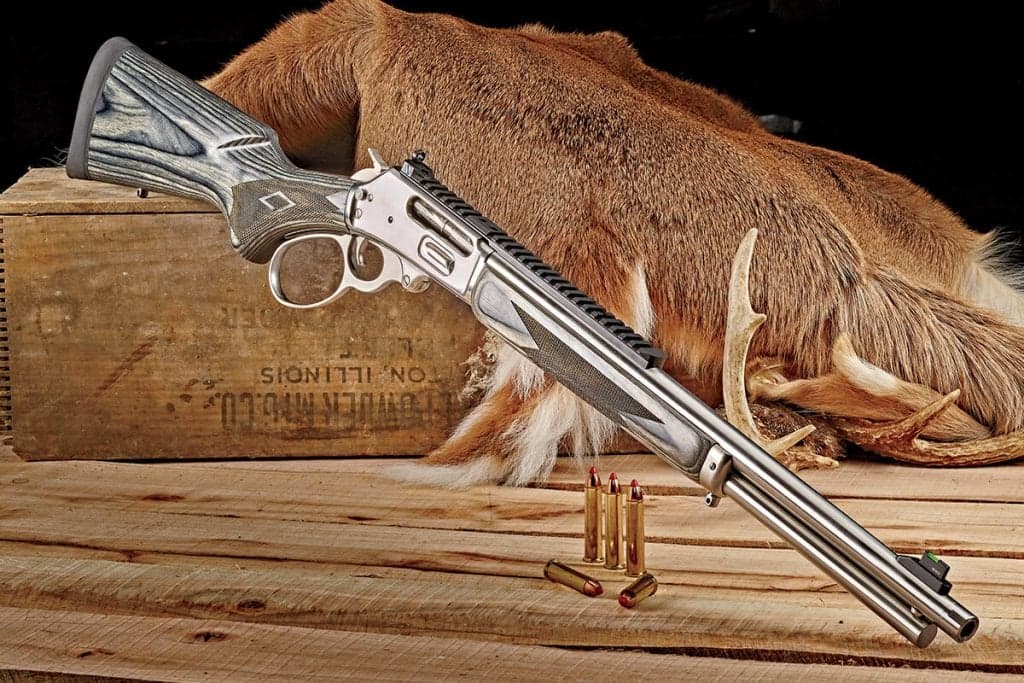
As introduced, the modern Model 1895 had a 22-inch barrel, a four-round half magazine, a straight-grip stock, and a squared finger lever. Its receiver was drilled and tapped for an optical sight. Marlin subsequently expanded the line with different barrel lengths, magazine capacities, stock configurations, finishes, and sighting systems.[1]
The shared designation can therefore be misleading. An original Model 1895 and a Model 1895 made after 1972 are related through Marlin’s design heritage and intended large-bore role, but they are not the same action.
The Model 336 Action
Operating the Model 336’s lever lowers the locking bolt and draws the breech bolt rearward. The extractor pulls the fired case from the chamber, after which the ejector expels it through the receiver’s right-side opening. The lever’s movement also cocks the hammer and operates the carrier, which raises the next cartridge from the tubular magazine into alignment with the chamber.[5]
Closing the lever moves the bolt forward, chambers the cartridge, and raises the locking bolt into engagement. This vertically moving locking component supports the breech bolt when the action is closed.
The side-ejection arrangement permits a scope to be mounted directly above the receiver. This became increasingly important as optical sights gained acceptance on American hunting rifles. Marlin began drilling and tapping Model 336 receivers for scope mounting during the 1950s.[6]
The basic Model 336 action also provided the foundation for other Marlin centerfire lever actions, most notably the modern Model 1895.
Micro-Groove Rifling
One of the Model 336’s best-known features is Marlin’s Micro-Groove rifling.
Conventional rifling generally uses a limited number of relatively broad and deep grooves. Marlin’s system instead employed numerous narrow, shallow grooves. The design is documented in U.S. Patent No. 3,100,358, issued to Thomas R. Robinson Jr. and assigned to Marlin Firearms Company.[7]
The patent describes a rifled barrel in which the driving sides of the lands are arranged to engage the bullet while limiting deformation and reducing the accumulation of fouling. It also specifies a large number of shallow grooves in relation to bore diameter.[7]
Marlin introduced Micro-Groove rifling in its rimfire rifles during the 1950s and incorporated it into the Model 336 centerfire line in 1956.[6] The company used the system extensively, although the number and dimensions of the grooves varied with caliber and production period.
Marlin also produced later rifles with conventional deep-groove rifling, commonly described in company literature and collector terminology as “Ballard-type” rifling. The term identifies the general rifling form; it does not mean that the barrel was manufactured by the historic Ballard company.
Rifling specifications must be tied to a particular model and period. The Model 336 Classic introduced in 2023, for example, was described with a six-groove, cold-hammer-forged barrel and a 1:12-inch right-hand twist in .30-30 Winchester rather than historic Micro-Groove rifling.[8]
Chamberings and Configurations
The Model 336 is most closely associated with the .30-30 Winchester and .35 Remington cartridges, although Marlin produced numerous chamberings and configurations over its long history.[3][6]
Variants differed in barrel length, magazine capacity, grip shape, sights, checkering, finish, and stock material. Some were compact carbines intended for hunting in dense cover, while others used longer barrels or specialized features.
The modern Model 1895 became particularly associated with the .45-70 Government cartridge. Its configurations have included traditional sporting rifles, short-barreled Guide Gun variants, stainless models, and rifles equipped with aperture sights or receiver-mounted rails.[1]
Because specifications changed, broad statements about barrel length, magazine capacity, sights, wood, or rifling cannot accurately describe every Model 336 or 1895. The precise suffix and production period are necessary to identify a particular variant.
Safety Developments
Early rifles in this lineage used hammer positions and internal mechanical features rather than a separate cross-bolt safety. Marlin added a cross-bolt safety to its lever-action rifles in 1984.[1]
Later Model 336 and 1895 rifles generally combined this manual safety with the exposed hammer and internal trigger-blocking components. Factory manuals describe the controls, loading and unloading procedures, maintenance requirements, and disassembly sequence for the rifles they cover.[9][10]
The presence or absence of a cross-bolt safety is one visible distinction between broad periods of production, but it should not be used as a precise dating method without additional evidence.
A Design Defined by Continuity
The Model 336 was not an isolated postwar invention. It was the result of successive revisions to a Marlin lever-action system that began with the Model 1893 and passed through the Model 36.
Its round bolt, side ejection, solid-top receiver, tubular magazine, and vertically moving locking bolt established a durable mechanical pattern. That pattern supported numerous Model 336 variants and, beginning in 1972, the modern Model 1895.
The design has changed in materials, manufacturing methods, rifling, safeties, sights, and external configuration. Its central identity, however, remains tied to the solid-top, side-ejecting action that Marlin developed more than a century ago.
Frequently Asked Questions
When was the Marlin Model 336 introduced?
Marlin introduced the Model 336 in 1948 as a redesign of the Model 36.
Which rifle preceded the Model 336?
The Model 336 descended from the Model 36, which developed from Marlin’s earlier Model 1893.
What is Micro-Groove rifling?
Micro-Groove rifling uses numerous narrow, shallow grooves instead of fewer, deeper conventional grooves. Marlin incorporated it into the Model 336 centerfire line in 1956.
Are the original and modern Model 1895 the same rifle?
No. The original appeared in 1895, while the modern Model 1895, introduced in 1972, uses a Model 336-derived action.
Why does the Model 336 use side ejection?
Its action ejects fired cases through the receiver’s right side. This leaves the receiver’s solid top available for mounting an optical sight.
Sources
- Dave Campbell, “A Look Back at the Marlin Model 1895,” American Rifleman, July 10, 2018.
- American Rifleman Staff, “I Have This Old Gun: Marlin Model 93 Carbine,” American Rifleman, May 31, 2017.
- Guy J. Sagi, “The Marlin 336: One of 2019’s Most-Popular Lever Guns,” American Rifleman, July 7, 2020.
- Guy J. Sagi, “Top-Selling Lever-Action Rifle of 2019: Marlin 1895,” American Rifleman, March 28, 2020.
- “Leveraging Heritage,” American Rifleman.
- Aaron Carter, “Top 10 Hunting Rifles: Marlin Model 336,” American Rifleman, September 19, 2012.
- Thomas R. Robinson Jr., “Rifled Gun Barrel, U.S. Patent No. 3,100,358,” U.S. Patent Office, August 13, 1963.
- Jeremiah Knupp, “New for 2023: Marlin Model 336 Classic,” American Rifleman, March 27, 2023.
- Marlin Firearms Company, “Models 336, 444 and 1895 Centerfire Lever-Action Rifles Owner’s Manual.”
- Marlin Firearms, “Model 1895 and Model 336 Lever-Action Rifles Instruction Manual.”
As a firearms enthusiast with a background in website design, SEO, and information technology, I bring a unique blend of technical expertise and passion for firearms to the articles I write. With experience in computer networking and online marketing, I focus on delivering insightful content that helps fellow enthusiasts and collectors navigate the world of firearms.
Comments
Be the first to leave a comment.
Be the first to read new editorial features, collector guides, and brand spotlights.