Key Takeaways
- The Auto-5 uses John M. Browning’s patented long-recoil system, in which the barrel and bolt initially recoil together.
- Regular production moved from FN in Belgium to Miroku in Japan during 1976, following wartime production by Remington.
- Serial numbers, barrel markings, configuration, originality, and condition must be assessed together when evaluating an Auto-5.
The Browning Auto-5 is one of the defining sporting shotguns of the 20th century. Designed by John M. Browning, it became the first mass-produced semi-automatic shotgun and remained in production, with interruptions and changes in manufacturer, from 1902 until 1999.[1][2] Its squared receiver profile earned it the familiar “humpback” nickname, but its historical importance rests on the long-recoil mechanism concealed beneath that distinctive silhouette.
How the Long-Recoil Action Works
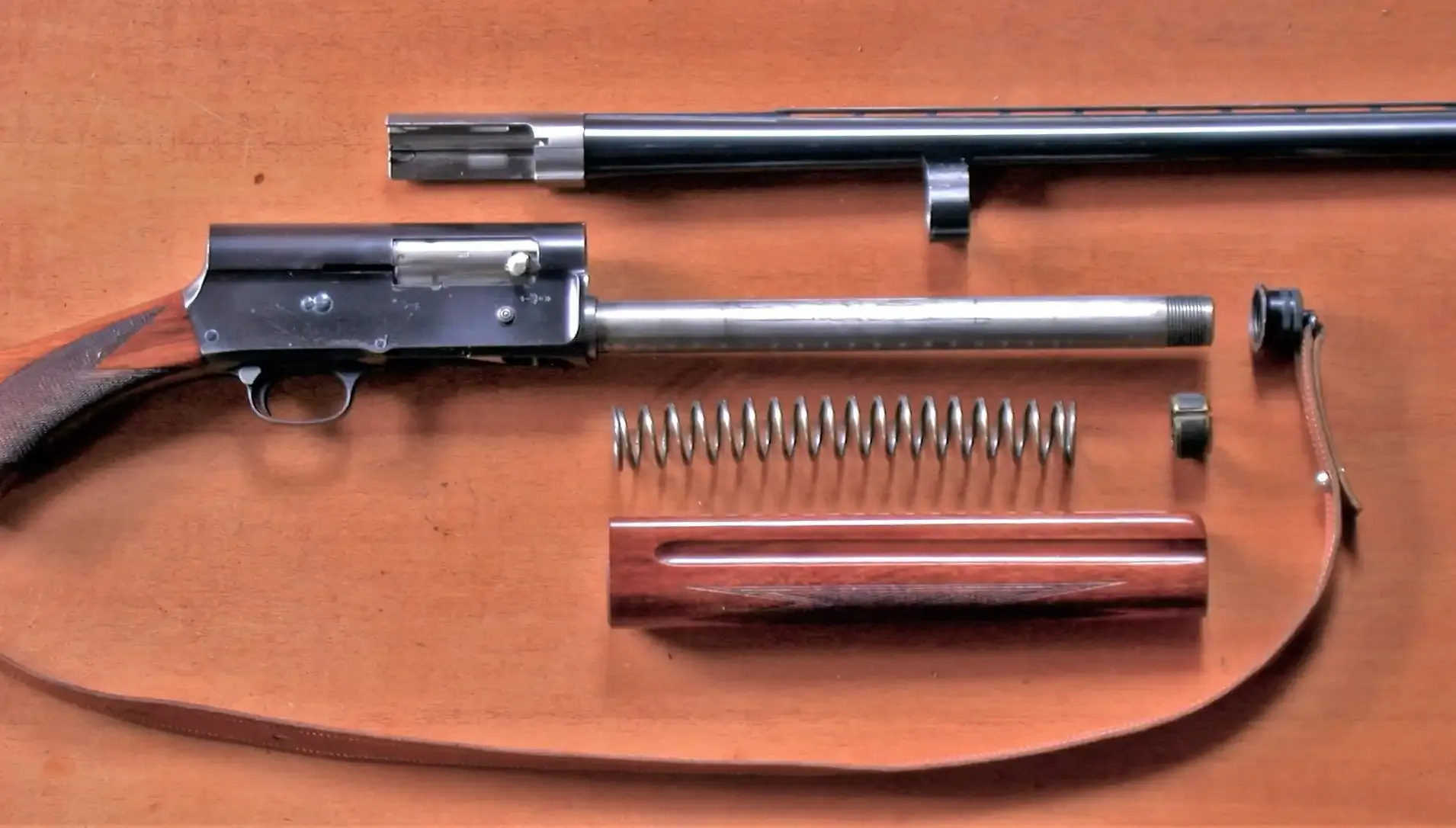
Browning filed his patent application for the recoil-operated design on February 8, 1900. U.S. Patent No. 659,507 was granted on October 9 of that year.[3] Upon firing, the locked barrel and bolt recoil together through a distance greater than the shell’s length. At the rear of their travel, the bolt remains back while the barrel returns forward, ejecting the fired shell. The bolt then moves forward, chambering the next round.
A recoil spring surrounding the magazine tube returns the barrel to battery. A bronze friction piece, used with one or more steel friction rings depending on the model, load, and prescribed configuration, regulates the barrel’s movement.[3][4] This system distinguishes the Auto-5 from later gas-operated and inertia-operated shotguns.
Correct friction-component arrangement is essential. Browning’s instructions vary between Light and Magnum models and among different load classes. The company warns that an incorrect arrangement can produce unnecessary recoil and severely batter the mechanism. Browning also specifies that the bronze friction piece must not be removed from its prescribed position behind the barrel guide ring.[4]
Lubrication requires similar care. According to Browning, the quantity and type of oil on the magazine tube alter the friction system’s resistance. Too much oil can increase the action’s recoil velocity, while rust, hardened grease, gummy lubricant, or insufficient lubrication can interfere with cycling. The tube should be kept clean and lubricated according to the correct manual for the particular Auto-5 model.[4]
Belgian, American, and Japanese Production
Fabrique Nationale d’Armes de Guerre, now FN Herstal, began producing Browning’s shotgun in Belgium in 1902. Browning’s first order covered 10,000 guns, and the first examples intended for the United States were shipped in 1903.[1][2] FN identifies the Auto-5 as the world’s first mass-produced semi-automatic shotgun.[5]
Germany’s occupation of Belgium halted normal exports in 1940. Browning consequently arranged for Remington to manufacture what collectors commonly call the “American Browning.” These guns were related to Remington’s Model 11 but incorporated Browning features, including the magazine cut-off. Remington production for Browning continued through 1947, while FN resumed supplying Browning from Belgium in September 1946.[1][2]
Production shifted again in the latter part of 1976, when Browning moved regular Auto-5 manufacture to Miroku in Japan.[6] FN nevertheless continued basic production into 1978 and subsequently completed occasional special runs, including the Gold Classic in 1984 and Centenary-series guns in 1989.[2] Country-of-origin markings therefore provide better evidence than a production-date assumption when identifying a specific gun.
Belgian and Japanese Auto-5s should not be reduced to a simple hierarchy of quality. Collectors generally value Belgian manufacture for its historical connection to FN and the original production period. Japanese guns offer later features, including factory interchangeable-choke barrels on many examples. Condition, configuration, originality, markings, and documented history remain more meaningful than country of manufacture alone.
Principal Models
The Standard Weight 12 gauge formed the core of the traditional Auto-5 line. Browning introduced lighter configurations by removing material from components such as the barrel ring and receiver and by reducing stock and rib weight.[2]
The Sweet Sixteen entered Browning’s line during the 1930s, although Browning’s own published sources differ by one year: its corporate timeline gives 1936, while an American Rifleman history based on factory research gives 1937.[2][7] The Light Twelve followed during the 1940s. The Light Weight 20 and three-inch Magnum 12 were added in 1958, and the three-inch Magnum 20 followed in 1967.[2][7]
These designations identify materially different configurations, not merely decorative names. Magnum barrels and actions are not interchangeable with the corresponding 2¾-inch Light-model components because their feeding and ejection systems differ.[4] A prospective buyer should confirm the receiver designation, chamber marking, barrel specification, and serial format rather than identify a gun from its furniture alone.
Barrels, Chokes, and Steel Shot
Most earlier Auto-5 barrels were built with fixed chokes. Browning began offering its Standard Invector interchangeable-choke system in 1983, and later Japanese barrels may therefore accept removable choke tubes.[6] The barrel marking is decisive: “INVECTOR” identifies a threaded barrel, while conventionally choked barrels require no removable tube.[4]
Browning’s current guidance states that Belgian-made and American-made Auto-5 barrels must not be used with steel shot. The company permits factory steel-shot loads in Auto-5s equipped with appropriate Japanese-made Invector barrels, subject to its choke restrictions. Browning does not recommend steel shot through Invector Full or Extra Full tubes.[8] A Belgian receiver fitted with a compatible Japanese Invector barrel may use steel shot, but the installed barrel, not the receiver’s origin, determines suitability.[8]
Replacement barrels also require correct model matching. Browning states that barrels of the same gauge and model are interchangeable, but Magnum barrels will not function correctly in Light actions, or vice versa.[4] Because barrels can be replaced, a receiver’s serial number does not establish that the attached barrel is original to the gun.
Reading Auto-5 Serial Numbers
Browning’s published serial guide is the appropriate starting point, but the company cautions that few records survive for pre-Second World War production. It lists early serial numbers from 1 to approximately 228,000 and describes exact dating of those guns as conjectural.[1]
For 1954 and 1955, the guide uses H for Standard Weight and L for Light Weight. In 1956, the Light Weight code changed to G; in 1957, M identified Standard Weight while G continued to identify Light Weight. From 1958 through 1967, a single-digit year prefix preceded the model letter. Thus, Browning’s example 8M1000 denotes a 1958 Standard Weight gun.[1]
Beginning in 1969, Browning used a two-digit year followed by the model letter and serial sequence. Its example 69G1000 identifies a 1969 Light Weight 12 gauge.[1]
From 1976 through 1997, Browning used a standardized format combining a serial sequence, a two-letter date code, and a three-digit model code. The listed model codes are:
- 151 — Magnum 12
- 161 — Magnum 20
- 211 — Light 12
- 221 — Sweet 16
- 231 — Light 20[1]
The year-code key is Z=1, Y=2, X=3, W=4, V=5, T=6, R=7, P=8, N=9, M=0. Browning’s example 01001RT151 identifies serial 01001, the year 1976, and a Magnum 12.[1]
Serial decoding should be combined with an examination of proof marks, country-of-origin markings, barrel inscriptions, engraving, safety style, and model-specific features. Browning’s table is useful, but it does not prove that every component currently on a firearm left the factory with its receiver.
Evaluating an Auto-5
Originality and condition drive collector interest. Examine the receiver and barrel markings, serial format, choke designation, chamber length, rib style, safety configuration, engraving, and wood-to-metal fit. Look for evidence of refinishing, altered barrels, replacement wood, cracked forearms, damaged screw slots, corrosion, and mismatched components.
The forearm deserves particular attention. Browning warns against squeezing its open rear section during disassembly because the wood can split. The magazine cap must be fully seated so that the forearm is held correctly against the receiver.[4] Existing cracks or oil-softened wood can reduce both serviceability and collector value.
A gun intended for use should be inspected by a qualified gunsmith, particularly if its maintenance history is unknown. The friction components must match the exact model and intended ammunition. Barrel markings must govern chamber length, choke selection, and shot-material compatibility.
End of Production
Browning discontinued the traditional Auto-5 after the 1999 Final Tribute Limited Edition. Miroku produced 1,000 Final Tribute 12-gauge guns with high-grade wood and engraved scenes depicting John M. Browning, the FN factory, and the Browning brothers’ first store.[1][2] Their serial format begins with “2000FT,” although Browning states that distribution began in 1999.[1]
The Auto-5’s collectible appeal comes from more than longevity. Its surviving examples document nearly a century of changes in sporting arms production across Belgium, the United States, and Japan. Correct identification depends on treating each gun as an assembly of evidence: receiver, barrel, serial number, markings, configuration, condition, and provenance. That disciplined approach separates an attractive old shotgun from a historically coherent collectible.
Frequently Asked Questions
What is the Browning Auto-5?
The Auto-5 is a long-recoil, semi-automatic shotgun designed by John M. Browning. FN began production in Belgium in 1902.
Why is the Auto-5 historically significant?
It is recognized as the first mass-produced semi-automatic shotgun. Its production history extended across most of the 20th century.
How does the Auto-5 action work?
The barrel and locked bolt recoil together after firing. The barrel then returns forward before the bolt chambers the next shell.
Where was the Auto-5 manufactured?
Regular production began at FN in Belgium, while Remington produced American Brownings during the Second World War era. Production moved to Miroku in Japan during 1976.
How can I determine an Auto-5’s production date?
Start with Browning’s official serial-number guide. Confirm the result against the firearm’s markings, features, and country of origin.
Sources
- Browning. “Auto-5 Semi-Automatic Shotgun: Dating and Serial Number Information.” Browning Customer Support.
- Vanderlinden, Anthony. “Browning Auto-5: The First Successful Semi-Auto Shotgun.” American Rifleman, February 9, 2021.
- Browning, John M. “Recoil-Operated Firearm.” U.S. Patent No. 659,507, filed February 8, 1900; granted October 9, 1900.
- Browning. “Auto-5 Magnum Owner’s Manual.” Browning Customer Support.
- FN America. “About FN.” FN America.
- Browning. “Historic Timeline.” Browning Customer Support.
- Browning. “Historic Timeline: 1900–1950.” Browning Customer Support.
- Browning. “Can I Shoot Steel Shot in My Browning Shotgun?.” Browning Customer Support.
As a firearms enthusiast with a background in website design, SEO, and information technology, I bring a unique blend of technical expertise and passion for firearms to the articles I write. With experience in computer networking and online marketing, I focus on delivering insightful content that helps fellow enthusiasts and collectors navigate the world of firearms.
Comments
Be the first to leave a comment.
Be the first to read new editorial features, collector guides, and brand spotlights.