Key Takeaways
- FN was founded in Herstal in 1889 to fulfill a Belgian government order for 150,000 Model 1889 Mauser rifles.
- John Moses Browning initiated FN’s High Power project, but Dieudonné Saive completed the production design after Browning’s death.
- Authenticating a collectible FN requires evaluating its serial numbers, proof marks, finish, configuration, and documented provenance together.
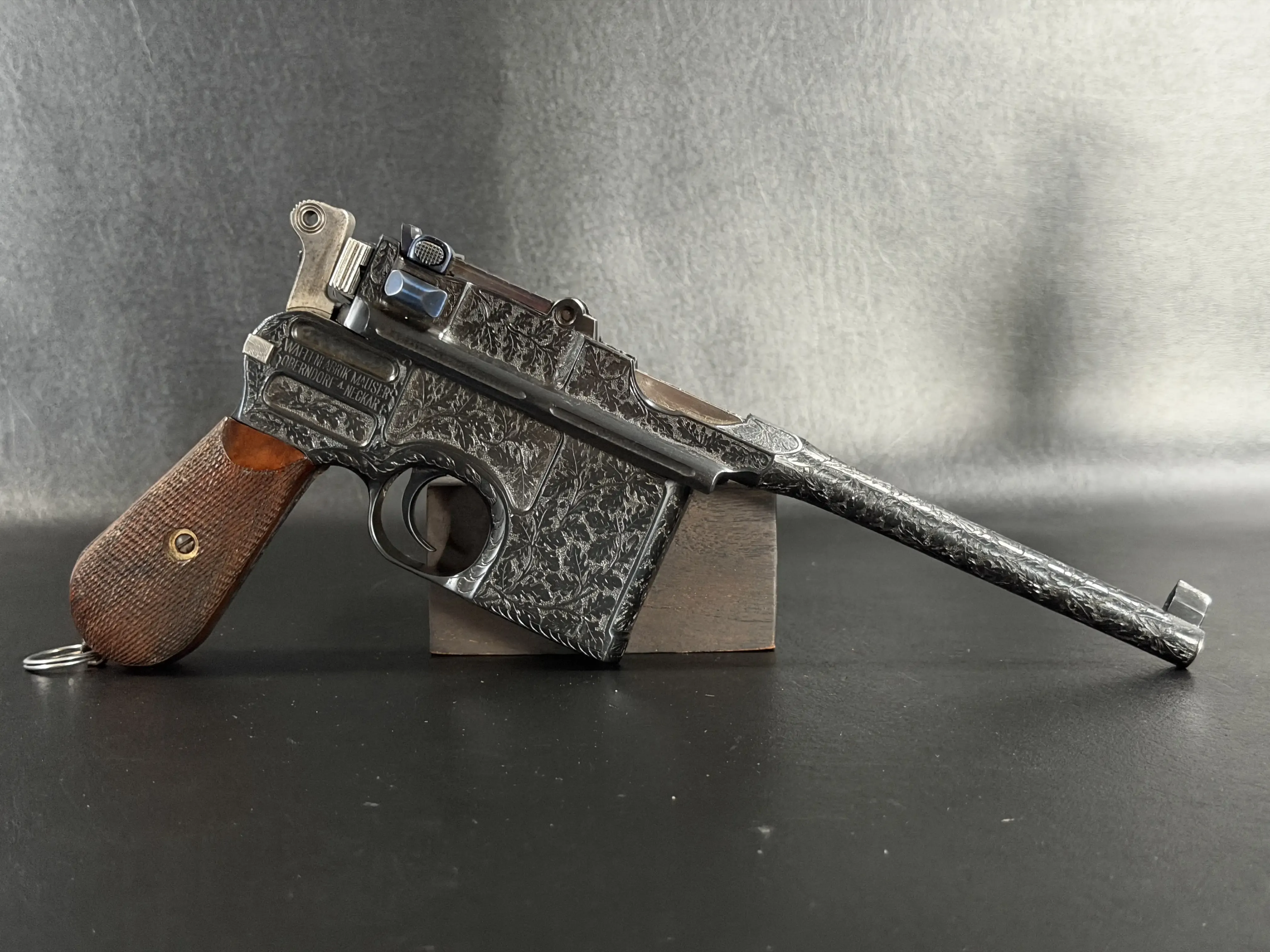
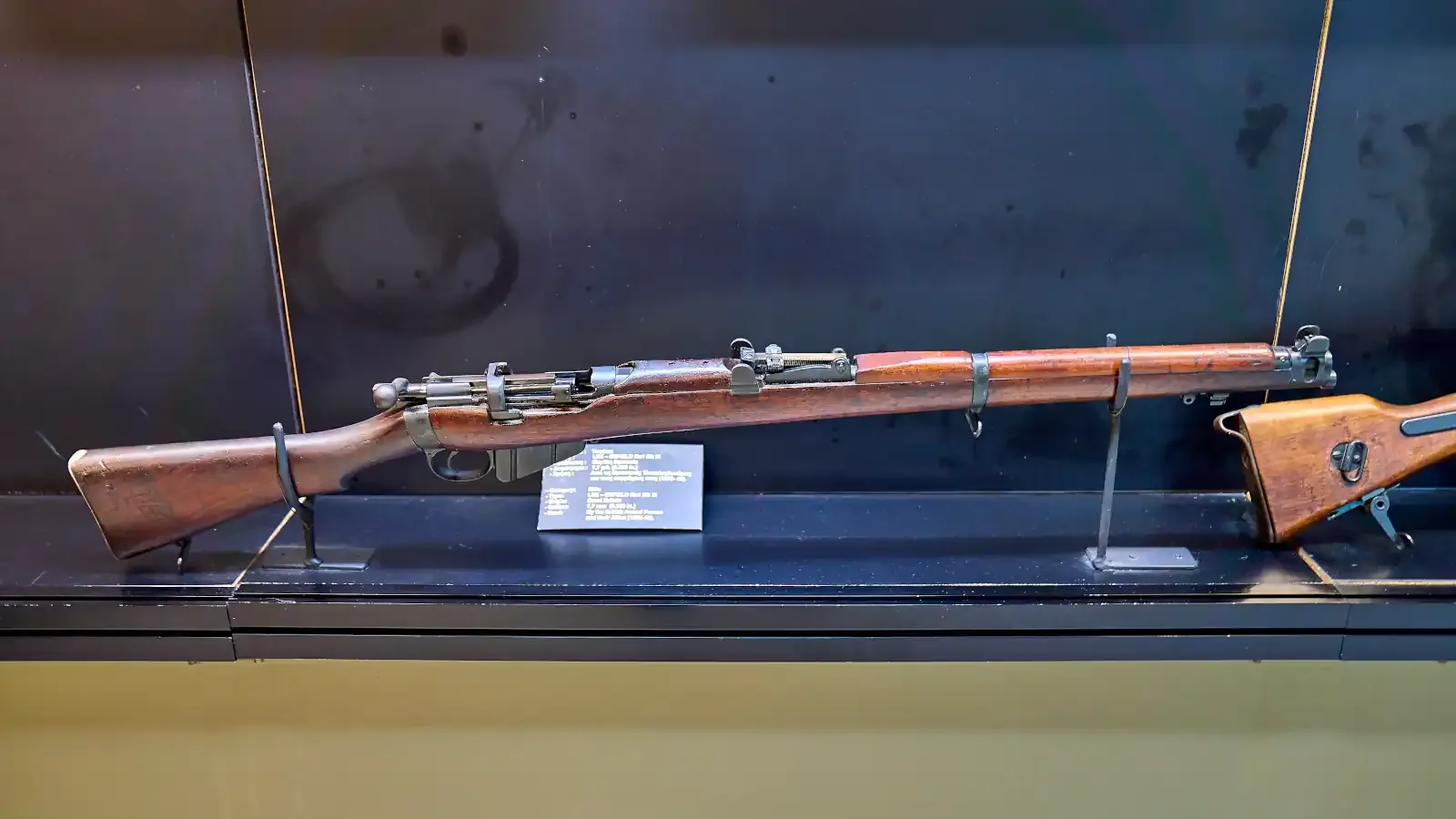
Fabrique Nationale began as an instrument of Belgian military policy. Established at Herstal in 1889, the company’s first assignment was a Belgian government order for 150,000 Model 1889 Mauser rifles. Assembly of the first rifles followed in 1891. FN subsequently diversified into ammunition, bicycles, motorcycles, automobiles, and sporting arms—an industrial breadth that helped sustain the factory when military orders slowed.[1]
That diversification also led to FN’s defining partnership. In 1897, commercial director Hart O. Berg encountered American firearms designer John Moses Browning while investigating bicycle manufacturing in the United States. FN secured European manufacturing rights to Browning’s self-loading pistol work, beginning a relationship that would shape the company for nearly three decades.[1]
Browning and FN’s Early Automatic Pistols
The Browning-designed pistol that became the FN Model 1900 was a compact, blowback-operated arm chambered for the 7.65×17 mm Browning cartridge, commonly known in the United States as .32 ACP. Its fixed barrel, detachable magazine, and recoil spring positioned above the barrel gave it a distinctive profile. More importantly, it demonstrated that a practical self-loading pistol could be manufactured in substantial numbers for military, police, and civilian markets.[1][2]
FN subsequently manufactured several other Browning designs, including the Model 1903, Model 1910, Baby Browning, and Auto-5 shotgun. Browning traveled repeatedly to Belgium to oversee development and production, creating a working relationship that went well beyond a conventional licensing agreement.[1]
The original article’s dramatic image of Browning collapsing over a Hi-Power drawing cannot be substantiated. Browning did die of heart failure in Liège on November 26, 1926, while working at FN, but Browning’s own corporate history states that the firearm then in final development was his Superposed over-and-under shotgun.[3] His work on FN’s new service-pistol project was nevertheless real and important: a surviving U.S. patent application filed on June 28, 1923, documents his locked-breech automatic-pistol design.[4]
Completing the High Power
The pistol ultimately known as the Grand Puissance, High Power, or P-35 was not solely Browning’s creation. It emerged from a prolonged FN development program responding to French military requirements for a modern 9 mm service pistol. Dieudonné Saive, an FN engineer who had worked with Browning, played the decisive role in converting the early prototypes into the production arm.[5]
Saive refined the staggered-column magazine, reduced the pistol’s dimensions, adopted an external hammer, and revised the mechanism as development continued. The resulting 9×19 mm pistol used a 13-round detachable magazine and entered Belgian service and production in 1935.[5] Its combination of service-pistol dimensions and comparatively high magazine capacity distinguished it from most contemporary military handguns.
The High Power’s history also produced several distinct collecting categories. Prewar Belgian pistols, German-occupation production, Canadian Inglis pistols, postwar commercial models, and later military or police-contract examples can differ materially in sights, stock slots, finishes, markings, and internal components. During the Second World War, German forces continued production at occupied FN, while John Inglis and Company manufactured the design in Canada for Allied contracts.[5]
Consequently, a model name or serial number alone is not enough to authenticate a High Power. Collectors should compare serial markings across numbered components, examine military acceptance and commercial proof marks, determine whether the finish is consistent with the claimed period, and establish whether the pistol’s features belong together. A refinished or parts-composite pistol may still be historically interesting, but it should not be represented or valued as an untouched original.
Saive, the FN-49, and the FAL
Saive’s importance extended well beyond the High Power. During the 1930s, he developed a gas-operated, self-loading military rifle employing a long-stroke piston and rear-locking, tilting bolt. German occupation interrupted work at Herstal, but Saive escaped Belgium and continued development in Britain. After the war, FN completed the design that entered the market as the SAFN or FN-49.[6]
The FN-49 occupied a transitional position between full-power, fixed-magazine semiautomatic rifles and the selective-fire service rifles of the Cold War. FN supplied it in several national configurations and chamberings, including 7×57 mm, 7.65×53 mm, 7.92×57 mm, and .30-06 Springfield. Surviving examples must therefore be identified by contract, caliber, markings, and original configuration rather than treated as one interchangeable production series.[6]
At the same time, Saive and FN were developing the Fusil Automatique Léger. Early FAL prototypes were built around intermediate cartridges, including the British .280 experimental round, before the rifle was adapted to the 7.62×51 mm cartridge selected for NATO standardization. Canada adopted a version of the design in 1954, and numerous countries subsequently adopted or manufactured FAL-pattern rifles.[1][7]
The FAL’s international production history is central to its appeal—and to the difficulty of collecting it responsibly. Belgian rifles coexist with licensed and nationally modified versions produced in countries including Britain, Canada, Australia, Austria, Argentina, Brazil, Israel, and South Africa. Metric-pattern and Commonwealth “inch-pattern” arms also differ in numerous components and manufacturing details. The presence of FN-pattern parts does not, by itself, establish that a rifle was manufactured in Belgium or remains in its original military configuration.
The MAG and MINIMI
FN’s postwar influence was not limited to rifles. The company developed the 7.62×51 mm FN MAG general-purpose machine gun and the smaller-caliber FN MINIMI light machine gun. Versions of both became standard American weapons: the MAG entered U.S. service as the M240 family, while the MINIMI became the M249 Squad Automatic Weapon.[8][9]
The U.S. Army first adopted the M240 as a vehicle-mounted weapon in 1977, with infantry versions following during the 1990s.[8] The Army selected the M249 to provide a portable automatic weapon for the infantry squad, and FN’s American operation became its domestic producer.[9] These adoptions illustrate FN’s ability to translate Belgian designs into weapons manufactured and supported within another country’s military-industrial system.
SCAR and FN’s American Manufacturing Base
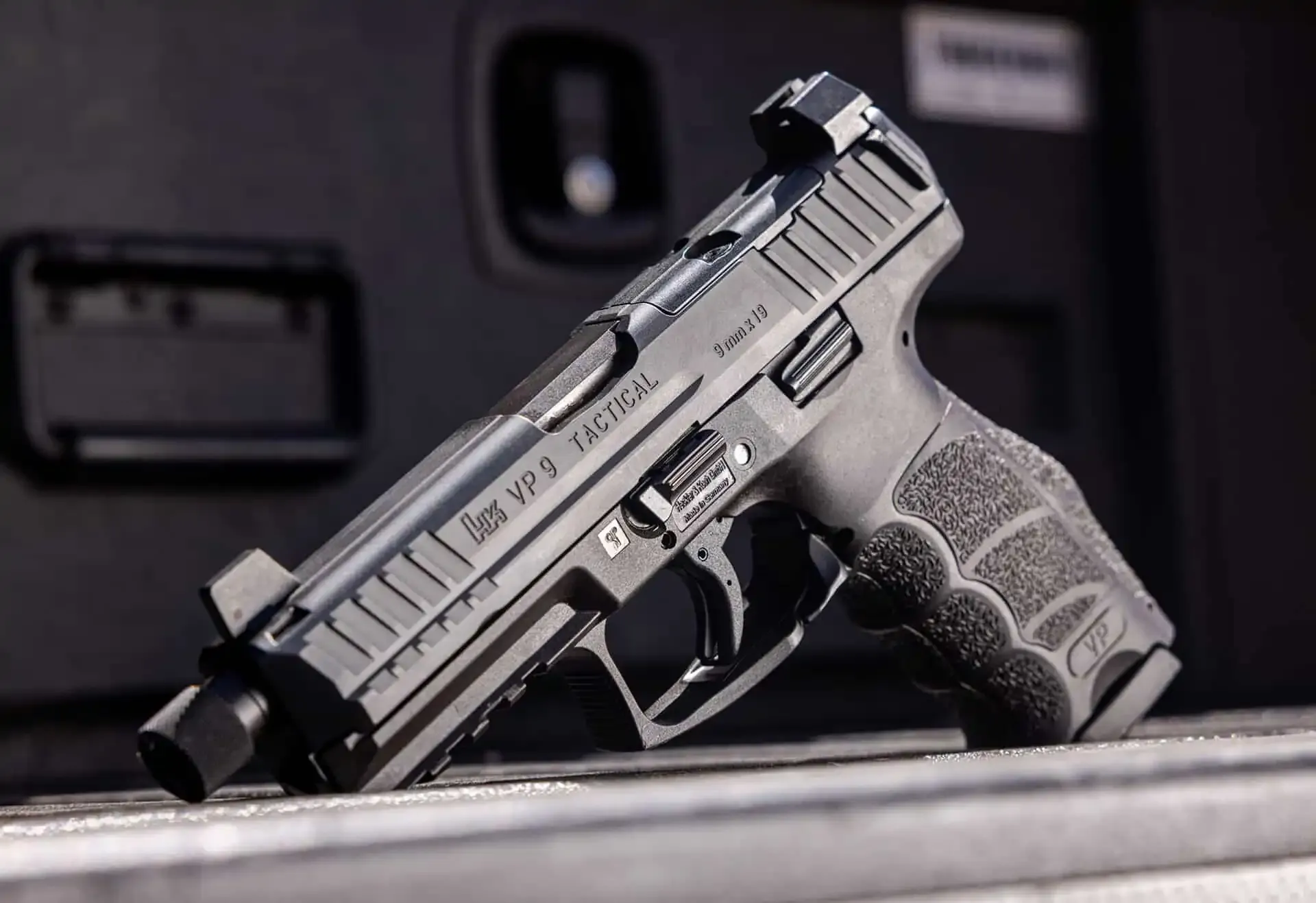
FN’s U.S. presence began in 1979, and its South Carolina manufacturing plant opened in 1981. The facility was initially established to produce the M240 for the U.S. Army and later manufactured weapons including the M249, M16A4, M4A1, and FN SCAR under U.S. government contracts.[10]
The SCAR program originated in a U.S. Special Operations Command competition. Nine vendors submitted 12 designs in 2004 for a family of modular rifles. Testing continued through 2008, when the SCAR and its enhanced grenade-launcher module were judged operationally effective and suitable.[11] Subsequent military and semiautomatic commercial variants extended the design beyond its original special-operations program.
Collectors should distinguish military-program history from the configuration of any individual commercial rifle. Model designation, receiver markings, barrel assembly, bolt carrier, stock, and import or manufacturer information all matter. Later factory modifications do not automatically apply to earlier examples, and an aftermarket component does not acquire military provenance merely because it resembles a service part.
Reading an FN Firearm as Evidence
FN’s long history creates opportunity for collectors, but it also rewards disciplined examination. A firearm should be evaluated as a physical document. Its serial numbers, proofs, inspector marks, acceptance stamps, importer information, machining, finish, and component configuration must support the same account.
Belgian proof marks are particularly useful, but they have defined meanings. The Liège Proof House applies marks associated with official testing; such a mark is not automatically a factory-production date, military acceptance, or confirmation that every component is original.[12] Marks should be interpreted using the system applicable to the firearm’s period, not through an undated chart or a resemblance found online.
The same restraint applies to provenance. A sales description records what a seller claimed. It does not independently prove military issue, ownership by a named person, combat use, or factory originality. Strong provenance rests on contemporaneous records, identifiable institutional markings, factory documentation, or an unbroken chain of custody tied to the specific serial-numbered firearm.
FN’s historical importance does not depend on embellishment. From the Model 1889 Mauser contract and Browning partnership to Saive’s High Power, FN-49, and FAL—and later the MAG, MINIMI, and SCAR—the company repeatedly converted engineering work into arms manufactured across national and generational boundaries. For collectors, the enduring lesson is straightforward: identify the exact variant, read the markings in context, and let documented evidence determine the story.
Frequently Asked Questions
When was FN Herstal founded?
FN was established in Herstal, Belgium, in 1889. Its first assignment was a Belgian government order for 150,000 Model 1889 Mauser rifles.
Did John Moses Browning design the High Power?
Browning developed the foundational locked-breech pistol design, but he died before the High Power was completed. FN engineer Dieudonné Saive substantially refined and completed the production pistol.
What is the relationship between the FN-49 and the FAL?
Both rifles were developed under Dieudonné Saive. The FN-49 was a full-power semiautomatic service rifle, while the later FAL became a selective-fire military rifle chambered primarily for 7.62×51 mm NATO.
Where were FN firearms manufactured?
FN’s historic manufacturing center is in Herstal, Belgium. FN also established production in South Carolina for American military, law-enforcement, and commercial markets.
How should collectors authenticate an FN firearm?
Collectors should examine serial numbers, proof and acceptance marks, importer markings, finish, and component configuration. Provenance claims should be supported by records tied to the specific firearm.
Sources
- FN America, “The History of FN”
- City of Liège Museums, Weapons Department Visitor’s Booklet
- Browning, “Historic Timeline”
- U.S. Patent No. 1,618,510, “Automatic Firearm,” John M. Browning
- American Rifleman, “The Browning High Power Story”
- American Society of Arms Collectors, “Fabrique Nationale Fusil Semi-Automatique d’Infanterie”
- American Rifleman, “FN: The First 125 Years”
- U.S. Army, “Soldiers Play Key Role in Fielding Lighter Machine Gun”
- U.S. Army Acquisition Support Center, Weapon Systems Handbook: M249 Squad Automatic Weapon
- FN America, “FN Announces $18 Million Expansion Project at Columbia, South Carolina Production Facility”
- FN America, “Why the FN SCAR”
- Permanent International Commission for the Proof of Small Arms, “Proof Marks in Force”
As a firearms enthusiast with a background in website design, SEO, and information technology, I bring a unique blend of technical expertise and passion for firearms to the articles I write. With experience in computer networking and online marketing, I focus on delivering insightful content that helps fellow enthusiasts and collectors navigate the world of firearms.
Comments
Be the first to leave a comment.
Be the first to read new editorial features, collector guides, and brand spotlights.