Key Takeaways
- FN Herstal received the USSOCOM SCAR contract in 2004 following a full and open competition.
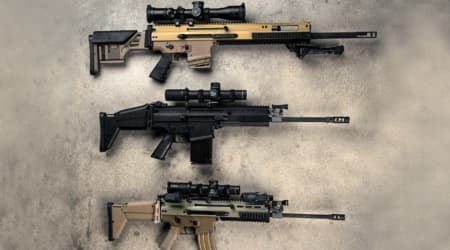
- The commercial family includes the 5.56 mm SCAR 16S, multi-caliber SCAR 17S, precision-oriented SCAR 20S, and compact SCAR 15P pistol.
- The 2026 redesign adds a hydraulically buffered carrier, revised controls, an extended M-LOK receiver, and improved suppressor compatibility.
The FN SCAR began as a military development program, not a commercial rifle concept. In January 2004, U.S. Special Operations Command issued a request for proposals for a new family of modular combat rifles. FN Herstal received the contract on November 4, 2004, following a full and open competition. From the outset, military operators participated in evaluating and refining the design.[1]
The resulting family comprised the 5.56×45 mm SCAR-L, designated Mk 16 in U.S. service, and the 7.62×51 mm SCAR-H, designated Mk 17. The Mk 13 Enhanced Grenade Launcher Module and the precision-oriented Mk 20 Sniper Support Rifle subsequently expanded the system. USSOCOM described the family as a modular platform developed specifically for special-operations requirements, with close-quarters and long-barrel configurations for the principal rifles.[2]
FN introduced semiautomatic commercial derivatives in the United States in 2008. Nearly two decades later, the company announced a substantially revised American commercial lineup in January 2026. The current family consists of the SCAR 16S, SCAR 17S and SCAR 20S rifles, together with the existing compact SCAR 15P pistol.[3]
The Architecture Behind the SCAR
The SCAR operates through a short-stroke gas-piston system. Propellant gas diverted through the barrel’s gas port acts on a piston, which delivers a brief impulse to the moving assembly. FN pairs this system with a two-position adjustable gas regulator.[4]
The design’s most recognizable structural element is its one-piece aluminum upper receiver and continuous top rail. The upper carries the principal operating components, while a polymer trigger module forms the lower portion of the firearm. A telescoping, side-folding polymer stock and adjustable cheekpiece remain standard on the next-generation rifles.[5]
The revised commercial models also retain cold-hammer-forged, chrome-lined barrels. FN describes the barrels as free-floating and user-changeable, although barrel and caliber compatibility depends on the particular model and approved components.[5] Claims that every SCAR model can be freely converted to every caliber should therefore be treated cautiously.
Controls on the new rifles are ambidextrous and configurable. They include a double-sided bolt catch and release, elongated magazine-release buttons, non-reciprocating charging handles and interchangeable selector levers. The receiver has also been extended forward and incorporates M-LOK attachment slots at the three-, six- and nine-o’clock positions.[5]
The 2026 Redesign
The most consequential internal change is a lighter, two-piece bolt carrier incorporating a hydraulic buffer. FN states that the buffer moderates the carrier’s movement and reduces felt recoil. The company also says the revised carrier can be installed in earlier commercial SCAR rifles.[3][5] These are manufacturer claims; the published material does not provide independent comparative recoil measurements.
FN also revised the trigger systems. The SCAR 16S and 17S receive an improved single-stage trigger, while the SCAR 20S uses a two-stage precision trigger. The rifles have conventional U.S.-standard muzzle shoulders and threads—1/2×28 on the 5.56 mm model and 5/8×24 on the 7.62 mm models—to support compatible muzzle devices and forward-venting, low-backpressure suppressors.[3]
According to FN, the next-generation rifles completed 16,000-round testing without failure of a major component.[3] That figure should be understood as FN’s reported endurance-test result, not as a guarantee that every rifle or component will reach the same round count under all conditions.
Models and Specifications
The SCAR 16S is the 5.56×45 mm carbine. FN lists a 16.25-inch barrel, an overall length of 34.75 to 37.25 inches, and a weight of 8.7 pounds. Its steel magazine is offered in 30- and 10-round configurations.[5]
The SCAR 17S is available in 7.62×51 mm and 6.5 Creedmoor. Both versions use a 16.25-inch barrel. FN lists the rifle at 8.9 pounds and 36 to 38.5 inches in overall length, with 20- or 10-round steel magazines.[6]
The SCAR 20S is the precision-oriented member of the commercial family. It is offered in 7.62×51 mm and 6.5 Creedmoor with a 20-inch barrel, 10-round magazine, and two-stage trigger. FN lists a weight of 10.7 pounds and an overall length of 41.25 to 43 inches. The 7.62 mm barrel has a 1:10-inch twist, while the 6.5 Creedmoor version has a 1:7.5-inch twist; both use 5R rifling.[7]
The SCAR 15P is classified and sold as a pistol. FN offers it in 5.56×45 mm and .300 Blackout, extending the commercial family into a substantially shorter configuration.[3][8] It should not be confused with a factory-stocked short-barreled rifle, which occupies a different legal category under United States federal law.
Military Lineage and Commercial Identity
The commercial SCARs share their operating concept and visual identity with the military family, but they are not simply military rifles placed into civilian packaging. The 16S, 17S and 20S are semiautomatic firearms with commercial configurations, model-specific barrels, different fire-control components and features developed for the American market.
Their historical importance rests on a documented relationship to the USSOCOM program. Contemporary command reporting confirms that the original SCAR was created through an operator-driven development process and evaluated by special-operations personnel. USSOCOM’s later reference material identifies the Mk 16, Mk 17, Mk 13 and Mk 20 as parts of the command’s Combat Assault Rifle family.[1][2]
For collectors, this documented progression provides a more defensible framework than generalized claims about rarity or investment potential. Early reciprocating-charging-handle rifles, later non-reciprocating-charging-handle versions, and the redesigned 2026 models represent identifiable stages in the commercial platform’s development. Model, caliber, finish, factory configuration, included accessories and documentary provenance all matter when evaluating a particular example.
The 2026 redesign marks the largest publicly documented revision of the American commercial SCAR family to date. It preserves the platform’s short-stroke piston system, aluminum upper receiver, folding stock, and military-derived profile while introducing a hydraulically buffered carrier, revised controls, an extended M-LOK receiver, and greater accommodation for low-backpressure suppressors. That combination of continuity and mechanical change gives the latest generation a distinct place in the SCAR’s developing history.
Frequently Asked Questions
What does SCAR stand for?
SCAR stands for Special Operations Forces Combat Assault Rifle. The platform originated from a USSOCOM development program.
When did FN receive the SCAR contract?
FN Herstal received the USSOCOM contract on November 4, 2004. The award followed a competitive evaluation involving special-operations personnel.
What is the difference between the SCAR 16S and 17S?
The SCAR 16S is chambered in 5.56×45 mm. The SCAR 17S is offered in 7.62×51 mm and 6.5 Creedmoor.
What distinguishes the SCAR 20S?
The SCAR 20S is the precision-oriented commercial model. It has a 20-inch barrel, two-stage trigger, and chamberings in 7.62×51 mm or 6.5 Creedmoor.
What changed in the 2026 FN SCAR redesign?
FN added a hydraulically buffered two-piece carrier, revised controls, an extended M-LOK receiver, and support for compatible low-backpressure suppressors. The underlying short-stroke piston system and recognizable SCAR configuration remain.
Sources
- Jennifer Chait, “Command Conducts First Critical Review for SCAR Program,” Tip of the Spear, U.S. Special Operations Command, April 2005, pp. 30–31.
- U.S. Special Operations Command, “2012 Fact Book,” 2012, pp. 33–34.
- FN America, “The Next Generation of the FN SCAR: The Legend. Reborn.,” January 15, 2026.
- FN America, “Why the FN SCAR,” technical and program history.
- FN America, “FN SCAR 16S,” product specifications.
- FN America, “FN SCAR 17S,” product specifications.
- FN America, “FN SCAR 20S,” product specifications.
- FN America, “FN SCAR 15P,” product information.
As a firearms enthusiast with a background in website design, SEO, and information technology, I bring a unique blend of technical expertise and passion for firearms to the articles I write. With experience in computer networking and online marketing, I focus on delivering insightful content that helps fellow enthusiasts and collectors navigate the world of firearms.
Comments
Be the first to leave a comment.
Be the first to read new editorial features, collector guides, and brand spotlights.