Key Takeaways
- Original factory condition generally matters more than superficial shine; refinishing can remove evidence and reduce collector value.
- Factory letters can confirm a revolver’s original configuration and shipping details, but the firearm must still match the documented record.
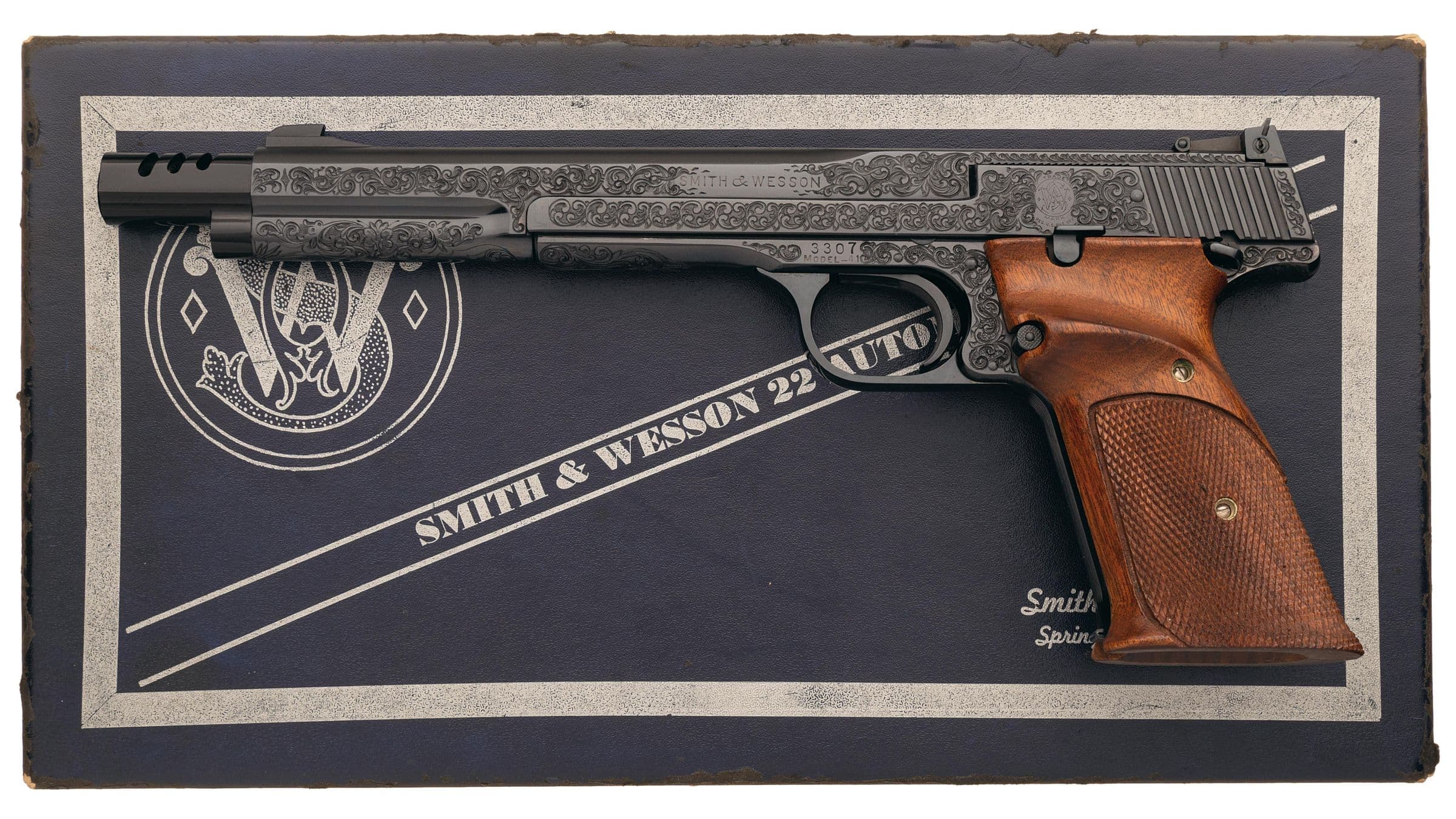
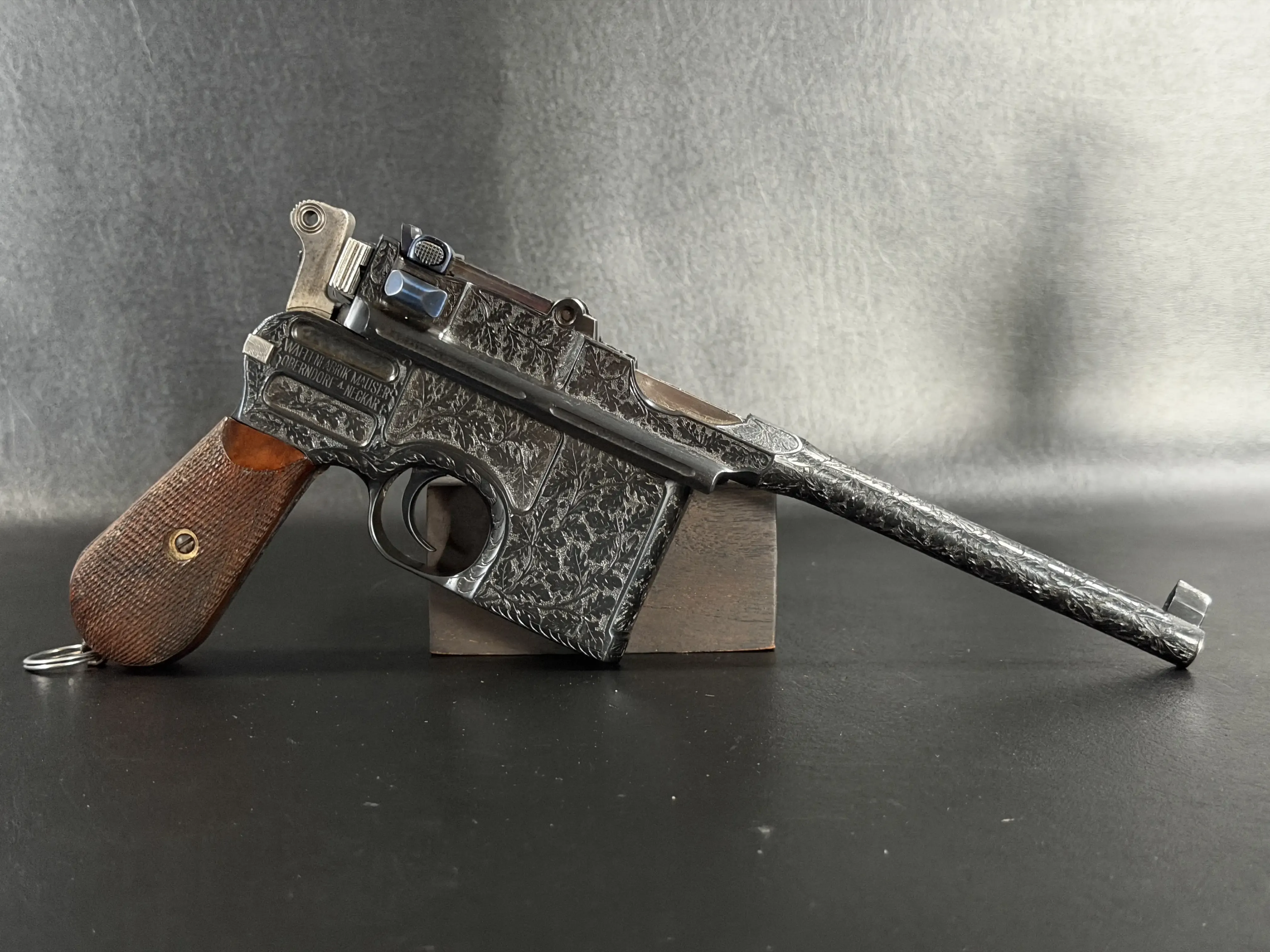
- Rare configurations, original accessories, credible provenance, and properly attributed engraving can distinguish an exceptional revolver from a standard example.
Two revolvers of the same model and production year can command sharply different prices. The difference may have little to do with caliber or barrel length and everything to do with originality, condition, configuration, factory documentation, and provenance.
That is the central discipline of serious revolver collecting: evaluate the individual firearm, not merely the name stamped on its barrel.
Factory Prestige: The Colt Python and Registered Magnum
The original Colt Python and Smith & Wesson Registered Magnum represent two distinct periods of premium American revolver production.
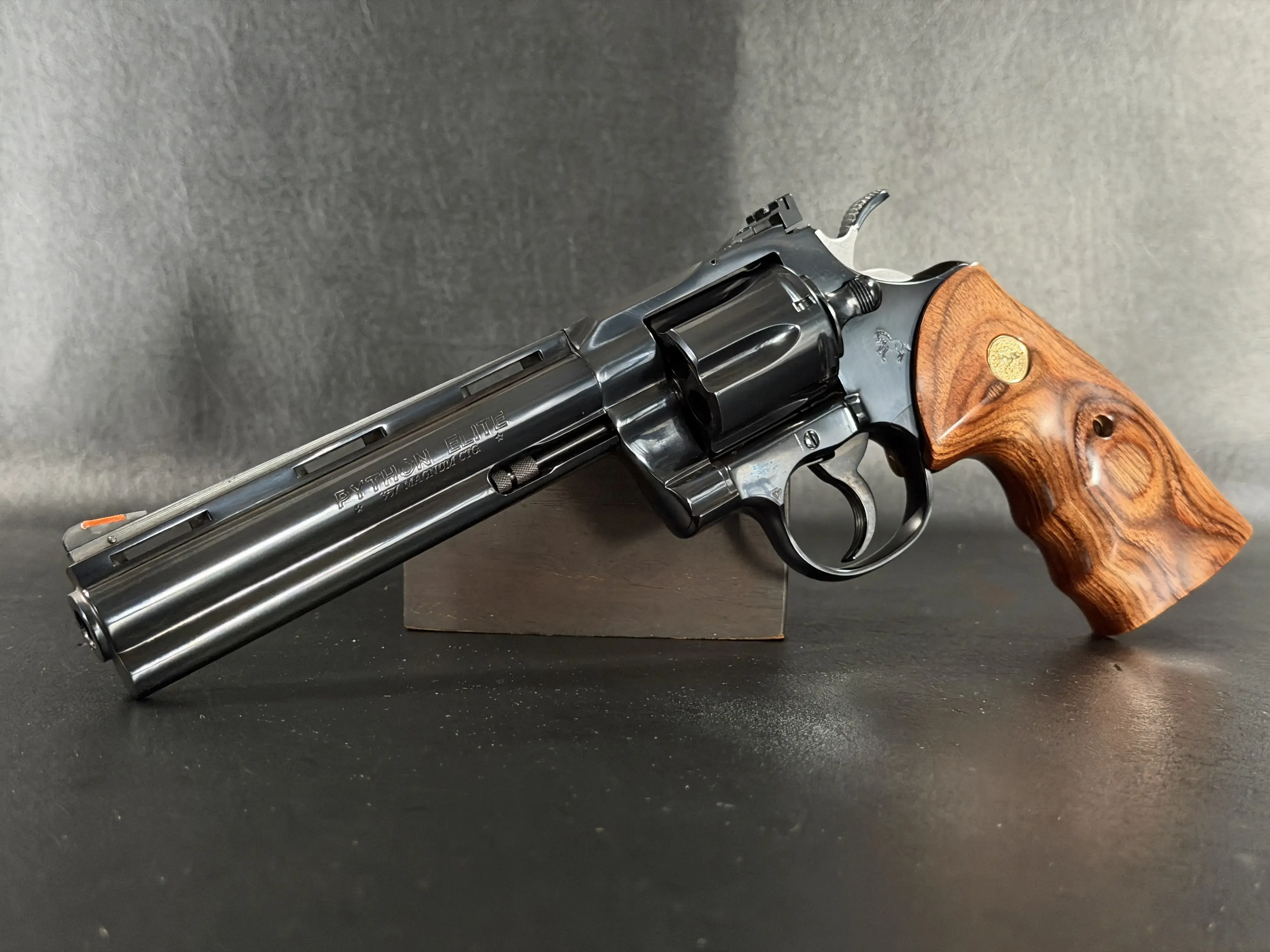
Introduced in 1955, the Python was Colt’s flagship .357 Magnum revolver. Its defining features included adjustable sights, a ventilated barrel rib, a full-length underlug, and an action requiring substantial hand fitting and finishing. The first Pythons had six-inch barrels; four-inch and 2½-inch configurations followed. Colt employee Al DeJohn, who helped develop the model, stated that the Python was also the first Colt to receive the company’s highly polished Royal Blue finish.[1]
The Python’s reputation rests partly on that labor-intensive construction. Contemporary accounts and later interviews describe components being individually fitted and exterior surfaces polished to a standard that made the revolver expensive to manufacture.[1][2] Collectors should nevertheless judge each surviving example independently. Model reputation cannot establish the originality, mechanical condition, or finish of a particular gun.
Smith & Wesson introduced its .357 Magnum revolver in 1935, two decades before the Python. Commonly called the Registered Magnum, it was conceived as a premium, largely made-to-order firearm. Buyers could select from multiple barrel lengths, front sights, grips, and sighting arrangements. Registered guns carried a separate registration number in the frame’s yoke cut, while the accompanying certificate recorded the revolver’s configuration and original registrant.[3]
The first production example was presented to Federal Bureau of Investigation Director J. Edgar Hoover on April 8, 1935. Smith & Wesson discontinued the registration program after approximately 5,500 revolvers, although production of the underlying .357 Magnum design continued without registration.[3]
These models remain important because their collectible identities extend beyond their mechanical specifications. They were premium products whose factory finish, configuration, and documentation form part of the object collectors are buying.
Originality Comes Before Shine
A glossy surface does not prove that a revolver retains its factory finish. Later polishing and refinishing can obscure markings, round frame edges, alter contours, and erase evidence needed to evaluate the gun.
The National Rifle Association’s museum guidance is direct: refinishing, excessive cleaning, or modification generally reduces the value of a collectible firearm. Its condition standards also distinguish original finish from later finish. A refinished gun should not be described simply as retaining a percentage of “original finish,” regardless of how attractive the work may be.[4]
Inspection should therefore concentrate on consistency. Collectors examine screw heads, lettering, proof and inspection marks, frame edges, muzzle wear, the recoil shield, the cylinder, and areas protected by the stocks. Finish color and surface preparation should make sense across the entire gun. Sharp markings surrounded by suspiciously soft contours, inconsistent wear beneath the stocks, or polishing that runs through stamped characters can indicate later work.
Originality is not the same as perfection. Honest holster wear on an otherwise correct revolver may be preferable to a flawless but undocumented refinish because the worn original surface preserves evidence of the firearm’s history and configuration.
Replacement stocks, sights, barrels, cylinders, and small internal parts also matter. Some changes may be period alterations or documented factory work, but they remain changes. A responsible description should identify them rather than folding them into a broad condition adjective.
Condition Requires a Defined Standard
Terms such as “excellent,” “fine,” and “very good” are meaningful only when the grading system is identified.
The NRA maintains separate standards for modern and antique firearms. Under its antique standard, “Excellent” requires all original parts and more than 80 percent original finish, while “Fine” requires all original parts and more than 30 percent original finish. The modern standard relies more heavily on overall wear, mechanical condition, corrosion, and surface damage.[4]
Other reference works use some of the same words differently. The NRA Museum specifically warns that a firearm described as “Excellent” under one system may receive another grade under a different guide.[4] A percentage estimate can provide additional precision, but it must refer explicitly to original finish. “Ninety percent of a later refinish” is not equivalent to “90 percent original finish.”
Condition also extends beyond the exterior. The bore, chambers, forcing cone, cylinder face, timing, lockup, and evidence of improper alteration should be evaluated separately. Mechanical inspection should be performed by someone qualified to assess the revolver without damaging it. A mechanically functional gun is not necessarily mechanically original, and a visually exceptional gun may still contain replacement or altered parts.
Configuration and Completeness
Scarcity is configuration-specific. A familiar model may become substantially less common when barrel length, finish, stocks, sights, engraving, or a factory package is considered.
The first step is to establish that the configuration is genuine. A short barrel is not automatically a rare factory variation; it may have been cut or replaced. Nickel plating is not automatically a scarce factory finish; it may have been applied after shipment. Engraving is not factory work merely because it resembles a recognized pattern.
Correct packaging can also matter. Period boxes, labels, manuals, tools, test targets, registration certificates, and accessories help reconstruct how a firearm was originally delivered. However, a box of the correct general style is not necessarily the original box for that gun. Matching serial-number markings, appropriate labels, and consistent wear provide stronger evidence.
Completeness is especially important for cased or specialty packages. When a revolver was sold with a particular case, optic, mount, or accessory set, a missing component changes the collectible object even if the firearm itself remains unaltered.
Factory Letters and Documentary Evidence
Manufacturer records can turn an assertion into a checkable claim.
Colt Archive Properties maintains shipping records dating to 1861 for many Colt firearms. Its archive letters may identify the original configuration, shipping date, destination, and recorded special features of a particular gun.[5] Such a letter can confirm that an unusual barrel length, finish, or engraving was present when the firearm left the factory.
Smith & Wesson records serve a similar purpose. The Smith & Wesson Historical Foundation preserves and researches historical factory documents, including records from the Registered Magnum period. Research on those revolvers relies particularly on the registration number rather than the serial number alone.[6]
A factory letter has limits. It documents what the surviving record states; it does not prove that every component presently on the firearm is the component originally shipped. The physical gun must still be compared with the documented configuration.
Provenance requires the same discipline. A persuasive ownership history rests on contemporaneous invoices, correspondence, registration documents, photographs, institutional records, or an unbroken chain of identified owners. A story repeated by successive sellers does not become evidence through repetition.
Even factory letters should be examined critically. The NRA Museum notes that forged letters and other false documentation exist, making confirmation with the issuing archive advisable when authenticity is in doubt.[7]
Engraving: Attribution Must Be Earned
Engraving can transform a production revolver into an important work of decorative art, but attribution demands more than stylistic resemblance.
Gustave Young, for example, worked for Colt and Smith & Wesson during the nineteenth century. The Metropolitan Museum of Art documents his German training, his work as Colt’s principal engraving contractor during part of the 1850s, and his later work for Smith & Wesson and other manufacturers.[8] Smith & Wesson’s own history of engraving likewise identifies Young and Louis D. Nimschke as significant figures in American firearms decoration.[9]
Unsigned work presents a particular problem. Similar scrolls, animal motifs, borders, or inlays can support scholarly attribution, but they do not by themselves prove authorship. Strong attribution may require factory records, period correspondence, an engraver’s pull or pattern, a signature, a documented commission, or comparison by a recognized specialist.
Descriptions should distinguish among “factory engraved,” “engraved for the factory,” “attributed to,” and “in the style of.” Those phrases represent different levels of evidence and should not be treated as interchangeable.
A Disciplined Collector’s Examination
A high-end revolver should be evaluated in layers:
- Identity: Confirm the maker, model, caliber, serial number, and all secondary assembly or registration numbers.
- Configuration: Record barrel length, finish, sights, stocks, engraving, and special-order features.
- Originality: Look for refinishing, replaced components, altered markings, or inconsistent wear.
- Condition: Apply a named grading standard and describe significant defects separately.
- Mechanical state: Have timing, lockup, alignment, bore, chambers, and safety assessed by a qualified person.
- Documentation: Compare the firearm with its factory letter, box label, certificate, invoice, and other records.
- Provenance: Separate documented ownership from tradition, recollection, and sales language.
- Market evidence: Compare recent sales of genuinely comparable examples, not merely firearms sharing the same model name.
The final comparison is often where mistakes occur. A documented factory-engraved revolver is not comparable to a later-engraved example. A Python retaining its original finish is not directly comparable to a refinished gun. A Registered Magnum with its original certificate and confirmed configuration is a different collector object from an otherwise similar revolver without documentation.
The name on the barrel establishes the category. The individual firearm—its surfaces, numbers, components, records, and history, establishes the collectible.
Frequently Asked Questions
What makes a revolver collectible?
Originality, condition, configuration, factory documentation, provenance, and rarity all contribute. The model name alone does not establish collectible significance.
Does refinishing reduce a revolver’s value?
Refinishing generally reduces collector value because it removes the original surface and may obscure markings or alter contours. Even an attractive refinish should not be represented as original finish.
What does a factory letter confirm?
A factory letter may document the original configuration, shipping date, destination, and recorded special features. It does not prove that every component currently on the revolver is original.
Why are original boxes and accessories important?
Correct boxes, certificates, tools, and accessories can help establish completeness and support the firearm’s documented history. A period-correct box is not necessarily the original box for that revolver.
How should an engraved revolver be authenticated?
Strong attribution may require factory records, period correspondence, signatures, engraver’s pulls, or evaluation by a recognized specialist. Similarity to a known engraving style is not proof of authorship.
Sources
- Keith Wood, “Colt Python: A Complete History,” Handguns Magazine, December 21, 2015
- American Rifleman, “Colt’s Pythons: Then & Now”
- Dave Campbell, “The History of the .357 Magnum,” American Rifleman, November 23, 2010
- Jim Supica, “Evaluating Firearms Condition,” NRA National Firearms Museum
- Colt Archive Properties, “About the Colt Archive Letter”
- Smith & Wesson Historical Foundation, “S&WHF Letters,” Smith & Wesson Forum
- NRA National Firearms Museum, “Fake!”
- The Metropolitan Museum of Art, “Ink Impression (‘Pull’) from a Gold-Inlaid Colt Revolver,” attributed to Gustave Young
- Smith & Wesson, “The Art of Engraving”
As a firearms enthusiast with a background in website design, SEO, and information technology, I bring a unique blend of technical expertise and passion for firearms to the articles I write. With experience in computer networking and online marketing, I focus on delivering insightful content that helps fellow enthusiasts and collectors navigate the world of firearms.
Comments
Be the first to leave a comment.
Be the first to read new editorial features, collector guides, and brand spotlights.