Key Takeaways
- The 92FS evolved through the Model 92, 92S, 92SB, and 92F rather than appearing as an entirely new design.
- Its defining mechanical change is an enlarged hammer-axis pin and matching slide groove that retain the slide if it fractures.
- Military M9 provenance requires appropriate government markings or documentation. Commercial M9-pattern pistols can closely resemble issued examples.
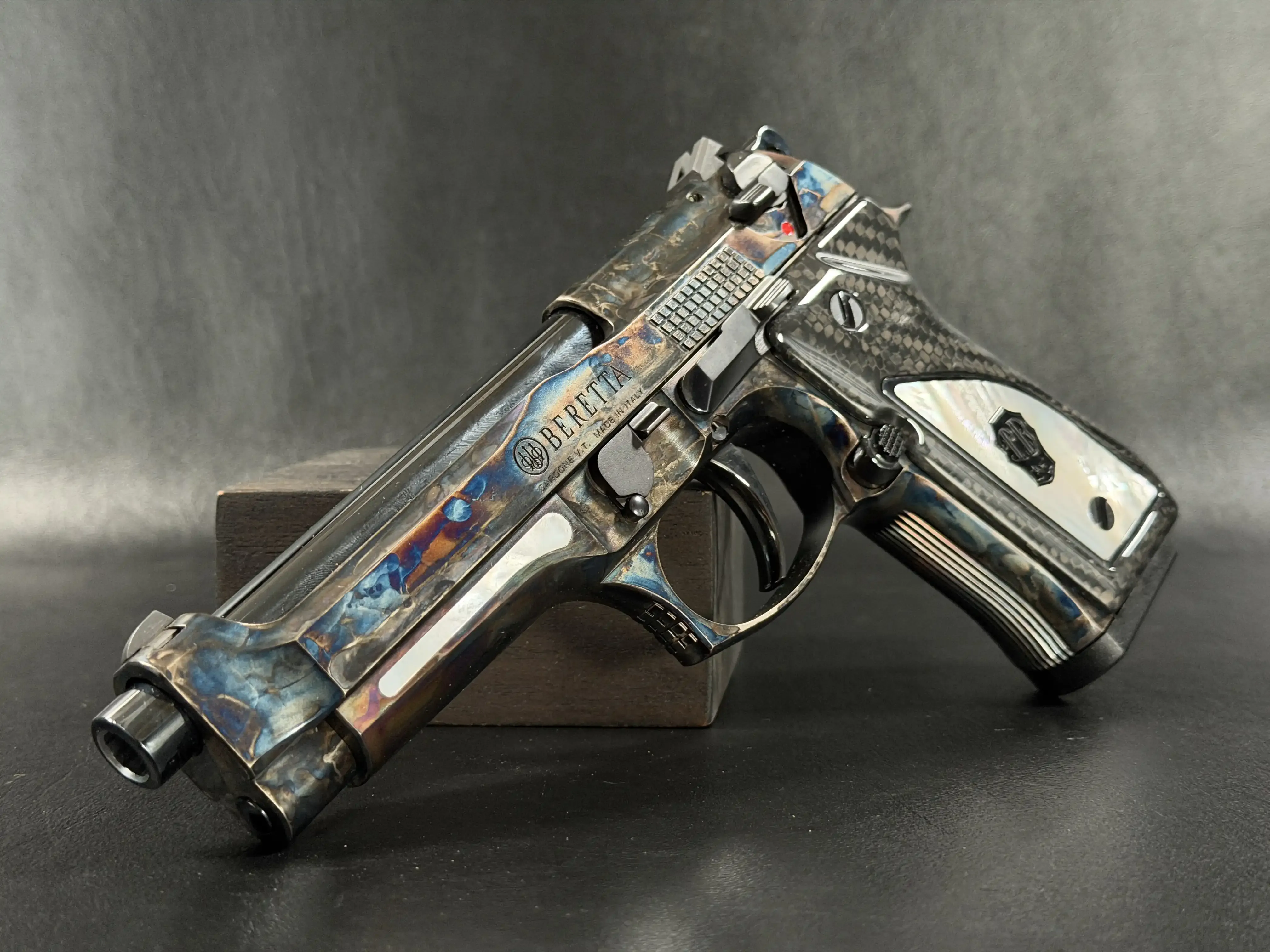
The Beretta 92FS is a full-size, locked-breech, double-action/single-action pistol chambered in 9 mm Luger. Its defining features include an aluminum-alloy frame, exposed hammer, double-column magazine, slide-mounted safety and decocking lever, and Beretta’s open-top slide. Although closely associated with the U.S. military M9, the 92FS represents a specific stage in the Model 92’s development rather than the beginning of the design.[1][2]
From the Model 1951 to the 92F
Beretta introduced the original Model 92 in 1975. Its immediate predecessor was the single-column Model 1951, from which it inherited the open-top slide and a locking system based on a vertically moving block beneath the barrel. The arrangement also resembled that of the Walther P.38. The Model 92 combined these elements with a double-column magazine and a double-action/single-action trigger mechanism.[1]
The original Model 92 placed its manual safety on the frame. Beretta moved the control to the slide on the subsequent 92S, where it also served as a decocking lever. Development of the 92S-1 for U.S. Air Force trials brought ambidextrous safety levers, a reversible magazine release positioned behind the trigger guard, larger sights, and revised grip surfaces. Beretta then introduced the 92SB with an automatic firing-pin block that prevented the firing pin from moving forward unless the trigger was pulled fully to the rear.[1]
The 92SB-F, sold commercially as the 92F, incorporated further changes for the U.S. XM9 trials. These included a squared and serrated trigger guard, a chrome-lined bore, modified grip panels, an extended magazine floorplate, and Beretta’s matte-black Bruniton finish. The 92SB-F was selected as the U.S. military’s M9 on January 14, 1985, replacing aging stocks of .45-caliber M1911A1 pistols and other handguns with a standardized 9 mm sidearm.[1]
Operation and Specifications
The 92FS operates by short recoil. After firing, the barrel and slide move rearward together for a short distance. The locking block then drops, disengaging the barrel from the slide. The barrel stops while the slide continues rearward to extract and eject the fired case, cock the hammer, and compress the recoil spring. The barrel remains substantially horizontal during this cycle rather than tilting as it does in many locked-breech pistols.[1][2]
The first shot may be fired by a long double-action trigger pull that cocks and releases the hammer. Cycling of the slide leaves the hammer cocked, making subsequent shots single-action. Rotating the ambidextrous safety lever downward disconnects the trigger mechanism, turns the firing-pin striker away from the hammer, and lowers the hammer. The lever remains in the safe position until manually returned to fire.[2]
Beretta’s manual lists the standard 92FS at 8.5 inches overall with a 4.9-inch barrel. Overall width is 1.5 inches, height is 5.4 inches, and approximate unloaded weight is 34.4 ounces. The traditional magazine holds 15 cartridges. The pistol has fixed sights with white inserts, a reversible magazine-release button, and an extractor that protrudes, exposing a red indicator when a cartridge is chambered.[2]
The standard pistol has an aluminum-alloy frame and a steel slide and barrel. Beretta specifies a phosphated and Bruniton-coated slide and a chrome-lined barrel. The open-top slide leaves much of the barrel exposed, providing the most readily recognizable visual characteristic of the Model 92 family.[2]
The Change That Created the 92FS
The “FS” specification is characterized primarily by its slide-over travel safeguard. In 1988, the U.S. General Accounting Office documented 14 M9 slide failures, including three in operational use and 11 during laboratory testing. Four shooters were injured. The Army attributed the failures to fatigue cracking near the slide’s locking-lug recess, while Beretta maintained that the ammunition used in the affected pistols contributed to the failures.[3]
Beretta addressed the hazard by enlarging the head of the hammer-axis pin and cutting a corresponding groove into the lower left slide rail. If the slide fractures, the pin enters the groove, preventing the rear portion from traveling off the frame toward the shooter. This retention device became the distinguishing mechanical feature of the 92FS specification.[1][2]
For collectors examining a pistol represented as a 92FS, the enlarged hammer-pin head and matching slide groove are therefore more significant than superficial similarities to an earlier 92F. The model marking should agree with the mechanical configuration. A pistol marked “92F” represents the earlier designation unless documented factory work or military modification establishes that it received the later retention system.
The 92FS and the M9
The military M9 and commercial 92FS share the same basic mechanism and slide-retention system, but their names are not interchangeable for historical or collecting purposes. Authentic military pistols bear government markings and acceptance identifiers that are absent from ordinary commercial 92FS production. Beretta has also sold commercial M9-pattern pistols with military-style markings, so the presence of “M9” on the slide does not by itself establish U.S. government ownership or service.[4]
A documented military M9 and a commercial 92FS may be mechanically equivalent while having different provenance. Government acceptance markings, serial-number context, and supporting records distinguish an issued military pistol from a commercially manufactured counterpart. Appearance alone is not sufficient.[4]
Collectors should also distinguish the standard 92FS from related members of the 92 family. The 92FS Compact features a shorter slide, barrel, and frame, along with a 13-round double-column magazine. The Compact Type M uses an eight-round single-column magazine. The Centurion combines the full-size frame and magazine capacity with the shorter upper assembly. Inox models use a stainless-steel slide, barrel, and selected controls with a gray-anodized alloy frame.[2]
Suffixes identify meaningful operating differences. A 92G has a spring-returning decocking lever rather than the FS lever that remains on safe. The 92DS is double-action-only but retains a manual safety, while the 92D is double-action-only without that lever. These are separate factory configurations and should not be described generically as standard 92FS pistols.[2]
The U.S. Army began fielding the SIG Sauer-based M17 in 2017 as the replacement for the M9, which had served as its standard sidearm since the mid-1980s. The succession closed the M9’s period as the Army’s standard pistol, but it did not alter the collector distinction between military M9S, commercial M9-pattern pistols, and Model 92FS variants.[5]
Frequently Asked Questions
What caliber is the Beretta 92FS?
The standard Beretta 92FS is chambered in 9 mm Luger.
Is the Beretta 92FS the same as the military M9?
The two pistols share the same basic mechanism and slide-retention system. Military markings, acceptance identifiers, and documented provenance distinguish an issued M9 from a commercial 92FS.
What distinguishes the 92FS from the earlier 92F?
The 92FS has an enlarged hammer-axis pin that engages a groove in the slide. This feature is designed to retain the rear portion of the slide if the slide fractures.
What is the standard magazine capacity of the 92FS?
Beretta’s manual specifies a 15-round magazine for the standard 92FS. Compact and single-column variants have different capacities.
What are the principal Beretta 92FS variants?
Documented variants include the 92FS Compact, Compact Type M, Centurion, and Inox. The 92G, 92DS, and 92D use different safety or trigger configurations and are separate factory models.
Sources
[1] Keefe, Mark A., IV. “The Beretta M9: 25 Years of Service.” American Rifleman, November 12, 2009.
[2] Beretta. Serie 92 Pistol User Manual. C60373 003, n.d., pp. 13–20.
[3] U.S. General Accounting Office. Procurement of the Beretta M9 Handgun. GAO/NSIAD-88-213, September 1988, pp. 9–13.
[4] Fitch, P. E. “Beretta M9 vs Beretta 92FS.” Shooting Illustrated, May 16, 2024.
[5] O’Donnell, Martin. “101st Airborne Division Fields Army’s New Modular Handgun System.” United States Army, November 29, 2017.
As a firearms enthusiast with a background in website design, SEO, and information technology, I bring a unique blend of technical expertise and passion for firearms to the articles I write. With experience in computer networking and online marketing, I focus on delivering insightful content that helps fellow enthusiasts and collectors navigate the world of firearms.
Comments
Be the first to leave a comment.
Be the first to read new editorial features, collector guides, and brand spotlights.