Key Takeaways:
· Smith & Wesson introduced the Model 500 at the 2003 SHOT Show as the first revolver built on its X-Frame.
· Its five-shot cylinder places the stop notches between the chambers, where the surrounding steel is thickest.
· Barrel length, muzzle assembly, product code, factory markings, and documentation help identify specific Model 500 variants.
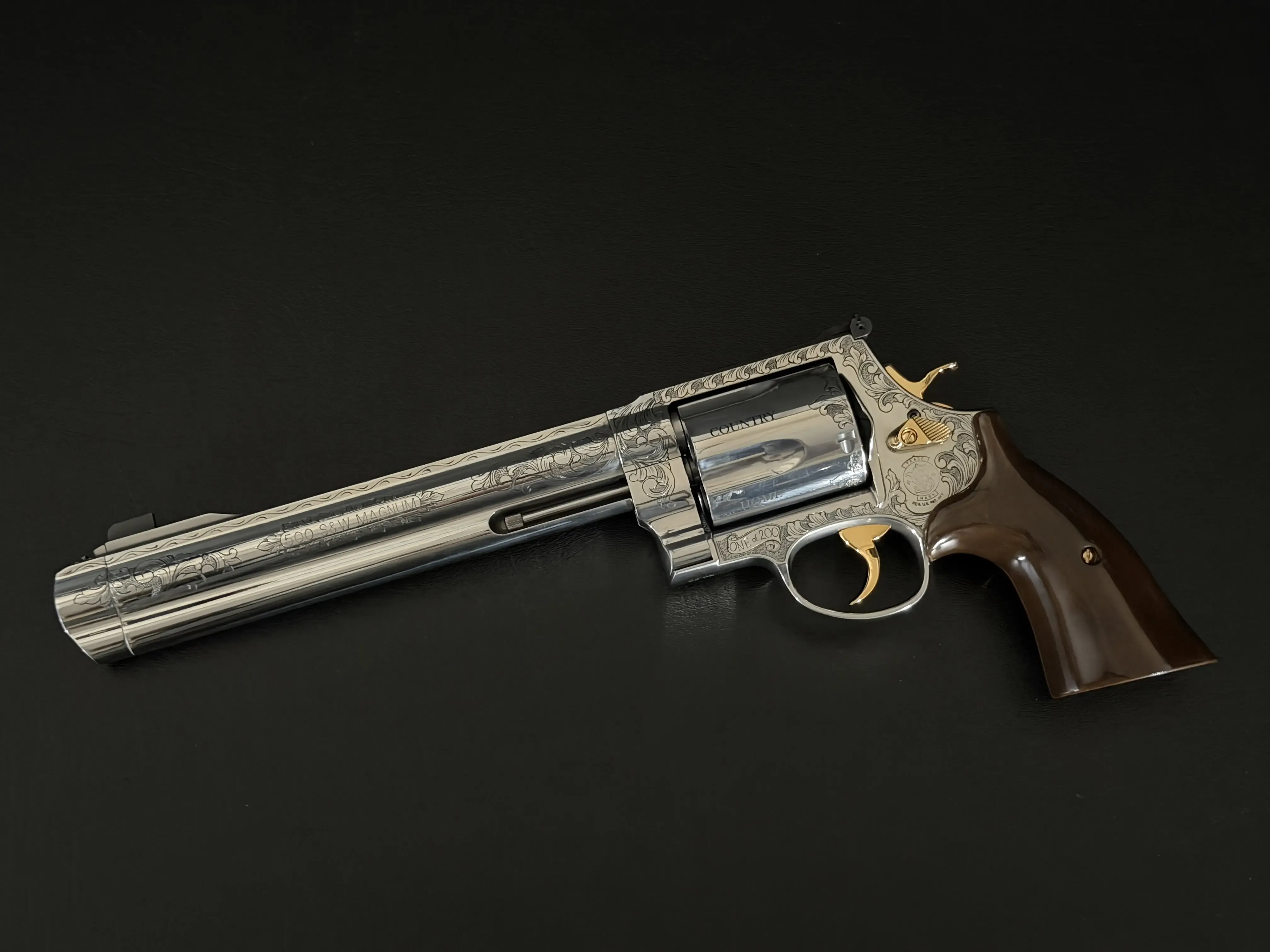
Smith & Wesson formally introduced the Model 500 at the SHOT Show in Orlando, Florida, on February 13, 2003. Chambered for the new .500 S&W Magnum cartridge, the five-shot revolver was the first firearm built on the company’s extra-large X-Frame. Smith & Wesson presented it as the largest and most powerful production revolver then available and positioned it primarily for handgun hunting.[1]
Development of the Model 500
Smith & Wesson product manager Herb Belin initiated the project in 2002. The objective was to develop a production revolver and straight-wall handgun cartridge that would exceed the performance of established large-bore chamberings such as the .454 Casull and .480 Ruger. Peter Pi of Cor-Bon worked with Smith & Wesson on the cartridge, and the complete revolver-and-ammunition system reached introduction in less than a year.[2]
The cartridge was dimensionally ambitious. Its bullet diameter is .500 inch, and its case measures 1.625 inches long. The Sporting Arms and Ammunition Manufacturers’ Institute specifies a maximum average pressure of 60,000 psi for the .500 S&W Magnum, substantially higher than the 36,000 psi standard for the .44 Remington Magnum.[3] These dimensions and pressures required more than an enlarged version of an existing Smith & Wesson revolver.
The X-Frame Design
The resulting X-Frame cylinder is approximately 2.3 inches long and nearly 2 inches in diameter. Despite its size, it holds five cartridges. This arrangement permits the cylinder-stop notches to sit between the chambers, where the surrounding steel is thickest, rather than directly above the chambers as on traditional six-shot Smith & Wesson cylinders.[2]
Smith & Wesson also added a frame-mounted ball detent that engages the yoke. Recoil drives the detent more firmly into its recess, reinforcing the cylinder’s lockup. The frame and cylinder are stainless steel, while the grip follows the smaller round-butt profile associated with Smith & Wesson’s K-Frame. The company fitted an overmolded Hogue grip to provide cushioning without requiring the shooter to grasp an equally oversized handle.[2]
Mechanically, the Model 500 remains a conventional exposed-hammer Smith & Wesson revolver in several respects. It can be fired double-action, with the trigger rotating the cylinder and cocking and releasing the hammer, or single-action after the hammer has been manually cocked.[4] The combination of familiar operation and an entirely new frame distinguished the Model 500 from custom-built single-action revolvers and handgun platforms adapted to rifle cartridges.
The original 8 3/8-inch configuration used a barrel tube installed inside a separate barrel shroud. Smith & Wesson’s X-Frame manual specifies that this assembly requires a dedicated tool and torque wrench for removal and installation. Depending on the variant, the muzzle assembly may incorporate a fixed or removable compensator intended to redirect propellant gases and reduce muzzle movement.[4]
The revolver’s mass, grip, and muzzle device moderated rather than eliminated recoil. In testing reported by American Rifleman, three early Cor-Bon loads used bullets weighing 275, 400, and 440 grains. The 400- and 440-grain loads produced approximately 2,400 and 2,660 foot-pounds of muzzle energy, respectively, from the test revolver. Fifteen five-shot groups fired at 50 yards with an unmagnified optic averaged slightly more than 2.5 inches.[2]
Expansion of the Model 500 Line
The first Model 500 appeared with an 8 3/8-inch barrel. Smith & Wesson expanded the line in February 2004 with a four-inch version equipped with an interchangeable compensator system. The company also announced that ported and non-ported compensators of different configurations would be offered for the shorter revolver.[5]
The model family subsequently included additional barrel lengths and Performance Center configurations. Smith & Wesson’s 2022 catalog listed three standard Model S&W500 product codes. SKU 163500 had an 8.38-inch barrel, a five-round cylinder, and a listed weight of 71 ounces. SKU 163501 also used an 8.38-inch barrel but incorporated a removable compensator and weighed 69.1 ounces. The four-inch SKU 163504 weighed 55.4 ounces and measured 10.25 inches overall. All three were cataloged with satin stainless finishes, stainless-steel frames and cylinders, synthetic grips, and adjustable rear sights.[6]
These catalog distinctions matter because barrel length alone does not identify a Model 500 variant. Two revolvers with nominally identical 8 3/8-inch barrels may have different muzzle assemblies, sights, weights, and product codes. Performance Center examples introduce further distinctions, including specialized barrel profiles, muzzle brakes, accessory rails, and tuned actions.
Collector Identification
Smith & Wesson places the Model 500’s internal serial number and model number inside the yoke area, visible when the cylinder is opened. These markings provide a better starting point for identification than external configuration alone.[4] The barrel marking establishes the intended chambering, while the product code, muzzle system, sight arrangement, barrel profile, and factory packaging can help separate catalog variants.
The factory X-Frame manual also identifies the .500 Special as an approved alternate cartridge in revolvers marked “500 S&W Magnum.”[4] This compatibility should not be confused with a separate Model 500 chambering or variant.
Configuration changes over the Model 500’s production history make original documentation especially useful. A factory box label, product code, dated catalog, and Smith & Wesson historical letter can help establish how a specific revolver was originally shipped. Aftermarket grips, optics, replacement sights, and changed compensators may alter its present appearance without changing its underlying model designation.
The Model 500’s principal historical distinction rests on documented engineering rather than limited production. It introduced the X-Frame, placed the .500 S&W Magnum into regular factory production, and established a platform that Smith & Wesson later used for other high-pressure revolver cartridges.
Frequently Asked Questions
When was the Smith & Wesson Model 500 introduced?
Smith & Wesson formally introduced the Model 500 at the SHOT Show on February 13, 2003.
Who developed the Model 500 and its cartridge?
Smith & Wesson product manager Herb Belin led the revolver project. Peter Pi of Cor-Bon worked with Smith & Wesson on the .500 S&W Magnum cartridge.
Why does the Model 500 hold five cartridges?
The five-shot arrangement allows the cylinder-stop notches to sit between the chambers, where the steel is thickest. It also avoids the additional cylinder size required for six .500 S&W Magnum cartridges.
Can the Model 500 fire .500 Special ammunition?
Smith & Wesson’s X-Frame manual identifies .500 Special as approved alternate ammunition for revolvers marked “500 S&W Magnum.”
How can collectors identify a Model 500 variant?
The model number and internal serial number appear inside the yoke area when the cylinder is open. Barrel length, sights, compensator design, product code, factory packaging, and documentation provide additional identification points.
Sources
[1] Smith & Wesson. “Smith & Wesson Introduces New .50 Caliber Magnum Revolver; Most Powerful Production Revolver Ever Made.” Smith & Wesson, February 13, 2003.
[2] American Rifleman. “Exceeding Expectations: Smith & Wesson’s X-Frames.” American Rifleman, June 30, 2015.
[3] Sporting Arms and Ammunition Manufacturers’ Institute. SAAMI Z299.3-2022: Voluntary Industry Performance Standards for Pressure and Velocity of Centerfire Pistol and Revolver Ammunition. ANSI/SAAMI Z299.3-2022, December 13, 2022.
[4] Smith & Wesson. Safety & Instruction Manual for S&W X-Frame Revolvers Only. 2022, pp. 10-14, 20-21, 26-29.
[5] Smith & Wesson. Smith & Wesson Announces New Handgun Products for 2004. February 12, 2004, p. 1.
[6] Smith & Wesson. 2022 Product Catalog. 2022, p. 62.
As a firearms enthusiast with a background in website design, SEO, and information technology, I bring a unique blend of technical expertise and passion for firearms to the articles I write. With experience in computer networking and online marketing, I focus on delivering insightful content that helps fellow enthusiasts and collectors navigate the world of firearms.
Comments
Be the first to leave a comment.
Be the first to read new editorial features, collector guides, and brand spotlights.