Key Takeaways
- Ruger introduced the GP100 in 1985 as the successor to its Security-Six and Speed-Six revolvers.
- The GP100 uses a solid frame, transfer-bar mechanism, modular internal assemblies, and a cylinder locked at the front, rear, and bottom.
- Collectors should evaluate chambering, capacity, barrel and lug profile, sights, finish, markings, and factory documentation rather than relying on serial numbers alone.
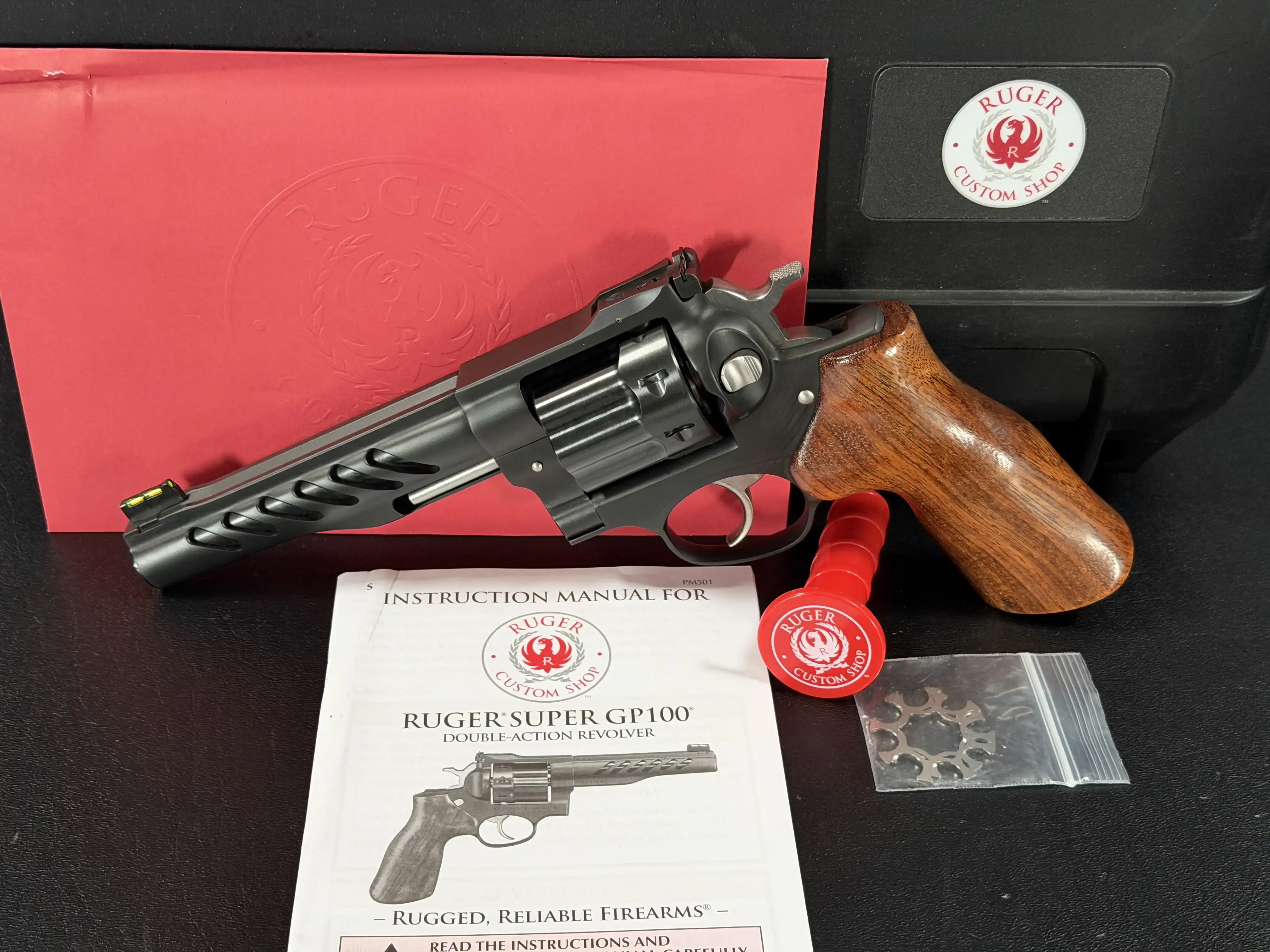
Ruger introduced the GP100 in 1985 as its next generation of full-size, double-action revolvers. The original six-shot model was chambered for .357 Magnum and .38 Special and succeeded the Security-Six and Speed-Six designs. Regular production appears in Ruger’s serial-number table beginning in 1986 with serial number 170-00001.[1][2]
A Heavier Successor to the Security-Six
The GP100 retained the Security-Six concept of a solid frame without a removable sideplate, but Ruger enlarged critical dimensions for the new revolver. In a contemporary 1986 examination, Stanley W. Trzoniec measured a 1.550-inch cylinder, compared with 1.500 inches on the earlier design. He also recorded an increase in top-strap thickness from 0.225 to 0.255 inches and a 5/8-inch barrel-thread diameter. His early four-inch test revolver carried a 170-004XX serial number and had a frame made from heat-treated AISI 4130 chromium-molybdenum steel.[3]
These changes were structural rather than cosmetic. The larger frame opening accommodated the wider cylinder, while the thicker top strap and barrel-shank area added material around the parts subjected to firing stresses. The GP100 nevertheless remained recognizably related to the Security-Six and incorporated features Ruger had used in the larger Redhawk.[3][4]
The grip frame was another significant departure. Instead of forming the complete front and rear profile of the grip, the frame terminates in a compact extension containing the hammer strut and mainspring. A one-piece grip surrounds this extension. Ruger could therefore fit grips of different shapes and dimensions without producing separate round-butt and square-butt frames.[4]
Lockwork and Cylinder Retention
The GP100’s cylinder assembly locks to the frame at three points: the front, rear, and bottom. Its ejector rod performs only the extraction function and does not rotate with the cylinder or serve as the forward locking point. The crane, cylinder, trigger-guard assembly, and related lockwork can be separated into major subassemblies without special tools.[4][5]
Internal components enter through the top or bottom of the grip frame, eliminating the conventional removable sideplate. The hammer operates through a trigger-connected transfer bar. Unless the trigger is held fully rearward, the transfer bar remains outside the path between the hammer and frame-mounted firing pin.[4]
Standard GP100s can be fired in double action by pulling the trigger through the complete firing cycle or in single action by manually cocking the exposed hammer. On .357 Magnum models, the chambers also accept .38 Special and .38 Special +P ammunition. Chambering and capacity vary across the broader family: Ruger has produced five-shot .44 Special, six-shot 10mm Auto, seven-shot .327 Federal Magnum, and ten-shot .22 Long Rifle versions in addition to the six-shot .357 Magnum configuration.[4]
Expansion of the GP100 Family
For most of its early history, the GP100 remained principally a .357 Magnum revolver offered in different barrel lengths, finishes, sight arrangements, and grip configurations. Ruger broadened the platform more substantially in the 2010s.
The Match Champion appeared in 2014 as a competition-oriented .357 Magnum variant. Its distinguishing features included a 4.2-inch slab-sided, half-lug barrel, an 11-degree crown, a radiused six-shot cylinder, chamfered chamber mouths, polished action components, and a Hogue hardwood grip. The original fixed-sight version used a fiber-optic front sight and Novak LoMount rear sight.[6]
Ruger added the ten-shot .22 Long Rifle GP100 in 2016. Model 1757 used a 5.5-inch partial-lug barrel, adjustable rear sight, fiber-optic front sight, and stainless-steel construction. Its reported factory specifications included a 42-ounce weight and 11.30-inch overall length.[1]
A five-shot .44 Special followed in late 2016. This stainless version combined an unfluted cylinder with a three-inch full-lug barrel, adjustable rear sight, fiber-optic front sight, and synthetic Hogue grip. The cylinder’s locking notches were positioned between the chambers rather than directly over them.[7]
The first 10mm Auto GP100 arrived in 2018 as a six-shot Match Champion. It used a 4.2-inch round-profile, half-lug barrel and full-moon clips for simultaneous loading and extraction of the rimless cartridges. Ruger’s manual states that the revolver can fire 10mm Auto without clips, although the ejector cannot remove the individual rimless cases normally. The same manual notes that Ruger tested the model with .40 S&W ammunition but does not recommend that cartridge because some commercial loads may misfire.[4][8]
Identifying and Dating a GP100
A GP100 should be identified by more than its serial number. Relevant characteristics include chambering, capacity, barrel length, lug profile, fixed or adjustable sights, finish, cylinder fluting, grip style, and model markings. Several of these components, particularly grips and sights, can be replaced, so their presence alone does not establish factory originality.
Ruger’s published serial history gives an approximate first serial number shipped for each year from 1986 through 2015. The company cautions that firearms were not always manufactured or shipped in numerical order and that one serial block could include several configurations. A serial number can therefore provide an approximate shipping period, but it cannot establish a specific model, barrel configuration, or original set of accessories. Ruger directs owners seeking confirmation of an individual revolver’s original configuration to obtain a factory letter of authenticity.[2]
The distinction is especially important for early revolvers, limited configurations, and models altered during decades of use. A persuasive collector description should reconcile the serial range with the revolver’s markings and physical configuration, then distinguish factory features from later replacements.
Frequently Asked Questions
When was the Ruger GP100 introduced?
Ruger introduced the GP100 in 1985. The company’s serial-number history begins regular production listings in 1986 with serial number 170-00001.
What revolvers did the GP100 replace?
The GP100 succeeded Ruger’s Security-Six and Speed-Six designs as the company’s next generation of full-size, double-action revolvers.
What chamberings has Ruger offered in the GP100 family?
Documented GP100 chamberings include .22 Long Rifle, .327 Federal Magnum, .357 Magnum, .38 Special, 10mm Auto, and .44 Special.
How does the GP100’s cylinder lock into the frame?
The cylinder locks at the front, rear, and bottom. The ejector rod performs only the extraction function and does not serve as the forward locking point.
Can a GP100 serial number establish its original configuration?
No. Ruger states that serial numbers were not always manufactured or shipped sequentially and that one serial block could include several configurations.
Sources
[1] Horman, B. Gil. “Tested: Ruger GP100 10-Shot .22 LR Revolver.” American Rifleman, March 9, 2016.
[2] Sturm, Ruger & Co., Inc. “Ruger GP100 Serial Number History.” Sturm, Ruger & Co., Inc., 2016.
[3] Trzoniec, Stanley W. “The .357 Magnum GP-100.” American Handgunner, September/October 1986, pp. 50–53.
[4] Sturm, Ruger & Co., Inc. Instruction Manual for Ruger GP100 Double-Action Revolver. n.d., pp. 10–13, 20–26, 31–38.
[5] Sturm, Ruger & Co., Inc. “GP100 Double-Action Revolvers.” Sturm, Ruger & Co., Inc., n.d.
[6] Horman, B. Gil. “Ruger GP100 Match Champion.” American Rifleman, October 17, 2014.
[7] Horman, B. Gil. “Tested: Ruger GP100 in .44 Special.” American Rifleman, 2017.
[8] Horman, B. Gil. “Tested: Ruger GP100 Match Champion 10 mm Revolver.” American Rifleman, April 27, 2018.
As a firearms enthusiast with a background in website design, SEO, and information technology, I bring a unique blend of technical expertise and passion for firearms to the articles I write. With experience in computer networking and online marketing, I focus on delivering insightful content that helps fellow enthusiasts and collectors navigate the world of firearms.
Comments
Be the first to leave a comment.
Be the first to read new editorial features, collector guides, and brand spotlights.