Key Takeaways
- Pre‑’64 Model 70 rifles use controlled-round feeding, a large claw extractor, and a receiver-mounted blade ejector.
- Winchester replaced controlled-round feeding with a push-feed action in 1964, then returned it with the Model 70 Classic in the 1990s.
- Serial numbers are a starting point, but action type, markings, condition, and originality must be examined together.
Few American sporting rifles are divided so sharply by a date as the Winchester Model 70. Collectors use “pre‑’64” to describe the original controlled-round-feed rifles and “post‑’64” for the substantially redesigned push-feed version. That shorthand is useful, but it leaves out two important chapters: the return of controlled-round feed in the 1990s and the Model 70’s later production outside New Haven.
Understanding those periods, and the mechanical differences between them, is essential when evaluating a Model 70.
The Original Model 70
Winchester developed the Model 70 from its earlier Model 54. A small number of rifles were completed in 1935, production inventory was assembled in 1936, and commercial deliveries began in 1937. The new rifle retained the Model 54’s coned breech, dual front locking lugs, nonrotating extractor, and receiver-mounted ejector while introducing a revised bolt-sleeve safety, improved trigger, separate bolt stop, gas-escape port, and hinged floorplate.[1]
These original rifles used controlled-round feeding. As the bolt moves forward, a large claw extractor captures the cartridge rim while the round rises from the magazine. The cartridge remains under mechanical control as it enters the chamber and is extracted. A fixed blade ejector expels the case; the force of ejection depends partly on how vigorously the bolt is drawn rearward.
The three-position safety is mounted on the bolt shroud. In its rear position, it blocks firing and locks the bolt. The middle position continues to block firing but permits the bolt to be operated for unloading. The forward position allows the rifle to fire. Safety-lever shapes changed during pre‑’64 production, so the presence of a three-position safety alone does not establish a precise production date.[1]
Winchester eventually promoted the Model 70 as “The Rifleman’s Rifle,” a company slogan that became closely associated with the model. Its reputation, however, came at a cost: the receiver and other components required extensive machining, making the rifle increasingly expensive to manufacture as competing designs adopted more economical production methods.[1]
The 1964 Redesign
Winchester introduced a substantially revised Model 70 in 1964. Its action used push feeding rather than the original controlled-round-feed system. The recessed bolt face pushed a cartridge from the magazine into the chamber, where the extractor engaged its rim. A spring-loaded plunger in the bolt face replaced the earlier receiver-mounted blade ejector.[2]
The redesign extended beyond the bolt. Winchester adopted a forged receiver requiring fewer machining operations, hammer-forged rifling, pressed stock checkering, and more economical bottom metal and furniture. The objective was straightforward: reduce production costs and keep the Model 70 competitive in a market increasingly dominated by rifles designed for efficient manufacture.[3]
Early examples drew strong criticism for their appearance and finish as well as for abandoning controlled-round feed. That reaction permanently influenced the market, but it should not be mistaken for proof that every push-feed Model 70 is mechanically deficient. Winchester progressively revised the design, including changes intended to reduce bolt binding, and later rifles generally displayed better workmanship than the first 1964 production.[3]
For collectors, the distinction is mechanical rather than merely chronological. A conventional post‑1964 push-feed bolt has a recessed face, a smaller extractor, and a spring-loaded plunger ejector. An original pre‑’64 bolt has the conspicuous external claw extractor and works with a receiver-mounted blade ejector.
The Model 70 Classic
Demand for the earlier action never disappeared. U.S. Repeating Arms Company, then producing Winchester-brand rifles, developed a new controlled-round-feed Model 70 and added it to the product line on a limited basis in 1992. The “Classic” designation followed in 1994.[3]
The Classic restored the large claw extractor, controlled-round feeding, coned breech, and receiver-mounted blade ejector. It was not an exact reproduction of a pre‑’64 rifle. It incorporated later manufacturing methods and revised features, including a modified anti-bind arrangement and additional provisions for handling gas from a ruptured cartridge case.[3]
Push-feed and controlled-round-feed versions overlapped during this period. Accordingly, a 1990s serial number does not by itself identify the action type. Winchester’s manual for Model 70 rifles made from 1992 onward recognizes controlled-round-feed, controlled-round push-feed, and push-feed bolts.[2] The bolt, ejector, barrel markings, and model designation must therefore be examined together.
New Haven, South Carolina, and Portugal
Model 70 production at Winchester’s historic New Haven, Connecticut, plant ended when the facility closed in 2006. Production resumed in 2008 at the FN facility in Columbia, South Carolina. Assembly moved to Portugal beginning in 2013, and manufacturing followed by 2015.[3]
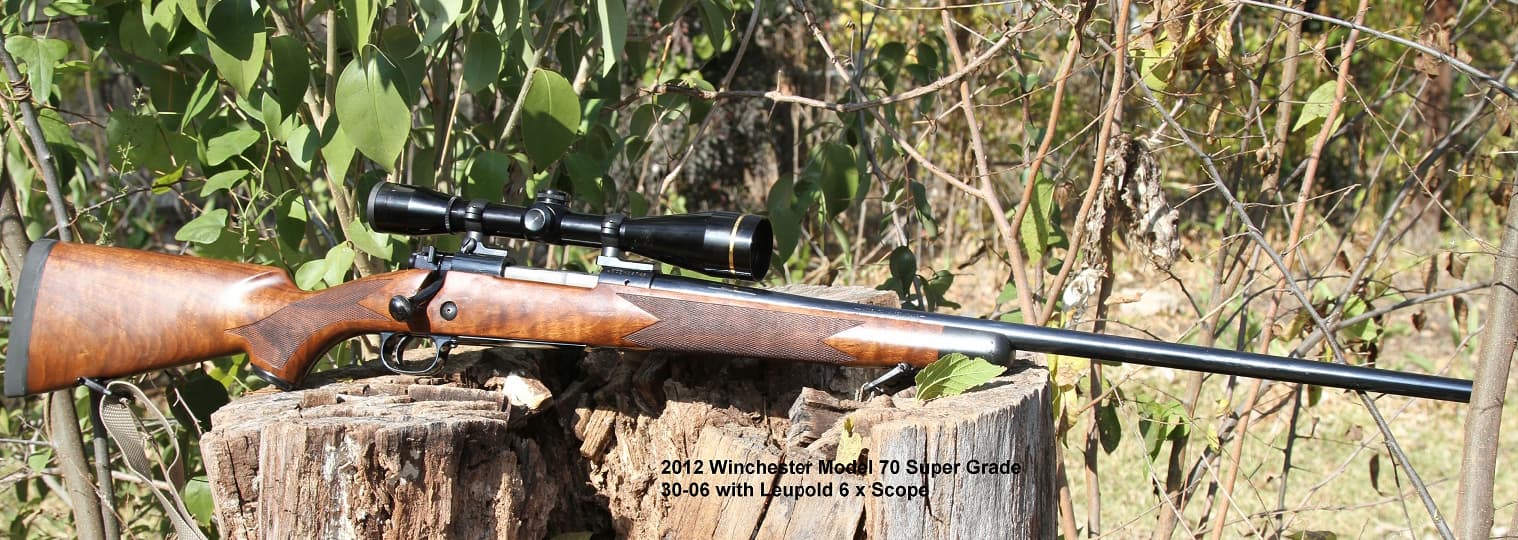
Current Model 70 rifles use controlled-round-feed actions with claw extractors, forged and machined steel receivers, three-position safeties, coned breeches, and receiver-mounted blade ejectors.[4]
Modern rifles also differ from both pre‑’64 examples and many New Haven Classics in their trigger system. Model 70 rifles produced from 2008 onward use Winchester’s three-lever M.O.A. trigger. The factory manual specifies an approximate 3½-pound initial setting and an adjustment range of 3 to 5 pounds.[2]
Identifying the Four Principal Periods
Original controlled-round feed
A pre‑’64 rifle should have a large external claw extractor, controlled-round-feed bolt, and receiver-mounted blade ejector. Collectors must also consider the serial number, barrel markings, stock configuration, sights, bottom metal, and period-specific safety design. Because features changed during the original production run, no single detail establishes originality.
Post‑1964 push-feed
A conventional push-feed example has a recessed bolt face, smaller extractor, and spring-loaded plunger ejector. Early rifles may show pressed checkering and simplified furniture associated with the 1964 cost-reduction program. Later examples can differ substantially in finish and configuration.
Classic controlled-round feed
A Classic normally combines a large claw extractor and blade ejector with later receiver and bolt geometry. Because controlled-round-feed and push-feed rifles were sold during overlapping years, inspect the action rather than relying on the date alone.
Current production
Current Model 70s use controlled-round feed and the M.O.A. trigger. They should not be described as New Haven rifles or exact pre‑’64 reproductions merely because Winchester describes the action as “pre‑’64 style.”
Evaluating a Collectible Model 70
Originality and condition are separate questions. A rifle may remain mechanically sound after being reblued, restocked, rebarreled, drilled for a nonfactory scope mount, or fitted with a replacement recoil pad, but those alterations generally matter to collectors.
Begin with the serial number and compare the rifle’s observable features with documented examples from the same period. Examine the receiver and barrel markings, extractor and ejector, safety, trigger, stock contours, checkering, sights, buttplate or recoil pad, sling hardware, and scope-mount holes. Look for refinished metal, sanded wood, disturbed screws, mismatched wear, cracks around the tang or recoil lug, and evidence of altered bedding.
Winchester’s online serial-number material is useful but carries an important limitation: the company describes it as a compilation drawn from transcribed and sometimes incomplete records and does not represent every serial-number-and-year combination as completely accurate.[5] Winchester recommends contacting customer service when a more precise determination may be possible.
The clearest way to understand the Model 70 is not as a simple contest between “good” pre‑’64 rifles and “bad” later ones. The original rifle is the principal collector category because of its design, workmanship, and historical position. The 1964 push-feed model is a distinct design with its own production variations. The Classic restored controlled-round feed without duplicating every earlier component, while current production preserves the Model 70’s defining action in a modern rifle.
For a buyer, the correct choice depends on the objective. Historical originality favors a carefully authenticated pre‑’64 example. A post‑1964 push-feed rifle may offer a comparatively accessible entry into Model 70 ownership. A New Haven Classic provides controlled-round feed in a later American-made rifle, and current production offers the same basic feeding principle with contemporary manufacture. In every case, the individual rifle, not its reputation alone, must support the description and price.
Frequently Asked Questions
What is a pre‑’64 Winchester Model 70?
A pre‑’64 Model 70 is an original-pattern rifle manufactured before Winchester introduced its redesigned action in 1964. These rifles are identified by features including controlled-round feeding, a claw extractor, and a blade ejector.
What changed on the Model 70 in 1964?
Winchester introduced a push-feed action with a smaller extractor and plunger ejector. The company also adopted manufacturing changes intended to reduce production costs.
When did controlled-round feeding return?
A revised controlled-round-feed Model 70 entered limited production in 1992. Winchester subsequently marketed this version as the Model 70 Classic.
Where are current Model 70 rifles manufactured?
Model 70 manufacturing moved from South Carolina to Portugal by 2015. Current rifles should be identified by their barrel markings and documented configuration.
Can a serial number confirm a Model 70’s age and originality?
A serial number can help estimate the production period, but Winchester cautions that its historical dating information is not complete in every case. It cannot independently prove that a rifle retains its original parts or configuration.
Sources
- American Rifleman, “The Model 70 Story: The Early Years,” originally published November 1980; republished May 23, 2019.
- Winchester Repeating Arms, “Model 70 Owner’s Manual.”
- Brian Pearce, “Winchester Post‑’64 Model 70,” Rifle Magazine.
- Winchester Repeating Arms, “Model 70 Bolt-Action Rifles.”
- Winchester Repeating Arms, “What Year Was My Winchester Manufactured? Serial Number Reference.”
As a firearms enthusiast with a background in website design, SEO, and information technology, I bring a unique blend of technical expertise and passion for firearms to the articles I write. With experience in computer networking and online marketing, I focus on delivering insightful content that helps fellow enthusiasts and collectors navigate the world of firearms.
Comments
Be the first to leave a comment.
Be the first to read new editorial features, collector guides, and brand spotlights.