Key Takeaways
- Factory, serial, date, and acceptance markings provide stronger identification evidence than grips, finishes, or slide-serration counts.
- East German pistols are commonly identified by their serial structure, two-digit date, and K100 acceptance mark; Bulgarian examples by the Circle 10 mark.
- Russian IJ-70 and Chinese Norinco exports are commercial pistols and should not be represented as Soviet or Chinese military-issue examples.
The Makarov PM is among the most recognizable service pistols of the Cold War. Soviet, East German, Bulgarian, and Chinese examples share the same basic design, but their markings, serial conventions, grips, and commercial configurations represent distinct collecting fields.
Accurate identification requires more than recognizing the familiar profile. Not every pistol chambered for 9×18mm Makarov is a PM, and not every PM with a Soviet-style grip is Soviet. The firearm’s original markings and construction provide stronger evidence than replacement parts, seller descriptions, or collecting folklore.
The Original PM Design
The Soviet Union adopted the PM, or Pistolet Makarova, in 1951. Designed by Nikolay Fyodorovich Makarov, it replaced the Tokarev TT-33 as the Soviet service pistol.[1][2]
The PM is an all-steel, straight-blowback pistol chambered for the 9×18mm Makarov cartridge. Its principal features include a frame-fixed barrel, a recoil spring surrounding the barrel, a double-action/single-action trigger, a slide-mounted safety and decocker, a heel-type magazine release, and an eight-round single-column magazine.[1][2]
The design is remarkably economical. The Royal Armouries describes the PM as having 27 parts, excluding the magazine. Its one-piece wraparound grip covers a sheet-metal mainspring that performs several functions. The slide-stop lever also serves as the ejector, while the recoil spring fits directly around the fixed barrel rather than requiring a separate guide rod.[1]
The safety operates in the opposite direction from the Walther PP system with which the PM is frequently compared. Moving the Makarov’s safety lever upward places the pistol on safe and lowers a cocked hammer. Moving it downward returns the pistol to the firing position.[3]
This operating system provides the first test when identifying an unfamiliar pistol. The Polish P-64 and P-83, Hungarian PA-63, and other Eastern European handguns use the 9×18mm cartridge but are not Makarov PMs. A true PM-pattern pistol has a fixed barrel, a recoil spring around the barrel, a one-piece grip, a slide-mounted safety, an external slide stop, and a heel magazine release.
Soviet Military PMs
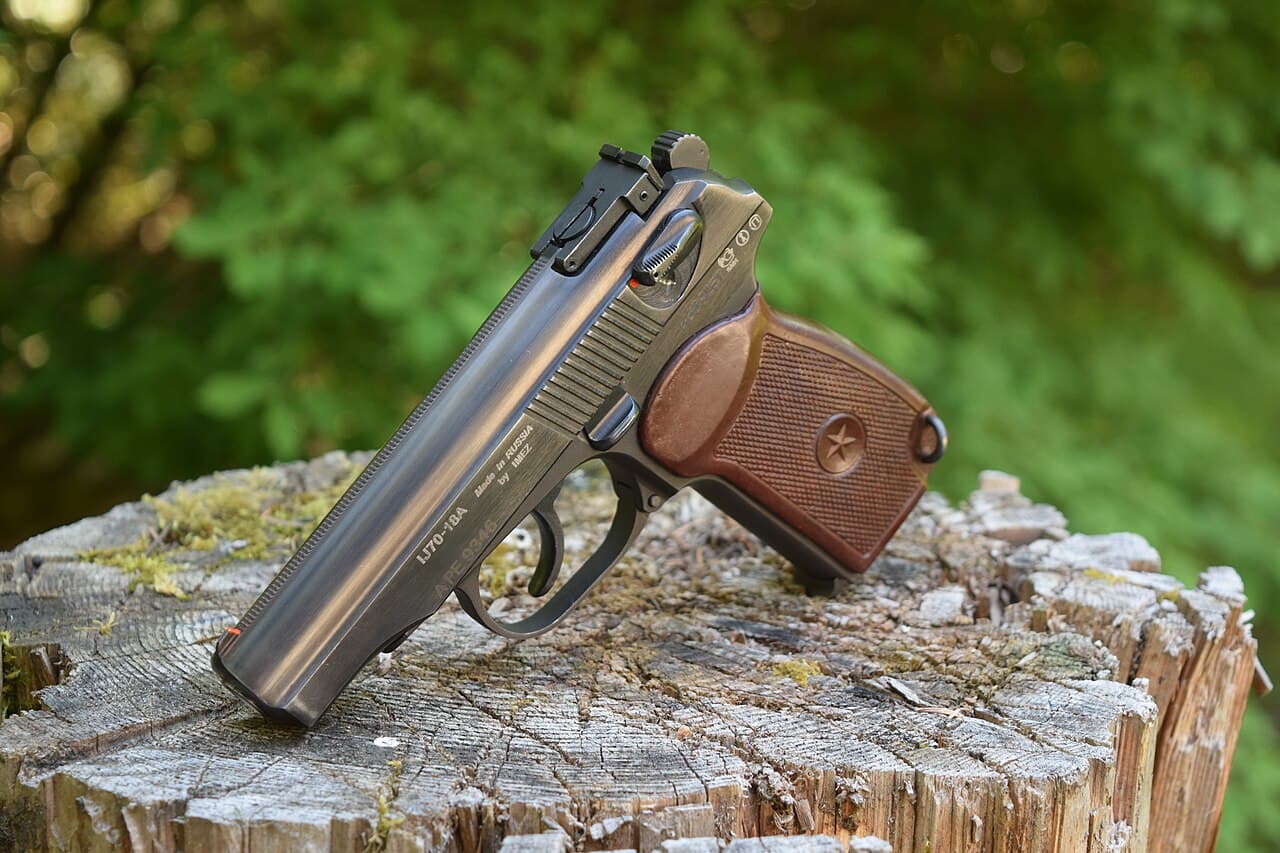
The Soviet military PM is the foundation of the collecting field. Typical examples have fixed sights, an eight-round magazine, a dark blued finish, and a brown or reddish-brown wraparound grip bearing a star within a circle.[2]
Military pistols normally carry a serial number on the left side of the frame and slide. Soviet serials commonly combine Cyrillic letters with numerals, while the frame may also display the production year and Izhevsk arsenal marking.[2]
Marking formats and manufacturing details changed during the PM’s long production history. A collector should therefore consider the arsenal mark, serial structure, date, machining, finish, grip, and other components together. No single feature proves Soviet military origin.
Grips are especially easy to replace. A correct Soviet-style grip may improve the appearance of a pistol, but it cannot establish where the frame and slide were manufactured. The same caution applies to magazines, safeties, hammers, and other parts that interchange among standard PM-pattern pistols.
Finish must also be evaluated carefully. Honest holster wear is consistent with service use. Rounded edges, shallow markings, polished-over corrosion, or an unnaturally uniform surface may indicate refinishing. A refinished pistol can still be mechanically sound, but it is not equivalent to an example retaining its original military finish.
Russian Commercial IJ-70 Pistols
Russian commercial exports belong in a separate category from Soviet military PMs. Baikal IJ-70 pistols began appearing in the United States during the 1990s. These commercial guns frequently carry English-language model, manufacturer, caliber, and importer markings, and many have adjustable rear sights.[4]
The complete model designation is important. American Rifleman documents a pistol marked “IJ70-18AH” and “IMEZ.” IMEZ identifies the Izhevsk Mechanical Factory, while the IJ70-18AH designation identifies a commercial higher-capacity configuration with a wider frame and magazine.[5]
Commercial IJ-70 pistols appeared in different calibers and magazine configurations. Some were chambered for 9×18mm Makarov, while others were manufactured for .380 ACP. A collector should never infer caliber from appearance or assume that ammunition is interchangeable between the two.
Serial prefixes used on American imports can also cause confusion. American Rifleman notes that the “RM” prefix on one documented IJ70-18AH was associated with its import serial. It did not establish that the pistol was the 246th Makarov manufactured by the Izhevsk factory, nor was there proof that “RM” meant “Russian Makarov.”[5]
The practical distinction is straightforward: fixed sights and Soviet military markings point toward a military PM, while an IJ-70 model designation, English export legends, and adjustable rear sight generally indicate commercial production. The entire pistol must still be examined because parts can be replaced.
East German Pistole M
East Germany manufactured its version of the Makarov from the late 1950s through 1965. Usually called the Pistole M, it is identified most reliably through its serial structure, date code, acceptance marks, and grip.[6]
A typical East German pistol has a letter prefix and four-digit serial number on the left sides of both the frame and slide. A two-digit date code follows the serial number and indicates the year of manufacture.[6]
Some internal parts, including the hammer on certain pistols, carry the final two digits of the serial number. These numbers may have been applied by electro-pencil or a similar process. Their appearance should not automatically be dismissed as later alteration, but not every internal component on every pistol was necessarily numbered.[6]
The rectangular K100 mark is another important identifier. It appears on the left side of documented East German pistols, forward of the slide stop, and is described as an inspection-acceptance mark. Additional proof and inspection symbols may also be present.[6]
Original East German pistols were not prominently marked with a national name or model designation. That makes the letter prefix, four-digit serial, two-digit date, and K100 acceptance mark considerably more useful than a general impression of quality.
East German grips are normally plain black plastic with fine checkering. Some may appear brownish or reddish under particular lighting, but color is not conclusive. A replacement East German-style grip can be installed on another PM-pattern frame just as easily as a Soviet-style grip can be added to an East German pistol.
Published lists of East German letter codes are based substantially on surviving examples. They are useful for comparison, but the underlying source acknowledges that the precise production total remains unknown.[6] An unusual code should be investigated rather than automatically declared rare.
Bulgarian Factory 10 Pistols
Bulgaria was the last Soviet-aligned European country to begin licensed production of the PM. Gun Digest places Bulgarian production at the Friedrich Engels Machine Works, also known as Factory 10, and dates regular manufacture from 1975 through 2007. Initial production occurred under Soviet supervision before Bulgarian control followed in 1976.[2]
The principal identifying feature is the number 10 enclosed within a circle on the left side of the frame. This factory emblem accounts for the common collector name “Circle 10.” The serial number and coded production information also appear on the left side of documented Bulgarian examples.[2]
Bulgarian military-pattern pistols generally retain the Soviet PM’s fixed sights, eight-round single-column magazine, heel release, and 9×18mm chambering. Many have reddish-brown star-pattern grips resembling the Soviet type, so grip appearance alone cannot distinguish Bulgarian from Soviet manufacture.
The factory mark is more useful. A true Circle 10 mark on the frame is direct evidence of Bulgarian Factory 10 production, while a star-pattern grip is only a removable component.
Collectors should also distinguish military-pattern Bulgarian pistols from later commercial configurations. Grips, finishes, and accessories were sometimes changed for export or civilian sale. A pistol should be classified by its factory and serial markings rather than by whichever grip or holster accompanies it.
Chinese Type 59
China produced its version of the PM as the Type 59. Established firearms publications identify it as a Chinese-made pistol based on the Soviet Makarov design and chambered for the 9×18mm cartridge.[3][4]
Documented Chinese pistols appeared outside China during the Cold War. Firearms News author Leroy Thompson records handling a Type 59 captured in Laos during the Vietnam War.[4] Chinese commercial pistols were later exported under Norinco markings, creating a separate category from military Type 59 examples.
Military and commercial Chinese pistols should not be treated as interchangeable. A Norinco-marked export with English commercial legends is not the same artifact as a military Type 59 with documented service history.
Chinese examples require particularly careful authentication. Replacement grips and other interchangeable components can create a superficially convincing pistol. An attribution should rest on the original markings, serial format, physical configuration, and provenance, not merely on grip design, finish, or slide serrations.
Claims that an unmarked or lightly marked pistol is a wartime bring-back require evidence. Capture papers, military records, dated photographs, or a documented chain of ownership are substantially stronger than an undocumented family or seller account.
Serration Counts and Other Shortcuts
Collectors often repeat formulas assigning specific numbers of rear slide serrations to Russian, East German, Bulgarian, or Chinese pistols. Serrations can be recorded as one physical characteristic, but they are not a secure identification method by themselves.
Slides can be replaced, production details can change, and commercial pistols do not always follow military conventions. A serration count should never override clear factory, proof, serial, or acceptance markings.
The most useful identifiers remain:
- Soviet arsenal, serial, and date markings
- Russian IJ-70 model and caliber designations
- East German letter prefix, four-digit serial, two-digit date, and K100 acceptance mark
- Bulgarian Circle 10 factory emblem
- Original Chinese military or Norinco commercial markings
These features should still be evaluated together. A single authentic part does not prove that the entire pistol remains in its original configuration.
Grips, Magazines, and Accessories
The PM’s one-piece wraparound grip is a defining mechanical feature, but grip style is only supporting evidence of national origin. Soviet-style star grips, plain East German-style grips, commercial thumb-rest grips, and modern aftermarket grips can all be moved between compatible frames.
The standard PM magazine is a single-column steel design holding eight cartridges. Russian commercial higher-capacity pistols use a wider frame and corresponding magazine, so they should not be described as standard military PMs.[1][5]
A collector examining a magazine should look for an undamaged body, even feed lips, smooth follower movement, and positive engagement with the heel catch. National manufacturing details may add collecting interest, but mechanical condition and originality are separate questions.
Holsters, lanyards, cleaning rods, and spare magazines can complete a period display. They do not authenticate the pistol. Each accessory should be examined independently for its country, period, markings, materials, and condition.
Examining a PM Before Purchase
Begin with the pistol unloaded. Record every visible marking before disassembly, including those on the frame, slide, barrel, grip, and magazine.
Check whether the frame and slide serials correspond. On an East German pistol, look for the letter prefix, four-digit serial, two-digit date, K100 acceptance mark, and any appropriate partial serials on internal components. On a Bulgarian example, examine the Circle 10 mark and serial arrangement. On a Russian commercial pistol, record the complete IJ-70 designation and caliber.[2][5][6]
Examine the finish under neutral light. Rounded corners, softened lettering, dished holes, and polished-over pitting can indicate refinishing. Normal service wear is generally concentrated along exposed edges and contact points rather than distributed with perfect uniformity.
Inspect the bore, crown, fixed barrel, slide rails, slide-stop notch, extractor, recoil spring, firing-pin channel, and mainspring for corrosion, cracks, excessive peening, or improvised alteration. Test magazine fit only with an empty magazine.
Mechanical operation alone does not establish that a surplus pistol is safe to fire. Any PM intended for shooting, particularly one with mismatched, modified, or refinished components, should be examined by a qualified gunsmith familiar with the design.
Building a Representative Collection
A focused collection can illustrate the PM’s principal national variations:
- A Soviet military PM with fixed sights and documented arsenal, serial, and date markings.
- An East German Pistole M with corresponding frame and slide numbers, a two-digit date, and K100 acceptance mark.
- A Bulgarian Factory 10 pistol with its original Circle 10 frame marking.
- A documented Chinese Type 59 or clearly identified Norinco commercial export.
- A Russian IJ-70 commercial pistol identified by its complete model and caliber markings.
Originality, condition, matching major components, and credible provenance matter more than a colorful story. The Makarov PM rewards close study because its national versions are similar enough to invite mistakes but different enough to document carefully.
The best approach is simple: read the markings, distinguish military manufacture from commercial export, and treat every unsupported attribution as a claim still requiring proof.
Frequently Asked Questions
How can I identify a genuine Makarov PM?
Look for a fixed barrel, recoil spring surrounding the barrel, one-piece wraparound grip, slide-mounted safety, external slide stop, and heel magazine release.
How is an East German Makarov identified?
East German Pistole M examples normally have a letter prefix, a four-digit serial number, a two-digit production date, and a rectangular K100 acceptance mark.
What does the Circle 10 marking mean?
A number 10 enclosed within a circle identifies documented Bulgarian Factory 10 Makarov pistols. It is normally found on the left side of the frame.
Is a Russian IJ-70 a military Makarov?
The IJ-70 is a Russian commercial-export model, not a Soviet military-issue PM. Many examples have adjustable sights and English-language markings.
Can slide serrations identify a Makarov’s country of origin?
Serration counts are not conclusive because slides can be replaced and production details can vary. Factory, serial, date, and acceptance markings provide stronger evidence.
Sources
- Royal Armouries, “Centrefire Self-Loading Deactivated Military Pistol—Makarov PM—Made 1968.”
- George Layman, “The Makarov and Other 9x18mm Pistols,” Gun Digest, July 10, 2020.
- Leroy Thompson, “The 9x18mm Makarov,” Handguns, September 24, 2010.
- Leroy Thompson, “A Genuine Look at the Historic Makarov PM 9x18mm,” Firearms News, October 8, 2021.
- American Rifleman Staff, “Rifleman Q&A: Is My KBI Makarov Rare?,” American Rifleman, November 15, 2016.
- Cameron S. White, “East German Makarov: A Cold War Classic,” American Rifleman, July 24, 2015.
As a firearms enthusiast with a background in website design, SEO, and information technology, I bring a unique blend of technical expertise and passion for firearms to the articles I write. With experience in computer networking and online marketing, I focus on delivering insightful content that helps fellow enthusiasts and collectors navigate the world of firearms.
Comments
Be the first to leave a comment.
Be the first to read new editorial features, collector guides, and brand spotlights.