Before Cylinder & Slide had a storefront, it had a tent. Bill Laughridge, a Fremont gunsmith and Army Reservist, borrowed one from his reserve unit and set it up at the Second Chance shoot in Michigan to repair competitors’ pistols. In the tent’s second year the writer Evan Marshall asked him to build a custom revolver, and the magazine article that followed gave him a national audience. American Rifleman identifies the magazine as American Handgunner.
Laughridge had come to the trade sideways. In the early 1970s he spent Saturdays at a local gun shop, and he was offered repair work after he stripped a Colt Woodsman that had defeated the owner’s son. By his own account he worked there part-time for about three years, then spent about four years building the gun department of a sporting goods store, and bought that store’s gunsmithing business once the local IPSC club had drawn him toward handguns. He opened Cylinder & Slide in November 1978; the company’s federal trademark registration claims first use on 31 December 1978. For roughly 18 years he towed a purpose-built shop trailer to major matches, and Patrick Sweeney recalls meeting him and the trailer at Second Chance in 1984. The shop’s 1997 website set out its approach: pistols built one at a time, no rush jobs, and reliability ranked ahead of accuracy.
The Browning Hi-Power gave the shop a specialty that few custom houses pursued. Charles Petty wrote in 2001 that inquiries about Hi-Power gunsmithing were routinely directed to Laughridge. The company made its own hammers, sears, triggers and extended safeties for the pistol, and later sold matched 1911 hammer, sear and disconnector sets pre-set to pull weights from 3 to 4.5 pounds, each supplied with a hardness certificate. It also brought the Safety Fast Shooting (SFS) kit to the United States, a Belgian-made conversion that lets a single-action pistol be carried hammer-down with the safety applied automatically. Petty described the kit as imported and distributed exclusively by Cylinder & Slide. It was listed as new on the company’s site by October 1999, first for the Hi-Power, with a 1911 version planned.
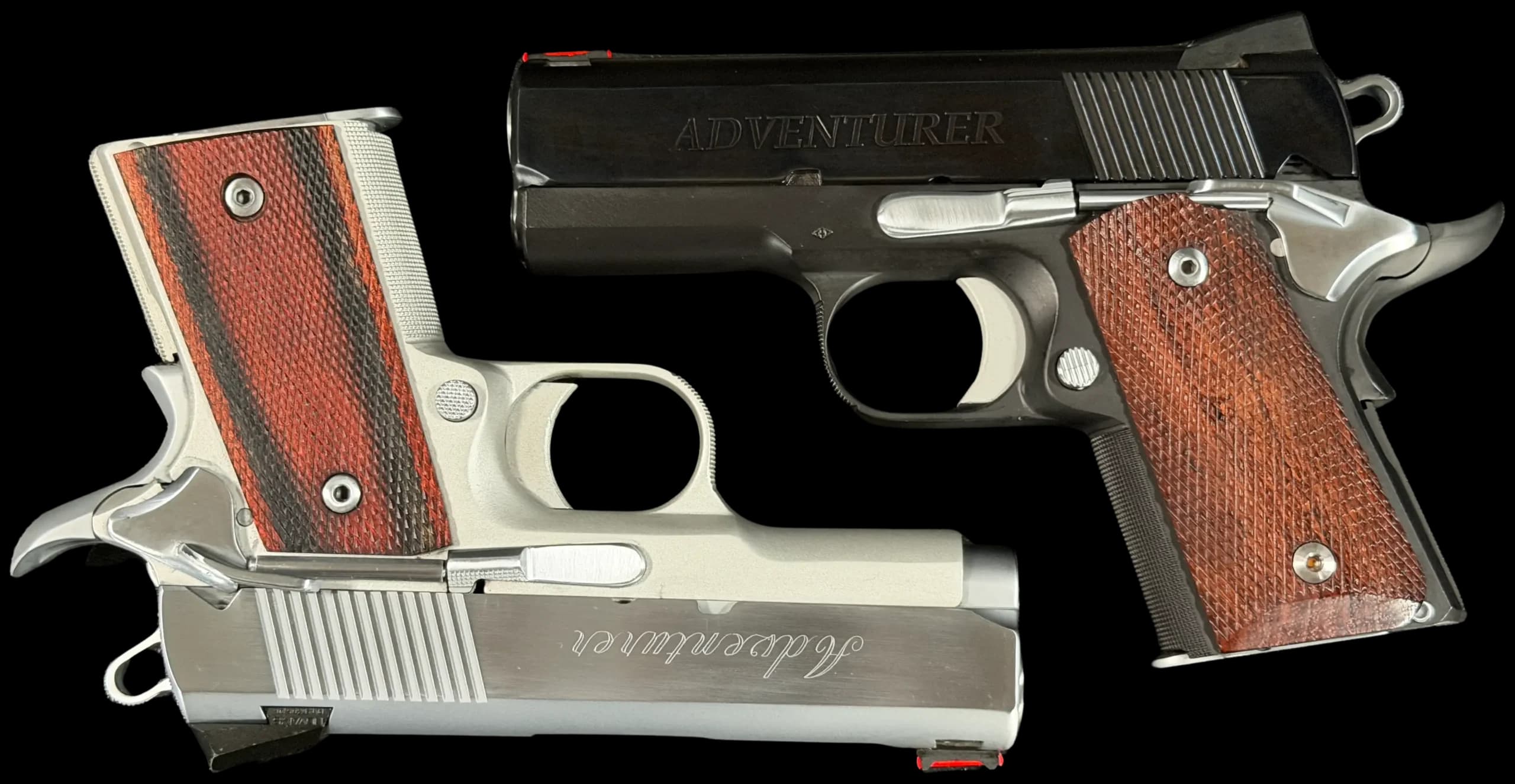
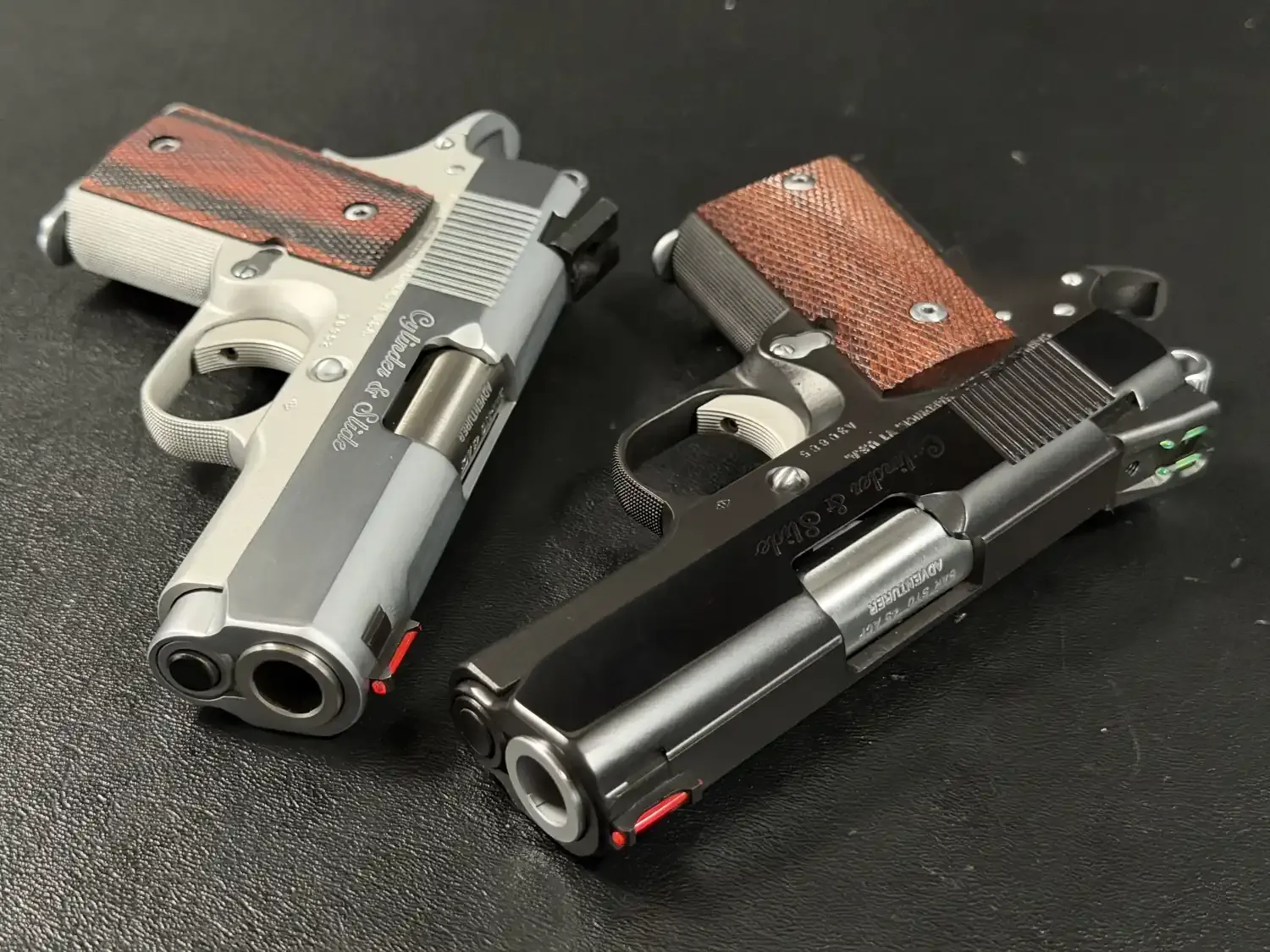
Laughridge also built shortened pistols. The Adventurer, covered by American Handgunner in 1998, started as a Colt Commander and finished with a 3.2-inch barrel, using Larry Seecamp’s captive recoil spring system. The Pathfinder applied the same idea to the Hi-Power in 2001, with half an inch cut from the middle of the grip frame and the halves welded back together. The Pocket Model followed: a .45 ACP 1911 with the enclosed hammer and rounded profile of Colt’s 1903 and 1908 pocket pistols. The prototype joined a Caspian Commander-length slide to an Officer’s-size frame, with extensions silver-soldered on by Chris Hagemann of the shop. Caspian then modified a frame mold for production, and Bill Jarvis made the barrels. The first run was 50 pistols, and Wiley Clapp reported a price above $3,000 in 2010.
Two projects defined the following decade. The Trident grew from a 2009 conversation with an active-duty SEAL attending one of Laughridge’s pistolsmithing classes in Virginia, who described fine sand fouling equipment overseas. The first Tridents were built on Springfield Armory 1911A1 pistols, and the Trident II moved to the company’s own slides and frames when the supply of Springfield base guns became a constraint. In parallel, Laughridge set out to build 100 reproductions of the earliest military 1911s for the pistol’s centenary, borrowing original low-serial pistols to measure. A supplier produced slides and frames to the early pattern, and Doug Turnbull applied the bluing. Hand polishing took 16 to 18 hours per pistol, and by mid-2013 the shop reported about 70 sold and roughly 20 delivered. The Modern Classic reused the same slide and frame with modern sights and safeties. In 2005 the American Pistolsmiths Guild named Laughridge its Pistolsmith of the Year.
By 2014 Laughridge was described as semi-retired, with a home and shop in western Nebraska. On 27 December 2022 the company announced that it was ceasing operations after more than 44 years, and Shooting Illustrated reported that he was in talks with several parties about continuing the business. In March 2023 two investors, not named in the reports, took over, with Laughridge staying on as a consultant and the shop remaining in Fremont. A custom Springfield SA-35 from the shop was reviewed in 2025, and the company’s site lists 245 E. 4th Street, Fremont. For collectors, the interest lies in the small numbered runs: the company limits the Pocket Model to 50 pistols a year and planned 100 anniversary pistols. No published total of completed pistols was found for either.
History & Milestones
Laughridge Opens Cylinder & Slide in Fremont
Bill Laughridge opened the shop in November 1978 and began advertising nationally. He had previously bought the gunsmithing business of the sporting goods store that employed him.
Adventurer Compact .45 Appears in Print
American Handgunner published a test of an early Adventurer prototype, a Colt Commander cut down to a 3.2-inch barrel. It established the shop’s line of shortened pistols.
Belgian-Made SFS Kit Joins the Catalog
The Safety Fast Shooting System appeared as a new product on the company’s website. The kit was made in Belgium and imported by Cylinder & Slide, initially for the Hi-Power.
Pathfinder Shortens the Browning Hi-Power
American Handgunner reviewed the first two Pathfinder pistols, each with a sectioned and rewelded grip frame. One carried the SFS conversion.
Guild Names Laughridge Pistolsmith of the Year
The American Pistolsmiths Guild gave Laughridge its 2005 award for his contribution to the profession.
Trident 1911 Developed for Field Use
Conversations with an active-duty SEAL at a Virginia pistolsmithing class led Laughridge to specify a low-maintenance 1911. The Trident was listed as new on the company’s site by December 2009.
Anniversary 1911 Reproduction Project Is Announced
Laughridge published plans for 100 reproductions of early military 1911 pistols and asked owners to lend originals for measurement. The same slides and frames later served the Modern Classic.
Shop Announces It Will Cease Operations
On 27 December 2022, the company said it was closing after more than 44 years and offered inventory and equipment for sale. Laughridge was retiring.
Two Investors Take Over the Business
Shooting Illustrated and The Shooting Wire reported in March 2023 that two investors would continue the shop in Fremont, with Laughridge consulting during the transition.