Key Takeaways
- The SVD is a purpose-designed precision rifle; the PSL uses a reinforced Kalashnikov-pattern action.
- Both rifles use 7.62×54R ammunition and 10-round magazines, but their magazines are not interchangeable.
- Collectors should verify operating components, markings, optic mounts, receiver condition, and configuration before assigning value.
The Soviet SVD and Romanian PSL are often grouped together because both are semiautomatic, 7.62×54R rifles with skeletonized stocks, detachable 10-round magazines, and left-side optic mounts. The resemblance is genuine, but it masks two mechanically distinct designs. The SVD was developed as a dedicated precision rifle; the PSL adapted Kalashnikov-pattern engineering to serve a broadly comparable marksman role.[1][2]
Origins and Intended Roles
Designed under Yevgeny Dragunov’s direction, the SVD emerged from a Soviet competition for a self-loading precision rifle and entered military service in the 1960s. Its purpose was to extend the effective reach of an infantry unit without burdening the marksman with a conventional heavy, bolt-action sniper system. The rifle was consequently designed as an integrated package incorporating the 7.62×54R cartridge, detachable magazine, iron sights, and PSO-1 optical sight.[1]
Romania developed the PSL during the early 1970s. Its full Romanian designation, Puşcă Semiautomată cu Lunetă, translates approximately as “semiautomatic rifle with scope.” Although intended to perform a role resembling that of the SVD, the PSL was built around an enlarged and reinforced Kalashnikov-pattern action rather than copied from Dragunov’s design.[2][3]
The distinction matters to collectors. A PSL is not a Romanian-manufactured SVD, and the two rifles should not be described as variants of the same mechanical platform.
Operating Systems
The SVD uses a short-stroke gas system. Its piston and operating rod transmit energy to the bolt carrier but do not travel with it throughout the complete operating cycle. A two-position gas regulator allows the operator to increase the gas impulse when adverse conditions or accumulated fouling require it. Locking is accomplished by a rotating bolt with three locking lugs.[4]
The PSL uses a Kalashnikov-derived long-stroke system in which the piston remains connected to the bolt carrier and travels with it. Its rotating bolt has two principal locking lugs, while its stamped receiver incorporates a reinforced front-trunnion area comparable in concept to the RPK light machine gun.[2][3]
These differences affect parts compatibility, disassembly, maintenance, and the movement of the action during firing. They also provide a reliable method of identification: an SVD bolt carrier does not have the fixed, full-length piston characteristic of the PSL’s Kalashnikov-pattern assembly.
Receivers and Optic Rails
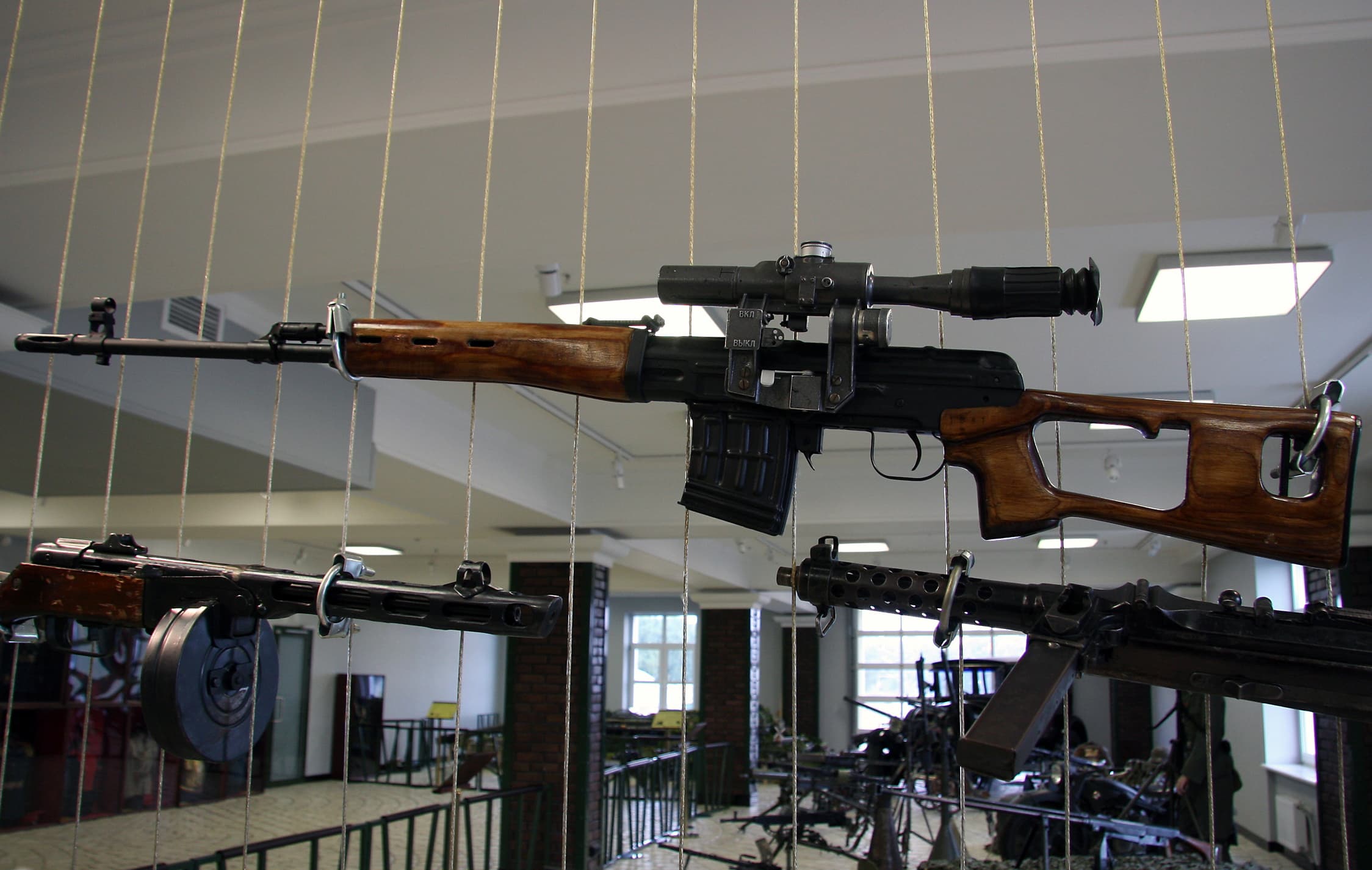
A traditional SVD has a machined receiver and a proprietary left-side dovetail for Soviet-pattern optical sights. The rifle’s dust cover is not the primary support for the optic. This arrangement permits the scope to be removed while leaving the iron sights available.
The PSL uses a stamped sheet-steel receiver with a separate optic rail attached to its left side. Current PSL-54 documentation likewise identifies a side mounting rail that permits continued use of the iron sights with an optic installed.[3][5]
Collectors inspecting a PSL should examine the receiver and optic rail carefully. Rivets should be properly formed and secure, and the rail should sit squarely enough to provide usable windage adjustment. Evidence of a displaced trunnion, distorted receiver, loose rail, or amateur refinishing warrants closer examination by a qualified gunsmith.
Optics
The SVD’s best-known sight is the 4×24 PSO-1. Its reticle incorporates an optical rangefinder, aiming chevrons, and lateral reference marks. The elevation system was developed around Soviet service ammunition and prescribed firing conditions; its numbered settings should not be assumed to predict the impact of every commercial 7.62×54R load.[1][4]
Romanian military PSL rifles were associated with the 4× LPS-series optic, while commercial rifles may be encountered with Romanian, Russian, Belarusian, or modern reproduction sights. Similar appearance does not establish that a sight is an original PSO-1 or that it was factory-matched to a particular rifle.[2]
Before assigning a premium to an optic, inspect its maker’s marks, serial markings, reticle, illumination system, mount, and adjustment drums. The rifle and sight should be evaluated separately unless documentary or physical evidence establishes that they were originally paired.
Magazines
Both rifles normally use detachable 10-round box magazines, but the magazines are not interchangeable. PSL magazines typically have prominent X-shaped reinforcing ribs. Russian and Chinese Dragunov-pattern magazines use different bodies, locking geometry, and reinforcing patterns.[3]
A magazine should lock into place without grinding, filing, or forced alteration. Modified magazines have less collector value and may create feeding problems. Because original magazines can materially affect the completeness and value of a rifle, buyers should confirm their type and condition before purchase.
Furniture and Muzzle Features
The familiar fixed-stock SVD combines a skeletonized buttstock with a removable cheekrest. Removing the cheekrest improves access to the iron sights when the optic is not fitted. Furniture materials and details changed during production, so laminated wood and later synthetic components must be assessed in the context of the rifle’s date and variant.[1][4]
The PSL generally has a laminated thumbhole stock with a raised comb. Commercial examples vary in wood color, finish, buttplate design, muzzle device, and the presence or absence of a bayonet lug. Such differences may reflect production changes or the requirements of a particular export market rather than unauthorized alteration.[2][3]
Commercial Names and Import Marks
In the United States, Romanian rifles have appeared under several commercial names, including PSL, FPK, Romak III, and PSL-54. A trade name alone does not establish the rifle’s assembler, production date, or precise configuration.[2]
Federal marking requirements make the firearm itself an important starting point. Imported firearms are generally marked with identifying information that includes the importer, model, caliber, manufacturer or country of manufacture, and a unique serial number.[6] These marks can help distinguish Romanian factory rifles from firearms assembled elsewhere using imported components.
Prospective buyers should record every visible marking rather than relying on a seller’s description. The serial number, manufacturer’s mark, country designation, importer’s name and location, model designation, caliber marking, proof or inspection marks, and any evidence of removed or restamped characters should be photographed clearly. Documentation should support—not replace—what is physically present on the rifle.
What Collectors Should Prioritize
For an SVD, confirm that the rifle is genuinely part of the Dragunov family rather than a PSL or another cosmetically similar design. Examine the receiver, short-stroke piston components, three-lug bolt, gas regulator, optic rail, furniture, magazine, and markings as a complete system.
For a PSL, concentrate on the stamped receiver, trunnion and rivets, bore, muzzle crown, optic-rail alignment, magazine fit, and importer markings. Determine whether the rifle is a Romanian factory-produced firearm or an assembly made from imported parts, and value it accordingly.
The essential conclusion is straightforward: the SVD and PSL share a cartridge, a general military purpose, and a recognizable Eastern European profile. They do not share the same action or manufacturing lineage. For collectors, understanding that distinction is the foundation for accurate identification, sensible valuation, and responsible preservation.
Frequently Asked Questions
Is the Romanian PSL a Dragunov?
No. The PSL resembles the SVD and serves a comparable marksman role, but it uses a distinct Kalashnikov-derived action.
What is the principal mechanical difference between the SVD and PSL?
The SVD uses a short-stroke piston, adjustable gas regulator, and three-lug bolt. The PSL uses a long-stroke piston and a two-lug bolt in a reinforced, stamped receiver.
Can SVD and PSL magazines be interchanged?
No. Both normally hold 10 rounds, but their bodies and locking geometry differ.
Do the SVD and PSL use the same optics?
Not necessarily. The SVD is associated with the PSO-1, while Romanian PSL rifles were commonly paired with LPS-series optics; commercial examples may carry other sights.
What should collectors inspect before purchasing either rifle?
Confirm the model, manufacturer, serial number, import marks, operating system, magazine type, optic mount, bore, and receiver condition. Documentation should agree with the rifle’s physical features and markings.
Sources
- Chris McNab, The SVD Dragunov Rifle, Osprey Publishing, 2023.
- Maxim Popenker, “PSL / FPK / Romak-3 Sniper Rifle,” Modern Firearms.
- Tamara Keel, “Review: Century Arms PSL 54,” American Rifleman, February 6, 2024.
- USSR Ministry of Defense, 7.62-mm SVD Dragunov Sniper Rifle: Technical Description and Service Manual.
- Century International Arms, PSL-54 Rifle Owner’s Manual, 2018.
- Bureau of Alcohol, Tobacco, Firearms and Explosives, “How to Receive Imported Firearms, Ammunition, and Implements of War,” U.S. Department of Justice.
The SVD and Romanian PSL share a similar appearance and military role but use fundamentally different operating systems. Understanding their actions, optics, magazines, and markings is essential for accurate identification and valuation.
Comments
Be the first to leave a comment.
Be the first to read new editorial features, collector guides, and brand spotlights.