
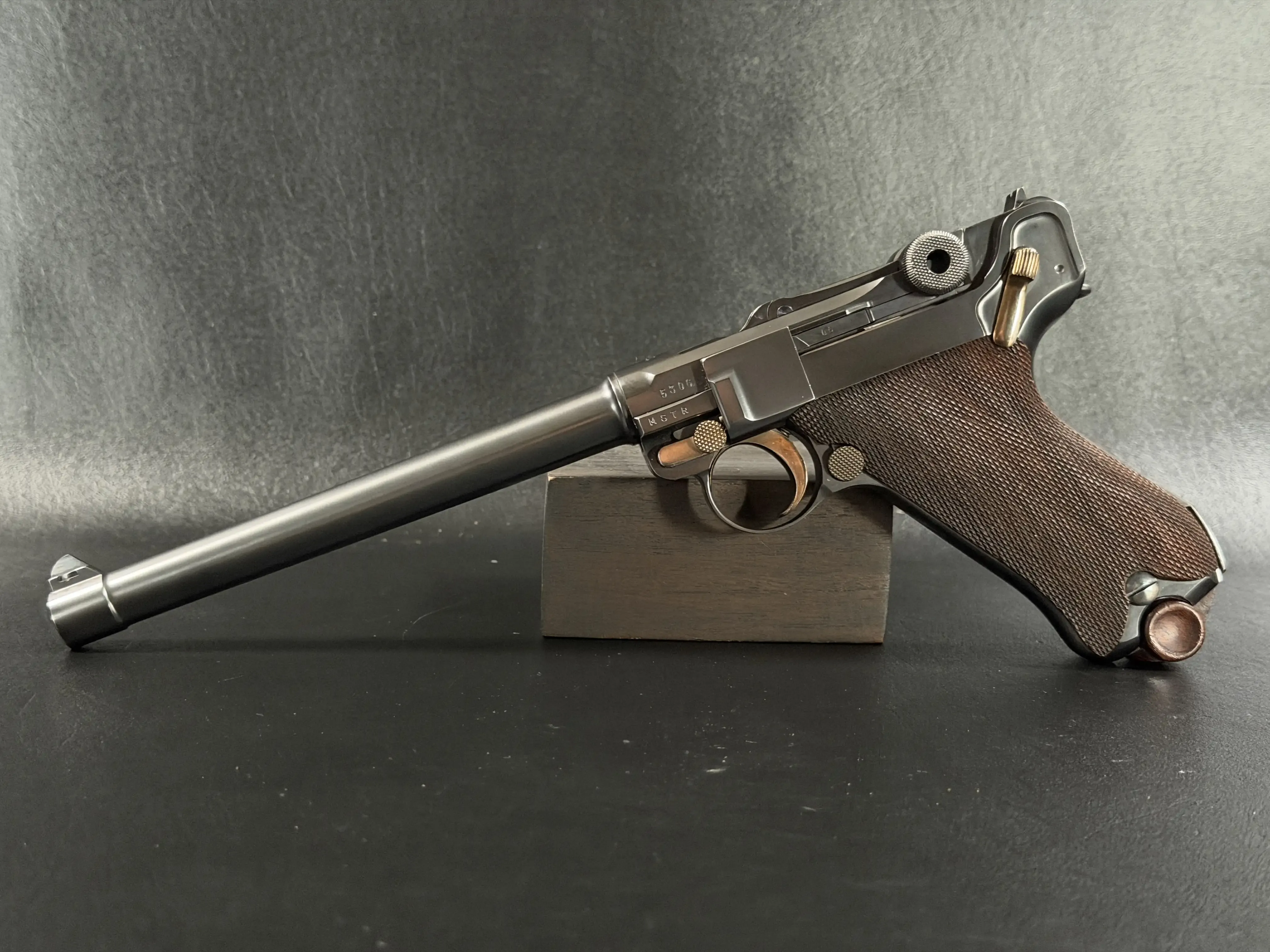

On a standard Luger the toggle locks open when the magazine runs dry, and closing it means removing the magazine or replacing it with a loaded one, then drawing the toggle back and letting it go. John V. Martz’s answer, the subject of U.S. Patent 3,956,967, was an L-shaped lever set into a milled section of the frame rail and worked by a modified sear bar slide. Moving the thumb safety to the safe position trips the hold-open latch, lets the toggle run forward, and locks the trigger at the same time. Martz filed the application on January 31, 1975, and the patent was granted on May 18, 1976. Guns so fitted are marked “MSTR,” for Martz Safe Toggle Release, and the mechanism itself leaves the pistol’s exterior unchanged.
Martz was born on August 19, 1924, and served in the U.S. Navy during the Second World War. His obituary records 25 years as an aircraft sheet-metal worker at McClellan Air Force Base, ending with retirement in 1976, and dates his work as a self-taught custom gunsmith from 1968. The Buffalo Bill Historical Center gives the same starting year for his Luger and P.38 conversions. J.B. Wood, who profiled him for American Handgunner in 1988, wrote that an interest in the mechanisms of the Walther P.38 and the Luger produced the toggle release first, followed by a Baby Luger and a Luger carbine. John Walter’s Luger encyclopedia places the conception of the release in the early 1970s. Martz worked in Lincoln, California, the town given on the patent, in a 1982 trade directory and in Wood’s article, from what Rock Island Auction describes as a home workshop.
The work was reconstruction, not refinishing. The Baby Luger has a shortened grip frame as well as a shortened barrel, and Wood notes that the change in dimensions forced several mechanical compensations. The carbines follow the original Luger carbine pattern, with barrels from 10 5/8 to 18 inches and detachable shoulder stocks on the longer guns. The .45 ACP pistols needed a larger frame. Ian McCollum of Forgotten Weapons describes a Luger frame cut in two and widened, with heavily reworked upper parts, while the Standard Catalog of Handguns describes two Lugers split and welded together. By early 1982 Martz’s entry in American Handgunner’s pistolsmith directory offered Luger and P.38 carbines, Baby Lugers, and .45 ACP Lugers and P.38s. Wood places a .22 Magnum Luger about four years before his 1988 article. He also reported a ten-gun Navy-pattern series in .38 Super in progress, a Baby Luger in .380 ACP, an ambidextrous safety option, and experimental pistols that included a Luger in .357 Magnum.
What the guns are made from matters to a collector. Wood states that Martz did not use collector-grade, matching-number pistols, only sound shooting-grade examples, and that the finished guns are identifiable by their Martz markings and mixed numbers. The standard finish was what Martz called “satin-white,” bare steel with a fine matte surface, with rust blue to special order. Martz did most of the machining and, by 1988, his own TIG welding. Ed Korda assisted with machining, Cameron McCreary and George Sarkisian made the stocks, grips and fore-ends, and the Rev. Herbert Muenkel of Zumbrota, Minnesota, did the rust bluing. Auction-house descriptions record the MSTR frame stamp together with a JVM monogram, in a circle or oval, under the side plate, inside the grip panels and on magazine bases.
Wood’s article is the closest thing to a production record located. His tally at the time lists 101 Baby Lugers, mostly in 9mm with a few in .30 Luger; 87 Luger carbines; 20 Lugers in .45; seven Baby Lugers in .380; seven guns in .22 Magnum; 33 Baby P.38s; 26 P.38 carbines; and nine P.38s in .45, at prices from about $1,500 to $6,000 or more. Later references give larger figures. The 2016 Blue Book of Gun Values lists 213 Baby Lugers in 7.65mm and 9mm together and 89 Lugers in .45 ACP; the Standard Catalog of Handguns gives approximately 205 and 85. None of these is a shop ledger, and they do not agree. John Eckert, writing for the American Society of Arms Collectors in 2015, credited Martz and fellow Californian Mike Krause with around 300 guns between them. That figure is hard to square with Wood’s count, which by itself comes to roughly 290.
An auction catalogue describes a Baby Luger built in Lincoln in 2002, more than three decades after Martz began. The Cody Firearms Museum holds one of his conversions, a First World War artillery Luger set up as a carbine with detachable stock and drum magazine (accession 2010.11.1, the gift of George and Patty Martin), and published it in Points West in 2011. Outdoor Life featured a Martz Luger in 2016 in a piece by Ashley Hlebinsky that directs readers to the same museum. Martz died in Roseville, California, on July 15, 2013, at the age of 88. Each of his guns is a modified original built on a mixed-number pistol, and the Baby configuration has been copied closely enough that Rock Island Auction has catalogued one such pistol as Martz style. Attribution therefore rests on markings, workmanship and paperwork.
History & Milestones
Martz Begins Luger and P.38 Work
Martz starts work as a self-taught custom gunsmith on Lugers and Walther P.38s, the year given by both his obituary and the Buffalo Bill Historical Center.
U.S. Patent 3,956,967 Granted to Martz
The patent issues on May 18 with three claims. In the same year, by his obituary’s account, Martz retires from McClellan Air Force Base.
Trade Directory Lists the Martz Range
American Handgunner’s pistolsmith directory for January/February lists Martz at Lincoln, offering Luger and P.38 carbines, Baby Lugers, and .45 ACP Lugers and P.38s. It is the earliest dated listing of these models located for this profile.
Luger Adapted to .22 Magnum Rimfire
Wood, writing in 1988, places the first .22 Magnum Luger about four years earlier and describes the difficulty of balancing the toggle action against the cartridge’s pressure curve. The year is approximate.
American Handgunner Publishes a Production Tally
J.B. Wood’s profile in the May/June issue records model-by-model counts, prices from about $1,500 to $6,000, and the names of Martz’s subcontractors. It is the most detailed contemporary account located.
Cody Firearms Museum Publishes Martz Carbine
Points West, the Buffalo Bill Historical Center’s magazine, features a Martz artillery Luger carbine conversion from the museum’s collection, accession 2010.11.1.