The land where Heckler & Koch was built had already been making firearms for a century. Oberndorf am Neckar, a town on the upper Neckar in Baden-Württemberg, was home to the Mauser works, one of the defining addresses in European arms manufacturing. When Allied occupation authorities dismantled Mauser's operations after 1945, they left behind a workforce, machining infrastructure, and institutional knowledge with nowhere to go. Edmund Heckler, Theodor Koch, and Alex Seidel incorporated a new company in 1949, initially producing sewing machine parts and precision gauges. The firearms business came shortly after, when the nascent West German Bundeswehr needed a rifle.
That rifle was the G3, and it established HK's position in ways the founders may not have anticipated. Developed in the late 1950s from the Spanish CETME design, itself derived from wartime German engineering, the G3 used a roller-delayed blowback operating system that HK would refine and apply across virtually every product line for the next three decades. The Bundeswehr adopted it in 1959. Over time, more than fifty nations fielded the G3 or its variants, making HK a significant exporter before it had any real civilian profile. The operating mechanism wasn't just a design choice; it became HK's engineering identity.
The MP5, introduced in the mid-1960s, applied the G3's roller-delayed system to a 9mm submachine gun scaled for close-quarters use. For most of its early life, it was one credible option among several. That changed in 1980, when Britain's SAS used MP5s during the Iranian Embassy siege in London, an operation that was broadcast live on television. The footage didn't just boost sales; it embedded the MP5 into the visual language of elite counterterrorism. Police and military units that had been evaluating options made decisions. Hollywood began using it as shorthand for professional operators. By the late 1980s and through the 1990s, the MP5 was arguably the most recognized submachine gun in the world, a status it held until the shift toward rifle-caliber platforms after 2001.
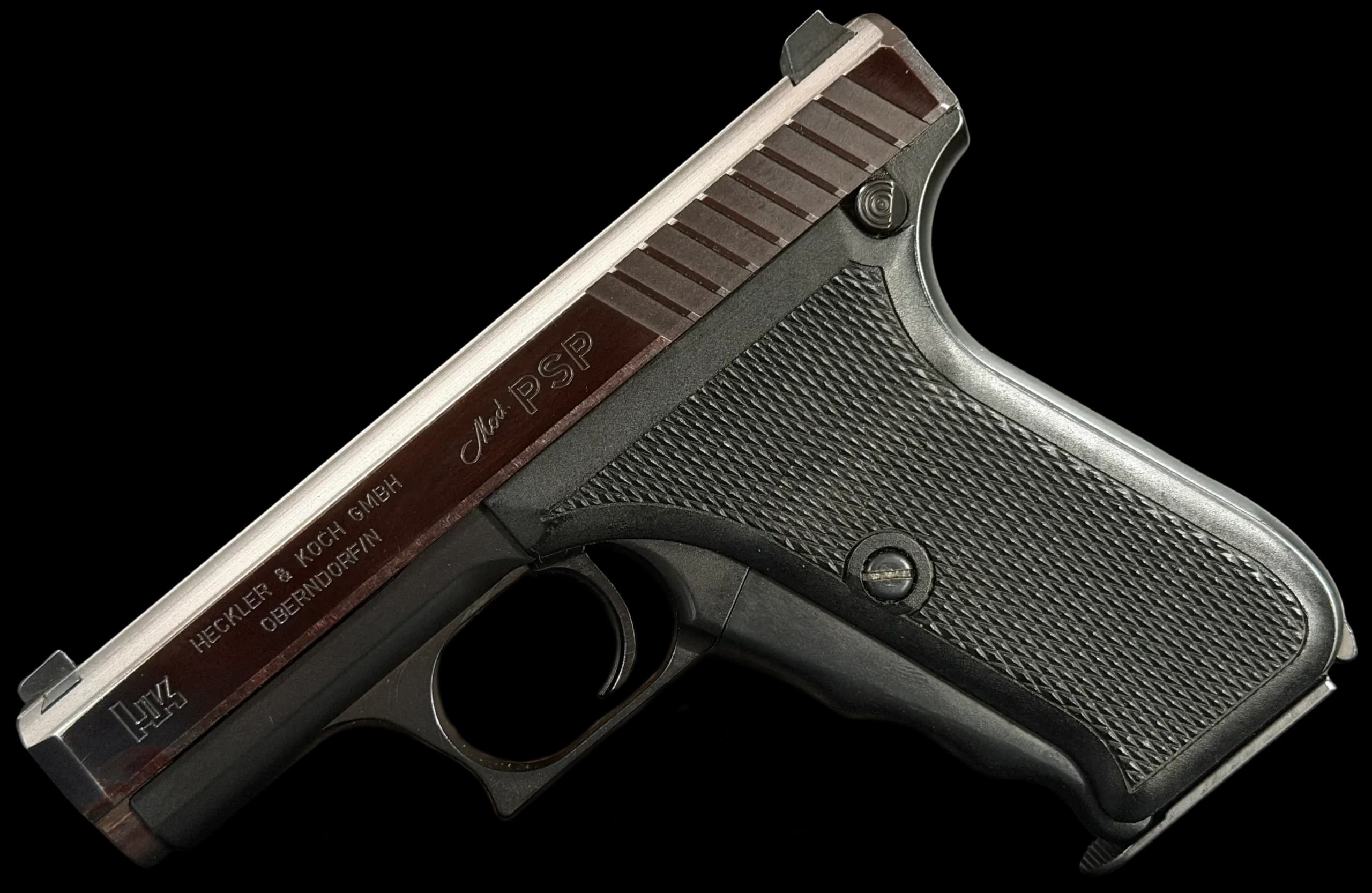
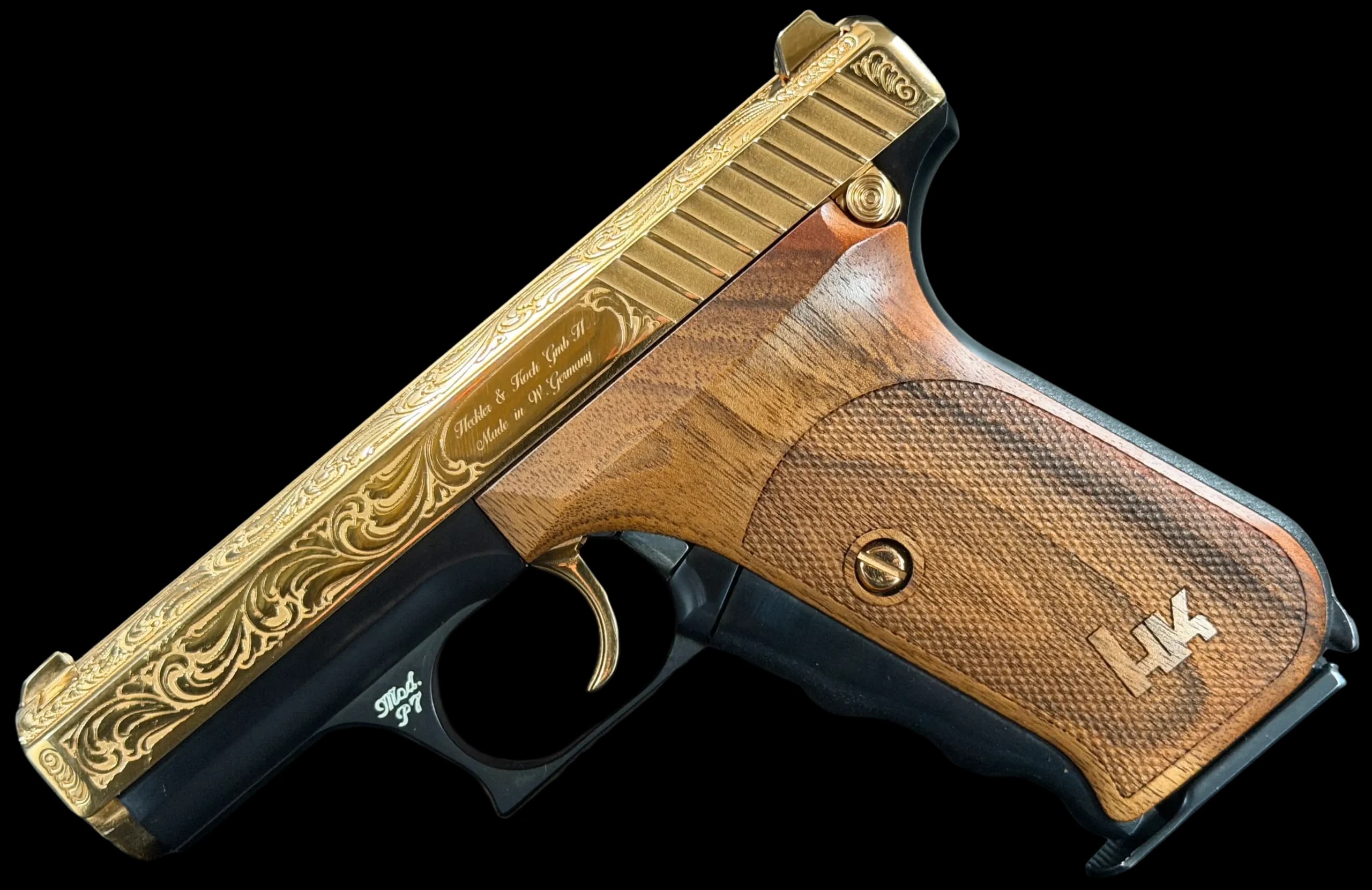
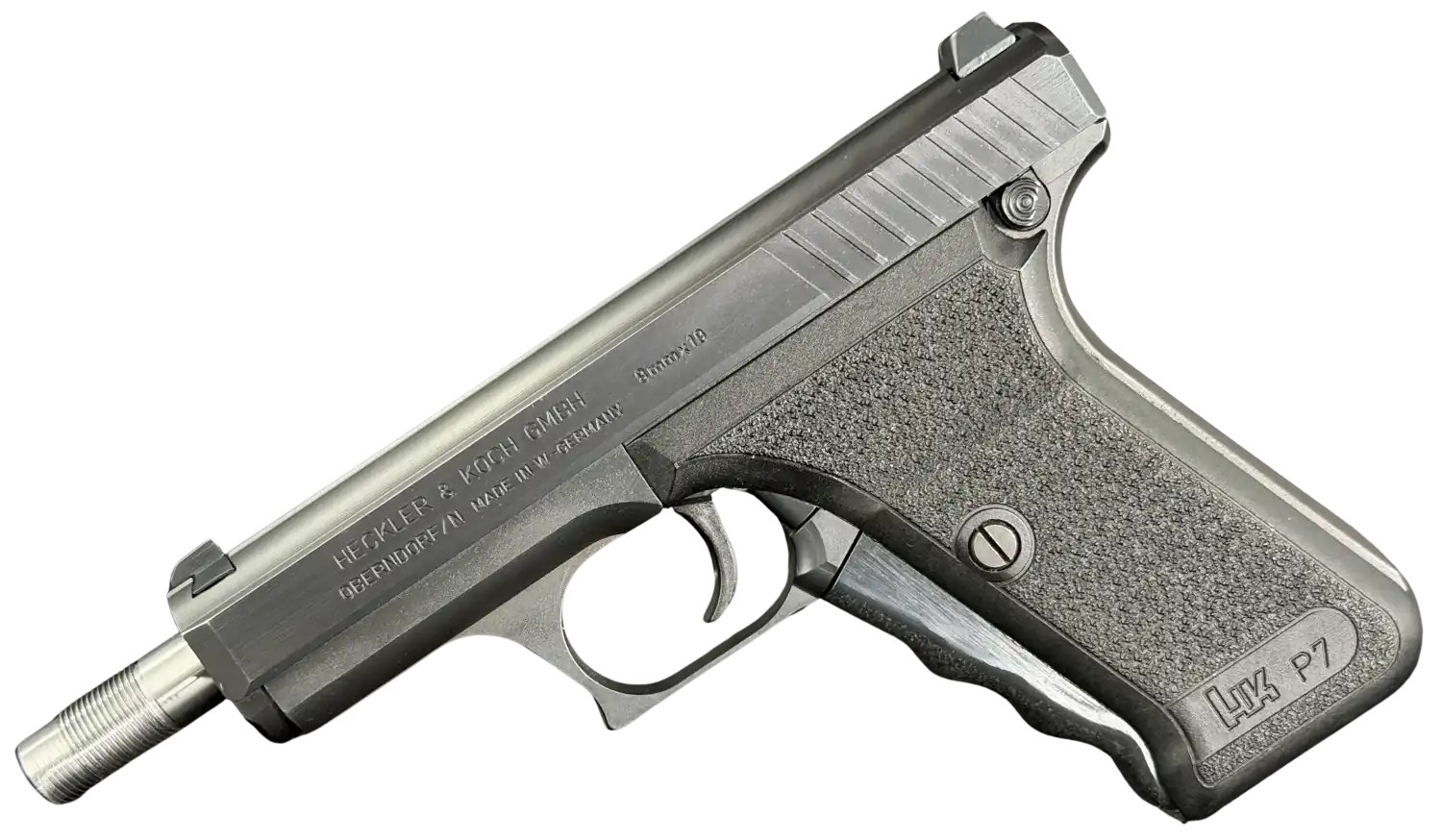
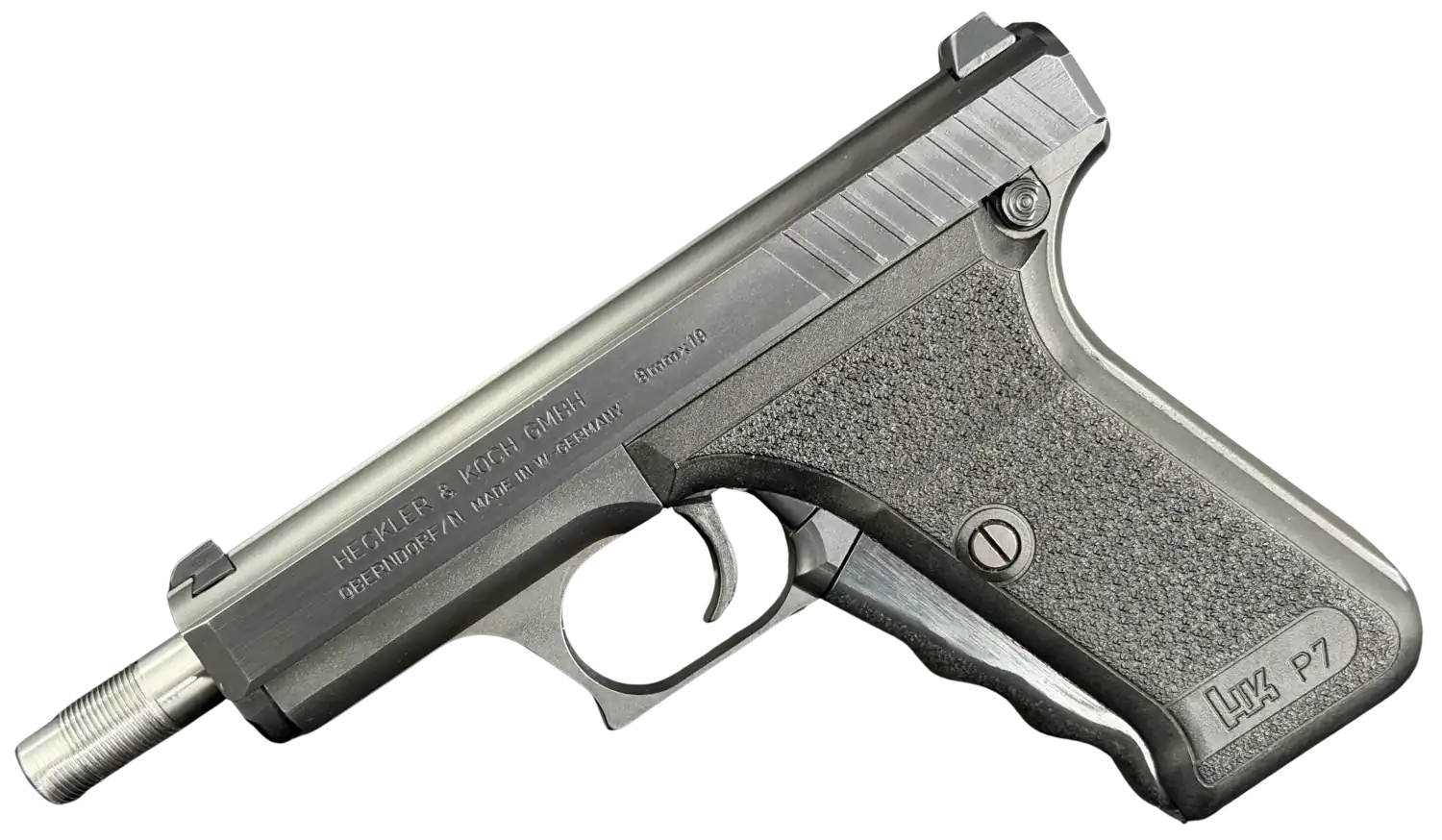
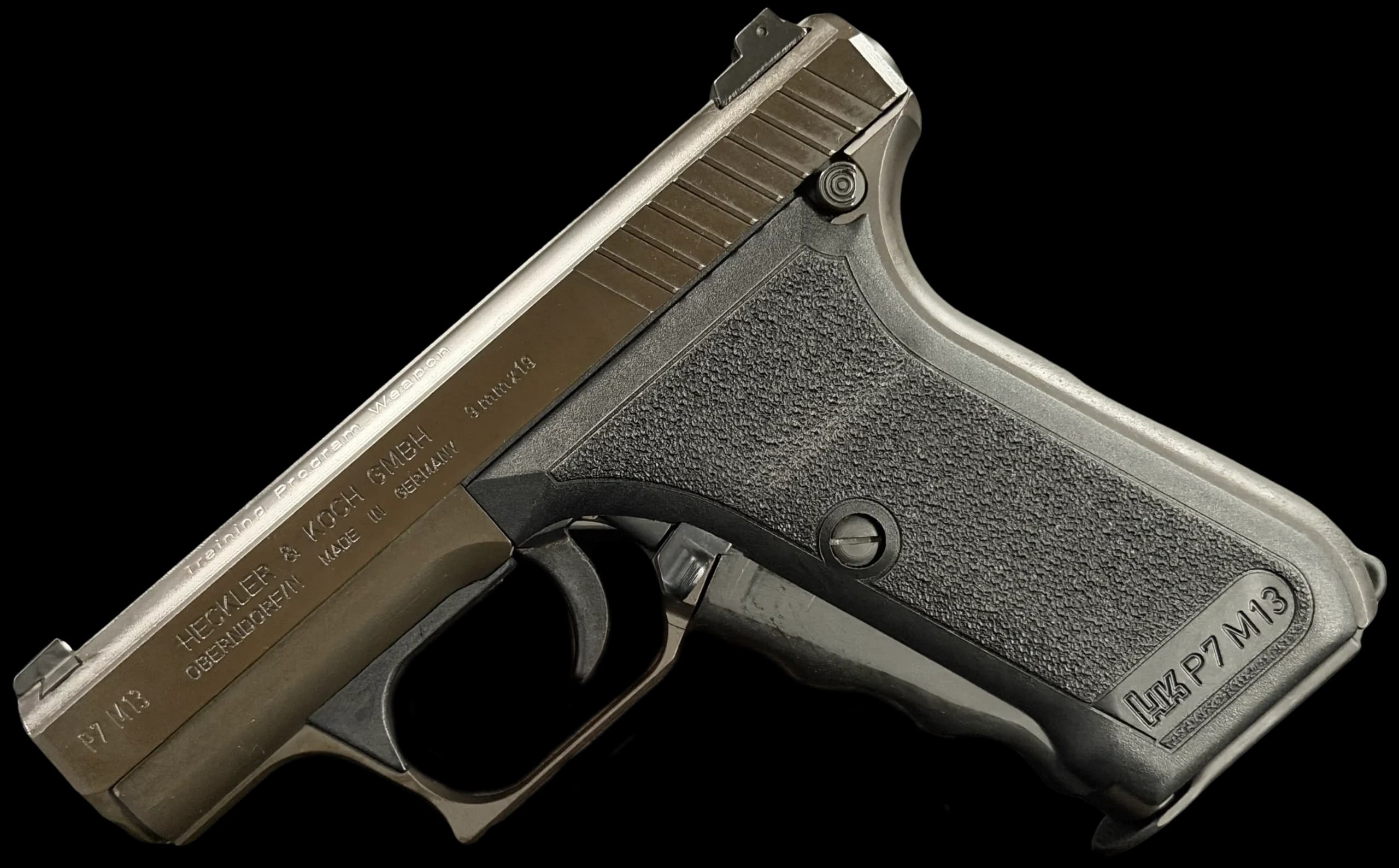
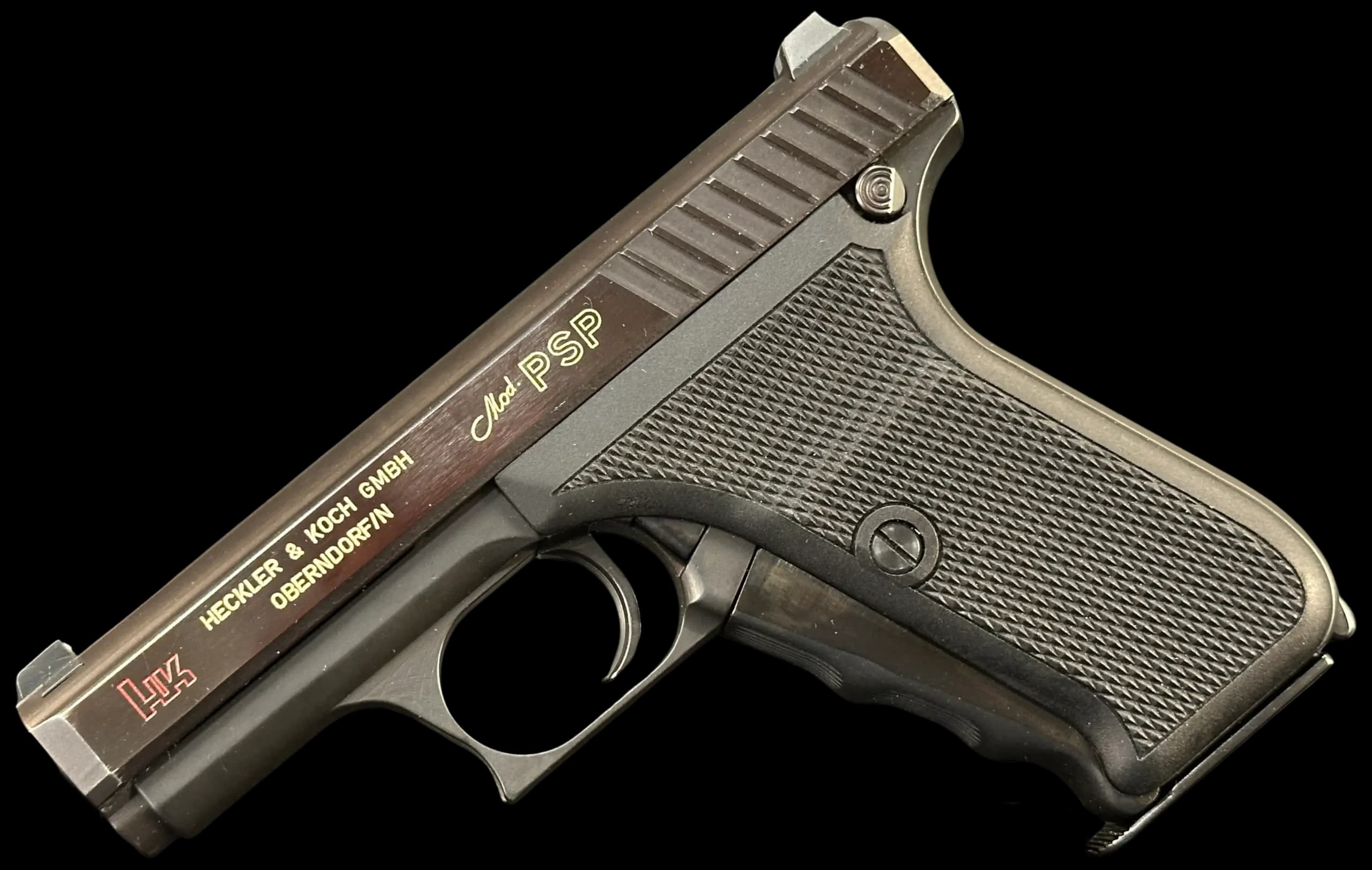
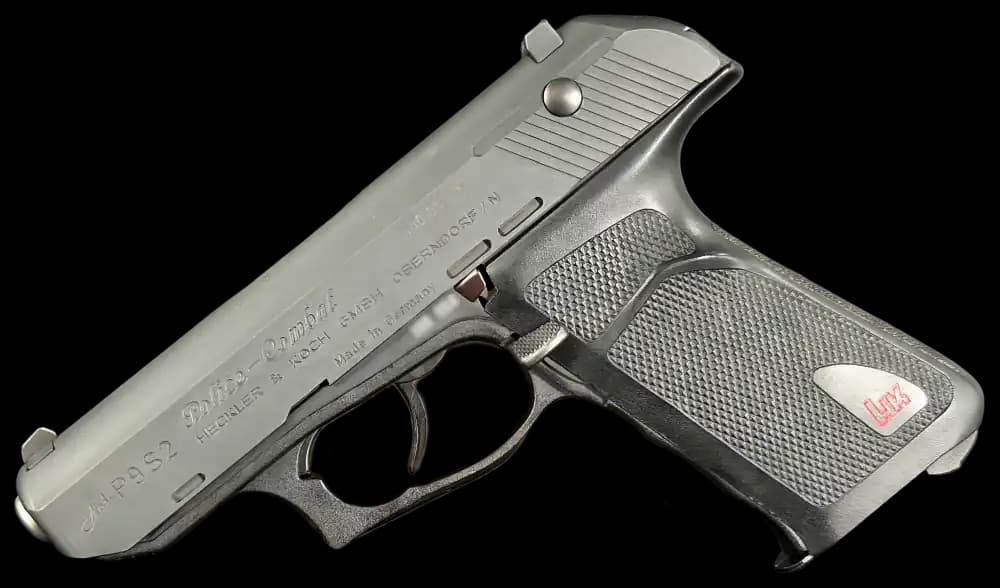
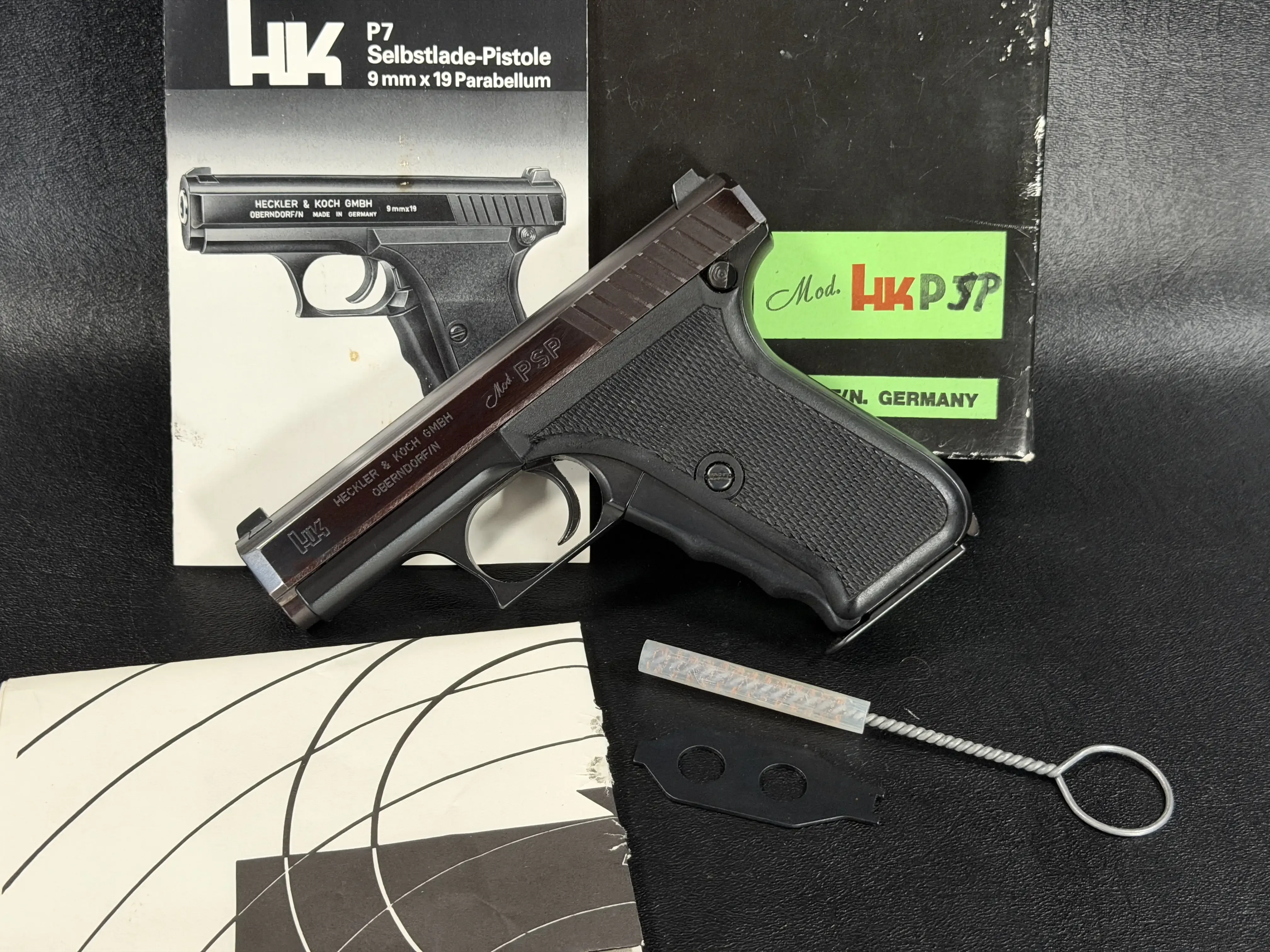
The P7 pistol, developed in response to a West German police requirement in the mid-1970s, showed a different side of the company. Where the G3 and MP5 were scaled for military use, the P7 was a compact, gas-delayed blowback design built around a squeeze-cocker mechanism on the frontstrap. It required deliberate grip to arm and fired with a light trigger pull once cocked, a mechanical solution to the dual demands of safety and speed. The P7 never achieved the commercial volume of competitors like the Beretta 92 or later Glock 17, but it earned lasting regard among shooters who prioritize mechanical ingenuity. The P7M8 in 9mm and the P7M13, with its higher-capacity magazine, remain desirable collector pieces, particularly in unissued condition.
HK's ownership passed through British hands; Royal Ordnance acquired the company around 1991, and it later became part of BAE Systems, before a German consortium bought it back in 2002. The transition back to German ownership coincided with, or perhaps enabled, the development that would define HK's contemporary reputation: the HK416. Developed in close collaboration with U.S. Special Operations Command in the early 2000s, the 416 replaced the direct-impingement operating system of the M16/M4 family with a short-stroke piston system, addressing reliability complaints that had followed the AR platform for decades.
DEVGRU used HK416s during the 2011 Abbottabad operation; the French Army adopted it as its standard-issue rifle, designated HK416 F; the U.S. Marine Corps selected it as the M27 Infantry Automatic Rifle. For collectors, the civilian-legal HK416 variants and the earlier HK45/VP series pistols represent the current face of a company that has been at this for over seventy years and, in key respects, still sets the reference standard.
History & Milestones
Three founders incorporate in Oberndorf
Edmund Heckler, Theodor Koch, and Alex Seidel establish the company on the grounds of the former Mauser facility, initially producing precision industrial components. The firearms chapter comes within a few years, when West German rearmament creates a requirement.
Bundeswehr adopts the G3 rifle
West Germany selects the G3 in 7.62×51mm as its standard service rifle, launching HK as a credible defense contractor. The roller-delayed operating system at the G3's core will define the company's engineering approach for the next thirty years.
MP5 enters production
HK scales the G3's roller-delayed mechanism down to 9×19mm, producing the MP5 for police and military use. Its significance is not immediately apparent; that comes later, with a specific operation in London.
P7 developed for German police trials
The PSP prototype appeared in 1976 in response to a West German police requirement; the commercial P7 followed by approximately 1979. The squeeze-cocker mechanism and gas-delayed operation make it one of the more mechanically distinctive pistols of its era.
Iranian Embassy siege broadcasts the MP5
The SAS assault on the Iranian Embassy in London, carried live on British television, puts the MP5 in front of a global audience. Police and military procurement decisions follow; the MP5 becomes the reference submachine gun for counterterrorism units through the 1980s and 1990s.
British Royal Ordnance acquires HK
HK passes from German private ownership into British hands, eventually becoming part of BAE Systems. The acquisition raises questions about the company's direction that persist through the decade.
German consortium returns HK to domestic ownership
A group led by Andreas Heeschen purchases HK from BAE Systems, reestablishing German ownership. The buyback precedes a period of significant product development, including the development of the platform that will become the HK416.
HK416 introduced for SOCOM
Developed in close collaboration with U.S. Special Operations Command, the HK416 replaces direct impingement with a short-stroke piston system on an AR-pattern platform. Adoption by DEVGRU and later by the French Army and USMC confirms the design's operational credibility.
HK416 reported at Abbottabad
U.S. Special Operations forces reportedly use HK416s during the operation that kills Osama bin Laden. The association, widely reported and not officially denied, reinforces the HK416's status as the tool of choice for Tier 1 units.
VP9 re-enters the service pistol market
HK introduces the VP9 striker-fired pistol, its first direct challenge to Glock and SIG in the high-volume service pistol segment in years. The design signals HK's intent to compete for law enforcement contracts it had largely ceded during the preceding decade.
Models & Reference Pages
Heckler & Koch Aqua Equipment
How do you build a gun that works where physics says it shouldn't? The story of the Heckler & Koch P11, the dart-firing underwater…
Four in One: The HK4
Heckler & Koch's first handgun, the HK4, could be converted between four calibers using a single grip frame, a system that actuall…
Global success: the HK G3
Born in Germany, refined in Franco's Spain, and finished in a rearmed West Germany, the HK G3 became the standard rifle of roughly…