Who Finished Browning’s Hi-Power? The Patents, the Prototypes, and Dieudonné Saive’s Work at FN
John M. Browning designed the Hi-Power’s cam-unlocked, locked-breech mechanism and built its first striker-fired prototypes, but he died in 1926, more than eight years before production began. FN’s patents and trials show how engineer Dieudonné Saive and FN turned that design into the Grande Puissance of 1935.
Key takeaways
- FN filed for the cam-unlocking system in Belgium on July 29, 1922, almost a year before Browning filed his U.S. application on June 28, 1923. Germany granted three FN patents on the design in 1926, before Browning died.
- Saive’s work began before Browning’s prototypes and continued after them. He supplied the double-column magazine, then replaced the striker with an external hammer and thumb safety, added a curved backstrap, and cut the magazine from 15 rounds to 13.
- FN’s July 1930 Belgian application already describes a hammer-fired pistol whose barrel, slide and recoil spring come off the frame as one unit. The 1933 Belgian trials changed the ejection port from oval to rectangular, and FN completed its first production pistols in March 1935.
John M. Browning died at Herstal, Belgium, on November 26, 1926 [1]. Fabrique Nationale (FN) completed the first production pistols of the model it named the Grande Puissance, or High Power, in March 1935, more than eight years after Browning’s death [2]. Browning designed the cam-unlocked, locked-breech mechanism, which FN patented in Belgium in 1922 and Browning patented in the United States in 1923, and he built the first prototypes [3][4][5]. FN engineer Dieudonné Saive led the project, supplied the double-column magazine, and made the changes that turned the striker-fired prototype into a hammer-fired service pistol [2][3][6]. FN’s Belgian trials settled the final configuration adopted in 1935 [2].
The French requirement and the first prototypes
The project began with a French military requirement issued in 1921. It called for a compact pistol with a magazine of at least 10 rounds, effective accuracy to 50 meters, and a magazine-disconnect device, and FN placed Saive at the head of its effort [6]. The French also wanted a positive manual safety and a pistol simple enough for an ordinary soldier to strip and reassemble [3].
Saive’s involvement predates Browning’s prototypes. He modified an FN Model 1903 pistol to accept a double-stack magazine and sent it to Browning, who developed two prototypes in 1921 and 1922 [2]. Both were striker-fired and built in Browning’s Ogden, Utah, shop: one was a blowback, the other a short-recoil, locked-breech design, and both used Saive’s double-column magazine [3]. FN judged the blowback version insufficiently robust for military service and continued with the locked-breech pistol, whose magazine held 15 rounds [3]. Anthony Vanderlinden, author of FN Browning Pistols, describes those two prototypes as the entirety of Browning’s involvement in the project [2].
What the patents record before Browning’s death
FN filed in Belgium nearly a year before Browning filed in the United States. FN’s Belgian application of July 29, 1922, became the priority claim for German Patent 424,528, which issued in the company’s name on January 25, 1926 [4]. It covers the locking system that defines the pistol: a projection under the breech end of the barrel carries a cam surface that rides on a fixed pin in the frame. The barrel and slide travel back together until the pin reaches a recess in the cam, which tilts the barrel down, frees its locking ribs from the slide, and lets the slide continue alone; the same pin stops the barrel’s rearward travel [4]. Two more German patents with the same Belgian priority issued in June 1926: one for a firing-pin and sear assembly carried in the breech block and designed for quick dismantling [7], and one for a trigger whose flattened pivot lets it be lifted out of its seat [8]. All three issued before Browning died.
Browning filed his own U.S. application from Ogden on June 28, 1923. U.S. Patent 1,618,510 was granted on February 22, 1927, three months after his death [5]. It describes a recoil-operated, striker-fired pistol in which a cam groove in the barrel lug bears on a transverse frame pin to unlock the barrel, replacing the swinging link of Browning’s Model 1911 [5][3]. The firing pin and sear sit in a removable breech bolt locked by a sliding safety piece, the slide runs inside a frame wider than usual, and the whole pistol can be dismantled without tools [5]. The patent refers only to “the usual magazine” and makes no claim on a staggered-column design [5].
Saive’s changes
After the prototypes reached Herstal, Saive led the pistol’s development and made the first round of changes the French requested [3]. One of the earliest was to replace the striker with a single-action external hammer and a manual thumb safety [3]. He later added a curved backstrap and reduced the magazine from 15 to 13 rounds to make the pistol lighter and easier to handle [3]. Colt’s patent on the Model 1911 design expired in 1928, which allowed Saive to bring some of Browning’s earlier design features into the pistol [6].
FN’s patents show the hammer-fired form by 1930. A Belgian application of July 18, 1930, published in Austria as Patent 136,089 on December 27, 1933, describes a hammer-fired pistol whose barrel is drawn down out of engagement with the slide by an inclined surface on a barrel extension bearing against an abutment in the frame [9]. Its recoil-spring guide ends in an eye mounted on the axle of a locking lever fitted to the frame; when that axle is withdrawn, the guide bears against the barrel extension, so the barrel, slide, and spring come off the frame as one unit [9]. The same document locks the extractor, trigger axis, and hammer axis against one another so they stay in place during field stripping [9]. Like the 1922 filings, it was filed in FN’s name.
From Grand Rendement to Grande Puissance
The French trials ran for years with changing requirements, and in 1928 FN decided to market the pistol itself as the Grand Rendement (High Efficiency) [2]. The 1929 stock market crash delayed its release [2]. FN demonstrated the pistol to the Belgian military in 1931, the Belgian government ordered 1,000 for field trials, and FN made about 1,100 pre-production pistols for the trials and for marketing [2]. The 1933 Belgian trials produced one significant design change: the ejection port went from oval to rectangular [2]. FN then received an order for 10,000 pistols, completed the first in March 1935, and renamed the model Grande Puissance, often called the G.P. or Model of 1935 [2]. Belgium adopted the pistol as its service sidearm in 1935; France, which had issued the original requirement, never adopted it [3][6].
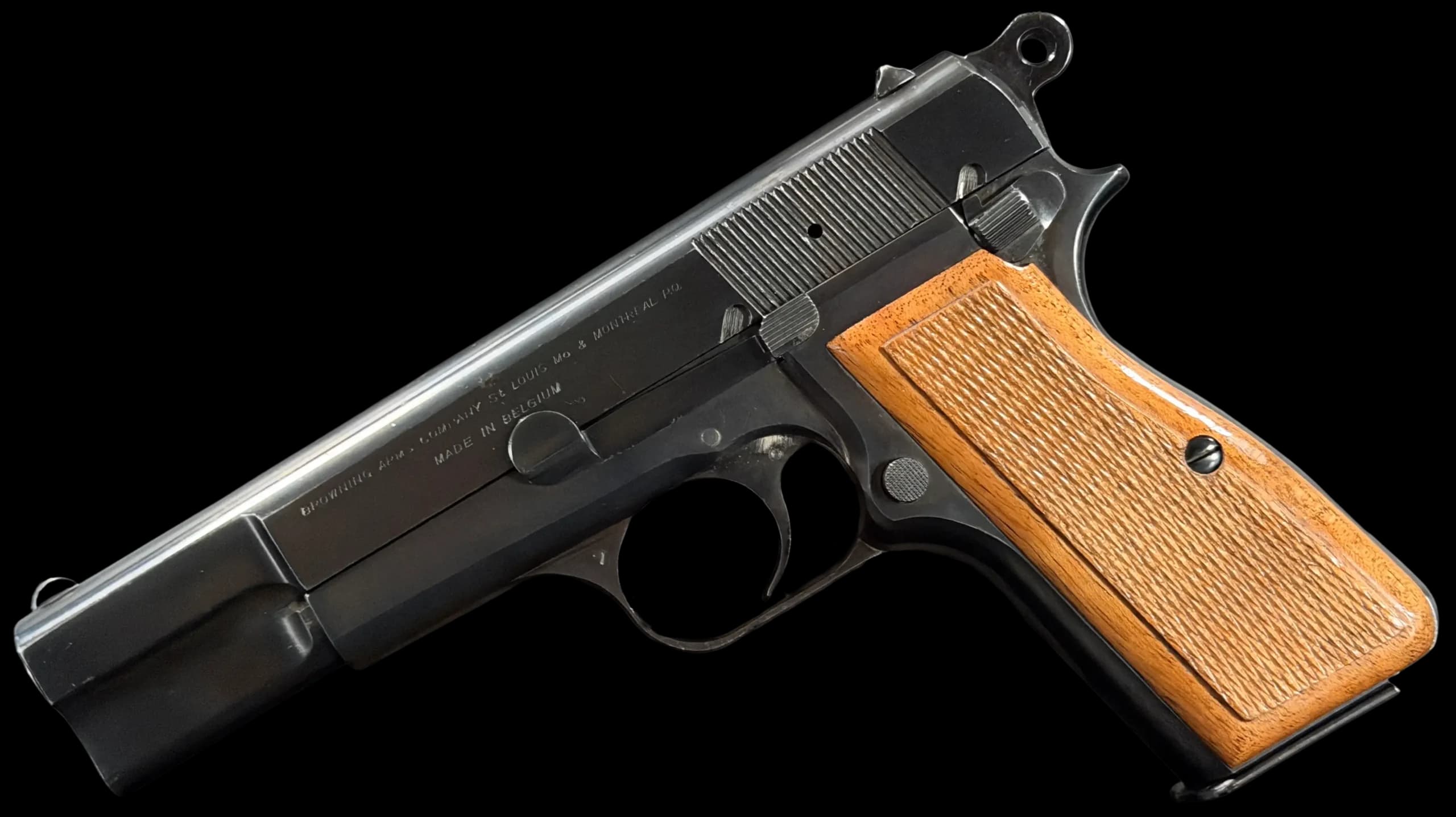
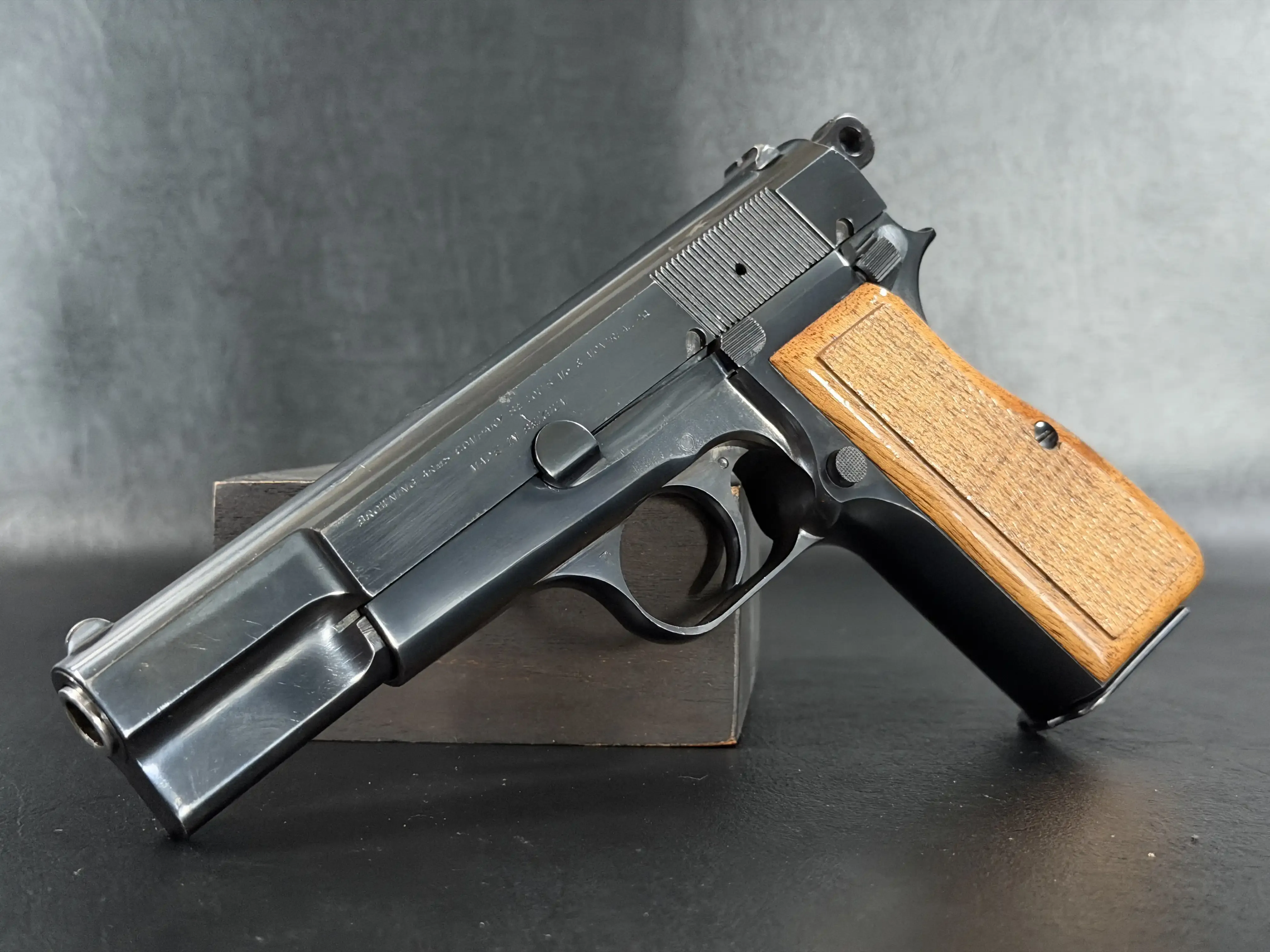
A surviving trials pistol records the early configuration. Serial number 10, a Belgian military trials pistol offered by Rock Island Auction Company on August 26, 2022, has the early oval ejection port, a ring hammer, a thumb safety, and a tangent rear sight graduated to 500 meters, and its slide is marked with FN’s two-line address and Browning’s patent mark [10].
Frequently Asked Questions
Did John Browning finish the Hi-Power before he died?
No. Browning died at Herstal, Belgium, on November 26, 1926, and FN did not complete its first production pistols until March 1935.
Which parts of the Hi-Power are documented as Browning’s work?
Browning built two striker-fired prototypes, one blowback and one locked-breech, and patented the cam-unlocked locking system in the United States. His U.S. Patent 1,618,510 was filed on June 28, 1923, and granted on February 22, 1927.
What did Dieudonné Saive contribute to the Hi-Power?
Saive designed the double-column magazine used in Browning’s prototypes and led the pistol’s development at FN. He replaced the striker with a single-action external hammer and thumb safety, added a curved backstrap, and reduced capacity from 15 rounds to 13.
Why was the pistol called the Grand Rendement before it became the Grande Puissance?
In 1928, FN decided to sell the pistol itself under the name Grand Rendement (High Efficiency). After the Belgian trials, FN renamed it Grande Puissance (High Power), also called the G.P. or Model of 1935.
Did France adopt the pistol it had asked for?
No. France issued the 1921 requirement that started the project but never adopted the pistol, while Belgium adopted it as its service sidearm in 1935.
Sources
[1] Rattenbury, Richard C. “John Moses Browning.” Encyclopaedia Britannica, July 20, 1998.
[2] Vanderlinden, Anthony. “80 Years of the Belgian High Power.” American Rifleman, September 23, 2015.
[3] Campbell, Dave. “A Look Back at the Browning High Power Pistol.” American Rifleman, October 24, 2017.
[4] Fabrique Nationale d’Armes de Guerre. “Selbstladepistole.” German Patent 424,528, Belgian priority July 29, 1922, German filing July 31, 1923, issued January 25, 1926.
[5] Browning, John M. “Automatic Firearm.” U.S. Patent 1,618,510, filed June 28, 1923, issued February 22, 1927.
[6] American Rifleman Staff. “The Browning High Power Story.” American Rifleman, October 21, 2020.
[7] Fabrique Nationale d’Armes de Guerre. “Selbstladepistole.” German Patent 430,307, Belgian priority July 29, 1922, German filing July 31, 1923, issued June 14, 1926.
[8] Fabrique Nationale d’Armes de Guerre. “Abzug für Selbstladepistolen.” German Patent 430,991, Belgian priority July 29, 1922, German filing July 31, 1923, issued June 29, 1926.
[9] Fabrique Nationale d’Armes de Guerre. “Selbsttätige Pistole.” Austrian Patent 136,089, Belgian priority July 18, 1930, Austrian filing July 13, 1931, published December 27, 1933.
[10] Rock Island Auction Company. “Lot 439: Serial Number 10 Belgian Military Trials FN High-Power Pistol.” Premier Firearms Auction #86, August 26, 2022. Auction estimate $14,000 to $22,500.
Browse our current Browning inventory, available for purchase.